TL;DR
- • Old-school 45-minute call prep does not survive a full pipeline — 6 calls a day × 45 min = 4.5 hours, which is all the non-selling time a rep has.
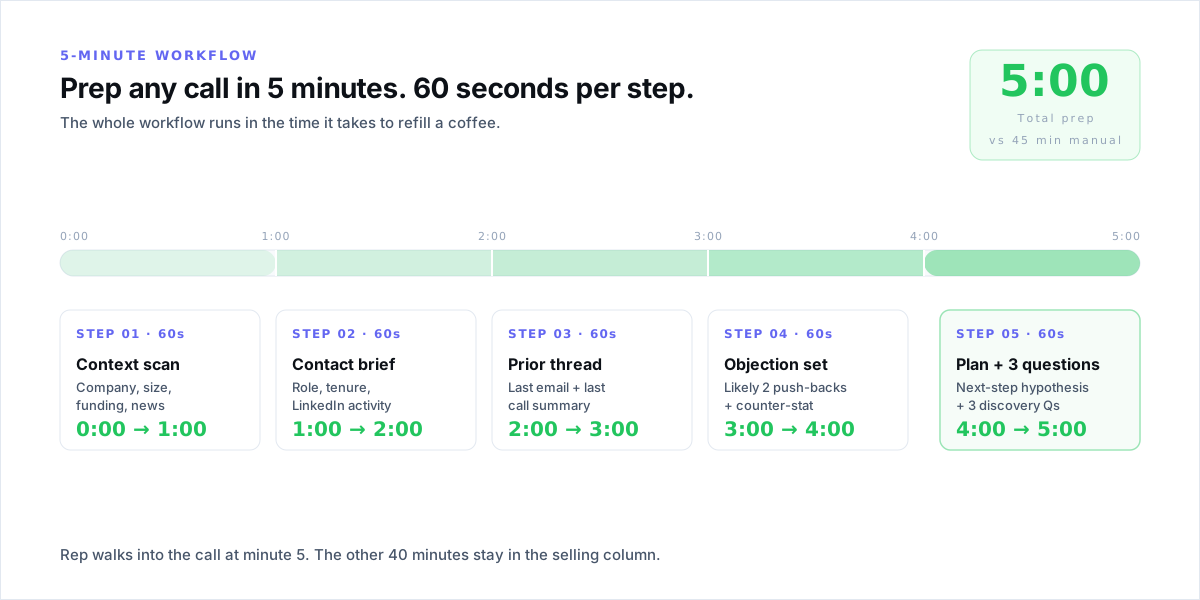
- • The 5-minute sales call prep workflow runs five 60-second steps: context scan, contact brief, prior thread, objection set, and a plan with three discovery questions.
- • A prepared rep walks in with a 7-part brief: account summary, contact brief, prior thread, likely objections, discovery questions, talk track, next-step hypothesis.
- • Prep emphasis shifts by call type — discovery leans on the question set, demo on the prior thread and committee, close on the economic buyer.
- • Prep quality is field coverage, not research volume. Read the right 7 fields in 5 minutes and you out-convert the rep who read the whole CRM in 45.
Snippet answer
A sales call prep workflow is the repeatable five-step sequence a rep runs before every call: a one-sentence account context, a contact brief, a prior-thread skim, an objection set with counter-stats, and a call plan with three discovery questions. Done well, it takes five minutes — not forty-five — because prep quality is a function of field coverage, not research volume.
Why 45-minute call prep lowers your quota attainment
Reps spend about 28% of their week actually selling, according to Salesforce's State of Sales Report. The rest is prep, admin, and tab-switching. A rep with 6 calls scheduled and a 45-minute-per-call prep habit is committing 4.5 hours a day to prep — which is all the non-selling time they have.
So reps do what anyone would: they skip it. They glance at the contact's LinkedIn in the hallway, scroll the CRM on the walk to the meeting room, and wing the first three minutes of the call. The 45-minute target was never realistic. It trained in SDR bootcamp on a calendar with two meetings a day. It does not survive Tuesday morning at an AE's desk.
The fix is not more prep. It is a time-boxed, field-driven workflow that hits the seven things that actually change the call, and nothing else. Prep quality is a function of field coverage, not research volume. Read the right seven fields in five minutes and you walk in sharper than the rep who read 36 CRM activities in forty-five. The prep is the work — not the overhead.
The 5-minute sales call prep workflow
Five steps. Sixty seconds each. Run them in order, starting 30 minutes before the meeting invite opens — not the week before. News breaks, contacts change roles, signals fire. Stale prep is a different kind of un-prepared.
- 1
Context scan (60s)
Company, headcount, funding stage, last material news. One sentence. If you cannot describe the account in one sentence, you are not ready to talk to anyone inside it.
- 2
Contact brief (60s)
Role, tenure in role, last LinkedIn post or comment. Tenure matters more than title — a 2-month VP and a 6-year VP run different meetings. A recent post tells you what they care about this week, not what was in the job description two years ago.
- 3
Prior thread (60s)
The last email, the last call summary, the last objection logged. For a first call, skim two relevant case studies instead. This step is where most 45-minute preppers burn the other 44 — you only need the line that changes what you say next.
- 4
Objection set (60s)
Name the two most likely objections for this specific account and jot the counter-stat or peer story for each. Not generic "price" and "timing" — the account-specific version. A Series-B fintech objects differently than a 1,200-seat enterprise.
- 5
Plan + three questions (60s)
Write one sentence for the call outcome you want ("book the POC kickoff with Eng in the room") and three account-specific discovery questions tied to the thread. Everything else is improvisation — which is fine, because now you have a spine.
The rhythm matters as much as the content. Do all five in one sitting, right before the call. Prep spread across the week gets wasted by drift — a post lands, a job changes, the prospect replies to yesterday's email. Five minutes, in one block, on the day of the meeting.
What a prepared rep walks in with — the 7-part brief
The workflow produces a brief. The brief is what you read while the meeting dial tone is still ringing. Seven fields, in this order. Every field has a job; no field is optional.
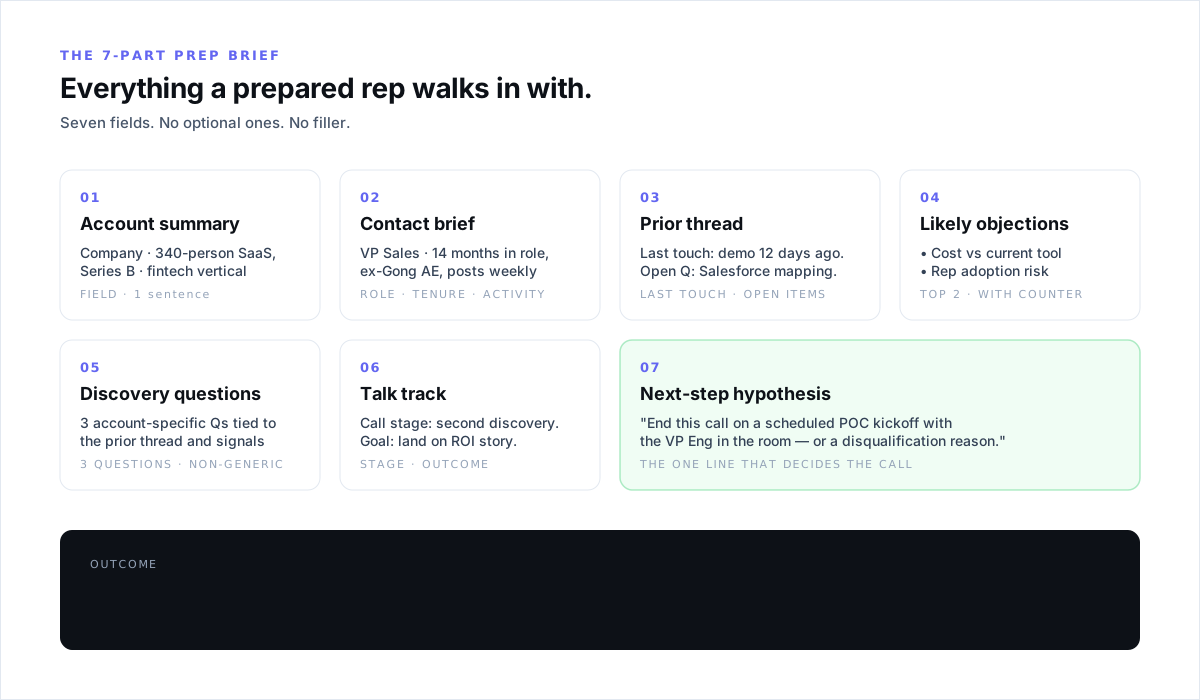
- 01
Account summary
Company, size, stage, vertical. One sentence that lets a stranger walk in warm.
- 02
Contact brief
Role, tenure, recent LinkedIn activity. Short — you are meeting a person, not their CV.
- 03
Prior thread
The last touch and the open item. If there is no prior thread, name the signal that triggered the call.
- 04
Likely objections
The top two push-backs this account will raise, each paired with a counter-stat or peer story.
- 05
Three discovery Qs
Three questions tied to the account, not the ICP. Generic questions earn generic answers.
- 06
Talk track
Call stage and the outcome you want to land on. Second discovery? Lands on ROI. Demo? Lands on a champion. Close? Lands on signed or not.
- 07
Next-step hypothesis
The one sentence you want to close the call on. If you cannot write this, the call will drift.
The seventh field does the heavy lifting. If you cannot write the next-step hypothesis in one sentence, the call will drift — you will land on "great chat, let's sync next quarter" and mistake it for progress. The one-line next step is the spine the other six fields hang on.
Prep by call type — discovery, demo, and close
The 5-minute workflow is the same every call. The emphasis inside each of the 60-second blocks shifts. A discovery-call prep is not a demo-call prep — and a close-call prep is another thing entirely. Run the same five steps; weight the fields differently.
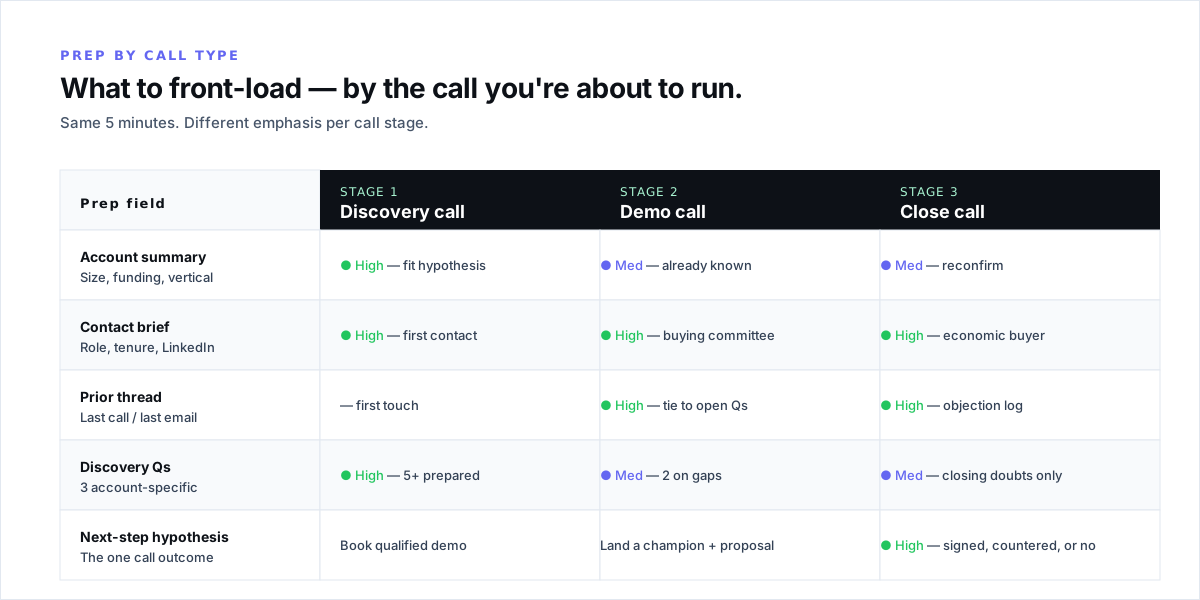
- Discovery call. Heavy on the account fit and the question set — you are still qualifying. Five sharp, account-specific questions beat five generic ones. See the sales workflow breakdown for how discovery sits in the full sequence.
- Demo call. Heavy on the prior thread and the buying committee. The person in the room is no longer the only person you are selling to. Walk in knowing who else needs to see what, and tie the demo to the two questions the champion asked on the first call.
- Close call. Heavy on the economic buyer and the objection log. The talk track narrows to signed, countered, or not this quarter. A rep who walks in without a signed-or-countered hypothesis is walking in to a "let's regroup" — which is the longest word in sales for lost.
5min
Total prep
Five steps, 60 seconds each.
7fields
In every brief
No optional ones. No filler.
45min
Saved per call
Vs. the old-school 45-minute habit.
28%
Time reps spend selling
Salesforce State of Sales, 2023.
6 mistakes that waste the 5 minutes
Even reps running a 5-minute workflow waste the five minutes in predictable ways. The six mistakes below are the ones I see most often.
- 1
Reading the entire CRM history.
The 45-minute prep habit is almost always this — scrolling through every activity log. You need the last touch and the open item. The other 36 activities are noise.
- 2
No next-step hypothesis.
If you cannot name the outcome in one sentence before the call, the call will drift into "great chat, let's sync next quarter." A concrete hypothesis gives the conversation a spine.
- 3
Generic discovery questions.
"What are your biggest challenges?" is a rep-trained reflex. Prospects see it as a red flag. Swap for a question only this account can answer — tied to a signal, a post, or a prior thread.
- 4
Skipping LinkedIn on a second touch.
The first call earns the right to a profile scan. The second one is where you miss a promotion, a new reporting line, a fresh post that changes the pitch. Thirty seconds on LinkedIn before every call — including the third, fourth, and fifth.
- 5
Prepping the week before, not 30 min before.
A Monday prep for a Friday call is a stale prep. News breaks. Contacts change roles. Threads move. Prep inside the 30-minute window before the meeting invite opens — or the prep does not count.
- 6
No talk track for the objection.
You know the two objections that will come up. Not having a specific response is a choice. The counter-stat or peer story should be in the brief, not recalled live under pressure.
Reps who run the workflow daily get fast because the workflow is boring. Boring is a feature. You want prep to be muscle memory so your five minutes of judgment go toward the three questions and the next-step hypothesis — not toward figuring out which tab to open first.
How Gangly runs sales call prep automatically
The workflow takes five minutes when the seven fields are in one place. Most reps lose the five minutes to tab-switching — CRM, LinkedIn, Gmail, the last Zoom recording, the Google doc with the notes from the discovery call. Gangly runs the assembly so the rep spends the five minutes on judgment.
- Call Prep Engine — drafts the 7-part brief before the meeting invite opens. Pulls CRM history, LinkedIn, the prior thread, and known objections into one place. The rep reviews and edits the three discovery questions and the next-step hypothesis.
- Signal Detection — surfaces fresh signals in the 30-minute window before the call (a new post, a job req, a funding event) so the brief is never stale.
- Workflow Sequencer — triggers prep brief generation automatically when a calendar invite lands with a known contact, so the rep never starts the 5-minute workflow late.
- Outreach Writer — turns the call plan into a ready-to-send follow-up draft before the meeting ends, using the next-step hypothesis as the ask.
The rep stays in control. Nothing runs without approval. The five minutes become the sharpest five minutes in the day — which is exactly what pre-call prep was always supposed to be.
Run the workflow
Try Gangly free for 14 days.
First prep brief live in 5 minutes. No credit card. Cancel any time.
Frequently asked questions
How do you prep for a sales call in under 5 minutes? +
Run a sales call prep workflow with five 60-second steps: a one-sentence context scan, a contact brief (role, tenure, LinkedIn), a prior-thread skim (last email or last call summary), an objection set (the two most likely push-backs with counter-stats), and a call plan with three account-specific discovery questions. Five minutes is enough because prep quality is a function of field coverage, not research volume.
What should be in a sales call prep checklist? +
A complete sales call prep checklist contains seven fields: account summary, contact brief, prior thread, likely objections, three discovery questions, a talk track tied to the call stage, and a next-step hypothesis for the call outcome. If any of the seven is blank, the call is under-prepped. If the checklist has more than seven, the rep is padding — research volume stops adding value past that point.
Is 5 minutes enough to prep a discovery call? +
For a first discovery call on an in-ICP account, yes — if the five minutes are structured. The constraint forces the rep to pick the signal that matters, draft three sharp questions, and name the outcome they want. Longer prep windows tend to produce more reading, not better questions. The 5-minute workflow consistently out-performs the 45-minute version in reply-per-call conversion because it ships questions, not notes.
How do you prep for a demo vs a discovery call? +
A discovery call prep leans on the account fit and a strong question set — you are still qualifying. A demo call prep leans on the prior thread and the buying committee — the person in the room is no longer the only one you are selling to. Same 5-minute workflow, different weights on each field. See the prep-by-call-type table above for how the emphasis shifts across discovery, demo, and close calls.
What is the biggest mistake in sales call prep? +
Reading the entire CRM history. The 45-minute prep habit trained in SDR bootcamp does not survive a full pipeline — 6 calls per day at 45 minutes each burns 4.5 hours, which is all the non-selling time a rep has. The fix is a time-boxed, field-driven brief. Prep quality is field coverage, not volume. Miss one of the seven fields and you are under-prepped; read 36 CRM activities and you are just busy.
How does AI call prep actually work? +
AI call prep tools pull structured data from the CRM (deal stage, prior notes, contacts), enrich with LinkedIn (role, tenure, recent posts), and assemble a pre-meeting brief against a fixed template before the calendar invite opens. The rep reviews, edits, and walks in prepared. The value is not the AI writing for the rep — it is the AI handling the assembly so the rep spends the five minutes on judgment, not on tab-switching.