
 By Siddharth Gangal
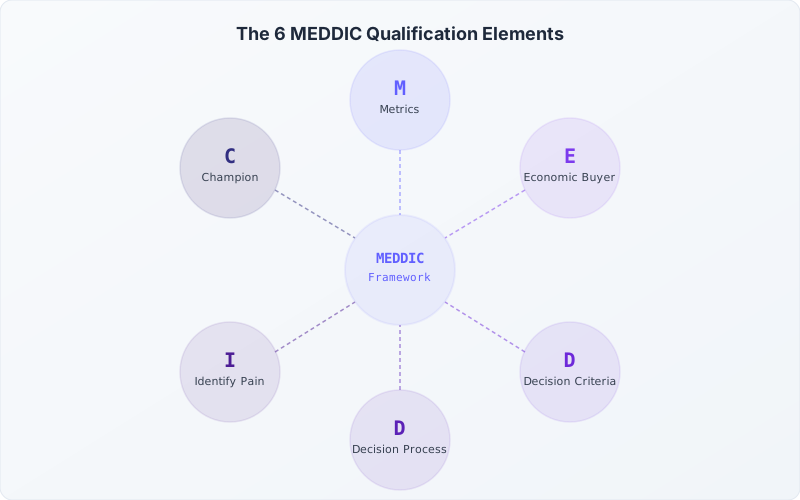
A MEDDIC worksheet turns six qualification concepts into an evidence-backed operating record for one opportunity. For each element, write the current assertion, supporting source, evidence date, confidence state, accountable owner, unresolved gap, and next verification action. Keep “unknown” available. A blank field is safer than a confident invention.
This page is the operating guide. The copyable MEDDIC worksheet template remains the canonical artifact. For foundational definitions and discovery prompts, use the MEDDIC sales framework guide. For team rollout, CRM design, and manager calibration, use the MEDDIC methodology adoption guide. Keeping those jobs separate prevents a template, a framework explainer, and an operating manual from becoming near-duplicates.
Use the worksheet as an evidence register
The worksheet should answer one practical question: what does the team currently know about this buying situation, how does it know it, and what must happen next? It is not a memory test, a stage gate by default, or a place to reward persuasive storytelling. It should make uncertainty inspectable.
The methodology-owner site describes MEDDIC as the original framework and MEDDPICC as a later variant that includes Paper Process and Competition. Its MEDDIC and MEDDPICC overview defines the elements and positions the framework for complex opportunities. That is useful owner context, but its commercial performance claims are not evidence that a particular worksheet improves revenue. This guide makes no such promise.
One row or panel per element is the right grain. Every row needs enough context for a manager who was not on the call to challenge it. A note such as “met CFO, strong champion, ROI 4x” cannot be audited because the actor, baseline, formula, source, date, and behavioral evidence are absent. Replace compressed labels with propositions:
- Assertion: the specific proposition believed to be true.
- Source: buyer statement, document, observed event, approved system record, or clearly labeled seller analysis.
- As-of date: when the source was observed and when it was last reverified.
- State: verified, buyer assertion, seller hypothesis, contradicted, stale, unknown, or not applicable.
- Owner: the person responsible for verification or correction.
- Next action: one concrete step, counterparty, due date, and expected evidence.
Complete the opportunity header before MEDDIC
The header establishes which opportunity, moment, and methodology version the worksheet represents. Without it, reviewers can compare answers captured under different scopes and mistake disagreement for poor execution.
| Header field | Required definition | Failure prevented |
|---|---|---|
| Opportunity identity | CRM ID, account legal or operating entity, motion, product scope, owner | Evidence attached to the wrong deal or namesake account |
| Commercial basis | Amount type, currency, term, one-time and recurring treatment, source | Comparing unlike values or invented ROI |
| Snapshot | Captured-at time, timezone, stage, forecast category if relevant, source version | Later information leaking into an earlier review |
| Methodology | MEDDIC, MEDDICC, or MEDDPICC; rubric version and effective date | Reviewers silently applying different element definitions |
| Eligibility | Which elements are required, conditional, or not applicable for this motion | A misleading denominator or forced completion |
| Review purpose | Coaching, deal inspection, handoff, stage decision, or another named use | One worksheet being treated as proof for every downstream decision |
Freeze the snapshot before a formal review. If an AE updates evidence during the meeting, preserve the pre-review state and record the correction as a new event. Salesforce documents that its Opportunity Field History and Stage History retain particular change details and actors, subject to configuration and platform behavior. History can prove that a value changed; it does not prove the new value is accurate.
Assign an evidence state to every answer
Evidence states prevent a seller hypothesis from quietly becoming a team fact. Define the states before completing the worksheet and require every element to use one.
| State | Meaning | Allowed use |
|---|---|---|
| Verified | Accepted evidence meets the team contract and is current | May support the declared review purpose |
| Buyer assertion | A named buyer participant stated it, but independent or authoritative confirmation is incomplete | May guide discovery; retain source and caveat |
| Seller hypothesis | The seller inferred it from available context | May create a test; must not be reported as buyer fact |
| Contradicted | Current sources conflict and no authority rule resolves them | Escalate or investigate; preserve both sources |
| Stale | The evidence exceeded the element-specific freshness rule or a material event changed | Reverify before consequential use |
| Unknown | No adequate evidence exists | Valid state; assign a next action if material |
| Not applicable | The declared motion and rubric exclude this element | Exclude from the denominator with an approved reason |
Evidence quality depends on the proposition. A signed security requirement can support one decision criterion, but it does not establish budget authority. A call transcript can show what someone said, but it does not guarantee the statement is complete or current. A seller-created business case can show transparent arithmetic, but buyer acceptance must be recorded separately.
Protect source identity and change lineage. NIST’s data-integrity glossary includes definitions centered on data not being altered without authorization and not being changed, destroyed, or lost in an unauthorized or accidental manner. NIST does not define MEDDIC, but that control principle is useful: keep stable record IDs, source links, timestamps, actors, original values, corrections, and reasons.
Document Metrics with baselines and ownership
A usable Metric is a buyer-relevant outcome with a baseline, target, unit, population, time horizon, source, owner, and calculation. “Save time,” “increase efficiency,” or a seller-generated percentage without inputs is not complete.
Record the metric proposition in a reproducible form: metric name; affected population; baseline; target or range; unit; observation window; source; source owner; as-of date; calculation; exclusions; and buyer acceptance state. Keep solution value separate from the customer’s underlying business metric. The team may estimate an impact, but label the estimate and assumptions.
Example: “The operations lead states that 18 analysts each spend an estimated 2.5 hours per week reconciling duplicate reports; the team will validate this through a two-week time sample.” The current weekly estimate is 18 × 2.5 = 45 analyst-hours. It remains a buyer assertion until the sample is complete. If a cost model later multiplies hours by a loaded labor rate, record the rate source and do not present cost avoidance as cash savings without buyer agreement.
Use these verification questions:
- Who owns the metric inside the buyer organization?
- Which system or approved study supplies the baseline?
- Are the unit, population, period, geography, and exclusions clear?
- Is the target approved, aspirational, or only suggested by the seller?
- What would falsify the proposed value relationship?
Verify the Economic Buyer without guessing from title
The Economic Buyer field should contain an authority proposition, not merely the most senior contact. MEDDICC’s official Economic Buyer definition describes the person with overall authority in the buying decision. For worksheet purposes, document the decision scope because authority may differ by amount, business unit, risk, contract type, or funding source.
Record: person or role; legal or operating entity; decision scope; authority basis; veto or approval behavior; source; access path; priorities; last verification; and any contradiction. “CFO” is insufficient if the project is approved by a business-unit president or a procurement committee. “Budget owner” is insufficient if another actor can stop the commitment.
Direct access is useful evidence, but access alone does not establish authority. A reliable next action asks a factual question through an appropriate participant: who can finally approve or reject this category and amount, what must they see, and how is that decision recorded? If the team has only an organizational-chart inference, mark seller hypothesis. If two participants name different authorities, mark contradicted and identify the rule that will resolve it.
Do not store sensitive personal detail merely to make the field look complete. Record only approved information necessary for the stated sales purpose, apply the organization’s access and retention rules, and route legal or privacy questions to qualified owners.
Separate buyer criteria from seller positioning
Decision Criteria are the buyer’s principles, requirements, and tradeoffs for evaluating options. MEDDICC’s Decision Criteria guidance distinguishes technical, economic, and relationship-related considerations. Treat those categories as prompts, not proof that every buyer uses the same weighting.
Give each criterion its own row: criterion; category; requirement or preference; stakeholder owner; weight or priority if the buyer actually supplies one; measurement method; evidence; decision stage; current fit; open validation; and last changed date. Keep three concepts separate:
- Buyer-stated criterion: what the organization says it will evaluate.
- Seller interpretation: how the solution may satisfy that criterion.
- Proof plan: which demo, document, reference, test, or commercial response will establish fit.
A requirements spreadsheet may be strong evidence for formal criteria, but informal priorities can still affect the decision. Record the source and authority for both. If the criterion changes, preserve the old value and effective date rather than rewriting history. If your team helped shape a criterion, say so; do not relabel seller positioning as an independently originated buyer requirement.
Map the Decision Process as dated events
The Decision Process should be a sequence of buyer actions, owners, dependencies, evidence, and dates. A seller’s desired close date is not the buying process. The worksheet should reveal what has happened, what is expected, what can block progress, and which steps remain unverified.
For every process event, record: event name; required predecessor; buyer owner; participants; planned date; actual date; entry evidence; output or approval artifact; status; dependency; exception path; and last verification. Include formal and informal decisions. Procurement and contracting belong in the declared MEDDPICC Paper Process if the team uses that variant; do not hide them inside a generic “legal” note.
Represent date confidence explicitly. “Security review on September 12” can be buyer-confirmed, tentatively held, seller-targeted, or inferred from a standard timeline. Those states have different value. When a date moves, store the prior date, new date, source, reason, actor, and downstream impact. Use the timeline qualification guide for deeper event and dependency design.
A simple test exposes false process confidence: ask another reviewer to reconstruct the next three buyer-controlled events from the worksheet alone. If they cannot identify the event, owner, dependency, date state, and completion evidence, the Decision Process is incomplete even if the text field is long.
Record pain, consequence, and priority separately
Pain should describe a specific problem experienced by named stakeholders, its observed consequence, and its priority relative to other work. Do not treat general dissatisfaction as a compelling business problem, and do not imply urgency from a seller’s quarter-end.
Capture three layers:
- Problem: what is failing, constrained, delayed, risky, or unnecessarily costly.
- Consequence: who or what is affected, with evidence and a measurable or observable impact where available.
- Priority: how the buyer compares this issue with alternative initiatives, including the consequence of no change.
Record the affected stakeholder, process, frequency, severity, source, baseline, attempts already made, constraints, counterevidence, and last verification. If a metric quantifies a consequence, link its ID instead of copying a number into two fields. If different stakeholders disagree about importance, preserve the disagreement.
The strongest next action is not “confirm pain.” It is a bounded verification step: review the exception log with the process owner, compare a declared baseline with an approved source, or ask the sponsor to rank the initiative against named alternatives. The sales discovery questions guide offers prompts; this worksheet records the resulting evidence and limitations.
Test Champion evidence through observable behavior
A Champion is not simply a friendly contact. MEDDICC’s Champion guidance emphasizes power, influence, and credibility inside the customer organization. The worksheet should test those attributes with observable behavior while avoiding claims about a person’s private motives.
Record: person or role; relevant influence domain; stated personal or organizational interest; credibility evidence; access evidence; actions taken; risks or constraints; last verified action; and a next test. Examples of observable behavior include correcting the decision map, arranging appropriate stakeholder access, sharing permitted process detail, helping define mutual next steps, or explaining why a proposed approach will fail internally.
Do not mark someone verified merely because they respond quickly, praise the product, attend many calls, or hold a senior title. Likewise, lack of an introduction does not prove bad intent; organizational policy or timing may constrain access. Label the current evidence and run an ethical, proportionate test.
A useful Champion test has a clear request and interpretation rule. Example: ask the contact to validate the stakeholder and decision map before a scheduled review. If they correct it with credible context, that supports influence and knowledge. If they cannot, the state remains unknown; it does not automatically become “no champion.”
Calculate completeness without inventing win probability
Use calculations to expose missing operating work, not to simulate scientific precision. Every measure needs a numerator, denominator, exclusions, cutoff, and rubric version.
- Evidence completion rate = accepted current element states ÷ eligible required element states × 100.
- Provenance coverage = sampled assertions with retrievable source and as-of date ÷ sampled assertions × 100.
- Freshness compliance = eligible states within their element-specific freshness rule ÷ eligible states subject to a freshness rule × 100.
- Next-action coverage = open material gaps with a named owner and due date ÷ open material gaps × 100.
- Contradiction rate = unresolved contradicted states ÷ eligible reviewed states × 100.
Report the elements beside the rates. A deal with verified Metrics, Decision Criteria, Decision Process, and Pain but an unknown Economic Buyer and untested Champion has four accepted states out of six: 4 ÷ 6 × 100 = 66.7%. That means two required elements lack accepted current evidence. It does not mean the deal has a 66.7% chance of closing.
Do not average away critical conditions. A team may declare that an unresolved identity error, fabricated source, or unauthorized data exposure is a hard failure regardless of completion. It may also decide that an unknown element is acceptable at an early stage if a dated verification action exists. Publish these rules before managers see outcomes.
Review a worked MEDDIC worksheet example
This fictional example demonstrates the method; it is not a benchmark or customer result. The opportunity is a multi-team reporting project reviewed at a defined snapshot.
| Element | Current proposition and source | State | Gap and next action |
|---|---|---|---|
| Metrics | Operations lead estimates 45 analyst-hours per week from 18 analysts × 2.5 hours; call note dated August 6 | Buyer assertion | Owner: AE. Validate with two-week sample by August 21 |
| Economic Buyer | Project sponsor names divisional COO; approval scope and threshold not established | Buyer assertion | Owner: sponsor. Confirm authority path before steering meeting |
| Decision Criteria | Approved requirements list contains security, data residency, implementation, and cost criteria | Verified | Map proof owner and due date for each criterion |
| Decision Process | Evaluation, security, finance, steering decision, and procurement events mapped with buyer owners | Verified | Reverify tentative steering date after security intake |
| Identify Pain | Exception log and process owner confirm duplicate reconciliation work and delayed weekly reporting | Verified | Link the approved log snapshot and preserve exclusions |
| Champion | Program manager corrected the stakeholder map and scheduled process-owner access; influence with steering group untested | Verified for current rubric | Ask for stakeholder-map validation before steering review |
Under a rubric that accepts the four verified states only, evidence completion is 4 ÷ 6 = 66.7%. Provenance coverage requires a separate count of assertions, not six element labels. If 12 of 15 sampled assertions have retrievable sources and dates, provenance coverage is 12 ÷ 15 = 80%. If both open material gaps have owners and due dates, next-action coverage is 2 ÷ 2 = 100%. Complete assignment does not mean the gaps are resolved.
The manager’s decision is conditional: continue the current discovery and proof plan, but do not represent Economic Buyer authority or the 45-hour baseline as verified. The worksheet provides a precise boundary for the next deal review meeting.
Run the manager review and correction loop
A manager review should test evidence and next actions, not rewrite the opportunity story from memory. Freeze the worksheet, remove later outcome information where practical, and review element by element.
- Confirm scope. Read the opportunity header, rubric version, eligible elements, cutoff, and review purpose.
- Challenge propositions. Ask what exact assertion each source supports and what it does not support.
- Inspect states. Verify that hypotheses, contradictions, stale evidence, and unknowns are labeled honestly.
- Reproduce calculations. Check units, denominators, exclusions, rounding, and arithmetic independently.
- Prioritize gaps. Separate material decision risk from optional enrichment and assign one owner per action.
- Record disagreement. Preserve the original label, reviewer label, evidence, reason, adjudicator, and resolution.
- Publish the decision. State permitted use, prohibited claims, next review trigger, and unresolved limitations.
Calibrate reviewers with the same frozen cases. Compare element state, evidence basis, and gap classification rather than only an overall score. Reviewer agreement = matching eligible state labels ÷ double-rated eligible states. If two managers match on 9 of 12 states, raw agreement is 75%. The disagreement categories are more actionable than the number: definition, source adequacy, identity, freshness, calculation, or judgment.
If an approved integration helps capture notes or suggest CRM updates, retain human review. Gangly’s documented product boundary is that post-call notes and suggested CRM changes are reviewed by the rep before sync. A generated summary is derived evidence, not independent buyer confirmation. Validate connected sources, permissions, record identity, correction, and rollback before relying on any write path.
Copy the printable MEDDIC worksheet
Copy this block into the team’s approved system or use the formatted MEDDIC template. Do not place restricted buyer information into an unapproved document.
Opportunity header
□ Opportunity and account IDs; entity; motion; product scope; owner
□ Amount basis; currency; term; source; snapshot time and timezone
□ Stage and forecast context; MEDDIC variant; rubric version; review purpose
□ Eligible, conditional, and not-applicable elements with approved reasons
Repeat for M, E, D, D, I, and C
□ Current proposition written as one testable statement
□ Source type, stable reference, named actor where permitted, and as-of date
□ State: verified / buyer assertion / seller hypothesis / contradicted / stale / unknown / N/A
□ Calculation inputs, units, formula, exclusions, and buyer acceptance where relevant
□ Counterevidence, dependency, freshness rule, and last verified date
□ Material gap, next verification action, owner, counterparty, due date, expected proof
Manager certification
□ Calculations reproduced; sources retrievable; sensitive data handled under policy
□ Critical unknowns and contradictions visible; no average hides a hard failure
□ Permitted use, prohibited claims, decision, reviewer, date, and next trigger recorded
□ Corrections preserve old value, new value, actor, reason, evidence, approval, and rollback
The finished worksheet is not the one with the most green boxes. It is the one that lets another authorized reviewer trace what is known, reproduce the math, see what remains uncertain, and execute the next verification step without inventing context. Connect it to the broader deal qualification criteria only through declared rules; neither artifact should silently overwrite the other.