
 By Siddharth Gangal
Sales feedback tools do not improve a team merely by recording more activity or generating more scores. They help only when evidence reaches the right reviewer, the reviewer names one change the seller can make, the seller practices or applies it, and somebody checks the next example. That complete loop—not the dashboard—is the product you are designing.
Direct answer. Choose sales feedback tools by six jobs: capture the work, find relevant evidence, assess it against observable criteria, deliver feedback in context, assign the next action, and verify behavior later. Hard-gate candidates on recording consent, permissions, evidence traceability, correction, export, and deletion. Then run every finalist on the same calls, messages, scenarios, reviewers, and scorecard for 30 days.
This page owns the operating workflow that joins tools together. If you already need a product-by-product call platform comparison, use the companion best call coaching software buyer guide. It covers vendor selection across post-call review, live guidance, roleplay, governance, pilot design, and cost. Here, the question is different: How should a team design and test its feedback stack, even when parts of that stack already exist?
Choose sales feedback tools around the feedback loop
A feedback tool is any system that moves an observable sales artifact toward a reviewed improvement. The artifact might be a discovery-call clip, cold email, account plan, opportunity note, roleplay, demo, proposal, or follow-up task. The improvement must be narrow enough to observe again: ask one quantified impact question, state the next step with an owner and date, acknowledge an objection before responding, or connect each contact to the correct account.
Do not begin with a feature list. Write one sentence in this form: “When event occurs, reviewer needs evidence within time, so they can give feedback, assign action, and verify later evidence.” An example is: “After a new account executive completes a discovery call, the manager needs the problem and next-step moments within one business day so they can score two rubric items, assign one practice, and inspect the next eligible call.”
That sentence exposes the actual requirements: capture coverage, moment retrieval, reviewer access, rubric support, notifications, assignment, and longitudinal evidence. A product with sophisticated analysis but no usable assignment or follow-up path covers only the middle of the loop.
| Weak buying statement | Testable feedback job |
|---|---|
| We need AI coaching | Find pricing-objection moments, show the exact transcript and audio, let a manager correct the label, and compare the next three eligible calls. |
| Managers need visibility | Route two representative artifacts per rep each week, with reason, owner, due date, and completed review state. |
| We need consistency | Have two reviewers independently score the same ten artifacts and reconcile disagreements against written anchors. |
| Reps need feedback faster | Measure elapsed time from eligible event to evidence-linked feedback delivered, excluding events that could not legally or technically be captured. |
Separate the six jobs in the feedback stack
A complete stack performs six distinct jobs. One platform may perform several, but the team should still name them separately so that a polished feature does not hide a missing handoff.
- Capture: preserve the approved call, message, document, practice attempt, or CRM event with identity, time, channel, and consent state.
- Retrieve: route a representative sample or a defined trigger. Search and AI can reduce review time, but the original artifact remains available.
- Assess: apply a versioned rubric to observable evidence. Distinguish human score, machine suggestion, self-assessment, and peer review.
- Deliver: place specific feedback beside the evidence, with visibility appropriate to the rep and situation.
- Act: turn feedback into a rehearsal, reading, call plan, manager discussion, or on-the-job behavior with one owner and due date.
- Verify: inspect later eligible work and decide whether the behavior appeared, still needs practice, or was not applicable.
These jobs also expose broken economics. If an analysis product surfaces 400 “coachable moments” each week and managers can review 40, the tool creates inventory rather than feedback. If assignments live in a learning platform but evidence lives in call software and completion lives in a spreadsheet, RevOps must reconcile three states. Calculate throughput from eligible artifact to verified action before adding automation.
Match tool categories to observable evidence
No category is universally best. Select the smallest combination that covers the target artifact and closes the loop.
| Category | Strongest evidence | Use it for | Watch for |
|---|---|---|---|
| Conversation intelligence | Audio/video, transcript, topic moments, linked meeting | Post-call review, examples, trends, call scorecards | Capture gaps, transcription errors, selection bias, recordings without valid access |
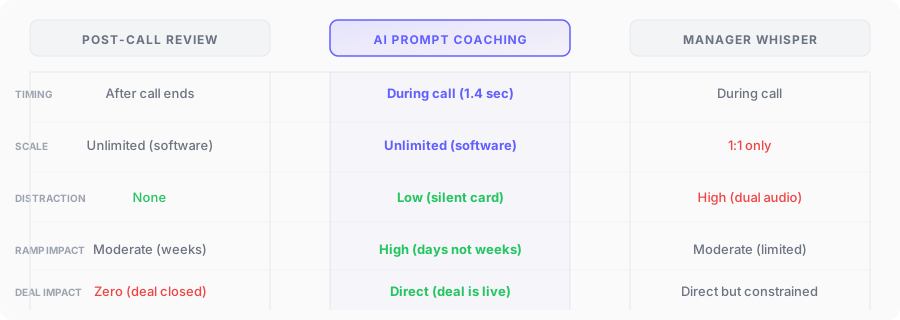
| Live guidance | Prompt event, timing, rep response, simulated or live context | Reminders during a conversation | Distraction, irrelevant prompts, hidden latency, customer exposure during testing |
| Roleplay and practice | Scenario, attempt, rubric score, retries | Safe rehearsal before customer work | Gameable scenarios and performance that does not transfer to live calls |
| Sales enablement or LMS | Assigned content, assessment, completion, certification | Structured learning and policy acknowledgement | Completion mistaken for behavior change |
| Messaging review | Email, sequence step, social message, reviewer annotation | Written outreach feedback and approvals | Template-level scores that ignore recipient context |
| CRM and task workflow | Account, opportunity, task, reviewed note, status history | Ownership, follow-through, deal-specific coaching | Feedback reduced to administrative correction |
| Shared document or video | Comment, version, screen recording, decision | Low-cost asynchronous feedback | Weak routing, permissions, reporting, and lifecycle control |
Official product documentation illustrates the differences without proving which product fits your team. Gong documents call scorecards as structured feedback on particular aspects of a call. HubSpot documents coaching playlists made from complete or clipped recordings, including sharing and access choices. Salesforce describes conversation intelligence that surfaces call moments, topics, trends, actions, and collaboration, while its enablement product supports practice pitches that managers and peers can score. These are capability claims from vendors; verify them in your own edition, region, configuration, and pilot.
Write requirements before comparing products
Convert the feedback job into acceptance tests. Mark each requirement as a hard gate, scored preference, or later roadmap item. Hard gates should be few and consequential; everything labeled mandatory makes evaluation meaningless.
- Coverage: named channels, meeting providers, dialers, languages, message types, roleplays, mobile calls, and imported artifacts.
- Evidence: click from a label to exact source context; replay original media; distinguish quotation, paraphrase, inference, and generated suggestion.
- Workflow: self-review, peer review, manager review, comments, scorecards, assignments, notifications, escalation, completion, and follow-up.
- Calibration: rubric versions, anchors, not-applicable state, independent reviewers, score history, disagreements, and corrections.
- Administration: bulk configuration, team hierarchy, manager changes, retention, export, audit history, APIs, sandbox, and support.
- Governance: consent indicators, access by role and region, sensitive-data handling, employee consultation, deletion, legal hold, and subprocessors.
- Accessibility: keyboard use, captions, transcript editing, screen-reader flow, color-independent states, and alternatives to live prompts.
Write tests as outcomes, not menu checks. “Supports scorecards” is weak. “Two managers independently score the same call, cite exact evidence, mark one item not applicable, reconcile a disagreement, and preserve both the original and final score” is testable. “Integrates with CRM” is weak. “A reviewed action attaches to the correct opportunity without overwriting owner, stage, or a newer note, and a failed write appears in an exception queue” is testable.
Score sales feedback tools with a weighted rubric
Use one scorecard for the buying decision and a different rubric for rep behaviors. Mixing them encourages evaluators to reward impressive coaching outputs while overlooking security, administration, or cost.
| Buying dimension | Weight | Evidence required |
|---|---|---|
| Evidence fidelity and coverage | 20 | Matched corpus results, misses, incorrect links, capture exceptions |
| Feedback workflow and follow-through | 20 | Timed end-to-end tasks for manager and rep |
| Rubric, calibration, and correction | 15 | Independent scoring exercise and audit history |
| Rep and manager usability | 10 | Task completion, median time, errors, accessibility review |
| Privacy, security, and governance | 15 | Contract, configuration, permission, lifecycle tests |
| Integration and administration | 10 | Normal and failure-path tests; administrator hours |
| Normalized operating cost | 10 | Three-year cost with usage, labor, overlap, and exit |
Score each item from zero to five only after defining anchors. Zero means absent or a failed hard gate; three means it completes the representative workflow with documented limitations; five means it completes edge cases with strong control and inspectable evidence. Weighted score equals sum(item score ÷ 5 × item weight). Report hard-gate failures beside the number, because a high average cannot compensate for unauthorized access or unusable evidence.
Normalize cost as subscription + usage + implementation + integration + administration + reviewer labor + enablement + governance + storage + overlapping tools + expected change and exit. Public seat prices rarely describe all of those terms. Ask vendors to price the same population, volume, support, retention, environments, and contract period.
Calibrate reviewers before trusting scores
A precise tool cannot rescue a vague rubric. Select the fewest observable behaviors needed for the role and call type, then test whether reviewers can apply every item consistently. Define what evidence counts, what does not count, when the criterion is not applicable, and what examples anchor each score.
Build a calibration set containing strong, weak, ambiguous, multilingual where relevant, short, long, interrupted, and technically flawed artifacts. Have two reviewers score independently without seeing automated output. Compare agreement item by item, discuss the reason for disagreement, revise anchors, then rescore a fresh set. Preserve the human reference and dissent; consensus reached after seeing the machine answer is not independent validation.
A rep-behavior rubric might assess whether discovery established current state, impact, decision process, and an owned next step. It should not give points for outcome facts the rep could not control. Avoid proxy measures such as a universal talk ratio or keyword count unless the team has validated their use in the specific motion. The sales coaching framework can help managers turn observable gaps into practice rather than personality judgments.
Calibration rule. If reviewers cannot agree against clear anchors, do not automate the disputed score. Improve the rubric, split the criterion, add a not-applicable state, or retain human judgment.
Run one closed-loop feedback workflow
The operating loop should be visible in one action record:
- Trigger: define eligibility, such as every first discovery call or two randomly sampled calls per rep each week.
- Route: assign the artifact and state why it was selected. Keep random sampling alongside risk or keyword triggers so feedback is not built only from anomalies.
- Self-assess: ask the rep to name one strong moment and one change before seeing the manager score.
- Review: the manager cites a timestamp, quotation, message, or record and applies the versioned rubric.
- Agree: manager and rep select one behavior, an action, a due date, and the next eligible observation.
- Practice: complete a rehearsal or prepare a live-work plan appropriate to the gap.
- Verify: inspect the next predeclared sample and close, continue, or revise the action.
Keep the feedback atomic. “Improve discovery” is not an action. “Before the next three first meetings, prepare one impact question; after each, mark whether the buyer named a measurable consequence and cite the moment” is observable. Use the sales coaching frequency guide when a pattern requires several practice cycles.
Apply recording, privacy, and people safeguards
Customer conversations and employee performance data can be sensitive. Applicable recording, monitoring, employment, privacy, sector, and cross-border rules depend on location and context. Involve qualified privacy, legal, security, and people teams; this guide is an operational test plan, not legal advice.
- Map audio, video, transcript, chat, summaries, scores, prompts, CRM fields, identifiers, exports, models, regions, backups, and subprocessors.
- Document the approved purpose, notice or consent flow, recording indicator, excluded meetings, pause control, and handling of sensitive content.
- Test least-privilege views for rep, manager, enablement, administrator, executive, temporary manager, former employee, and vendor support.
- Verify retention, search, export, correction, access request, deletion, legal hold, account closure, and backup expiry using test records.
- Separate developmental coaching from consequential people decisions. Provide a route to challenge incorrect transcripts, labels, context, or scores.
Hard-stop a pilot for cross-team exposure, recording without the approved control, fabricated quotations presented as evidence, uncorrectable identity mismatches, or material deletion failure. A compliance page is useful diligence evidence but does not prove that your tenant is configured correctly.
Run a matched 30-day pilot
Run the finalist against the current workflow on matched inputs. A practical 30-day pilot includes a setup week, two measured weeks, and a decision week. If usage is infrequent or behavior transfer needs more observations, extend the measurement period rather than manufacturing certainty.
| Phase | Work | Output |
|---|---|---|
| Days 1–5 | Approve scope; connect test systems; configure roles; calibrate one rubric; load representative corpus | Baseline, test cases, stop conditions, trained participants |
| Days 6–19 | Route matched artifacts; collect human and tool results; record errors, time, corrections, actions, and non-use | Event-level pilot ledger and weekly exception review |
| Days 20–25 | Inspect later evidence; run permission, export, deletion, integration-failure, and administrator tests | Behavior observations and control evidence |
| Days 26–30 | Score independently; normalize costs; interview users; document risks and conditions | Approve, reject, extend, or keep current workflow |
Include different roles, tenure, managers, channels, languages, deal types, and recording conditions in proportion to real work. Track exclusions. Do not let a vendor choose only clean calls or enthusiastic users. Freeze the rubric and material configuration during the measured phase, logging every change. Compare medians and distributions rather than only averages that hide outliers.
Build a representative test corpus
Before live users begin, assemble an approved corpus that mirrors the feedback job. For completed calls, include different meeting types, audio quality, accents, languages, durations, speaker counts, customer participation patterns, and outcomes. For messages, include approved, rejected, edited, replied-to, bounced, and context-poor examples. For roleplay, include the same persona facts, objection, success evidence, prohibited claims, and stopping point for every candidate. Label which artifacts are eligible and why.
Create a human reference without vendor output on screen. Reviewers should mark the evidence location, rubric answer, confidence, and ambiguity. Do not force consensus where the artifact genuinely supports several interpretations. Those disputed cases are valuable because they test whether a product exposes uncertainty or presents a brittle answer as fact. Keep personally sensitive material out of the corpus unless its use is approved and necessary; use redacted or synthetic edge cases when they can test the same workflow.
Test normal work and failure paths
Each candidate should process identical artifacts under identical settings. Then inject controlled failures: a recording without one speaker, an incorrect CRM association, a manager change, a revoked integration, a duplicate meeting, a late transcript, an unsupported language, and a request to correct or delete a test record. Record what the user sees, what the administrator sees, whether the event retries, and whether the system can recover without hidden manual work.
Require evaluators to score independently before a group discussion. Product enthusiasm and polished vendor facilitation can otherwise become part of the result. The decision packet should contain raw task evidence, not only workshop notes or a vendor-generated summary.
Measure feedback quality and behavior transfer
Instrument the chain from opportunity to learn through verified behavior. Use denominators and windows that another analyst can reproduce.
- Capture coverage = successfully captured eligible artifacts ÷ eligible artifacts. Segment missing artifacts by channel, region, language, permission, and technical reason.
- Evidence precision = reviewed surfaced moments judged relevant ÷ surfaced moments reviewed. Keep a reason taxonomy for errors.
- Feedback lead time = delivered timestamp − eligible artifact timestamp. Report median and upper percentile; exclude only predeclared ineligible events.
- Action completion = actions accepted and completed by due date ÷ actions due. Completion alone does not show learning.
- Behavior transfer = later eligible artifacts showing the agreed behavior ÷ later eligible artifacts reviewed. State observation count and reviewer.
- Correction rate = materially corrected tool outputs ÷ tool outputs reviewed. Separate transcript, speaker, evidence, label, score, and assignment errors.
- Reviewer agreement: report item-level agreement or an appropriate reliability statistic, with the scoring scale and sample.
Measure manager time as well as rep time. A faster moment finder may reduce listening but increase disputes, annotation, or administration. Pair quantitative events with short interviews: What did you ignore? Which evidence did you distrust? When was feedback too late? Which action changed real work? For a broader measurement design, see sales coaching metrics.
Do not claim that a four-week pilot caused win-rate or revenue movement. Deal mix, territory, season, manager, and sample size can dominate short results. Business outcomes can remain a monitored guardrail while the buying decision relies on nearer evidence: capture, accuracy, workflow completion, behavior observation, and cost.
Implement the stack without creating tool sprawl
Assign one owner for each state, not one owner for “coaching.” RevOps owns integrations, definitions, and exception reporting; enablement owns rubric design and calibration; managers own feedback judgment and follow-up; reps own self-assessment and action; security and privacy own applicable controls; an executive sponsor owns scope and resourcing.
Choose one system of record for the action. The evidence may remain in conversation or messaging software, while the action and due date live in the existing manager workflow or CRM. Use stable links and identifiers. Do not copy sensitive transcripts into every system merely to make integrations appear complete.
Document the handoff as a state model: eligible, captured, routed, opened, reviewed, accepted, assigned, completed, re-observed, and closed. Name the event that advances each state, the system that records it, and the owner who resolves exceptions. This prevents two products from both claiming completion when one means “AI output created” and the other means “manager delivered feedback.” Preserve timestamps so lead time can be reconstructed rather than estimated in interviews.
Design notifications around exceptions and due work. A manager does not need a message for every transcript; they need a queue of scheduled reviews, capture failures, disputed evidence, overdue actions, and behaviors due for re-observation. Let users control nonessential notifications, and test whether team changes reroute open work correctly.
Launch with one call type, one team, one rubric, and one repeatable cadence. Publish definitions, examples, visibility, dispute path, and what the program will not be used for. Hold a weekly calibration and exception review during rollout, then reduce frequency only after agreement and workflow reliability stabilize. Retire overlapping tools or workflows explicitly; adding another notification channel is not implementation.
Gangly can support the context around that loop by joining account signals, call preparation, reviewed notes, and CRM follow-through. It does not replace a manager’s evidence-based judgment or a properly governed coaching program. See the live call coach and post-call notes workflow for product-level scope.
Use the final selection checklist
JOB: target artifact ___ · trigger ___ · reviewer ___ · feedback deadline ___ · action ___ · later evidence ___.
HARD GATES: approved capture ___ · consent/notice ___ · permissions ___ · source-linked evidence ___ · correction ___ · export ___ · deletion ___ · accessibility ___.
RUBRIC: version ___ · observable behaviors ___ · anchors ___ · not-applicable rule ___ · calibration set ___ · reviewer agreement ___.
PILOT: current-workflow control ___ · matched corpus ___ · roles/channels/languages ___ · stop conditions ___ · frozen configuration ___ · exclusions ___.
MEASURES: capture coverage ___ · evidence precision ___ · lead time ___ · action completion ___ · behavior transfer ___ · correction rate ___ · manager time ___.
COST: subscription/usage ___ · implementation ___ · integrations ___ · administration ___ · reviewer labor ___ · governance ___ · overlap/exit ___.
DECISION: hard-gate result ___ · weighted score ___ · unresolved risk ___ · owner ___ · review date ___ · approve/reject/extend/keep current ___.
The final output should be a decision record, not a product ranking. Preserve the requirements, corpus, raw events, score anchors, independent evaluations, exceptions, costs, and reason for the choice. Re-test after material product, model, policy, team, or workflow changes. A feedback stack earns renewal when it repeatedly turns trusted evidence into an action and that action into observable improvement.