
 By Siddharth Gangal
The 30-second verdict
MEDDIC vs BANT is the wrong question framed the right way often enough that it ranks. The right question is "which artifacts do I need to leave this call holding?" — and the answer changes by deal shape, not by acronym preference.
MEDDIC names six: Metrics, Economic Buyer, Decision Criteria, Decision Process, Identify Pain, Champion. It was built at PTC in 1996 by Dick Dunkel under sales leader John McMahon, then used to grow PTC from $300M to $1B in four years (Sales MEDDIC Group). It is the default for complex enterprise deals — long cycles, big committees, regulated buyers.
BANT names four: Budget, Authority, Need, Timeline. IBM published it in the 1960s. It still works — for the deal shape it was built for: short cycles, single decider, clear pain. Companies using BANT systematically report roughly 33% higher close rates on transactional deals than those running no qualification at all.
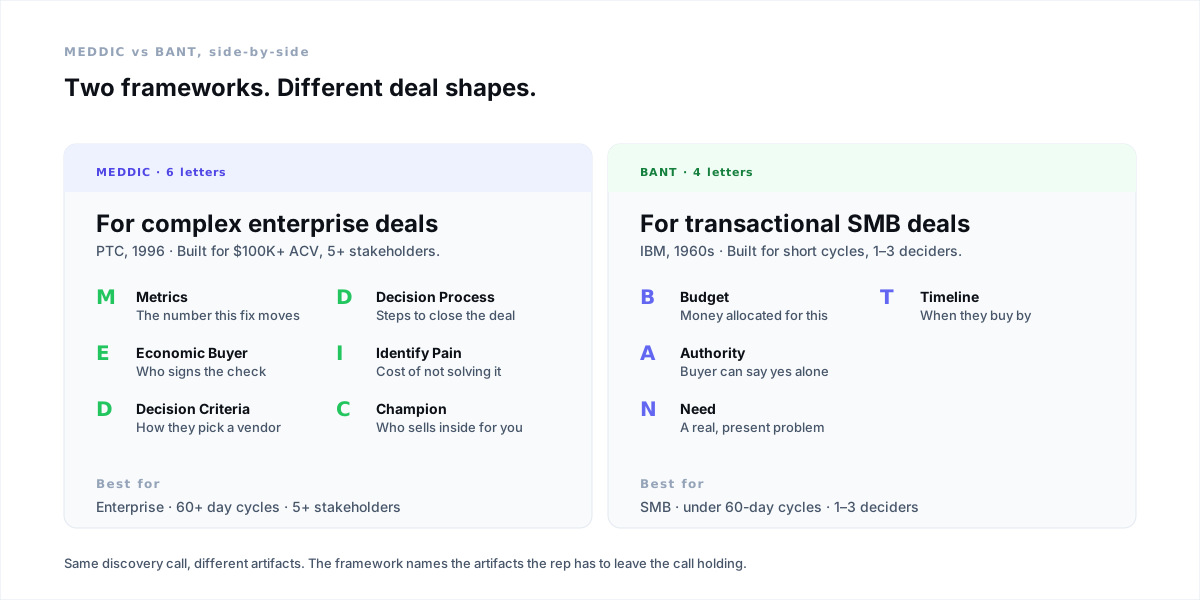
Skip ahead if you already know which side of that table you live on. The bulk of this post is the letter-by-letter breakdown of each, the 8-criteria head-to-head, the 5 scenarios where each wins, the hybrid most experienced teams actually run, and the 5-step install that gets qualification out of the training deck and into the deal record.
MEDDIC, broken down letter by letter
Six letters. Each names an artifact the rep has to leave the call holding — not a question to ask in order. A rep who reads the 6 MEDDIC questions off a notepad has a worse call than one who runs none of them. The framework is the checklist of what good qualification produces, not the script for getting it.
Each letter, the artifact it captures, and the question that gets you there:
- M
Metrics
The number on the buyer's dashboard this fix would move. "12-point reply-rate lift, current baseline 7%" beats "better outreach." If the buyer can't cite the number to their CFO, the deal will die at procurement.
What to ask: "What's the KPI on your dashboard that this would move, and what's the current baseline?"
- E
Economic Buyer
The person who controls the budget for this purchase. Not the loudest stakeholder. The signature on the order form. Most stalled enterprise deals are stalled because the rep is selling to the influencer and never met the EB.
What to ask: "Who else needs to sign off on this — and when can we bring them in?"
- D
Decision Criteria
How they will pick a vendor — formal scorecard, security review, peer references, free trial. Get this in writing on call 2 or you'll discover a new criterion the day before close that you can't hit.
What to ask: "What does a vendor have to prove to win this evaluation?"
- D
Decision Process
The actual steps from "we like it" to "PO signed" — legal, security, procurement, board, signature. Not the same as criteria. A 47-page MSA is a process artifact, not a criterion. Map it on the deal record.
What to ask: "Walk me through the steps from picking a vendor to signed contract."
- I
Identify Pain
The cost of not solving it — in dollars, headcount, missed quota, churn, regulatory exposure. Pain without a number is a complaint. The same buyer who shrugged at "inefficiency" funds "$2M in churn this year."
What to ask: "If nothing changes in the next two quarters, what does that look like?"
- C
Champion
The person inside the account who will sell this forward when you leave the call. Not the loudest complainer — the one whose performance review is tied to the metric. A deal without a named champion is a coffee chat with extra steps.
What to ask: "Whose number does this move — and would they be the one to push this internally?"
MEDDPICC adds two more — Paper Process (legal, security, procurement) and Compete (which competitors are in, and where you're strong vs weak). For most modern $100K+ enterprise SaaS deals, MEDDPICC is the practical default; the original MEDDIC under-fits because deals now stall in legal more than they stall in discovery.
The single most-skipped letter in real deals is Champion. Reps confuse "friendly contact who returns my emails" with "person whose performance review is tied to the metric this fix moves." The first will not carry your deal forward when it stalls. The second will. If you can't name your Champion in one sentence, you don't have one yet.
BANT, broken down letter by letter
Four letters. Tighter than MEDDIC, faster to run on a 30-minute call, and built for deals where one person can sign and a second person doesn't need to weigh in. Same artifact discipline applies: BANT names what the rep has to leave the call holding, not the questions to recite in order.
- B
Budget
Money allocated for this purchase, in this fiscal cycle, with someone's name on the line. Not "we have budget somewhere" — a specific line item. If the answer is "we'd need to find it," budget is not yet qualified.
What to ask: "Is there a budget line for this in the current cycle, and who owns it?"
- A
Authority
The buyer can sign on their own (or quickly loop in the one person who can). Distinct from MEDDIC's Economic Buyer because BANT assumes shorter chains. If you're selling to a manager who has to "check with the VP," authority is unconfirmed.
What to ask: "Are you the one who signs off, or is there someone else?"
- N
Need
A real, present problem you fix, important enough that the buyer would pay to make it stop. Need without urgency is curiosity. Curiosity does not close.
What to ask: "What's broken right now that brought you to this call?"
- T
Timeline
A specific date by which the buyer wants this live — driven by an event, a renewal, or a quarterly target. "Sometime this year" is not a timeline. "Before our June board meeting" is.
What to ask: "What's the date you need to be live by, and what drives that?"
The most common BANT failure is asking for Budget on call 1, before the buyer has surfaced the cost of inaction. The buyer says "we don't have budget" — which is true at that moment, before you've helped them count the savings — and the rep disqualifies a deal that was actually winnable. Order matters: Need first, then Authority, then Timeline, then Budget. Old-school BANT taught the order alphabetically. Modern BANT runs Need-Authority-Timeline-Budget for a reason.
The 8-criteria head-to-head comparison
Eight criteria a rep actually cares about — letter count, deal shape, what the framework explicitly captures, what it ignores, where it shines, where it breaks, and which one your CRM is more likely to be configured for already.
| Criterion | MEDDIC | BANT |
|---|---|---|
| Letter count | 6 (8 with MEDDPICC) | 4 |
| Origin | PTC, 1996 (Dick Dunkel) | IBM, 1960s |
| Best ACV range | $100K+ | Under $15K |
| Best cycle length | 60+ days | Under 60 days |
| Best stakeholder count | 5+ | 1–3 |
| Captures buying committee | Yes (EB + Champion) | No |
| Captures budget explicitly | No (implied via EB + Process) | Yes |
| Industry adoption (2026) | ~73% of SaaS at $100K+ ARR | Default in SMB sales |
Read the table top-to-bottom and the verdict is obvious: these frameworks are not competing — they are designed for different deal shapes. The mistake is treating them as interchangeable. The other mistake is debating which is "better" without naming the deal shape you're optimizing for.
Two rows in the table do most of the work for the decision. The "best stakeholder count" row separates the deals where one person can sign from the deals where six people have to agree. And the "captures buying committee" row tells you whether the framework even has language for that complexity. BANT does not have a Champion letter. MEDDIC does not have a Budget letter. Both are deliberate omissions for the deal shape each was built for. A BANT-trained rep walking into a 7-stakeholder enterprise deal will identify Need and Timeline correctly and miss the procurement process entirely. A MEDDIC-trained rep walking into a $3K SMB deal will spend 25 minutes on Decision Process for a deal that closes by credit card.
When to use MEDDIC (5 scenarios)
MEDDIC earns its keep when the deal has too many moving parts for a 4-letter framework to cover. Five scenarios where MEDDIC (or MEDDPICC) is the right choice — and where BANT would actively cost you the deal:
- 1
Enterprise SaaS, $100K+ ACV
At this price tier, every deal has 5+ stakeholders, a 90-day cycle floor, and a security review. MEDDIC's Decision Process and Decision Criteria letters are the only thing that keeps the rep ahead of legal and InfoSec.
- 2
Multi-stakeholder committee buys
6+ named contacts on the deal record. The Champion + Economic Buyer split is non-negotiable — the loudest seat at the table is rarely the one signing the contract.
- 3
Anything sold into regulated industries
Healthcare, finance, public sector. Decision Criteria balloons (HIPAA, SOC 2, FedRAMP, DPA). MEDDIC forces the rep to surface these on call 1 instead of finding them at week 11.
- 4
Land-and-expand motions where the EB sits two levels above the user
If the user loves you and the VP funds you, you need MEDDIC. BANT will book you 30 product demos that never reach signature.
- 5
Replacement deals against an incumbent
Decision Criteria is doing all the work — you have to know exactly which 4 boxes the incumbent fails on and the 4 boxes you need to clear. BANT does not give you that resolution.
The pattern: anywhere the deal is bigger than one person and the timeline is longer than one quarter, MEDDIC's Decision Process and Champion letters do the work BANT can't. Companies fully adopting MEDDPICC report 18% higher win rates and 24% larger deal sizes versus simplified frameworks (per industry benchmarks). The deal-size lift comes from Champion and Economic Buyer — when the rep multi-threads correctly, the deal upsizes.
When to use BANT (5 scenarios)
BANT gets a bad rap from enterprise reps who tried to use a 4-letter framework on a 7-stakeholder deal and lost. That was always going to fail. On the deal shape BANT was built for, it still produces some of the highest close rates in B2B sales. Five scenarios where BANT is the right choice:
- 1
SMB SaaS, sub-$15K ACV
Founders or department heads buying for themselves. One signature, no procurement, sub-30-day cycle. BANT's 4 letters are exactly the artifacts the rep needs to leave the call holding.
- 2
Self-serve to assisted-sales upgrade
PLG motion where the buyer trialed the product, knows the value, and just needs a call to greenlight the team plan. BANT clears the call in 20 minutes.
- 3
Renewals and expansions on existing customers
Champion is already mapped, Pain is already identified, Decision Criteria are already met. Only Budget and Timeline need confirming. BANT is the right depth.
- 4
Inbound leads from a high-intent channel
Pricing-page-visit-to-demo conversions. The buyer has self-qualified on Need; the rep just confirms Budget, Authority, Timeline.
- 5
High-volume BDR-to-AE handoffs
A team running 30+ discovery calls a week per AE cannot sustain MEDDIC discipline on every one. BANT keeps the qualification bar high enough to filter pipeline without burning the rep on every call.
The pattern: when the deal is one person spending department-or-team-level money on a quarterly horizon, BANT's 4 letters cover everything that matters. Add MEDDIC overhead and you slow the call without producing better qualification. Match the framework to the deal — that's it.
The MEDDPICC + BANT hybrid most teams actually run
Watch any seasoned enterprise AE run their top 10 deals and you will not see pure MEDDIC. You will see a hybrid: MEDDPICC structure for the deal-record artifacts (Champion, Economic Buyer, Decision Criteria, Decision Process, Paper, Compete) and BANT-style discipline at close stage for Budget and Timeline. The training deck says "MEDDIC only." The actual qualification motion is a hybrid.
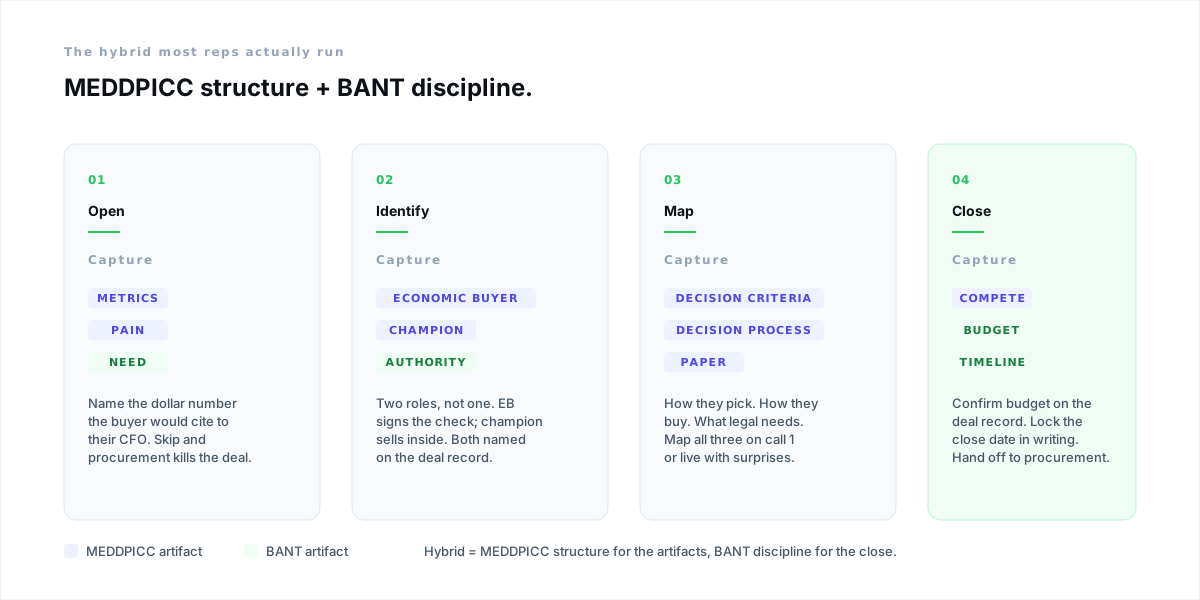
The hybrid works because MEDDPICC under-confirms Budget and Timeline (it implies them via Decision Process but never asks the dollar question or the date question explicitly). BANT under-maps the buying committee (one person is rarely the only person on a $100K deal). Stack the two and each one covers the other's blind spot.
Implementation rule: capture MEDDPICC artifacts on the deal record continuously across the cycle, and run an explicit BANT-style Budget + Timeline confirmation in the last call before procurement. That last confirmation catches the deals that look qualified on paper but have no actual budget line.
6 mistakes that wreck both frameworks
Six failure modes that show up across both frameworks. None of them are framework problems. All of them are workflow problems — how the rep runs qualification, not which acronym they pick.
- 1
Treating the framework as a script
A rep who reads the 6 MEDDIC questions in order off a notepad has a worse call than one who runs none of them. The framework names the artifacts the rep has to leave with — the wording is the rep's problem.
- 2
Skipping Metrics because the buyer "gets it"
Buyers say "yeah we need this" without ever naming the dollar amount this would move. The deal then dies at procurement when the CFO asks for the business case the rep never built.
- 3
Confusing Champion with Friendly
A friendly contact is the person who returns your emails. A champion is the person whose performance review is tied to the metric you move. Many "champions" on the CRM are actually friendlies — and friendlies don't carry the deal.
- 4
Confirming Budget too early
Asking "what's your budget?" on call 1 BANT-style is the fastest way to sound like a vendor. Confirm Need and Authority first, surface the cost of inaction, then ask for budget when the buyer is already counting the savings.
- 5
Letting Timeline be self-reported
"We want this by end of Q2" without a forcing function is wishful. A real timeline is anchored to an event — board meeting, contract renewal, regulatory deadline. Without the anchor, Q2 becomes Q4 every time.
- 6
Using MEDDIC on a $5K SMB deal
A 6-letter framework on a 30-minute call to a single decider produces a robotic call and a lost deal. Match the framework to the deal shape. Both directions of mismatch are equally bad.
The meta-failure underneath all six: treating qualification as a thing that happens once on call 1 instead of an artifact set the rep refreshes every call. Buying committees change. Champions leave. Budgets get cut. A deal qualified in week 1 and never re-qualified is a deal heading for a surprise close-loss in week 11.
How to install qualification into the discovery workflow
The framework debate is a distraction. The real lift comes from installing qualification into the call workflow itself, so the rep captures the right artifacts every call without remembering the acronym. Five steps to install:
- 1
Pick the framework that fits the deal shape
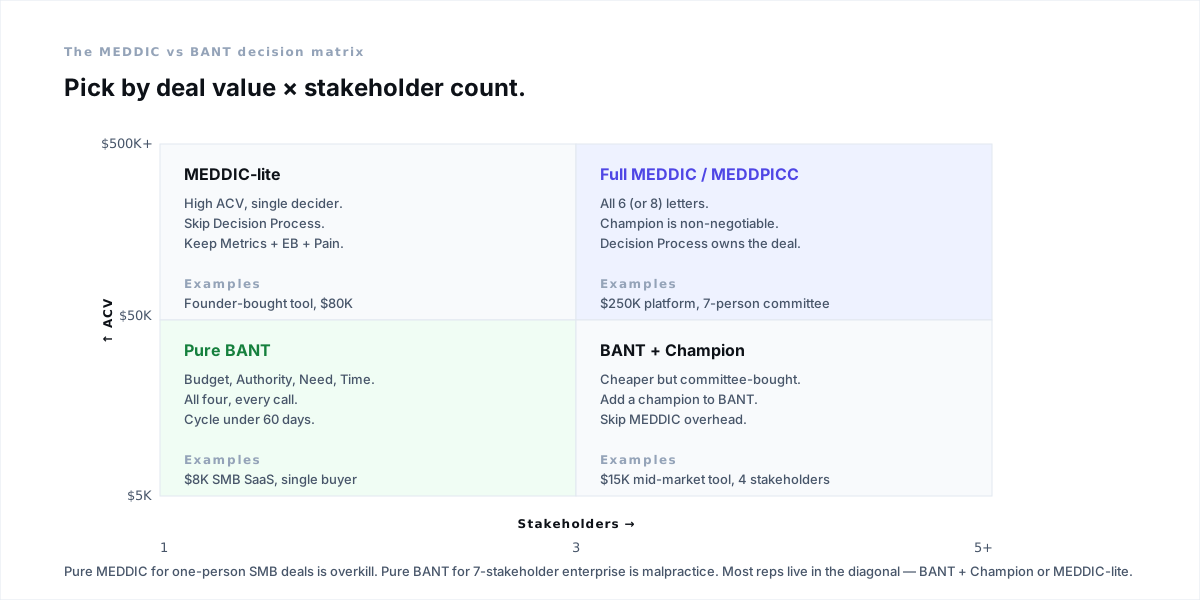
Use the decision matrix above. SMB single-decider = BANT. Enterprise committee = full MEDDPICC. Most reps live in the diagonal — BANT + Champion or MEDDIC-lite. Pick once per deal segment, not per call.
- 2
Write the 4 (or 6) artifacts onto the deal record itself
Custom CRM fields for each letter. The rep cannot mark a deal "qualified" without filling them. This is where most teams cheat — they teach the framework but never make the CRM enforce it.
- 3
Build the question into the call prep brief, not the script
For every upcoming call, the brief surfaces which artifacts are still missing on this deal. The rep walks in knowing they need Decision Process today — not running through 6 questions cold.
- 4
Hold a 5-minute deal review on the artifacts every Friday
For each deal in the rep's top 10, the manager asks one question per missing letter. "Tell me your champion." "Tell me your decision criteria." Either there's an answer or it's the rep's homework for the week.
- 5
Re-score the deal when an artifact shifts
New stakeholder named = re-score the EB. New competitor surfaces = re-score Decision Criteria. Static qualification dies the moment the buying committee changes — and on enterprise deals, it changes every two weeks.
Step 2 is the one that matters most and gets done least. Most teams teach MEDDIC in the SKO, then never enforce it in the CRM. The rep marks deals "qualified" with empty Champion and Decision Criteria fields, the manager runs forecast off vibes, and the framework dies inside two quarters. The CRM has to enforce the artifacts or the framework is theatre.
73%
SaaS using MEDDIC
Of SaaS companies selling at $100K+ ARR (2025 industry data).
25%
MEDDIC win-rate lift
On complex deals vs unstructured qualification.
33%
BANT close-rate lift
On transactional deals vs no qualification at all.
24%
MEDDPICC deal-size lift
From multi-threading the EB and Champion correctly.
How Gangly runs MEDDIC and BANT on every call
Gangly runs qualification as part of the rep workflow — no separate framework training, no manual deal-record fields the rep forgets to update. The 8 MEDDPICC artifacts (and the 4 BANT ones) live on the deal record, are surfaced in every call prep brief, and are captured automatically from the call transcript before the rep closes the meeting window.
- Call Prep Engine — surfaces which qualification artifacts are still missing on this deal before the call. Walks the rep in knowing they need Decision Process today, not a 6-question script.
- Live Call Coach — listens via Zoom or Google Meet, detects when the buyer surfaces a metric, a champion, a decision criterion, and tags it on the deal record in real time.
- Post-Call Notes + CRM Hygiene — drafts the post-call note against the framework structure (5-part anatomy) and pushes the captured artifacts to HubSpot or Salesforce on rep approval. The CRM enforces the artifacts.
The result: qualification stops being a quarterly training exercise and becomes the default output of every call. The rep doesn't pick MEDDIC or BANT on call 1 — they run the call, and the right artifacts land on the deal record.
Related reading: the discovery call framework covers the 12 questions that map to MEDDIC's letters; how to win more sales calls walks through the 5-phase call structure; and the objection handling framework covers what happens when qualification surfaces a real concern.