
 By Siddharth Gangal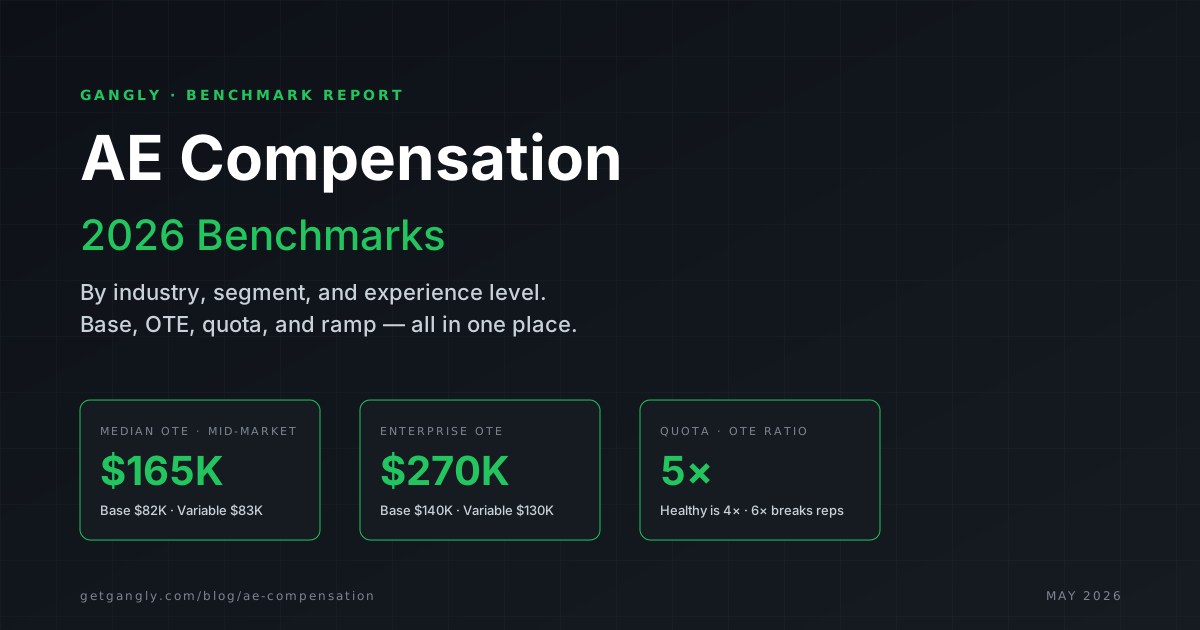
TL;DR
- 2026 US median AE compensation: $165K OTE mid-market, $270K enterprise, on a 5.4× quota-to-OTE ratio (Bridge Group 2025 + RepVue May 2026).
- Top-paying industries are cybersecurity, cloud infrastructure, and pharma; lowest are industrial manufacturing and traditional financial services.
- Pay scales 3× from associate AE to strategic AE — $90K OTE at entry, $420K+ OTE at top-of-band for Fortune 500 closers.
- Median 2025 attainment was 52%, down from 58% in 2022. The headline OTE on the offer letter is not the number most reps bank.
- Six questions decide whether an offer is signable: quota-to-OTE ratio, written ramp, accelerator cap, clawback window, team attainment median, and territory definition.
Snippet answer
AE compensation is the package an account executive earns, made of base salary, variable commission, equity, and short-term bonuses. In 2026 the US median mid-market AE earns $165K on-target earnings on a $700K to $1.0M quota; the median enterprise AE earns $270K on a $1.3 to $2.0M quota. Pay varies 3× across industries and experience tiers. The quota-to-OTE ratio — not the headline number — determines whether an offer pays out.
What AE compensation is (and what the 2026 numbers actually mean)
AE compensation is the bundle of pay an account executive receives for closing new revenue. Four components stack into the total package: a fixed base salary, a variable commission tied to closed-won bookings, equity in the company, and short-term bonuses paid out for hitting non-quota objectives. The 2026 US median for a mid-market AE sits at $165,000 on-target earnings — that is the number Bridge Group and RepVue data converge on as of May 2026.
The headline number hides four kinds of variance. Industry variance pulls cybersecurity and cloud-infrastructure AEs above $240K while parking industrial-manufacturing AEs near $130K. Experience variance scales pay 3× from associate AE to principal AE. Geographic variance adds 10 to 15% on top in San Francisco and pulls 10% off in the southeast. Attainment variance is the quietest one — median quota attainment in 2025 was 52% (Bridge Group), so the median rep earns roughly $135K against a $165K OTE, not the full number.
This guide compiles the 2026 benchmarks from RepVue (May 2026), Bridge Group 2025 SaaS AE Report, Pavilion Pulse 2025, Levels.fyi (2026), BuiltIn (2026), Glassdoor (May 2026), Indeed (2026), Gusto (April 2026), and Visdum (2024). Where sources disagreed, the post uses a weighted average tagged to the segment and tier. Every number in the tables below is paired with a source so you can validate against your own offer letter.
Read the tables in order. Industry first, because industry sets the band. Experience second, because experience sets the slot inside the band. Region third, because region adjusts the band by 10 to 15%. Then pay mix, comp structure, qualifications, and the six-question offer checklist. By the end of the guide you will know exactly where your current or prospective AE seat sits on the 2026 market map.
AE pay by industry — the 2026 benchmark table
Industry is the largest single driver of AE compensation. The same job title pays 2× differently between B2B SaaS and traditional financial services. The reason is deal size: AE pay scales with average contract value, and ACV scales with industry. Cybersecurity and cloud-infrastructure ACVs run six figures by default; insurance and industrial ACVs run mid-five figures.
| Industry | Base range | OTE range | Top-quartile total | Notes |
|---|---|---|---|---|
| B2B SaaS / Tech | $95–140K | $190–280K | $350–500K | Highest variable upside. Median OTE $200K (RepVue, 2026). Enterprise tier dominates the right tail. |
| Cybersecurity | $120–160K | $240–340K | $450–600K | Premium over horizontal SaaS. Long cycles, large ACVs, and CISO buyer pulls comp higher. |
| Cloud infra / Data | $120–155K | $240–320K | $400–550K | Snowflake, Databricks, AWS, GCP. Bands set by levels.fyi data — $230K median total comp. |
| Fintech / Payments | $100–140K | $200–290K | $360–480K | Stripe, Block, Adyen-tier pay similar to top SaaS. Smaller players closer to financial-services bands. |
| Media / Advertising | $70–110K | $130–200K | $250–320K | Lower base, heavier variable. Programmatic and CTV AEs trend 20–30% higher than legacy media. |
| Healthcare / Medical Devices | $95–135K | $180–260K | $300–400K | Long sales cycles, high earning ceiling. Stryker, Medtronic AEs cluster at the top of the band. |
| Financial Services | $75–115K | $130–200K | $250–340K | Insurance and wealth-management AEs land lower; capital-markets AEs land higher with bonuses. |
| Industrial / Manufacturing | $70–105K | $120–180K | $220–280K | Lower base-variable spread. Field travel, channel-led motions, longer cycles. Recovery from 2022 lows still in progress. |
| Logistics / Supply Chain | $75–110K | $140–200K | $240–320K | Flexport, project44-tier SaaS pulled industry up. Traditional 3PL AEs sit at the lower bound. |
| Pharma / Life Sciences | $110–150K | $190–270K | $310–410K | Closer to MBA-track bands. Bonuses pay on territory growth rather than direct commission. |
Sources: RepVue (May 2026), Bridge Group 2025 SaaS AE Compensation Report, Levels.fyi (2026), BuiltIn (2026), Visdum (2024).
Three patterns in the table. First, the top six industries (SaaS, cybersecurity, cloud, fintech, healthcare, pharma) cluster within $50K of each other at the median — pick the one that fits your career path, not the one with the headline OTE. Second, the top-quartile column matters more than the median when comparing offers; cybersecurity\'s right tail at $600K beats SaaS\'s $500K by 20%, and that gap compounds across a five-year run.
Third, watch for industry transitions that look like lateral moves on paper but are actually demotions in earning velocity. Moving from cybersecurity to media-tech for the same OTE often means swapping a 4× quota plan for a 5.5× quota plan because programmatic ACVs are smaller — same on-target number, lower realized earnings. Use the account executive career path framework to map industry choice to your earnings curve.
AE pay by experience level — junior, mid, senior, principal
Experience scales AE pay roughly 3× from associate to principal seats. The jumps are not linear — they cluster at three transitions. Associate AE to AE adds about $50K OTE. AE to Senior AE adds another $40K. Senior AE to Enterprise AE adds $60 to $100K and changes the work fundamentally. Strategic and principal AE seats sit on top of an enterprise track record and a Fortune 500 close list, not on years of service.
| Level | Base | OTE | Quota | Ramp | What the seat looks like |
|---|---|---|---|---|---|
| Associate AE (0–1 yr) | $58–80K | $90–130K | $400–650K | 4 months | First AE seat. Often promoted from BDR/SDR. Tight ramp, supervised pipeline, smaller deals. |
| AE (1–3 yr) | $75–110K | $140–200K | $700K–1.0M | 5 months | The classic AE band. Mid-market motion, 30–90 day cycles, 50/50 pay mix. Where most AEs live. |
| Senior AE (3–6 yr) | $95–135K | $180–270K | $1.0–1.5M | 5–6 mo | Mixed mid-market and emerging enterprise. Multithreading expected. Accelerators meaningful. |
| Enterprise AE (5–10 yr) | $120–160K | $240–340K | $1.3–2.0M | 6–9 mo | Named accounts, $100K+ ACV deals, procurement/security cycles. Median OTE $270K (RepVue, May 2026). |
| Strategic / Principal AE (8+ yr) | $140–180K | $300–420K+ | $2.0–4.0M+ | 9–12 mo | Fortune 500 named accounts. Single deals can be 60–80% of annual quota. Heavy MBO + RSU layer. |
Sources: RepVue (May 2026), Bridge Group 2025, BuiltIn (2026), Glassdoor (2026).
A pattern most reps miss: experience tiers do not open by tenure, they open by quota attainment history. Two consecutive years at 100%+ attainment moves you from AE to Senior AE band almost regardless of total years. Two consecutive misses drops you back. Hiring managers read the last 24 months of attainment far more closely than the resume timeline. If you sit at 18 months in a seat and miss year-1 quota, your earning ceiling for the next move is the lower half of the AE band — not the Senior AE band the calendar would suggest.
Strategic and principal AE seats deserve a separate note. The OTE is real, but the compensation skews toward MBO bonuses and RSU grants more than commission. A $360K OTE strategic AE may pull $180K in base, $120K in variable, and $60K in MBO. The MBO criteria — pipeline generation, executive sponsorship, expansion ARR — are negotiable in the contract and shift quarter to quarter at most companies. Read the MBO section three times before signing.
AE pay by US region — where the bands actually move
US region adjusts the AE band by roughly plus or minus 15%. The 2026 distribution looks different from pre-pandemic distributions because remote work flattened the curve — most companies now pay within 5 to 10% of a national median for remote roles rather than paying SF rates everywhere. The five major metros still command a premium for in-office or hybrid seats.
| Region | Average total comp | Notes |
|---|---|---|
| San Francisco / Bay Area | $173K | Glassdoor median (2026). Premium of 10–15% over US-average. Most concentrated stock comp. |
| New York Metro | $135K | Indeed reports $101K base + $35K commission for NYC. RepVue greater NYC band $130–155K base for enterprise AEs. |
| Boston | $129K | BuiltIn 2026. 7+ year AEs average $128,925; new AEs at $58,750. |
| Austin | $127K | Glassdoor 2026. RepVue Austin enterprise base $90K with $180K OTE. |
| Seattle | $125K | RepVue base band $95–155K. Boosted by cloud-infra players. |
| Washington DC | $145K | Glassdoor 2026. Boosted by GovTech and federal-vertical SaaS. |
| Chicago | $112K | Indeed 2026. Mid-market dominant; enterprise tail less concentrated. |
| Dallas-Fort Worth | $110K | BuiltIn 2026. Texas no-state-tax pushes net-pay higher. |
| Atlanta | $105K | Cluster of fintech and SaaS HQs. Bands trail Austin by ~15%. |
| US remote (national median) | $118K | Bridge Group 2025 indicates remote bands normalizing within 5% of US median rather than paying SF rates. |
Sources: BuiltIn (2026), Glassdoor (May 2026), Indeed (2026), Gusto (April 2026), RepVue regional pages (May 2026), Bridge Group 2025.
A note on remote pay. In 2022 most SaaS companies paid SF-tier rates for fully remote AEs hired anywhere in the US. By 2026, most have shifted to a national-median band with localized adjustments — Stripe, GitLab, HubSpot, and Snowflake all moved this direction between 2023 and 2025. The practical result: an AE in Indianapolis can earn $145K base on a remote enterprise seat where the same role in SF would pay $160K. The 10% gap is real but smaller than most reps expect.
State income tax matters more than headline pay at the senior tiers. A $260K enterprise AE in Austin nets roughly $14K more than the same OTE in San Francisco after California state tax. By the strategic AE tier with $360K+ OTE, the no-state-tax states (Texas, Florida, Tennessee, Nevada, Washington) deliver a meaningful annual delta that compounds with RSU vest events.
$165K
Median mid-market AE OTE in 2026
Bridge Group 2025 + RepVue May 2026 weighted average.
$270K
Median enterprise AE OTE in 2026
RepVue Enterprise Account Executive page, May 2026.
52%
Median quota attainment for AEs in 2025
Bridge Group 2025 SaaS AE Compensation Report — down from 58% in 2022.
5.4×
Quota-to-OTE ratio at median
Weighted across RepVue, Bridge Group, Pavilion Pulse 2025 benchmarks.
Base vs variable — the four pay-mix archetypes
Pay mix is the ratio between base and variable inside your OTE. A 50/50 mix on $200K OTE means $100K base and $100K variable at 100% attainment. The mix signals what the company believes about its sales motion. Four archetypes cover 95% of AE plans in 2026.
| Pay mix | Sample OTE | Split | Who runs this plan |
|---|---|---|---|
| 50/50 | $200K | $100K · variable $100K | Series B–C SaaS, mid-market AE. The default 2026 mix. Predictable income with real upside on accelerators. |
| 60/40 | $200K | $120K · variable $80K | Enterprise AE at public companies, healthcare AEs, pharma. Lower risk, lower variable ceiling. |
| 70/30 | $200K | $140K · variable $60K | Account management and renewal-heavy AE seats. Variable is more retention bonus than commission. |
| 40/60 | $200K | $80K · variable $120K | Seed and Series A AE. The motion is still being found, so the company shifts risk to the rep. Highest upside, highest variance. |
The Bridge Group 2025 median is 53/47 — slightly base-heavy. Public companies tilt more toward 60/40; early-stage startups tilt toward 40/60. A plan that does not match the company stage is worth a second look. A Series C company running a 60/40 plan is shifting risk onto the AE because the motion is still not predictable enough to forecast. A seed-stage company running a 70/30 plan usually means a founder who has not built a sales team before and is benchmarking against the wrong companies.
For a deeper read on how the pay mix interacts with quota and ramp, see the AE compensation benchmarks breakdown — it covers the SaaS-specific structures in more detail, including accelerator mechanics and equity bands by stage.
The four types of executive compensation in an AE plan
Every AE compensation plan in 2026 is built from four building blocks. Knowing the blocks separately is the difference between negotiating the wrong thing (you cannot move accelerator caps) and the right thing (you can almost always move ramp length or equity at startups).
- 01
Base salary
Fixed monthly pay that does not depend on performance. Pays the rent. Typically 50–60% of OTE for closing AEs and 60–70% of OTE for account-management variants. Used to attract reps and stabilize income during ramp.
- 02
Variable commission
Performance pay tied to closed-won bookings. Paid monthly or quarterly. The standard structure pays a flat percentage of ACV up to 100% quota, then steps up via accelerators. The variable side is where comp plans either work or break.
- 03
Equity (RSU, ISO, NSO)
Long-term incentive. At startups, 0.05–0.25% of the company; at public companies, $30–120K annual RSU grants. Vests over four years with a one-year cliff. Worth real money at growth-stage and public; mostly story at seed.
- 04
MBO and SPIF bonuses
Short-term incentives tied to non-quota outcomes — pipeline generation, CRM hygiene, product-specific deals, vertical pushes. $5–20K per quarter is typical. Real income if criteria are stable; a trap if they shift mid-quarter.
A worked example. An enterprise AE at a Series C cybersecurity company in 2026 might earn $280K OTE composed of $140K base, $140K target variable, an 0.06% equity grant vesting over four years (paper value $120K at the current 409A, secondary-market value closer to $180K), and a $20K quarterly MBO tied to pipeline generation in new logos. Total annual paper comp: roughly $475K. Total realized cash this year: $280K plus or minus attainment, with equity payouts deferred to a liquidity event.
A common mistake: optimizing the wrong block. Reps spend negotiating energy on a $5K base-salary bump when a one-month extension of ramp is worth $30K in retained year-1 commission. Equity at a Series A is worth more in expected value than the same dollar of base at Series C. Push for the block where the company has flexibility, not the block where the headline number lives.
AE qualifications — what the comp band actually pays for
AE qualifications are what each comp band actually pays for. Hiring managers do not pay a $270K enterprise AE for showing up — they pay for a track record of closing $100K+ ACV deals across multi-stakeholder buying committees with procurement and security in the path. Each tier has a different qualifications profile.
| Tier | Experience | Skills the band pays for | Credentials and path |
|---|---|---|---|
| Associate AE | 0–1 yr (often SDR/BDR promote) | Pipeline hygiene, basic discovery, demo handoff. Expected to close inbound and small outbound deals under $25K ACV. | No degree gate at most SaaS. Strong BDR performance plus internal recommendation is the path. |
| AE | 1–3 yr in a closing seat | Full-cycle prospecting, discovery, demo, multi-stakeholder negotiation. Forecast accuracy within 20%. | Bachelor's degree common but not required. Sales methodology certification (MEDDIC, Command of the Message) signals readiness. |
| Senior AE | 3–6 yr · 2+ years at quota | Pipeline planning, executive multithreading, complex pricing negotiation, deal coaching for junior reps. | Track record matters more than credentials. Two-year run of 100%+ attainment opens doors. |
| Enterprise AE | 5–10 yr · enterprise track record | Procurement and legal navigation, security review handling, 6+ stakeholder mapping, board-level executive sponsorship. | Enterprise SaaS playbook fluency. Often requires prior enterprise quota carry at a peer-tier company. |
| Strategic AE | 8+ yr · Fortune 500 closes | Account planning across 1–10 named accounts. Quarterly QBR discipline. Cross-functional orchestration with CS, SE, and partnership teams. | Often requires named-account history at one or more peer-tier vendors. MBA helps but is not required. |
Two qualifications get under-weighted in most rep self-assessments. Forecast accuracy is the quiet promotion gate — a Senior AE who forecasts within 15% of actuals quarter after quarter gets the next enterprise seat over a Senior AE who hits quota but forecasts erratically. Multithreading is the other one — single-thread reps cap at the AE band because enterprise deals require executive sponsorship at three or more functions. If you cannot map a $100K+ deal across CFO, CIO, and line-of-business sponsor, the enterprise comp tier is closed to you.
For SDRs and BDRs reading this who want to know what the AE band actually requires beyond the resume bullet, the SDR to AE transition playbook covers the 90-day prep window in detail.
How to evaluate an AE offer — the 6-question checklist
Six questions answer whether an AE offer is signable, survivable, or a treadmill. Run every offer through these before you sign. The questions are ordered so that a clear failure on any one of them is enough to pause the negotiation.
- 1
What is the quota-to-OTE ratio?
Divide quota by OTE. 4× is healthy, 5× is the 2026 median, 6× or higher is structurally broken. Anything past 6× pays out only for the top quartile of reps.
- 2
Is the ramp in writing?
A ramp period that is not in the offer letter does not exist. Push for a written 5–6 month ramp with month 1 at 0% quota, scaling to 100% by month 6.
- 3
Where are accelerators capped?
A cap below 150% attainment signals a company that does not want to pay for overperformance. Uncapped accelerators or caps at 200%+ are the rep-friendly default.
- 4
How long is the clawback window?
A clawback of 90 days for refund-driven returns is standard. Anything over 180 days pushes post-sale risk onto the AE, which is a customer-success problem, not a sales one.
- 5
What was last year's team attainment median?
Ask the hiring manager directly. If they refuse to share, that is your answer. Median attainment under 50% means the comp plan is cosmetic — the number on paper is not the number reps bank.
- 6
What is the territory definition?
Named accounts vs greenfield vs hybrid. Read the territory carve before signing. A $1.8M quota on 35 named accounts is signable; a $1.8M quota on open territory in a contested space is a treadmill.
A scoring shorthand. Pass on at least four of the six and the offer is signable. Fail on the quota-to-OTE ratio or the team-attainment-median question and walk away unless the OTE is at the top of the band — those two questions are the hardest to fix in negotiation because they reflect company-level decisions, not rep-level ones.
The least-asked question on the list is number five — last year\'s team attainment median. Hiring managers know the number; most just are not asked. A team where the median rep cleared 65% of quota is meaningfully different from a team where the median cleared 40%, and the difference is invisible from the offer letter. Ask in the final round before signing. If the manager evades, the answer is below 50% and the comp plan is cosmetic.
How Gangly helps AEs hit the number the plan pays for
Compensation pays for output, not effort. Most AEs miss quota not because the plan is broken — they miss because the workflow between signal, outreach, call prep, notes, and CRM eats four to six hours per day. That is time that does not turn into pipeline.
Gangly is the sales workflow system that turns buying signals into prepared reps. Signal detection runs continuously across LinkedIn, funding news, and job-change feeds. When a signal lands on an account in your territory, Gangly drafts the signal-grounded outreach, builds the call prep brief, runs a live coach during the meeting, captures notes, and updates the CRM — all in one connected sequence. Reps stop being the glue between five tools.
The economic case is direct. An AE on a $1.0M quota at 5× ratio needs to close roughly $80K per month in bookings. The constraint is not motivation — it is the number of decision-quality conversations the rep can run in a week. Gangly lifts that ceiling by removing the workflow tax between signals and conversations. Start a 14-day free trial, or book a demo to see how the system maps to your current comp plan.
For more on the broader workflow — what Gangly automates and how it connects to your existing CRM — see the product overview.
Continue reading
Workflows
AE Compensation Benchmarks (2026)
2026 US B2B SaaS AE compensation benchmarks — OTE by segment, base/variable splits, quota math, ramp, and red flags before signing.
Workflows
Enterprise AE vs Mid-Market AE: Which Fits You
Enterprise AE vs mid-market AE — the $90K OTE delta, cycle lengths, skill-transfer matrix, a 9-question fit test, and the promotion plan.
Workflows
SDR Compensation Benchmarks 2026: OTE, Base, Variable
The 2026 read on SDR compensation — median OTE, base/variable split, bands by experience, geography, and stage. Plus attainment reality.