
 By Siddharth Gangal
Why the question keeps getting asked — and why most answers miss
Every second LinkedIn post claims AI is about to end B2B sales. Every third one claims it already has. Neither is what a rep sees on a Monday morning in 2026. What the rep sees is a daily feed of 20 warm accounts ranked by signal, twelve outreach drafts to review before 10am, three call prep briefs already written for the day's meetings, and a CRM that somehow stayed current overnight.
That is the honest version of how AI is changing B2B sales. Not "AI is transforming the industry." Not "AI will replace the rep by Q3." Four specific workflows got absorbed — four that used to consume most of the day. The rep kept the other half — the deal work, the commercial negotiation, the close — and got a lot more hours to spend on it.
Most takes on this topic conflate two very different things: AI drafting a rep's day and AI replacing a rep's day. The first one paid off. The second one burned a lot of domains in 2024 and 2025, and the teams still running it are the ones not hitting quota in 2026. The difference matters because it is the whole answer.
The 8 shifts AI has made to B2B sales in 2026
Eight shifts. Four of them ship pipeline today. Four are still on the roadmap — or the autopsy report. Read them in order and it becomes obvious where to spend the AI budget and where to stop.
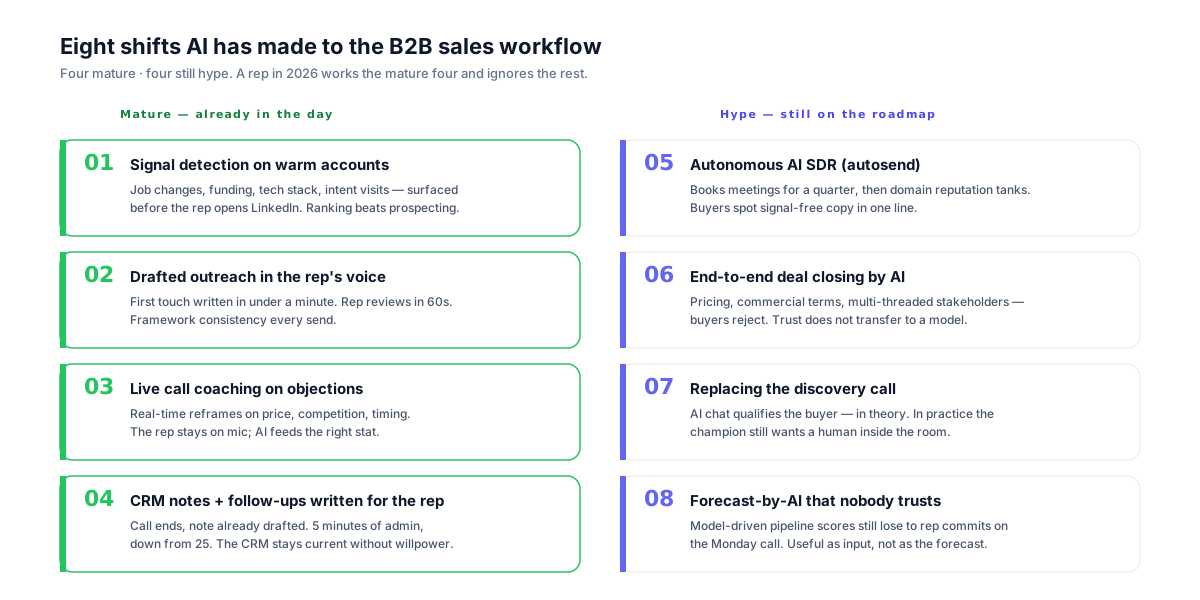
- 01MatureSignal detection on warm accounts
Job changes, funding events, tech-stack shifts, and intent visits surface the 20 accounts worth working today — before the rep opens LinkedIn. The workflow changes from "who do I call" to "which signal do I act on first."
- 02MatureDrafted outreach in the rep’s voice
First-touch email drafted from the signal in under a minute. The rep edits for 60 seconds. Framework consistency every send, so the worst email of the week looks like the best one. Nothing autosent.
- 03MatureLive objection handling on calls
Mid-call, the coach surfaces the reframe on price, competition, or timing. The rep stays on mic and gets the stat they can never remember in the moment. The analysis used to happen after the call — now it happens during it.
- 04MatureCRM notes and follow-ups written for the rep
Call ends, the note is already drafted. Five minutes of admin, down from twenty-five. HubSpot, Salesforce, and Pipedrive stay current without willpower. This is where AI pays the quota back first.
- 05HypeThe "autonomous AI SDR"
The tool finds the contact, writes the email, schedules the send. Books meetings for a quarter. Then Gmail catches up, reply rate craters, and the domain spends the next six months in reputation rehab. A workflow without a rep is not a workflow.
- 06HypeAI closing the deal end-to-end
Commercial negotiation, procurement questions, five-person buying committees — buyers reject it and the deal stalls. Trust does not transfer to a model on the first million-dollar purchase. Probably not on the hundredth.
- 07HypeAI replacing the discovery call
AI chat qualifies the buyer — in the deck. In the deal, the champion still wants a human inside the room before they spend political capital internally. Chat qualifies lead magnets, not pipeline.
- 08HypeAI-only forecasting
Model-driven pipeline scores still lose to rep commits on the Monday call. Forecast AI is useful as an input — a tiebreaker, a variance alert — not as the forecast. CROs who replaced rep judgment learned this in Q4.
For a deeper look at shift #01, see how to spot buying signals in B2B. Shift #03 gets its own breakdown in live call coaching with AI. Shift #04 has a full post in post-call note automation.
What AI has not changed — and probably never will
The things AI has not changed in B2B sales are the things that hold the deal together. A list, kept short so it is easy to remember the next time a vendor pitches autonomous closing.
The 2026 B2B buyer: why AI on the rep’s side is table stakes
The reason AI has moved from "interesting experiment" to "table stakes" is not vendor push. It is buyer pull. Four things about the 2026 B2B buyer explain the whole shift.
- 1
77% of B2B buyers run the purchase like a research project
Buyers complete a majority of their research before ever talking to a rep (Gartner, 2020 — and the share has climbed since). Reps who show up without a signal show up after the deal has already narrowed.
- 2
The buying committee has swelled to 6–10 people
Gartner's B2B buying research puts the average committee at 6–10 stakeholders across the deal cycle. Multi-thread is no longer optional — and AI is the only way a rep personalizes for ten stakeholders without cloning themselves.
- 3
Buyers expect the rep to know their company cold
Showing up without reading the annual report is a deal-killer. AI-synthesized prep collapses what used to be 45 minutes of reading into a 5-minute brief, so every call starts at the level the buyer already expects.
- 4
Reply rates have fallen across every channel
Cold email, LinkedIn DM, cold call — benchmarks trend down year on year as volume rises. The rep who stands out is the one with a signal in the first line, not the one who sends more.
A rep in 2026 who shows up to a discovery call without AI prep is showing up with one hand tied. The buyer is not hostile — the buyer is just ten tabs ahead. For the buyer-behavior playbook, see the discovery call framework.
A rep’s day — before AI and in 2026
The clearest way to see how AI is changing B2B sales is to look at where the rep's hours go. Before AI: 5 hours of admin for every 3 hours of selling. In 2026: that ratio flips, not because the rep works harder, but because four workflows collapse in duration.
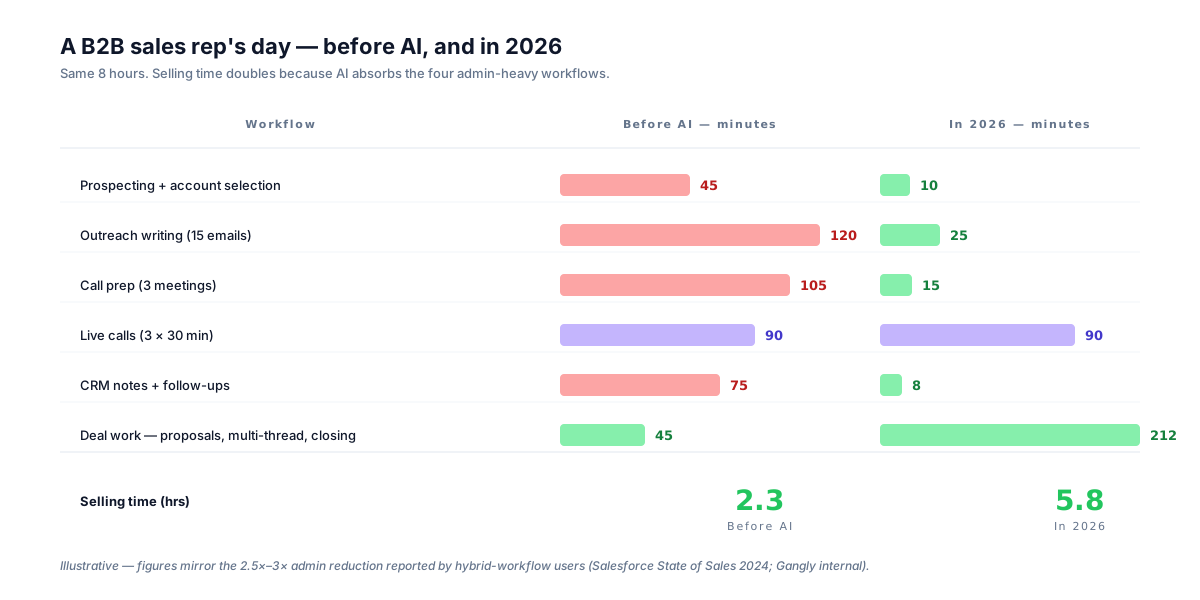
Selling time / day
5.8h
Up from 2.3h pre-AI. Salesforce State of Sales 2024 reported reps spending 28% of time selling; hybrid-AI workflows push that past 70%.
Admin cut
80%
On CRM writing alone. Auto-drafted notes and follow-up tasks collapse 25 minutes of post-call work to under 5.
Reply rate
2.1×
Hybrid (AI drafts, rep sends) vs manual outreach, across public benchmarks (Lavender 2023, Smartlead 2024).
The rep does not get four extra hours of rest. They get four extra hours on deal work — proposals, multi-threading, champion coaching, closing. That is where quota is actually paid. AI did not write the deal. It cleared the runway so the rep could.
The four failure modes that waste AI spend in B2B sales
Every dollar wasted on AI in B2B sales in 2024–2026 can be traced back to one of four failure modes. None of them are model problems. All of them are workflow problems.
- 1
Autosend without rep review
The headline AI sales failure mode. The rep never sees the draft, so the signal gets lost, the voice gets lost, and the domain gets lost. If a rep cannot press send on every outgoing email, cut the list until they can.
- 2
Volume chasing that burns the list
AI makes it trivial to send 500 emails before lunch. Most ICP lists have ~100 good contacts. The other 400 train Gmail to classify the domain as bulk, and every future send — even the good ones — lands in Promotions.
- 3
Tool sprawl with no sequence
14 AI tools doing one thing each, none of them handing off to the next. The signal lives in tool A, the draft in tool B, the CRM in tool C, the call coach in tool D. The rep tab-switches instead of selling.
- 4
Rep voice drift
Ninety days of AI drafts with no edits and the rep stops sounding like themselves in writing. When they pick up the phone, prospects hear a different person than the one who sent the inbound. Trust drops before discovery starts.
Fixing these is free. Keep the rep on the send button, cap list size to what the rep can review in a morning, run one sequence end-to-end, and edit enough drafts that the rep stays recognizable on email. For the deep cut on why autosend fails, see AI vs manual outreach.
How to build the 2026 AI sales stack (without burning the domain)
The stack reps actually run in 2026 is four layers, not fourteen. Each layer absorbs one admin workflow and hands the output to the next. The rep is the orchestration glue — and the sign-off on every external action.

- 1. Signal layer. Monitor job changes, funding events, intent, and tech-stack shifts. Rank accounts by signal confidence. Surface the top 20 warm accounts every morning. Tools in this layer must export to the outreach layer without manual tagging.
- 2. Outreach layer. Draft the first touch from the signal in the rep's voice. Review, edit, send — from the rep's inbox, not a bulk sender. No autosend, no scheduled batches, no AI-only sequences.
- 3. Call layer. Call prep in under 5 minutes, live coach on objections during the call, post-call note drafted before the meeting ends. Requires Zoom or Google Meet live transcription.
- 4. CRM layer. One-click sync to HubSpot, Salesforce, or Pipedrive. Deal stage, activity history, and follow-up tasks update themselves. The CRM feeds tomorrow's signal back into layer 1, closing the loop.
For a ranked tool pick per layer, see the best AI tools for sales teams in 2026. For the short list of individual tools the rep installs first, see AI tools for sales reps.
How Gangly runs the 2026 B2B sales workflow automatically
Gangly is built as the single-sequence version of the four-layer stack. Not fourteen point tools — four workflow stages that hand off to each other inside one system, with the rep on the send button for every external action.
- Signal Detection — monitors LinkedIn job changes, funding events, CRM activity, and keyword triggers. Surfaces the top warm accounts every morning, ranked by signal confidence.
- Outreach Writer — drafts the first touch from the signal in the rep's voice. Trained on the rep's past approved emails. Every draft routes through review before it can send.
- Call Prep + Live Coach — builds the prep brief in under 5 minutes and surfaces objection reframes on the live Zoom or Google Meet call. The rep stays on mic.
- Post-Call Notes + CRM Hygiene — drafts the CRM note before the call window closes, then syncs to HubSpot, Salesforce, or Pipedrive with one click. Stage, close date, and follow-up tasks update from the call transcript.
See a rep workflow in action or compare tiers on Gangly's pricing.
Key takeaways — what to do next
- AI absorbed admin, not selling. Four workflows are mature. Four are still hype. Spend the budget on the first four.
- Keep the rep on the send button. Every autosend workflow from 2024–2025 ended in domain damage. Do not run one in 2026.
- Four layers, one sequence. Signal → Outreach → Call → CRM. Tools that do not hand off to the next layer get cut.
- Measure selling time and reply rate, not tool adoption. If the stack is not moving either number in eight weeks, the stack is wrong.
- Keep writing enough yourself to stay recognizable. C-suite asks, sensitive re-engagements, anything under 20 sends a week — write it manually.