
 By Siddharth Gangal
Why hesitation is the most honest signal on a sales call
Buyers lie about price, timing, and interest. They do not lie about hesitation. The body is faster than the script, and the voice gives them away a full sentence before the words do.
Most reps are trained to listen for objections — the stated concerns the buyer has put into words. "It is too expensive." "We already have a tool." "Now is not the right time." Those are easy to rehearse for, and every enablement deck has a reframe ready.
Hesitation is the pre-objection state. It is the signal an objection is forming in the buyer's head but has not been voiced yet. Research from Gong on thousands of B2B sales calls shows that the strongest predictor of call outcome is not what gets said — it is the cadence, pause, and speech rate of the buyer in the final third of the call. The voice leaks what the words will not.
That is why hesitation detection matters. If a rep waits for the stated objection, they are already behind the buyer's thinking by 20–40 seconds. If they catch the hesitation the moment it happens, they can run the response while the doubt is still forming — and the deal is still pliable.
The 6 audio signals that reveal buyer hesitation
Six signals carry most of the hesitation weight on a sales call. They are not all audio — two are linguistic — but they all show up in the call audio in real time, which is what makes them useful. A rep who trains on these six will read a call better than 80% of their peers inside a month.
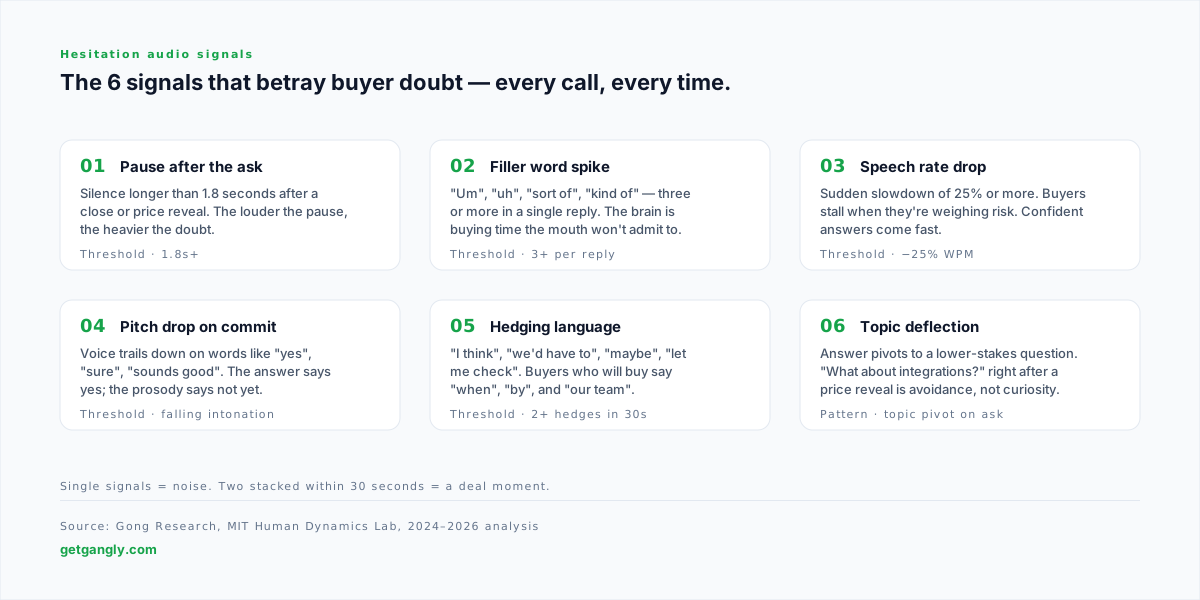
- 01
Pause after the ask
Silence longer than 1.8 seconds after a close, a price reveal, or a direct commitment question. The louder the pause, the heavier the doubt. Most confident yeses come back inside 800 milliseconds.
- 02
Filler word spike
"Um", "uh", "sort of", "kind of", "I mean" — three or more in a single reply. The brain is buying time the mouth will not admit to. Filler density spikes when the buyer is negotiating with themselves.
- 03
Speech rate drop
A sudden slowdown of 25% or more from the buyer's baseline cadence. Confident answers come fast. Buyers stall when they are weighing risk they have not surfaced yet.
- 04
Pitch drop on commit
Voice trails downward on words that should carry lift — "yes", "sure", "sounds good". The answer says yes; the prosody says not yet. Falling intonation on commitment words is the single most reliable tell.
- 05
Hedging language
"I think", "probably", "we'd have to", "maybe", "let me check", "in theory". Buyers who will buy say "when", "by", and "our team". Two or more hedges inside 30 seconds is a signal, not a speech habit.
- 06
Topic deflection
The buyer answers a lower-stakes question instead of the one asked. "What about integrations?" right after a price reveal is avoidance, not curiosity. The pivot itself is the data.
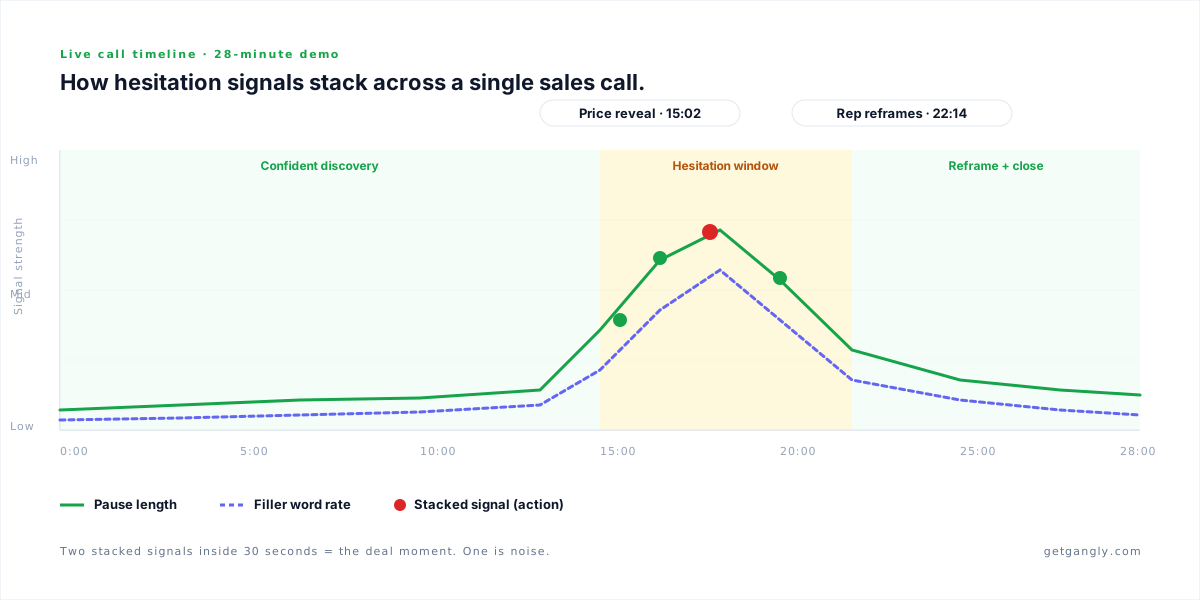
The trap is reading any one signal in isolation. Some buyers pause because they are thinking. Some hedge because it is their speech habit. Single signals are noise. Two signals stacked inside a 30-second window — a pause of 2.3 seconds followed by a hedge on the next reply — is the pattern worth responding to.
Definition
A stacked hesitation signal is two or more of the six audio signals inside a 30-second rolling window. Stacked signals carry 4–6× the predictive weight of single signals for in-call objection formation. Non-stacked signals are noise — reading them as doubt leads to over-correcting and talking past a buyer who was simply thinking.
What hesitation does not mean (the over-read risk)
The most common failure is over-reading. A rep learns about hesitation signals on Monday, listens for them on Tuesday, hears a 2-second pause in a discovery call on Wednesday, and talks for 45 seconds to fill it — cutting off the buyer's disclosure. Hesitation detection without calibration makes reps worse, not better.
- 1
Slow talkers are not hesitating
Some buyers speak at 120 words per minute as a baseline. The signal is the drop from their rate, not the absolute tempo. Gangly calibrates to the speaker after the first 90 seconds, so baselines are personal.
- 2
Filler words are not always doubt
Some reps, buyers, and cultures run 3–5 fillers in any reply as a speech habit. Hesitation detection reads delta from baseline, not absolute filler count. One "um" in a 60-word answer from a low-filler speaker is a signal; four "ums" from a high-filler speaker is normal.
- 3
Silence is not always stalling
A 3-second pause in the middle of a thoughtful discovery answer is the buyer actually thinking. Pauses only count as signals when they follow the rep's ask, not the buyer's own sentence.
- 4
Hedging is not always weakness
"We'd have to loop in legal" is a process statement. "We'd probably have to... I mean, maybe we could... " is a hedge. The shape of the language matters more than the words.
The rule: read delta from baseline, not absolute signal. A buyer who averages 180 words per minute and drops to 120 on the pricing answer has just dropped 33%. That is a signal. A buyer who averages 120 words per minute and stays at 120 across the call is not hesitating. They just talk at that pace.
How AI detects hesitation in real time
Real-time hesitation detection runs on a three-layer stack — a transcription layer, an acoustic layer, and a linguistic layer. Each runs in parallel on the live call audio, and the alert fires only when two or more signals stack inside the 30-second window.
Layer 1 · Transcription
Zoom or Google Meet audio is transcribed in under a second of latency. This is table stakes — the other two layers run on top of it.
Layer 2 · Acoustic
Pause length, speech rate, and pitch contour are computed against the speaker's personal baseline — calibrated from the first 60–90 seconds of the call.
Layer 3 · Linguistic
Filler words, hedging phrases, and topic-shift patterns are matched against a rolling 30-second window. Two stacked signals fire the alert.
The industry calls this conversational intelligence. Gong and Chorus built the retrospective version — you watch the replay and learn what you missed. The live version, where the signal surfaces during the call, is what live call coaching makes possible. Retrospective is useful. Live is decisive.
The 5 deal moments where hesitation matters most
Hesitation happens throughout a call, but it carries different weight at different moments. Five moments account for roughly 80% of the deal-altering hesitation the average rep encounters.
- 01
The price reveal
The second after you quote a number. Hesitation here almost never means the number is wrong — it means the buyer has not solved the internal approval problem yet. The right move is to diagnose the anchor, not defend the price.
- 02
The close or next step
"So shall we move to a procurement call next week?" The pause after this is the most honest data point in the call. If the answer is yes, it comes fast. If it hedges, the deal is not where the rep thinks it is.
- 03
The discovery turn
When you ask about the real pain — the 6am stress, the board pressure, the missed number. Hesitation here is fear of disclosure, not doubt about the product. Stay quiet. Let the pause do the work.
- 04
The competitor mention
The buyer names an incumbent and then stalls. They are comparing two things at once: your pitch, and the political cost of switching. The pause is a procurement question, not a feature question.
- 05
The multi-threading ask
"Who else on your team should be part of the next conversation?" A confident buyer names two people. A hesitating one says "let me check". That is a champion signal, not a stalling signal.
The price reveal and the close are where most deals turn. The discovery turn is where most pipeline gets qualified honestly. The competitor mention and the multi-threading ask are where deal size and close date get set. Miss hesitation in these five moments and the rep will misread the deal for the next two weeks.
Key insight
Hesitation on the price reveal is almost never about the number. It is about the internal approval problem the buyer has not solved yet. Reps who diagnose the approval problem close more deals than reps who discount the number.
The 4-move playbook for the next 10 seconds
Detecting hesitation is only half the job. The other half is knowing what to do in the 10 seconds after the signal fires. Four moves, in this order, handle the majority of hesitation moments on a live call.
- 1
Acknowledge the pause
Do not fill the silence. Most reps talk to cover the discomfort and lose the signal. Let the 1.8 seconds become 3. The buyer is closer to saying what they actually think than they will be for the rest of the call.
- 2
Diagnose before defending
"What part of that is the hardest to get aligned on internally?" Price, timing, trust, approval — they are four different objections that sound like one hesitation. The rep who diagnoses before defending wins the next 10 minutes.
- 3
Offer the easier path
Hesitation is often "I do not know what happens next." Give the buyer a smaller ask that makes yes cheaper — a follow-up call with procurement, a short pilot, a scoped security review. Small yeses compound into a close.
- 4
Land the specific next step
End every hesitation moment with a date and an owner. "I'll send the DPA draft to Priya by Friday." Ambiguity fed the hesitation. Specificity starves it.
The order is not optional. Defending the price before diagnosing the anchor — the move most reps default to — sends a message the buyer registers as "the rep heard my doubt and pushed back on it." That is the opposite of the signal the rep wants to send. Diagnose, then defend. Offer the easier path, then land the next step. Repeat across the five deal moments, every call, every week. For a fuller playbook on what to do after you diagnose, the objection handling framework covers the response layer in depth.
How Gangly surfaces hesitation on the live call
Gangly runs hesitation detection as part of the Live Call Coach — the third stage of the full rep workflow that starts with signal detection and ends with a synced CRM note. The rep does not change what they say. Gangly changes what they see.
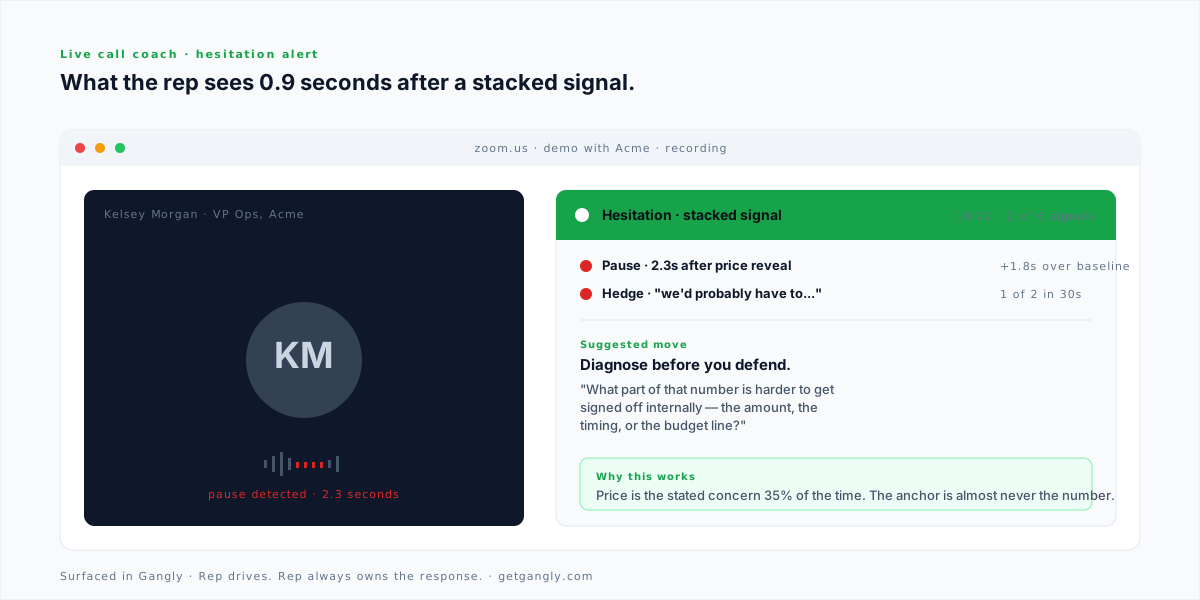
- Live Call Coach listens to the call via Zoom or Google Meet integration. When hesitation patterns appear — pause spikes, hedge density, topic deflection near an objection keyword — it surfaces a coaching card with a suggested next move. The rep reads, decides, speaks. The card does not talk for them.
- Call Prep Engine primes the card library before the call — pulling the account's likely objections, the relevant proof points, and the right diagnostic questions into memory so the reframe surfaces instantly instead of after a database hop.
- Post-Call Notes logs every hesitation moment into the CRM note automatically — which moment triggered it, how the rep responded, and whether the deal moved. Pipeline reviews get built on what actually happened, not memory.
The rep drives. Gangly surfaces the signal and the next move. The 10 seconds after the hesitation fires stops being a guessing game and becomes a repeatable workflow — call after call, rep after rep.
Related reading: the live call coaching deep dive covers the broader category, and how to handle the price objection picks up where the "diagnose before defending" move ends.