
 By Siddharth Gangal
TL;DR
- Definition: an AI sales assistant is software that handles the repetitive parts of a rep day — research, signal detection, outreach drafting, call prep, live coaching, notes, CRM updates — and ties them into one sequence so the rep does not tab-switch between steps.
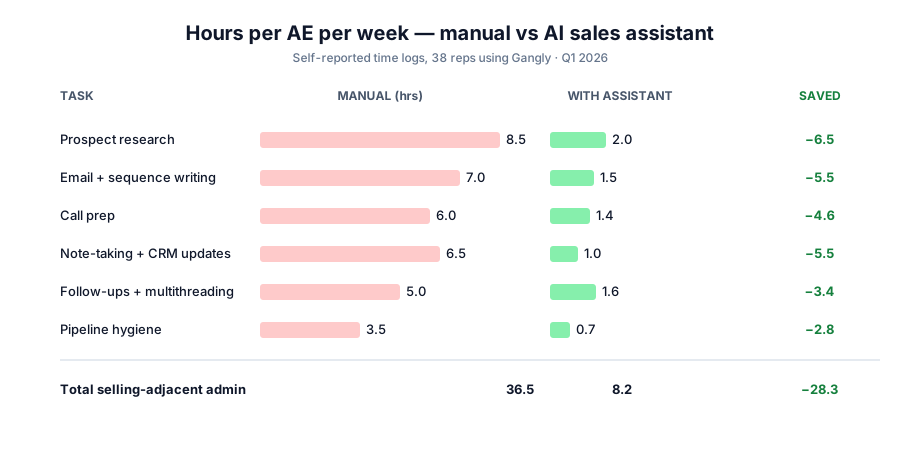
- Time math: a typical AE loses 36 hours per week to selling-adjacent admin. A real AI sales assistant takes that to about 8 hours, returning 28 hours per rep per week (Gangly cohort, Q1 2026).
- Adoption rule: the 10-20-70 rule — 10% of ROI is the model, 20% is the prompts and context, 70% is rep behavior change. Skip the 70% and the tool sits unused.
- First step: map where the rep actually loses time today, then pilot one assistant with 3 to 5 reps for 14 days before signing a seat contract.
What is an AI sales assistant?
An AI sales assistant is software that uses machine learning, large language models, and workflow automation to do the repetitive parts of a sales rep day — prospect research, signal detection, outreach drafting, call preparation, live coaching, note-taking, and CRM updates. The goal is straightforward: hand the human rep the work that needs human judgment, and hand the machine the work that does not.
The category covers a wide range. On one end sit point tools — an email coaching app like Lavender, a meeting notetaker like Avoma, an enrichment engine like Clay. On the other end sit full-stack rep operating systems that connect signal to outreach to call to notes to CRM in one motion. Both call themselves AI sales assistants. They are not the same product, and they do not produce the same ROI.
For this guide, the working definition is the full-stack version: an assistant that covers more than one step in the workflow, integrates with the CRM, and keeps a human rep in the loop. The point tools have their place, but the time savings reps actually feel come from connecting the steps.
What an AI sales assistant actually does
Strip the marketing language and an AI sales assistant does eight things. Every product in the category covers some subset of this list. The ones that cover most of it well are the ones reps stay in.
- 1
Prospect research
Pull company news, headcount changes, recent funding, tech stack, and a one-line buyer profile into a single account brief.
- 2
Signal detection
Watch job changes, hiring posts, funding rounds, and buyer activity. Rank accounts that just got a reason to buy.
- 3
Outreach drafting
Write signal-led emails and LinkedIn DMs that name the event in the first sentence — in the rep voice, not template voice.
- 4
Call prep
Build a one-page brief in under five minutes — buyer history, pain to bridge, three discovery questions, two objection lines.
- 5
Live coaching
Surface objection responses, pricing prompts, and next-step language during the call without the rep alt-tabbing.
- 6
Notes and summaries
Transcribe the call, fill MEDDPICC or BANT fields, and produce a follow-up draft inside the same tab the rep was in.
- 7
CRM updates
Push stage moves, next steps, and contact data into Salesforce or HubSpot — no end-of-day data-entry block.
- 8
Forecast and pipeline hygiene
Flag zombie deals, stuck stages, and stale close dates before the forecast call so the rep sees them first.
Notice the pattern. Each task is a slice of the day where a rep currently pays a context-switch cost — open a tab, hunt for context, write something, paste it somewhere else, log the result. An AI sales assistant earns its seat price when it removes the context switches, not when it adds another tab.
The five-layer AI sales assistant stack
Group the eight tasks into five layers and the assistant becomes legible. Each layer feeds the next. Cut any one layer and the workflow breaks at that seam.
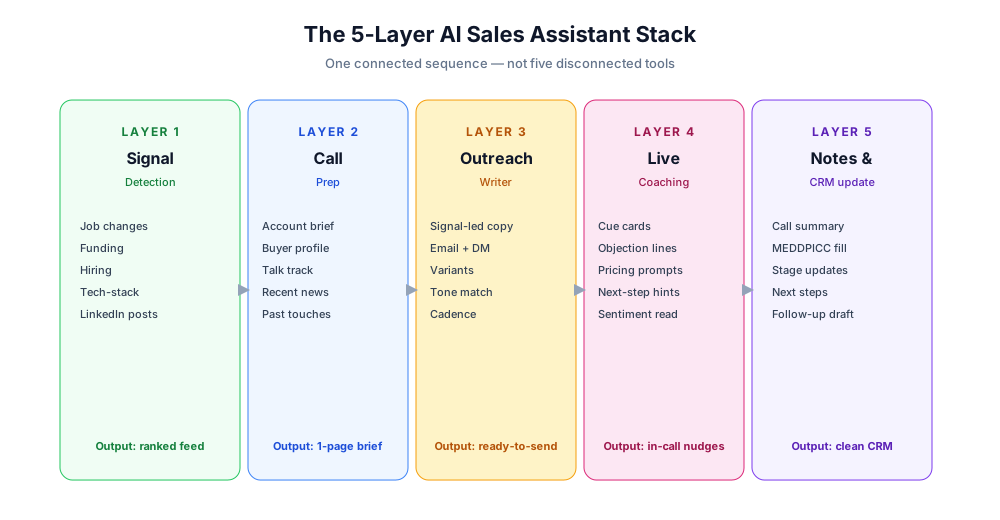
Layer 1: Signal detection
The day starts with a question — who just got a reason to buy. Signal detection watches job changes, hiring posts, funding rounds, tech-stack swaps, and buyer activity on LinkedIn, then ranks accounts by how recent and how relevant the signal is. Read the deep version in the buying signals B2B guide.
Layer 2: Call prep
Once a meeting is on the calendar, prep is where most reps quietly bleed time — 45 minutes of tabs, or 4 minutes of skim. Call prep produces a one-page brief with the buyer profile, account history, recent news, three discovery questions, and two objection lines. The sales call prep workflow covers the exact format.
Layer 3: Outreach writer
The outreach layer is where AI sales assistants earn or lose buyer trust. A signal-led draft that names the event in the first sentence — "saw you joined Acme two weeks ago from Northwind" — outperforms a templated icebreaker by 5 to 10 times. The rep reviews, edits, and ships.
Layer 4: Live coaching
On the call, the assistant surfaces objection responses, pricing prompts, and next-step language without the rep alt-tabbing. The difference between a transcript tool and a coaching tool is whether the AI helps the rep mid-call or only after.
Layer 5: Notes and CRM
After the call, the assistant writes the summary, fills MEDDPICC or BANT, drafts the follow-up, and pushes stage moves to the CRM. If this layer does not write back to Salesforce or HubSpot cleanly, the rep ends up doing manual updates at 6 p.m. and the ROI evaporates. The CRM hygiene playbook covers what good looks like.
AI sales assistant vs AI SDR vs CRM AI
Three categories get lumped together in the AI sales market and they do not solve the same problem. Picking the wrong one for your motion is the most common buying mistake. Read the dedicated comparison in AI SDR vs AI sales assistant.
| Dimension | AI sales assistant | AI SDR / agentic | CRM AI |
|---|---|---|---|
| Primary job | Make a human rep faster across the full day | Send outbound at machine scale, often autonomously | Make CRM data and reporting smarter |
| Human in the loop | Yes — rep reviews and ships | Optional — many run lights-out | Yes — driven by user query |
| Coverage | Signal → outreach → call → notes → CRM | Prospecting and first-touch only | Inside the CRM only |
| Best for | AEs, BDRs, founders doing real outbound | Volume top-of-funnel at low ACV | RevOps and CRM admins |
| Risk | Adoption gap if rep workflow is messy | Brand damage from generic agentic outreach | Insights without action |
| Example | Gangly, HubSpot Sales Hub AI, Pipedrive AI | AiSDR, 11x, Artisan (Ava) | Salesforce Einstein, Clari |
The shortest version: an AI sales assistant amplifies a human rep. An AI SDR replaces a human rep at the top of the funnel. A CRM AI helps a RevOps team understand what already happened. Most B2B teams under $20M ARR want the first. Teams running pure volume motions sometimes layer in the second. Every team eventually wants some of the third.
The 10-20-70 rule for AI sales adoption
Ask a sales leader what makes an AI rollout work and most will talk about the model — GPT-5, Claude, Gemini. The answer is wrong by a factor of seven. The 10-20-70 rule, adapted by enterprise AI teams from McKinsey's change-management research, frames the real distribution of ROI.
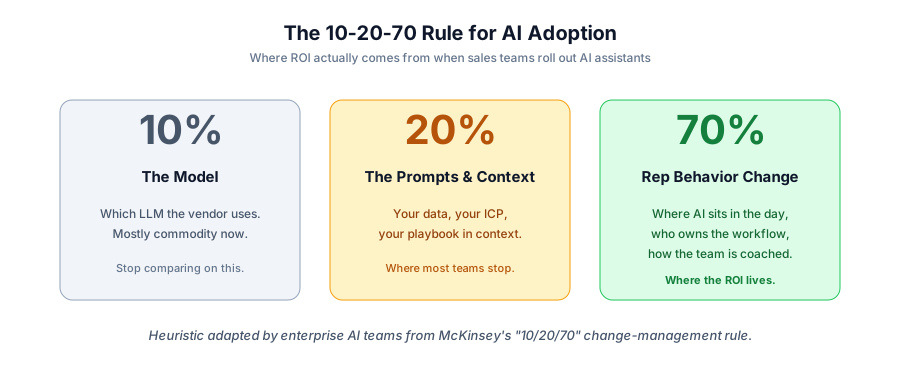
10% the model. Frontier models are mostly commodity now. The difference between two top vendors using different base models is in the noise. Stop comparing on this.
20% the prompts and context. Your ICP, your messaging, your playbook, your past-won data — fed into the assistant so the drafts sound like your team, not a generic vendor demo. Most teams stop at this layer and assume they are done.
70% rep behavior change. Where the AI sits in the day. Who owns the workflow. How the team is coached. Whether the rep trusts the draft enough to ship it without a 20-minute edit. This is where ROI actually lives, and it is the layer almost everyone skips. Read more in AI tools for sales reps.
The teams that win at AI sales adoption look like this: a single workflow owner, weekly coaching on the assistant for the first 30 days, a Slack channel for "what did the assistant get wrong today," and a metric tied directly to rep behavior — not vendor uptime.
How to pick an AI sales assistant in 2026
The buyer's matrix below maps the most-cited vendors on two axes: workflow coverage (do they handle one step or the full sequence) and rep autonomy (is the human in the loop or does the AI ship without review). Position changes quarter to quarter — validate with your own pilot.
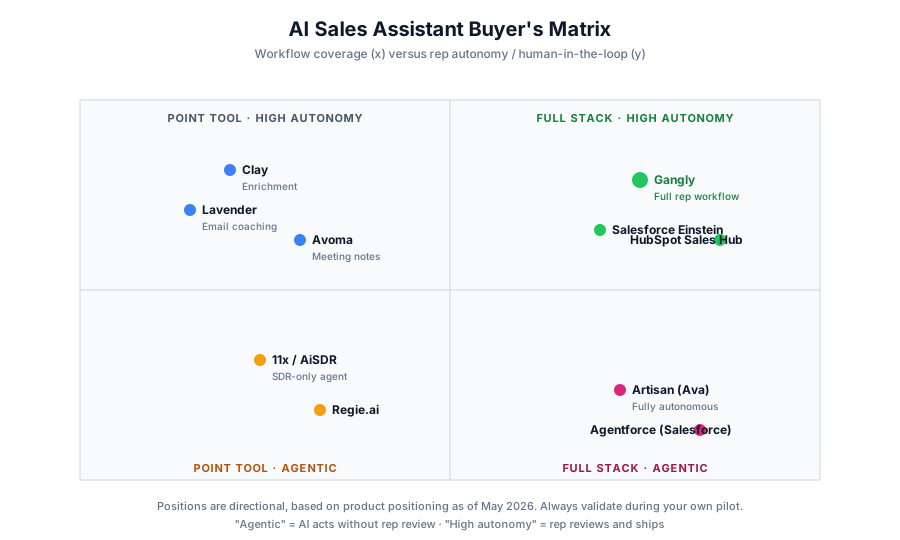
Seven criteria separate a sales assistant that earns its seat from one that becomes the third tab nobody opens.
- 1
CRM write path that the team trusts
If the assistant cannot write back to Salesforce or HubSpot cleanly, the rep will keep doing manual updates and the ROI evaporates inside a month.
- 2
Signal ingestion that does not need RevOps to build
Job changes, funding, hiring, and LinkedIn activity must come in out of the box. If you need an integration project to detect a hiring signal, the vendor is selling you middleware.
- 3
Outreach that sounds like the rep
Tone match per rep. Verify by sending five drafts to your top AE and asking, "would you send this without edits?"
- 4
Real call coaching, not just transcripts
Look for in-call cue cards, not a transcript file in a drawer. Transcripts are the floor, not the product.
- 5
One sequence, not five tools
Avoid stacking a signal tool, an email writer, a notetaker, a coaching tool, and a CRM enrichment tool. Five tools means five vendors, five logins, five reasons reps abandon the workflow.
- 6
Pricing that scales with seats, not events
Event-based pricing punishes the teams that adopt fastest. Look for per-seat plans with a fair fair-use ceiling.
- 7
A 14-day path to first value
If the vendor needs a six-week implementation, the product is enterprise IT, not a sales assistant.
Run the pilot the same way every time. Pick three reps. Run two weeks side-by-side — assistant on for one cohort, assistant off for the other. Measure minutes saved per rep per day, reply rate, and meetings booked. If the assistant does not produce a clear separation by day 14, the product is not ready. Read the broader comparison in best AI tools for sales teams.
The ROI math — and a 12-week payback model
The number that sells the assistant to the CFO is not the reply lift. It is the payback window. Most full-workflow AI sales assistants pay back inside one quarter for a five-seat team. Here is the math the way most CROs end up writing it on a napkin.
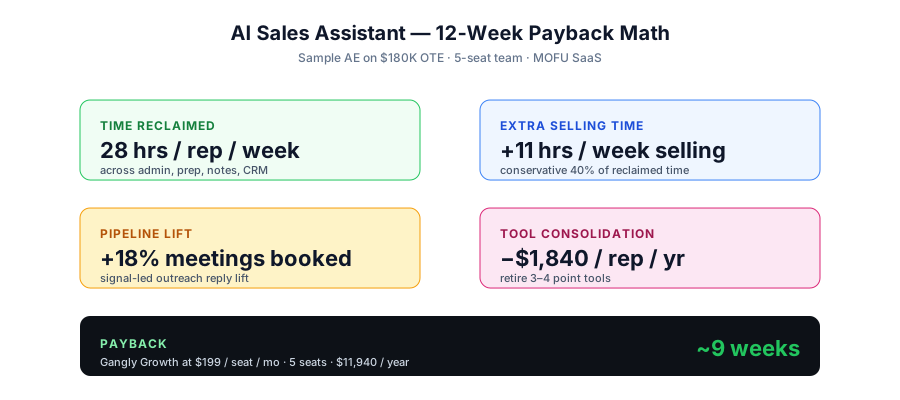
Time reclaimed: across signal scanning, research, outreach drafting, prep, notes, CRM, and pipeline hygiene, a typical AE on a manual workflow burns 36.5 hours per week on selling-adjacent admin. With a connected assistant, that drops to about 8 hours. Net: roughly 28 hours per rep per week back — Gangly cohort data across 38 reps in Q1 2026.
Conversion gain: reps assume only 40 percent of reclaimed time turns into selling activity. That is still 11 extra selling hours per rep per week. On a four-hour-call-per-meeting motion, that is two to three additional buyer conversations per rep per week.
Pipeline lift: signal-led outreach drafted by the assistant lifts reply rates from a 2% cold baseline to 8 to 15% (Gangly rep data, Q1 2026). A conservative 18% lift in monthly meetings booked is realistic by week eight.
Tool consolidation: a full-stack assistant typically retires three to four point tools — an email coaching tool, a notetaker, an enrichment subscription, and either a sequencer or a meeting tool. Average savings: about $1,840 per rep per year.
Payback: at $199 per seat per month on Gangly Growth, a five-seat team is $11,940 per year. Against the tool savings alone, payback is roughly 11 months. Against the time savings monetized at a $180K OTE, payback runs about 9 weeks. See Gangly pricing for the full plan grid.
Common mistakes reps and managers make
Seven failure modes show up in almost every AI sales rollout that quietly stalls. Each one has a fix that costs nothing.
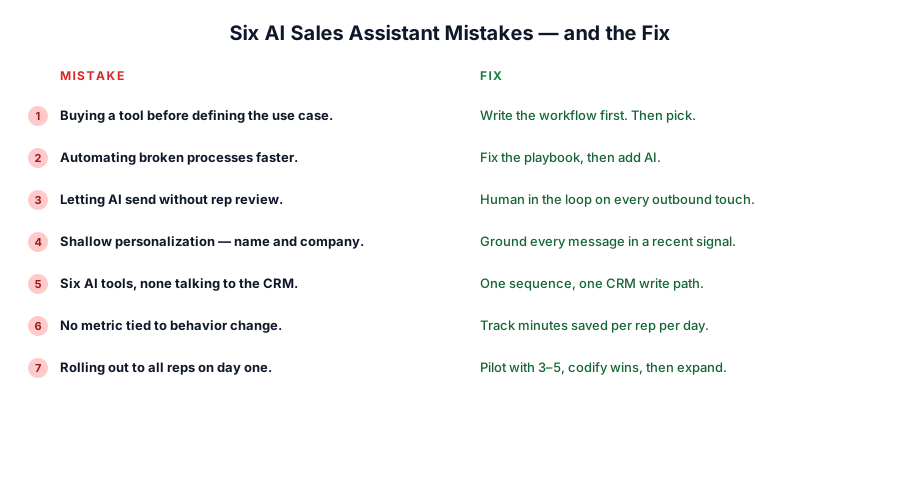
Buying the tool before defining the use case. Sales leaders see a demo, get excited, and sign before anyone has written down which workflow the assistant is supposed to fix. Six months later the assistant is one of 14 logos in the stack. Write the workflow first — exactly which 30 minutes per rep per day this assistant is supposed to give back. Then go shopping.
Automating broken processes faster. If the cadence is bad, an AI sales assistant just sends bad messages at a higher volume. Fix the playbook first — opener, pain bridge, ask. Then layer in AI.
Letting AI send without rep review. The temptation to ship at machine scale is real. The buyer pushback is faster. Keep a human in the loop on every outbound touch for the first 90 days. Graduate certain low-risk sequences once you have data.
Shallow personalization. Inserting first name and company name is not personalization — it is mail merge with a worse reputation. Real personalization means a recent, specific event tied to the buyer. Read the deep version in cold email personalization beyond "I saw you posted about".
Six AI tools, none talking to the CRM. The most common stack failure. Each tool works alone. Together they create a mess of half-synced records and reps quietly abandon the workflow. Push for one sequence with one CRM write path.
No metric tied to behavior change. If the only metric is "we deployed the tool," nobody knows whether it worked. Track minutes saved per rep per day, week over week, for the first 90 days. If the number does not move, the tool is not earning the seat.
Rolling out to everyone on day one. Big-bang rollouts almost always fail. Pilot with three to five reps. Codify what works. Then expand. The reps in the pilot become the internal evangelists.
Metrics that prove your AI sales assistant is working
Five metrics are enough. Track them weekly for the first 90 days. If four of five are moving in the right direction by week eight, the assistant is working. If two or fewer are moving, swap the tool.
- 1
Minutes saved per rep per day
Self-report at the end of week one, week four, week twelve. Target: 90+ minutes per rep per day by week four.
- 2
Reply rate on signal-led outreach
Cold baseline is around 2%. Signal-led with an AI sales assistant should sit at 8 to 15% inside 60 days.
- 3
Meetings booked per rep per week
Track the trailing four-week average. Reps who act on signals inside 24 hours book 3.4× more meetings (Gangly cohort data, Q1 2026).
- 4
CRM hygiene score
Percentage of opportunities with a next step, close date inside policy, and a MEDDPICC field filled. Target: 90%+.
- 5
Forecast accuracy
Variance between committed and actual at quarter close. Should tighten by 5 to 8 points within two quarters of rollout.
How Gangly works as an AI sales assistant
Gangly is built as the full-stack AI sales assistant — one sequence, not five tools. Signal Detection ranks accounts that just got a reason to buy and pushes a daily feed before 8 a.m. local time. Outreach Writer drafts signal-led emails and LinkedIn DMs in the rep voice. Call Prep produces the one-page brief in under five minutes. Live Coaching surfaces objection lines and pricing prompts mid-call. Notes and CRM Update writes the summary, fills MEDDPICC, drafts the follow-up, and pushes to Salesforce or HubSpot without the rep touching a field.
The product is rep-facing on purpose. The rep stays in the loop on every outbound touch. The assistant earns its seat by removing the boring 28 hours a week, not by replacing the conversations that close revenue. See the workflow in detail at how Gangly works or jump to book a demo.
What to do this week
- Write down the three workflows in your week that lose the most time today. Be specific — "research," "prep," "notes," not "admin."
- Pick three reps for a 14-day pilot. Run two weeks side-by-side — assistant on for two reps, assistant off for one — and measure minutes saved per day.
- Apply the 10-20-70 rule. Spend most of the rollout effort on rep behavior and coaching, not on vendor selection.
- Read the buying signals B2B guide next for the input the assistant needs, or jump to the AI SDR vs AI sales assistant comparison if you are weighing both categories.
- If your motion is rep-led, book a 20-minute Gangly demo. The product is built for exactly this workflow.