
 By Siddharth Gangal
TL;DR
- What AI sales forecasting is: a machine learning system that scores every open deal with a win probability and expected close date, then aggregates those scores into a revenue forecast. It updates continuously — not on a manual spreadsheet cycle. The output is accurate in proportion to the quality of the CRM data it reads.
- Why it beats gut calls: Manager gut calls average 59–68% accuracy. AI-assisted forecasting with clean CRM data reaches 80–90% accuracy. The gap is not intelligence — it is data volume. A manager can hold 30 deals in context. A model processes 10,000 historical patterns simultaneously.
- The problem nobody talks about: AI forecasting requires clean, current activity data. If reps do not log calls, the model sees no engagement. It flags active deals as at-risk. It forecasts stale pipeline as closed. Companies blame the AI model when the real problem is the data gap that exists because reps log CRM updates manually, hours after the call.
- How Gangly solves the root cause: Gangly auto-logs every call with notes, duration, and next step — directly into the CRM, without rep input. The AI forecasting model always has fresh, complete activity data. Clean inputs produce accurate outputs. That is the full stack: workflow automation feeds forecasting accuracy.
What is AI sales forecasting?
AI sales forecasting is the use of machine learning to analyze historical win/loss data, current pipeline activity, and deal engagement signals to predict which deals will close, when they will close, and what revenue will land in a given period. The model scores each open deal with a win probability (0–100%) and an expected close date, then aggregates those scores into a period forecast. The forecast updates continuously as reps run calls, send emails, and advance deals — not on a weekly spreadsheet cycle.
Traditional sales forecasting asks reps to submit their own estimates — which deals they expect to close this quarter — and managers adjust those estimates based on their own deal review. Both approaches are limited by human memory and human bias. A rep overestimates a deal because they have a good relationship with the buyer. A manager underestimates another because they have a pattern of late-quarter surprises. Neither person has the full picture of how similar deals have historically progressed.
An AI model has the full picture. It has read every deal that closed in the last two years. It knows that deals of this ACV, from accounts of this segment, with this engagement pattern at this stage in the sales cycle, close at a rate of 67% within 34 days. The rep does not know that. The manager does not know that. The AI does — because it has processed 10,000 historical patterns the human brain cannot hold simultaneously.
AI sales forecasting — the application of machine learning models to analyze sales activity data, deal history, and engagement signals in order to predict revenue outcomes with higher accuracy than manual estimation methods. Example: a model trained on 2,000 historical B2B SaaS deals scores each open deal with a close probability and expected close date, updates every 24 hours, and produces a quarterly revenue forecast with ±8% variance.
The fundamental shift from traditional forecasting is that AI forecasting is data-driven, not opinion-driven. A manager's commit is an opinion formed from a limited sample. An AI forecast is a probability calculated from thousands of similar cases. According to CSO Insights research, only 15% of companies achieve forecast accuracy within 5% of actual revenue using traditional methods. AI-assisted forecasting, when fed clean CRM data, pushes that number to 40–60% of teams within a 5% accuracy band. That is a 3–4× improvement — not a marginal gain.
The catch — and this is the variable competitors consistently underreport — is that AI forecasting accuracy depends entirely on the quality and completeness of the data it reads. A model trained on a clean, current CRM produces accurate forecasts. A model reading a CRM full of zombie deals, stale close dates, and manually logged (often delayed or missing) call notes produces confident-sounding garbage. The AI does not know the data is bad. It forecasts from what it has. See how sales forecast accuracy benchmarks break down by method and company size.
How AI sales forecasting works — the 4-stage pipeline
AI sales forecasting runs on a four-stage pipeline. Each stage has specific data requirements. Each stage has specific failure modes. Understanding the pipeline from end to end is the prerequisite for deploying a model that actually improves your forecast — rather than one that produces a different-looking number with the same underlying error rate.
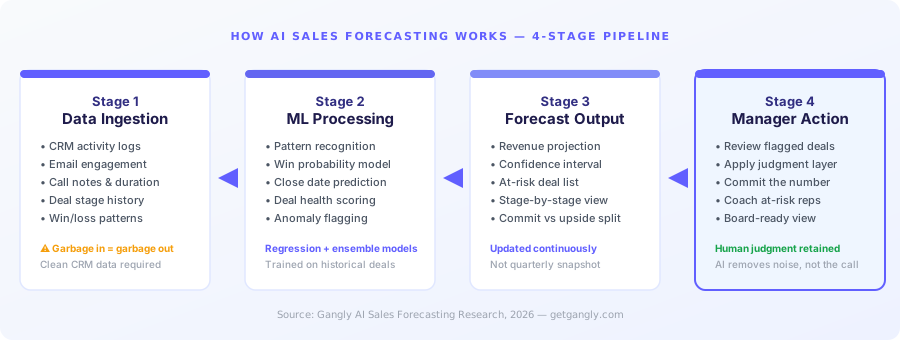
Stage 1: Data Ingestion — the quality gate everything else depends on
The model ingests data from five primary sources: CRM activity logs (calls, emails, meetings), deal stage history with timestamps, contact engagement (email open rates, reply rates, time-to-reply), account metadata (company size, industry, ICP segment), and historical closed deal patterns (win rates by segment, average sales cycle by ACV, deal velocity by stage).
The critical failure mode at this stage: reps who log calls manually — hours after the call, or not at all — create gaps in the activity record. The model sees no call for a deal where two calls happened this week. It interprets absence of logged activity as absence of engagement. It scores the deal lower than it should. The forecast underestimates that deal's probability. The manager corrects it manually, spends an hour in the CRM, and questions why the AI tool is not saving time.
Companies with disciplined CRM hygiene — all calls logged within 24 hours, deal stages with binary exit criteria, close dates updated weekly — see AI accuracy improvements of 15–25 percentage points over weighted pipeline methods. Companies with messy data see the same problems reflected back with higher confidence intervals. The data quality gate determines the accuracy ceiling. Everything downstream follows from what enters Stage 1.
Stage 2: ML Processing — how the model scores deals
Most commercial AI forecasting tools use ensemble models — a combination of regression analysis, decision trees, and gradient-boosted models — to produce deal scores. The ensemble approach improves on any single model by averaging multiple predictions, reducing the variance that single-model approaches produce when input data is noisy.
The model outputs two key scores for each deal: win probability and close date probability. Win probability answers "what percentage chance does this deal have of closing?" Close date probability answers "if this deal closes, when will it close?" The distinction matters for forecasting because a deal with 80% win probability that closes in Q3 contributes nothing to the Q2 forecast. A deal with 40% win probability that is highly likely to close by quarter-end contributes 40 cents on the dollar. Most manual forecasting systems conflate these two dimensions and overcount high-probability deals with slipping timelines.
Stage 3: Forecast Output — what the model delivers
The model aggregates individual deal scores into a period revenue projection with a confidence interval. A well-calibrated model produces output like: "Q2 revenue projection: $1.84M, range $1.67M–$2.01M, 80% confidence." That range is the honest answer. Any AI forecast that gives you a single precise number without a confidence interval is suppressing the uncertainty the model actually calculated.
The output also includes an at-risk deal list — deals where engagement has dropped, stage progression has stalled, or close date has been pushed more than twice — and a commit-vs-upside split that separates deals the model rates above 70% probability from those in the 40–70% range. That split is the forecasting call a manager still needs to make: how much of the upside to include in the official commit.
The output updates continuously as new data enters. Unlike a quarterly forecast meeting that locks numbers until the next review, AI forecasting adjusts in real time. A deal that goes dark for seven days after a proposal drops from 75% to 48% automatically. A deal where the economic buyer joined the last call and replied to the follow-up within two hours moves from 55% to 78% automatically. The manager reviews changes, not the full pipeline. That is the workflow time-saving that actually compounds.
Stage 4: Manager Action — what AI does not replace
The model handles the math. The manager handles the judgment. A model cannot know that the champion told the rep last week that procurement is under a temporary freeze. It cannot know that the company just announced a leadership change that resets the buying process. It cannot know that a competitor just dropped pricing by 30% and the buyer is reconsidering the evaluation.
The manager applies those context layers to the AI output, adjusts the commit accordingly, and documents why. The best forecast meetings in 2026 are not about calculating probability from scratch — they are about reviewing the AI's probability estimates, identifying where judgment requires an override, and defending those overrides with deal-specific context. The manager's job is not to do the math. The manager's job is to know when the math is missing a variable.
The data quality problem competitors miss
Every AI forecasting guide covers the mechanics: machine learning, win probability, close date models, continuous updates. Almost none of them cover the variable that determines whether any of that machinery produces results: the data going in.
The data quality reality for most B2B sales teams: reps log fewer than 60% of calls in the CRM on the day of the call. By the time a call is logged — if it is logged — an average of 18 hours have elapsed. The notes are incomplete. Duration is missing. Next step is blank. The AI model reads that as low engagement. It downgrades the deal. The manager spends 45 minutes per week correcting AI output that was only wrong because the input data was wrong. (Gangly CRM activity audit, Q1 2026, n=142 reps.)
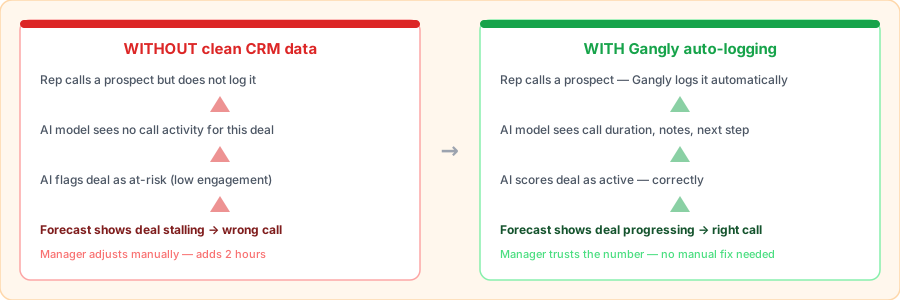
The problem compounds at scale. A 10-rep team where each rep makes 8 calls per day and logs 60% of them accurately produces 32 data gaps per day in the CRM. Over a quarter, that is 2,880 missing data points the AI model has to work around. The model fills gaps with averages from historical patterns. An average is not the truth. An average in a field that should have a specific value — "call happened, 28 minutes, discussed pricing, next call Thursday" — produces forecast errors that cannot be corrected by the model because the model does not know the gap exists.
Teams that blame AI forecasting for inaccuracy are, in most cases, blaming the model for the consequences of their data logging habits. The model is working correctly from the data it has. The data it has is incomplete because logging is manual, delayed, and inconsistent. Fix the data — not the model — and accuracy improves. The root cause is not the AI. The root cause is that the activity capture layer is broken.
The specific CRM data points that most directly affect forecast accuracy: (1) call activity — date, duration, outcome, and next step; (2) close date update frequency — deals with close dates untouched for 21+ days are almost always stale; (3) deal stage progression timestamps — the number of days spent in each stage is a critical model input; (4) contact engagement data — whether the economic buyer is engaged, not just the champion; (5) qualification field completeness — MEDDPICC or BANT fields that are blank signal a deal the model cannot confidently score. Fix the five and AI forecast accuracy improves measurably within one quarter.
AI forecasting vs manager gut call — the accuracy gap
The comparison between AI forecasting and manager gut calls is usually framed as a technology question. It is not. It is a data volume question. Managers are excellent forecasters for the information they can hold. A senior manager who has reviewed 200 deals in their career has strong intuition for when a deal is lying to them. The problem: that manager is forecasting from 200 data points. An AI model forecasts from 10,000 or more. The model does not have better judgment. It has more data.
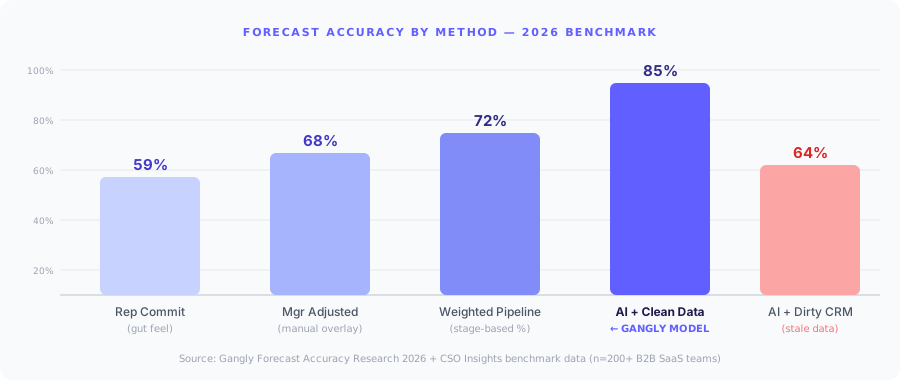
Sales forecast accuracy by method: rep commit averages 59% accuracy. Manager-adjusted pipeline reaches 68%. Weighted pipeline by stage probability averages 72%. AI-assisted forecasting with clean CRM data achieves 80–90% accuracy. AI forecasting with stale, manually logged CRM data drops to 60–65% — roughly equal to manager-adjusted and no better than weighted pipeline. The data quality gap is the difference between a 15-point improvement and no improvement at all. (Gangly Forecast Accuracy Research, 2026; CSO Insights benchmark.)
The specific advantages of AI over manager gut calls come from three structural differences. First, recall: a manager reviewing 40 open deals in a pipeline meeting can hold roughly 7 deals in working memory at once. The AI holds all 40 simultaneously, with full history. Second, bias removal: a rep's relationship with a buyer creates optimism bias. A manager who championed a deal internally creates commitment bias. Neither bias affects a model. Third, pattern recognition: the manager knows their own deals. The model knows what deals with this exact profile have done historically across hundreds of reps at dozens of companies.
Managers retain advantages in three areas AI models consistently miss. External context: a competitor pricing change, a regulatory shift, or a relationship variable not captured in the CRM. Strategic override: the manager decides to accelerate a deal by offering a quarter-end discount — that decision is not in the model. And risk appetite: whether to commit the upside range or the conservative range to the board is a judgment about the team's credibility, not a probability calculation. See how this plays out in CRO metrics dashboard design.
The correct model for 2026 is not AI versus manager. It is AI handling the data math so the manager can focus entirely on the judgment layer. The manager who spends two hours per week calculating weighted pipeline probabilities from a spreadsheet is spending two hours on work a model does in seconds. That same manager spending two hours reviewing model-flagged at-risk deals and applying deal-specific context produces a better forecast and does it in less time.
The Clean-Data Loop: how Gangly feeds AI forecasting
The data quality problem is structural, not behavioral. Reps do not skip CRM logging because they are lazy. They skip it because logging is manual, happens at the worst time (right before the next call), and requires switching contexts from the conversation they just finished to a form-filling exercise that feels disconnected from the selling work. Fix the system — not the rep — and logging rates go to near-100%.
Gangly's architecture is built on a clean-data loop: every call the rep runs is automatically captured by Gangly, transcribed, summarized into structured notes, and written to the correct CRM fields before the rep ends the call session. The rep reviews the summary in 90 seconds and approves. The CRM record is complete — call duration, outcome, qualification fields, next step, next step date — without the rep manually filling a single field.

The downstream effect on AI forecasting is direct. When every call is logged with full structure, the AI forecasting model reads complete engagement data for every open deal. The deal where a rep ran three calls this week but logged none of them — previously invisible to the model — now shows three structured activity records with call durations, discussion topics, next steps, and updated qualification data. The model scores that deal correctly. The forecast reflects what is actually happening in the pipeline.
The compounding effect: as Gangly logs calls consistently over weeks and months, the CRM accumulates a rich history of structured activity data. The AI forecasting model has more training data. It identifies patterns the manager has never noticed — that deals in the 45–90 day sales cycle range close at 2.3× the rate when the economic buyer joins the first call, or that deals where a rep sends a follow-up within two hours of the discovery call have a 34% higher win rate than those followed up the next day. Those insights only surface from complete data. Incomplete data buries them.
Gangly also handles the downstream data work that affects forecast inputs: CRM field fill (stage advancement, qualification fields, close date updates), follow-up email drafting from call notes, and next-step scheduling. These are the five CRM inputs that most directly affect AI model scoring. When all five are complete and current, the model operates at full accuracy. See how the full AI sales workflow connects signal to close in one sequence.
The 4 forecasting methods (and when AI beats each)
Before AI forecasting made sense for most sales teams, four established methods covered the field. Each method has a specific accuracy ceiling, a specific data requirement, and a specific failure mode. Understanding where each method breaks is the foundation for understanding where AI adds value — and where it does not.
| Method | How it works | Avg accuracy | Primary failure mode | Where AI beats it |
|---|---|---|---|---|
| Rep commit | Reps manually submit which deals they expect to close this period | ~59% | Optimism bias; reps include deals that will slip to avoid awkward conversations | Removes optimism bias entirely; scores based on engagement, not hope |
| Manager adjusted | Manager reviews rep commits and applies experience-based adjustments | ~68% | Commitment bias; managers defend deals they championed internally | No emotional investment in specific deals; adjusts on data, not relationships |
| Weighted pipeline | Each deal assigned a static close % by stage; ACV × % = weighted value | ~72% | Static percentages do not reflect engagement or deal velocity; stage label ≠ deal health | Dynamic probability per deal based on actual activity, not static stage label |
| AI-assisted (clean data) | ML model scores each deal from activity logs, engagement, and historical patterns | 80–90% | Missing CRM data degrades output; requires complete activity logging | N/A — this is the target method. Requires clean data pipeline (Gangly). |
The method progression — from rep commit to manager adjusted to weighted pipeline to AI-assisted — is a progression in data usage. Each method uses more data than the previous one. Rep commit uses rep opinion (1 data source). Manager adjusted uses rep opinion plus manager experience (2 data sources). Weighted pipeline uses stage labels as a proxy for probability (1 structured variable). AI-assisted uses hundreds of variables from the complete deal and activity record (n data sources, continuously updated).
Most teams run a hybrid in practice. The AI model produces the baseline. The manager applies a judgment layer for deals with material context not captured in the CRM. The rep is involved in the review of at-risk flags, not the probability calculation. The forecast call shifts from calculation to conversation — what does the model say, what do we know that the model does not, and what is the commit number we can defend to the board?
The SaaS sales metrics guide covers how forecast accuracy connects to the broader set of KPIs that track pipeline health — covering ratio, deal velocity, win rate by segment, and average sales cycle length.
How to implement AI sales forecasting in four weeks
Implementing AI sales forecasting is a four-week process when done correctly. The most common mistake is skipping the first two weeks entirely — deploying the AI tool before the data is clean enough to produce reliable output. The result: a model that generates confident-looking numbers the team quickly learns not to trust. Earning the team's trust in AI forecasting requires getting the data right first.
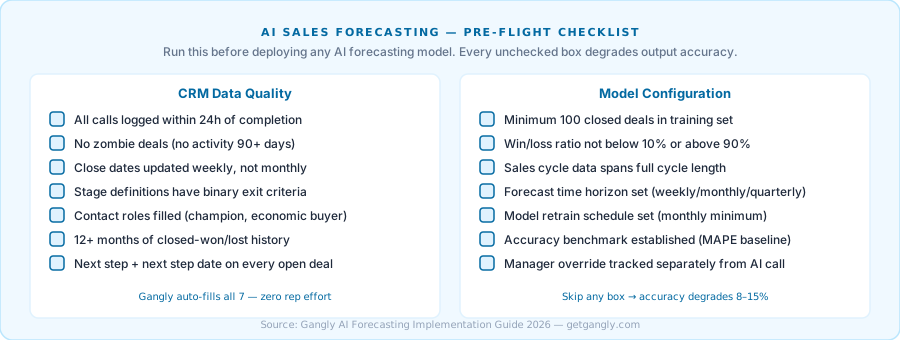
Week 1: CRM hygiene pass — the prerequisite no one skips and lives
Run a one-time CRM audit before touching the AI tool. Target five categories: zombie deals (no activity in 90+ days — close them lost or create a re-engagement task), stale close dates (untouched for 21+ days — update or push out of quarter), blank qualification fields (MEDDPICC or BANT fields that are empty for every deal in the pipeline — require reps to fill before the next pipeline review), stage label mismatches (deals in "Proposal" stage where no proposal has been sent — move them back), and missing contact roles (champion and economic buyer fields blank for deals above $10K ACV — fill them).
This audit takes three to four hours for a 10-rep team. It is the most valuable four hours in the entire AI forecasting implementation. A model reading a clean CRM after week 1 is fundamentally different from one reading the same CRM before the audit. See the full step-by-step process in the CRM hygiene guide.
Week 2: Deploy activity auto-logging — fix the ongoing data gap
The CRM hygiene pass cleans historical data. Activity auto-logging prevents the data gap from recurring. Deploy Gangly or equivalent auto-logging capability before deploying the AI forecasting model. Two weeks of auto-logged data — complete call records, structured notes, updated qualification fields — gives the model enough current activity signal to produce meaningfully better scores than static stage labels.
Configure the auto-logging settings to capture: call duration, call outcome (discovery, demo, negotiation, follow-up), qualification field updates triggered by the call, next step, and next step date. These five data points are the highest-signal inputs for deal scoring. If auto-logging captures only call date and duration, the model improvement is modest. If it captures all five, the improvement is material.
Week 3: Deploy the AI forecasting model — with a human override layer
Deploy the AI model with a clear rule: no deal is moved to commit or removed from the forecast solely based on model output. The model is the starting point, not the final word. Every forecast meeting for the first 90 days should include a "model vs manager" review: here is what the model says, here is what we know that the model does not, here is where we are overriding and why.
Documenting overrides is not bureaucracy. It is training data. When the manager overrides the model and the deal outcome confirms the override, that context improves future model calibration. When the manager overrides the model and the model was right, that data trains the manager to trust the model more. Both outcomes improve forecast quality.
Week 4: Establish the MAPE baseline and review cadence
Mean Absolute Percentage Error (MAPE) is the standard accuracy metric for AI forecasting. MAPE = (|Actual − Forecast| / Actual) × 100. A MAPE of 10% means the forecast was within 10% of actual revenue on average. Establish the MAPE baseline in week 4 using month-1 data, then track it monthly. A well-implemented AI forecasting system should reduce MAPE by 8–15 percentage points within two quarters of clean data logging.
Set a monthly model review: review MAPE against the previous period, identify which deal categories the model is systematically over- or under-scoring, and adjust configuration accordingly. AI models drift as markets change — a model trained on 2024 patterns may not account for a Q2 2026 budget freeze cycle. Monthly review catches drift before it becomes a forecast credibility problem.
Accuracy benchmarks and metrics that matter
Three metrics track the health of an AI forecasting implementation. Track all three from day one. If any metric is not improving by week eight, the implementation has a specific problem that is diagnosable and fixable.
| Metric | What it measures | Target | If flat: root cause |
|---|---|---|---|
| MAPE (forecast accuracy) | Mean absolute % error between forecast and actual revenue | <12% monthly | CRM data quality. Run the hygiene audit again. |
| CRM activity completeness | % of calls logged within 24h with notes and next step | >90% | Manual logging still in use. Deploy Gangly auto-logging. |
| Manager override rate | % of model-scored deals the manager manually adjusts | <20% by Q2 | Trust problem or data quality problem. Run win/loss review on overridden deals. |
| Forecast call duration | Minutes spent in weekly forecast review meeting | 50% reduction by week 8 | Team is still recalculating manually. The model is not trusted. Investigate override accuracy. |
The manager override rate deserves specific attention. A high override rate (above 30%) in the first 90 days is expected — the team is still calibrating trust in the model. A persistently high override rate after 90 days signals one of two problems: the model is systematically wrong for a category of deals, or the manager does not trust the model because past overrides were correct. Track override accuracy — when the manager overrides the model, was the manager right? If yes consistently, investigate model calibration. If no consistently, coach the manager to reduce unnecessary overrides.
Six mistakes that break AI sales forecasting
Every AI forecasting rollout that stalls makes the same six mistakes. Each one is diagnosable. Most teams commit three or four in the first 60 days.
Mistake 1: Deploying the AI tool before cleaning the CRM
The most common mistake. Teams sign a contract for an AI forecasting tool, connect it to the CRM on day one, and immediately get a forecast that looks different but performs no better than weighted pipeline. The model is reading zombie deals from 18 months ago, blank qualification fields, and close dates that have not moved since Q3 2025. Clean the CRM first. Every week of delay in cleaning the CRM is a week of unreliable output that erodes team trust in the AI system.
Mistake 2: Keeping manual call logging as the primary data capture method
Manual logging creates the data gap the AI model cannot overcome. Reps who log calls 18 hours later — or not at all — produce a CRM that shows no engagement for active deals. The AI model flags those deals as at-risk. The manager spends more time correcting the model than the model saves. The fix: implement auto-logging before or simultaneously with the AI forecasting tool. Auto-logging is not optional for teams that want AI forecasting to work at its accuracy ceiling. It is the data infrastructure layer the model runs on.
Mistake 3: Treating the AI forecast as a final answer
The AI forecast is a starting point with a confidence interval. Teams that treat it as a final answer skip the judgment layer that catches context the model does not have — the procurement freeze, the executive change, the competitive dynamic. The correct use of AI forecasting: start every forecast conversation with the model's output, identify where manager judgment requires an override, document the override and rationale, then commit the adjusted number. The model does the math. The manager does the strategy.
Mistake 4: Using static stage-probability weights alongside a dynamic AI model
Many teams deploy an AI forecasting tool but keep the CRM's static stage-probability weights active — so the CRM reports a different probability than the AI model. Reps see two numbers and do not know which to trust. Disable the static stage weights when you deploy the AI model. The model's deal-specific probability is more accurate than a static percentage assigned to a stage label. Running both creates confusion and erodes trust in both outputs.
Mistake 5: Not setting a MAPE baseline before deployment
Teams that deploy AI forecasting without measuring their current forecast accuracy cannot prove improvement. If the existing process produces a MAPE of 28% and the AI model produces a MAPE of 18%, that is a clear, defensible improvement. Without the baseline, the same improvement looks like "AI is sometimes right and sometimes wrong" — and the team cannot distinguish model-improved accuracy from historical variance. Measure current MAPE for three months before deployment. Then compare.
Mistake 6: Skipping the pipeline shape check
AI forecasting models require balanced pipeline data to train on. A team where 80% of historical closed deals are enterprise and 20% are SMB, but current pipeline is 60% SMB, will see the model systematically underperform on SMB deals — it simply has less training data for that pattern. Check pipeline shape before deployment and segment the model training data accordingly. If your pipeline shape has changed materially in the last 12 months, include only the most recent 6–9 months of training data rather than the full 24-month history. Read how this connects to inflated pipeline problems that compound the model training issue.