
 By Siddharth Gangal
TL;DR
- →70% of replies in a cold email sequence come from the follow-up touches, not the first email. Stopping after one email leaves most of the sequence's value on the table.
- →Timing: Wait 3–5 business days before follow-up 1. Extend intervals: day 7, day 14, day 21, day 30 (breakup).
- →Every follow-up must add new value — a stat, a case study, a direct question, or a new angle. "Just checking in" is not a follow-up; it is a second first email.
- →Signal-based follow-up outperforms fixed schedules: when a prospect opens your email 3 times without replying, that is a 72-hour hot signal — follow up immediately.
Sixty percent of reps send one cold email and stop. The research consistently contradicts this behavior: 70% of replies in a well-structured cold sequence come from follow-up touches 2 through 5 (Woodpecker study, 2025). The problem is not that prospects are not interested — it is that they are busy, their inbox is competing with 50 other priorities, and the timing of the first email was wrong.
A cold email follow-up is not a second chance to pitch the same product. It is a second touch with new information, a different angle, or a timely signal that makes this specific moment more relevant than the last. The difference between a follow-up that gets ignored and one that gets a reply is whether it gives the prospect a new reason to care.
This guide covers every element of a high-performing cold email follow-up strategy: the timing rules, the content framework, the 5-touch sequence structure, 7 ready-to-use templates, and the signal-based approach that turns engagement data into perfectly timed outreach.
Why follow-up emails drive more replies than the first email
The first cold email has a structural disadvantage: the prospect has no relationship with the sender, the email arrives at an unpredictable moment, and the inbox is already competing with high-priority internal messages. Even a perfectly crafted first email gets ignored 85 to 92% of the time — not because the value proposition is wrong, but because the timing is wrong.
Follow-up emails have a different dynamic. By the second or third touch, the recipient has a vague familiarity with the sender's name. The email does not feel entirely cold anymore. More importantly, the follow-up arrives at a different moment — and that different moment might be when the prospect is actively thinking about the problem the sender addresses.
The data on this is consistent across studies:
- Sequences that include 4 to 6 follow-ups generate 3x the reply rate of single-email campaigns (Woodpecker, 2025)
- The highest reply rates in a sequence typically come from touchpoint 3 or 4, not touchpoint 1
- The breakup email (the final touch) consistently generates 30 to 40% of total sequence replies
- Adding a single follow-up to a one-email campaign improves reply rate by an average of 65%
The implication is clear: stopping after one email is not respectful of the prospect's time — it is leaving most of your sequence's potential unrealized. A follow-up sequence is not harassment; it is persistence in a noisy environment.
How long to wait before following up on a cold email
Timing is the most commonly asked question about cold email follow-up. The research points to a specific answer: 3 to 5 business days before the first follow-up.
Shorter than 3 days signals desperation and irritates prospects who have not had time to review the original email. Longer than 7 days allows the context of the first email to fade — the prospect no longer remembers what they are following up from, and the message reads like a new cold email rather than a continuation of a conversation.
| Touch | Timing | Content type | Expected reply share |
|---|---|---|---|
| Email 1 | Day 1 | Trigger-based intro + CTA | 20–25% |
| Follow-up 1 | Day 4–5 | New value — stat or case study | 25–30% |
| Follow-up 2 | Day 7–8 | Direct question about priority | 20–25% |
| Follow-up 3 | Day 14–15 | Industry peer case study | 10–15% |
| Follow-up 4 | Day 21–22 | New angle or different pain point | 5–10% |
| Breakup email | Day 30–35 | Final resource offer, explicit exit | 30–40% |
One important note on the breakup email's disproportionate reply rate: the high performance is because it creates psychological finality. When a prospect knows this is the last email, the cost of not responding suddenly feels real. Many prospects who have been passively interested but not acted will reply to a breakup email simply because they did not want to leave the conversation without acknowledgment.
What to say in a cold email follow-up (not "just checking in")
"Just checking in to see if you had a chance to review my last email" is the most common and least effective follow-up opening in B2B sales. It communicates no new value, signals that the sender is managing their own pipeline anxiety rather than serving the prospect's interests, and gives the reader zero reason to respond.
Every follow-up must answer the prospect's implicit question: "Why should I respond to this email now, when I did not respond to the last one?" The answer must come from new information, not from repetition.
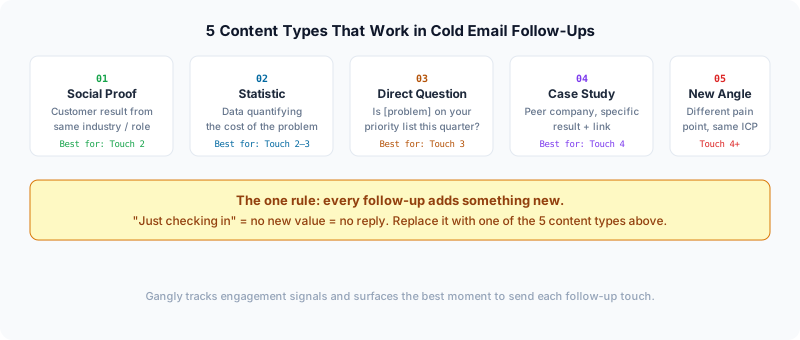
The five content types that work in cold email follow-ups:
- New social proof. A customer result from someone in the same industry or role as the prospect. "We just helped a VP of Sales at [similar company type] reduce prep time per call from 45 minutes to 4 minutes. Worth a quick conversation?" This works because the prospect's implicit reaction is "that company is like mine — if it worked for them, it might work for me."
- Relevant statistic. A data point that quantifies the cost of the problem your product addresses. "73% of AEs say admin work prevents them from hitting quota (Salesforce, 2025). If that resonates with your team, I'd like to show you what we built to fix it." The stat validates the problem without the sender appearing self-serving.
- Direct priority question. A single, binary question about where the problem ranks for them. "Is reducing rep admin time on your list for Q3, or has something else taken priority?" This question is not a pitch — it is an honest inquiry that respects the prospect's decision to deprioritize if that is what has happened.
- Industry-specific case study. A short link or 2-sentence summary of a relevant customer story. "Here's a case study from a team similar to yours — they went from 20% to 34% quota attainment in one quarter after implementing Gangly. Three minutes to read if you are curious."
- New angle on a different pain point. If the first email addressed one problem, pivot to a different one that the same ICP faces. "I reached out about prep time last week. Separately, I have noticed that most teams in your space also struggle with CRM accuracy — is that on your radar?"
The 30/30/50 rule for cold emails explained
The 30/30/50 rule is a cold email structure framework that distributes content across three functional zones. It applies to both the initial email and follow-ups.
- First 30% — relevance and context. Why is this rep reaching out to this specific person at this specific company right now? This section contains the trigger event, the personalized hook, or the signal that prompted the outreach. It should answer "why me, why now?" before the prospect has to ask.
- Next 30% — value proposition. What outcome does the product deliver and why does it matter to someone in this role? This section is short — 1 to 2 sentences of substance. No feature lists, no company history, no founder story. One outcome, stated clearly.
- Final 50% — the ask. This is where most cold emails fail. Half the email's real estate belongs to the CTA. A specific, low-friction ask: "Are you free for 15 minutes on Thursday?" is better than "I would love to connect sometime." The specificity of the ask communicates confidence and makes it easy for the prospect to say yes rather than constructing a response.
Applied to follow-ups, the 30/30/50 rule shifts: the first 30% is the new piece of value (stat, proof, question), the next 30% is a one-sentence reminder of the value prop, and the final 50% is the same specific ask with a new specific date.
For deeper frameworks on the full cold email structure, see the guide on the cold email copywriting framework.
The 5-touch cold email follow-up sequence
Below is a full 5-touch sequence structure with timing, purpose, and the specific element each touch adds. This is the Gangly-recommended sequence for B2B outbound targeting AEs, VPs of Sales, and founders at Series A to C companies.
Touch 1 — The original email (Day 1)
Trigger-based opening that references a specific signal: "Congratulations on the Series A — you are now building the sales team to justify the capital." Two sentences on the problem your product addresses for companies at their stage. One specific CTA: "Are you free for 15 minutes on [day]?" Under 100 words.
Touch 2 — The value-add follow-up (Day 4–5)
Subject: Re: [original subject line]. Open with a one-sentence acknowledgment that they may not have had time. Add one new piece of value — a customer result or a relevant statistic. Re-state the CTA with a new date. Under 80 words.
Example: "Know your inbox is full. Wanted to add one thing: a team similar to yours (same stage, same ICP) cut rep admin time by 60% in the first month. If that number is interesting, [link to 2-min video] shows how. Still happy to find 15 minutes if Thursday works."
Touch 3 — The direct question (Day 7–8)
Drop the pitch entirely. Ask one direct question about where the problem ranks on their priority list. "Quick question: is reducing rep admin time on your Q3 list, or has something else taken priority? Either answer helps me calibrate."
This touch gets replies even from prospects who have not been engaging. The honest, non-pitchy tone creates a low-friction response opportunity.
Touch 4 — The case study (Day 14–15)
Share a 2-sentence case study from a company in the same vertical or at the same funding stage. "A [similar company] went from 20% to 34% quota attainment in one quarter after reps stopped spending 2 hours on manual prep before each call. Case study is 3 minutes if you are curious: [link]. Worth 15 minutes to see if the same applies to your team?"
Touch 5 — The breakup email (Day 30–35)
State explicitly that this is the last email. Offer one piece of value with no strings attached. "This is my last outreach on this — I do not want to clutter your inbox. If you ever want to talk about [specific problem], the door is open. In the meantime, here is a guide that reps in your role have found useful: [link]. No reply needed — good luck with [relevant initiative they mentioned or company milestone]."
The breakup email's performance comes from its honesty. It removes the sales pressure, makes the prospect feel respected, and often triggers a response from people who were interested but did not reply to earlier touches because they were not ready.
Signal-based follow-up: timing your touches to buying behavior
Fixed-schedule follow-up sequences are better than no sequences. But signal-based follow-up is better than fixed schedules.
Signal-based follow-up means sending the next touch when the prospect's behavior indicates active interest, rather than waiting for a predetermined calendar date. The signals that indicate active interest:
- Multiple email opens without a reply. A prospect who opens your email three times is thinking about what it says. They may be looking for a reason to respond or trying to figure out if this is relevant. An immediate follow-up that adds new information at this moment of active consideration outperforms a follow-up sent 4 days later.
- Pricing page visit. If your email includes a link to the pricing page and the prospect visits it, they are evaluating whether the cost is in range. A follow-up within 24 hours of this signal that addresses pricing objections directly will close more conversations than one sent on day 7 regardless of behavior.
- Website visit after email open. A prospect who opens the email and then visits the product page is doing self-directed evaluation. They are interested but not yet ready to reply. A follow-up that reduces the friction of the next step — "I noticed you took a look at the product — happy to give you a 10-minute walk-through on your terms" — meets them at the point of their investigation.
- LinkedIn engagement after email touch. If a prospect views your LinkedIn profile after receiving an email, they are checking credentials. A LinkedIn connection request that references the email is a warm outreach at a high-credibility moment.
Gangly tracks engagement signals from cold email campaigns and surfaces them in a daily priority list. Instead of managing follow-up schedules manually, reps see which prospects are actively engaging and follow up with context about what triggered the priority flag. This is how signal-based selling applies to the follow-up layer of outbound.
7 cold email follow-up templates that get replies
These templates are organized by the follow-up position in the sequence. Adapt them to your specific ICP, product, and customer examples — the structure is the reusable part, not the exact words.
Template 1: The value-add follow-up (Touch 2)
SUBJECT: Re: [original subject]
Hey [Name],
Know your inbox is full — wanted to add one thing before I leave this alone.
A [ICP company type] in [industry] cut [metric] by [result] in [timeframe] using [product]. Here is the 2-minute version: [link]
Still happy to find 15 minutes if [specific day] works.
[Name]
Template 2: The direct question (Touch 3)
SUBJECT: Quick question
Hey [Name],
One question: is [specific problem] on your priority list for Q3, or has something else taken over?
Either answer genuinely helps me calibrate whether this is worth your time.
[Name]
Template 3: The case study follow-up (Touch 4)
SUBJECT: [Company similar to theirs] — [specific result]
Hey [Name],
[Similar company] went from [before state] to [after state] in [timeframe]. Their situation looked a lot like yours: [one-sentence parallel].
Full case study is 3 minutes: [link]
Worth 15 minutes to see if the same applies?
[Name]
Template 4: The new angle (Touch 4 — alternative)
SUBJECT: Different thought on [company name]
Hey [Name],
I reached out about [original pain] last month. Separately — most VPs of Sales I speak with at your stage also run into [second pain point]. Is that one on your radar?
15 minutes if either problem is live: [calendar link]
[Name]
Template 5: The signal-triggered follow-up
SUBJECT: Re: [original subject]
Hey [Name],
Noticed you took a look at the product page — happy to give you a 10-minute walk-through on your terms. No prep required, no sales deck, just the thing you wanted to see.
[Calendar link] if that works.
[Name]
Template 6: The breakup email (Final touch)
SUBJECT: Closing the loop
Hey [Name],
Last email on this — I do not want to keep cluttering your inbox.
If [specific problem] ever moves up the priority list, I am easy to reach. In the meantime, here is something that might be useful regardless: [link to genuinely useful resource]. No reply needed.
Good luck with [relevant milestone or initiative].
[Name]
Template 7: The re-engagement email (30+ days after sequence ends)
SUBJECT: [New trigger event at their company]
Hey [Name],
Congratulations on [specific new event — funding, hire, product launch]. We reached out a few months ago about [original problem] — with [new event], I imagine the context may have shifted.
Worth a quick conversation? [Calendar link]
[Name]
The breakup email: your highest-performing final touch
The breakup email deserves its own section because of how consistently it outperforms every other follow-up in the sequence. The psychology is simple: finality creates urgency.
Throughout the sequence, the prospect has been able to defer responding because they knew another email would arrive. When the breakup email arrives and explicitly closes the loop, that deferral option disappears. Prospects who have been interested but passive suddenly face a decision: respond now or lose the thread entirely.
Three rules for the breakup email:
- State explicitly that this is the last email. Vague finality does not trigger the same response. "Closing the loop" or "This is my last outreach" signals genuine closure in a way that "Haven't heard from you" does not.
- Offer something with no strings attached. A link to a relevant resource, a guide, a data report — something genuinely useful that the prospect can take without committing to a next step. This removes the sales dynamic from the final interaction and makes the sender appear credible and generous rather than frustrated.
- Reference something specific to them. A recent company milestone, a goal they would have mentioned, or an initiative that matters at their stage. "Good luck with [specific thing]" shows you paid attention and did not treat this as a mass campaign.
The breakup email's 30 to 40% reply rate means it deserves as much craft as the first email. Reps who treat it as a throwaway last touch are underinvesting in the highest-performing moment in their sequence.
Six cold email follow-up mistakes killing your reply rate
- "Just following up" as an opening line. This phrase is the single most common and most damaging opener in cold email follow-up. It signals no new information and invites the reader to archive the message without reading further. Replace it with the new piece of value immediately.
- Sending follow-ups on the same day of the week. If your first email went on Monday and every follow-up arrives on Monday, you are competing with the same inbox density every time. Vary the day and time — Tuesday and Thursday emails have higher average open rates than Monday emails.
- Follow-ups that are longer than the original email. As the sequence progresses, each follow-up should get shorter, not longer. Follow-up 4 should be 40 to 60 words. A longer follow-up signals that the sender is over-explaining because the core message is not working.
- Changing the CTA in every email. If email 1 asks for a 15-minute call and follow-up 1 asks for a 30-minute demo and follow-up 2 asks to connect on LinkedIn, the prospect has no consistent path to yes. Pick one CTA and keep it consistent across the sequence — the goal is to get them to the same next step, just from a different angle each time.
- No reply thread. Follow-ups that restart the conversation with a new subject line lose the cumulative familiarity the sequence builds. Reply threads — "Re: [original subject]" — maintain continuity and have higher open rates because they look like active conversations rather than new cold pitches.
- Stopping at two follow-ups. Most reps stop at one or two follow-ups. The data says most replies come from touchpoints 3 through 5. Reps who stop early are systematically leaving replies on the table across their entire pipeline.
Metrics that prove your follow-up sequence is working
Track these four metrics at the sequence level to identify where your follow-up strategy is strong and where it needs revision.
Reply rate by touchpoint
Break down your total sequence reply rate by which touchpoint generated the reply. If 80% of your replies come from touchpoint 1 (original email), your follow-ups are underperforming. If breakup email replies are below 20% of total, the breakup email needs more work. Target distribution: 20 to 25% from email 1, 25 to 30% from touch 2, 20% from touch 3, 10% from touch 4, 30 to 40% from breakup. For benchmarks, see the cold email reply rates guide.
Open rate by subject line and position
Track open rate separately for the original subject versus the "Re:" follow-up thread. If the reply thread open rate is significantly lower than the original, prospects are opening the first email but not clicking back in when the follow-up arrives — which suggests the first email did not create enough interest to warrant a second look.
Meeting booked rate per sequence
The downstream metric. Of all prospects who entered the sequence, what percentage booked a meeting? Benchmark: 3 to 6% for a well-targeted outbound sequence to a cold ICP. Below 2% indicates a problem in ICP targeting or core messaging — not follow-up strategy.
Unsubscribe and spam complaint rate
If follow-up frequency or content is causing unsubscribes above 0.5% or spam complaints above 0.1%, the sequence is too aggressive or the targeting is too broad. A high unsubscribe rate is a signal that the follow-ups are being experienced as harassment rather than value-adding outreach. For deliverability implications, see the cold email deliverability guide.
Follow Up at the Right Moment
Know when a prospect is ready to reply
Gangly tracks email opens, link clicks, and website visits and surfaces the accounts that are actively considering you — so follow-up happens at the peak of their interest, not on a fixed calendar schedule.