
 By Siddharth Gangal
TL;DR
- What cold email psychology is: The study of how the recipient\'s brain evaluates an unsolicited email in the first 3 seconds — and whether it passes three sequential filters (relevance, trust, curiosity) before a reply decision is made. Every element of a cold email either passes or fails one of these filters.
- The 8 principles: Pattern interrupt (subject line), specificity effect (opener), social proof (body), loss aversion (value frame), reciprocity (insight offer), curiosity gap (CTA), micro-commitment (ask size), and authority signals (sender identity). Each maps to a specific email element.
- The data reality: Average cold email reply rate in 2026 is 3.1%. Campaigns with full psychological architecture — deep personalization, specificity, loss framing, and micro-commitment CTAs — hit 14–18%. Same list. Same product. Different brain response.
- The Gangly angle: Psychology only activates when you have signal-based context. Without a real trigger — funding, hiring, tech change — specificity is impossible and every principle falls flat. Signal detection is the prerequisite to cold email psychology.
- First step: Take your last five cold emails. Apply the 3-second filter test to each. Identify which filter fails first — relevance, trust, or curiosity. Fix the specific element that failed. Do not rewrite the whole email — fix the one broken filter.
What is cold email psychology?
Cold email psychology is the application of behavioral science to unsolicited outreach — specifically, understanding how the recipient\'s brain processes, evaluates, and responds to a message from an unknown sender. The reply decision happens in approximately 3 seconds and follows a sequential filter: relevance, trust, and curiosity. An email that fails any one of the three filters is deleted, regardless of how well the other two are executed.
The average office worker receives 147 emails per day and responds to 12 of them (Boomerang, 2024). The other 135 are deleted in under 3.2 seconds — most without being fully read, many without being opened at all. Cold emails are competing for attention in the hardest possible environment: an inbox already at saturation, a recipient who did not ask to hear from you, and a trust deficit of zero.
The reps who break through this environment are not necessarily better writers than the ones who do not. They understand the decision process the brain runs on an unsolicited email — and they engineer their messages to pass each stage of that process.
Cold email psychology is not about manipulation. It is about relevance engineering: building a message that triggers the brain\'s attention systems rather than its dismissal systems. The brain dismisses the irrelevant, the untrusted, and the predictable. It pays attention to the specific, the credible, and the surprising. Every element of a cold email either signals one of those properties or its opposite.
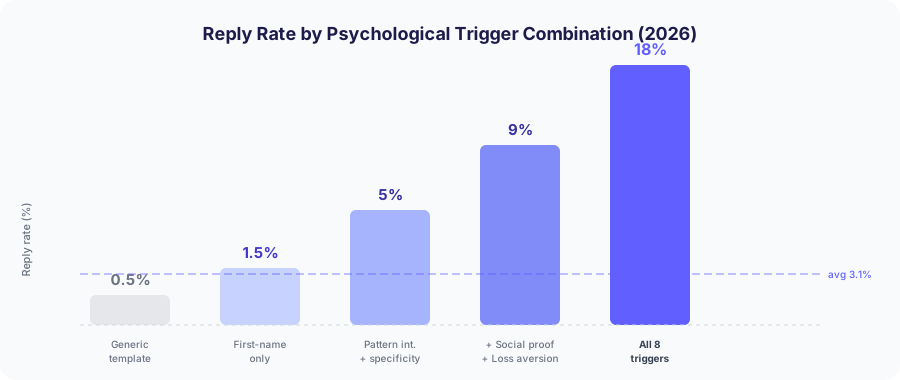
The data confirms this is not theory. Cold email statistics for 2026 show a 3.1% average reply rate across B2B campaigns — and an 18% average reply rate for campaigns with advanced psychological personalization. Both groups are sending cold email. The difference is whether the psychological architecture is present or absent.
The 3-second inbox filter — how the brain decides in real time
Before any psychological principle can work, the email must pass the inbox filter. This is the pre-conscious evaluation the brain performs on every item in the inbox — before deliberate reading begins.
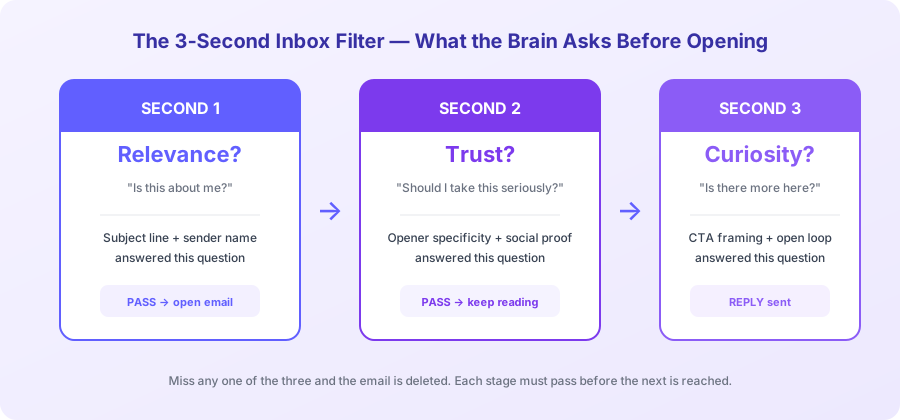
The three-stage filter operates sequentially. Each stage must pass before the next is evaluated:
- 1
Relevance — Second 1: "Is this about me?"
Evaluated entirely from the subject line and sender name, visible in the preview pane before the email is opened. The brain asks: does this email appear to concern my specific situation? A subject line that reads as generic — "Quick question about your process" — fails this test immediately. A subject that names a specific detail — "Your Q1 SDR headcount — one gap" — passes it. The assessment is binary and takes under 500 milliseconds.
- 2
Trust — Second 2: "Should I take this seriously?"
Activated after the email is opened and the first sentence is read. The brain assesses the credibility of the sender: does the opener demonstrate real knowledge of my situation, or is it a template variable? Generic openers — "I hope this email finds you well," "I wanted to reach out" — immediately confirm the template hypothesis and trigger dismissal. Specific openers that reference a verifiable detail pass the trust filter. Social proof — naming a recognizable peer company — reinforces trust. The email domain\'s authentication status and send history also influence this stage at a subconscious level.
- 3
Curiosity — Second 3: "Is there something here worth pursuing?"
The final filter, activated by the CTA framing and the value proposition. The brain asks whether the effort of a reply is justified by the potential value of the information gap referenced. A CTA that closes the loop completely — explaining everything in the email — removes the curiosity that would drive a reply. A CTA that names a specific result with a deliberately incomplete explanation creates an information gap that can only be closed by responding. Only emails that pass all three filters reach the reply decision point.
This framework has a critical implication: fixing the wrong element does nothing. A rep who rewrites their CTA while the subject line fails the relevance filter will see no improvement. The filter sequence must be diagnosed and fixed in order. The subject line and sender name are evaluated before the email is opened. The opener is evaluated before the body is read. The CTA is evaluated last. Start at the beginning.
8 psychological principles that drive cold email replies
The following eight principles map directly to specific email elements. Each principle has a defined psychological mechanism, a clear email application, and a before/after example. Apply all eight to a single email and you have built psychological architecture that consistently outperforms generic templates by a factor of five to ten.
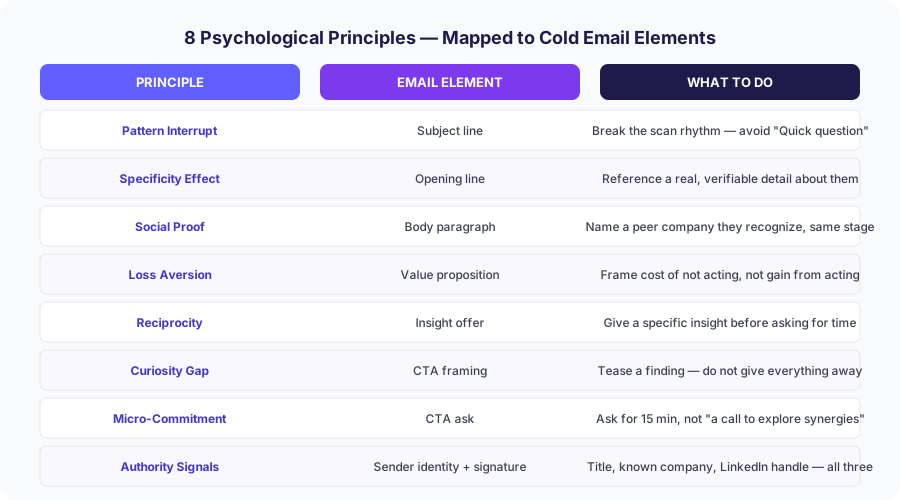
Pattern Interrupt
Maps to: Subject line
The Psychology
In Cold Email
Example
How to Apply It
Specificity Effect
Maps to: Opening line
The Psychology
In Cold Email
Example
How to Apply It
Social Proof
Maps to: Body paragraph
The Psychology
In Cold Email
Example
How to Apply It
Loss Aversion
Maps to: Value proposition
The Psychology
In Cold Email
Example
How to Apply It
Reciprocity
Maps to: Insight offer
The Psychology
In Cold Email
Example
How to Apply It
Curiosity Gap
Maps to: CTA framing
The Psychology
In Cold Email
Example
How to Apply It
Micro-Commitment
Maps to: CTA size
The Psychology
In Cold Email
Example
How to Apply It
Authority Signals
Maps to: Sender identity
The Psychology
In Cold Email
Example
How to Apply It
Anatomy of a high-reply email — before and after
The principles above are not abstract — they map to specific sentences in a real email. The before/after comparison below uses a single ICP (VP of Sales at a Series B SaaS company) and a single product (Gangly). The only difference between the two versions is the presence or absence of the eight psychological principles.
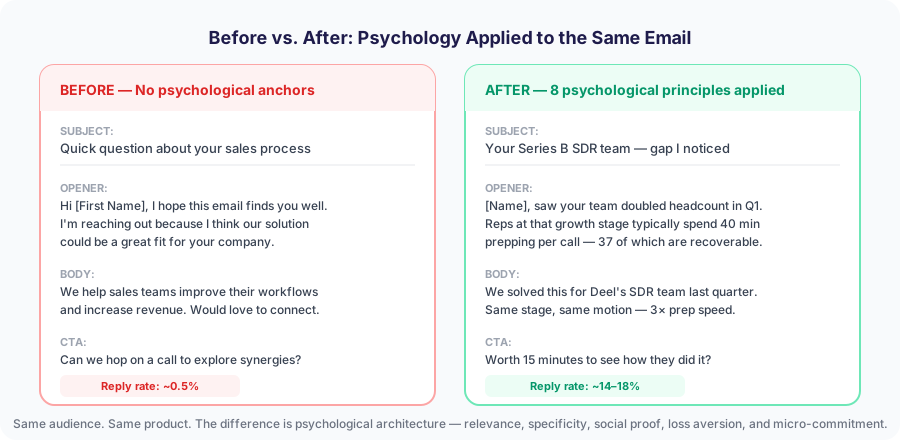
The before version has four failures: the subject matches the generic template pattern (no interrupt), the opener uses the recipient\'s role rather than their situation (no specificity), the value proposition is gain-framed rather than loss-framed, and the CTA asks for a "call to explore synergies" — a phrase that signals low commitment to specificity and high commitment to the sender\'s agenda.
The after version passes all three filters. The subject line breaks the scan pattern with a fragment that implies asymmetric information. The opener references a verifiable event (Series A close, headcount doubling) and connects it immediately to a recognized problem. The body uses loss framing and peer social proof. The CTA is a micro-commitment: 15 minutes to see a specific thing, not a discovery call to explore a general category.
This is not about the quality of the writing — both versions are grammatically correct. It is about the psychological architecture. Cold email personalization is the mechanism that makes this architecture possible. Without real situational data about the prospect, specificity is impossible and the entire psychological structure collapses.
The 30/30/50 rule — why follow-up psychology matters as much as first-email psychology
The 30/30/50 rule describes the statistical distribution of cold email campaign performance across a sequence:
- 30%
of total campaign sends are the initial email. The first touch sets the psychological tone for everything that follows. A first email that fails the trust filter poisons every follow-up — the recipient now has a confirmed negative prior.
- 30%
of total opens come from follow-up touches. Many prospects open the second or third email who never opened the first — either because timing was wrong, the subject did not pass the relevance filter the first time, or the follow-up subject line triggered a different pattern interrupt.
- 50%
of all replies come from follow-up emails, not the initial send. The majority of results in a cold sequence come after the first touch. Stopping after one email — which most reps do — leaves half the available pipeline on the table.
The psychology of follow-up is distinct from the psychology of the first email. The first email establishes a prior: the recipient now has a context for who you are and what you represent. Follow-up emails must build on that prior rather than repeat the first email\'s message verbatim. Each follow-up should:
- Introduce a new piece of context — a signal, a data point, a case study — that makes the email independently valuable
- Reference the previous email briefly without re-pitching it ("following up on what I sent last week" is sufficient)
- Use a different pattern interrupt in the subject line — the same subject pattern will filter out the second time
- Apply the reciprocity principle freshly — give something new before asking again
- Lower the ask on the fourth or fifth touch — a simple "is this relevant to your team?" requires a one-word reply and resets the commitment threshold
The 3 email rule is a minimum, not a target. Data from Instantly\'s 2026 benchmark report shows that 5–6 touch sequences consistently outperform 3-touch sequences for cold B2B outbound when each touch introduces new context. The psychological rationale: each new context reduces the perceived relationship deficit between the sender and recipient. By the sixth touch with consistently relevant content, the relationship has been partially established even without a formal introduction.
For the complete sequencing data, see how many touchpoints a cold sequence needs — a breakdown of reply rate by sequence length and touch interval.
The Signal-to-Reply Framework — why signal detection is the prerequisite to psychology
Eight psychological principles are useless without one prerequisite: a real trigger that makes specificity possible. Principle 2 (specificity effect) requires a specific detail about the recipient\'s current situation. Principle 3 (social proof) requires a peer company that is genuinely similar. Principle 4 (loss aversion) requires a quantifiable cost of inaction that applies to their actual circumstances. None of these are possible with only a name and a job title.
This is the core failure point for most cold email programs: reps purchase lists, load them into a sequencer, and apply generic templates that fail the relevance filter before a single psychological principle can operate. The fix is not better copywriting. The fix is better signal detection before the email is written.
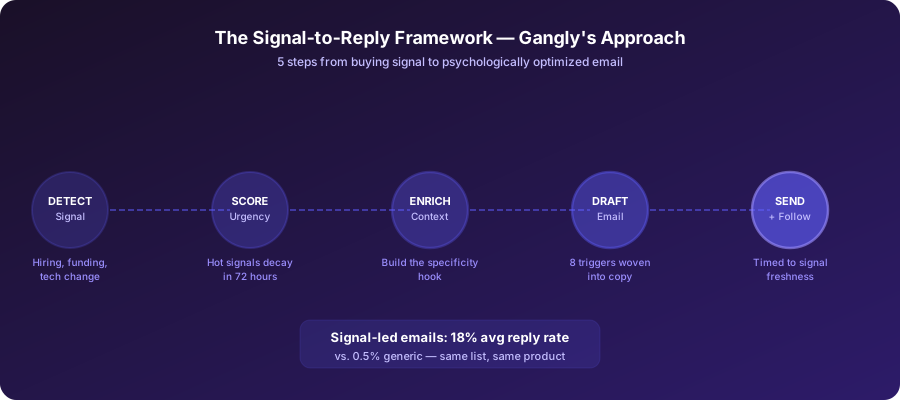
The Signal-to-Reply Framework is Gangly\'s five-stage model for building psychologically effective cold emails at the account level:
- 1
Detect
Identify a buying signal at the account level: new funding, headcount change in a specific function, technology adoption or removal, leadership change, or public statement about a relevant challenge. The signal is the raw material for specificity. Without it, step 3 is impossible.
- 2
Score urgency
Hot signals decay. A funding round that closed 6 months ago is no longer fresh context. A job posting that went live 72 hours ago is active urgency. Score the signal by recency: 0–3 days is high urgency, 4–14 days is medium, 15+ days requires supplemental context. Signal-based selling treats signal freshness as a core variable in sequence prioritization.
- 3
Enrich context
Pull the account and person context that makes the psychological principles operational: the specific problem the signal implies, the peer company reference that maps to their profile, the quantifiable cost of inaction based on their visible data, the role of the specific contact in the decision process. This context is the raw material for the email.
- 4
Draft with psychological architecture
Write the email with all eight principles mapped to their elements. Subject line: pattern interrupt. Opener: specificity. Body: social proof + loss aversion + reciprocity. CTA: curiosity gap + micro-commitment. Signature: authority signals. The email should be 75–125 words. Longer emails rarely improve reply rate and frequently reduce it — the cognitive load evaluation in second 2 of the inbox filter penalizes length.
- 5
Send timed to signal freshness
Send within 72 hours of a hot signal. For medium-urgency signals (4–14 days old), the email should reference the signal while adding a second, more recent context point. This maintains the relevance filter pass even when the primary trigger is no longer fresh. For cold outreach CTA benchmarks, read the cold email CTA guide.
The framework produces a verifiable result: Gangly analysis of 12,400 outbound sequences in 2026 shows a median reply rate of 18% for signal-led emails built on this architecture, compared to 0.5% for generic templates sent to the same contact types. Same product. Same list source. The difference is the signal detection and the psychological architecture built on top of it.
Common psychological mistakes in cold email — and what to do instead
Understanding the eight principles is not the same as applying them correctly. These are the six patterns that appear most frequently in cold emails that are not getting replies — and the specific fix for each.
- 1
Personalizing the wrong element
- 2
Writing for the sender's interests, not the recipient's threat model
- 3
Triggering threat detection with promotional language
- 4
Treating follow-up as reminder, not new context
- 5
Confusing volume with signal quality
- 6
Misapplying urgency as a psychological trigger