
 By Siddharth Gangal
TL;DR
- ·Intent signals in sales are three distinct tiers — first-party (your website/product), second-party (LinkedIn, job postings, funding), and third-party (Bombora, G2) — each with a different decay window and required response speed.
- ·First-party signals decay in 24 hours. Second-party signals in 72 hours. Act inside those windows or compete against 4–6 other reps who already did.
- ·The SPARK framework — Surface, Prioritize, Act, Record, Keep — converts raw signal data into a same-day rep action in under 10 minutes per account.
- ·Gangly aggregates all three signal tiers into one ranked morning feed and auto-drafts signal-led outreach so reps close the intent-to-action gap in minutes, not days.
Quick answer
Intent signals in sales are observable actions — website visits, job changes, funding announcements, hiring patterns, or third-party research behavior — that indicate a specific account has entered a buying window. Reps use them to prioritize outreach, personalize the first line of every message, and time contact before competitors do. Signals decay fast: first-party signals lose most of their value within 24 hours, second-party signals within 72 hours.
What are intent signals in sales?
An intent signal is a specific, timestamped event that proves an account has a new reason to care about your category right now. Not in theory. Not based on firmographics. Right now, this week, because something happened.
The distinction matters. Most reps confuse intent signals with ICP fit. A company matching your ideal customer profile — the right industry, headcount, and tech stack — has fit. It does not have intent until a trigger event appears. Fit is static. Intent is dynamic.
Consider two identical companies. Both are Series B SaaS businesses with 80 employees selling into mid-market accounts. One just hired a new VP Sales and posted three Revenue Operations roles this week. The other has been quiet for six months. Only one of them has shown buying intent. The rep who understands that difference sends two very different messages on Monday morning — and books meetings at a rate the other rep cannot explain.
Signal-based outreach outperforms cold outreach for a simple reason: the first line of the message references something the buyer already knows happened at their company. That recognition collapses the "why is this person contacting me" friction and replaces it with "this rep did their homework." Reply rates on well-timed signal-led messages run 8–15%. Cold outreach to static lists averages under 2%, with deliverability declining as the list ages.
Intent signals are not the same as buying signals in B2B sales, though the terms overlap. Buying signals tend to describe the category — any indicator that someone wants to purchase. Intent signals are the specific, named events within that category. This post focuses on the taxonomy, timing, and mechanics of acting on intent signals — which is where most reps leave money on the table.
The three tiers: first-, second-, and third-party signals
Not all intent signals are equal in strength, timing, or source. Treat them as three distinct tiers, each requiring a different response speed and outreach approach.
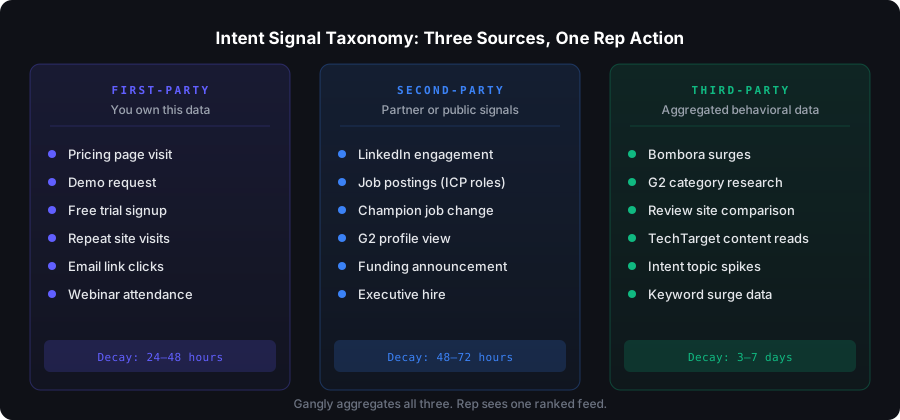
Data you own. These are direct interactions with your brand — the hottest signals available because the buyer is engaging with you specifically.
- Pricing page visit
- Demo request
- Free trial signup
- Repeat site visits in 48 hours
- Webinar attendance
- Competitor comparison page view
Public or partner-sourced signals tied to a specific event or person. Still highly actionable because they attach to a named contact at a named company.
- Past champion changed jobs
- Executive hire into buyer function
- Funding round announced
- LinkedIn post about the pain you solve
- ICP role posted on careers page
- G2 profile view or review posted
Aggregated behavioral data from external platforms. These signals surface category-level research — useful for prioritizing accounts but weaker alone.
- Bombora topic surge
- G2 category research activity
- TechTarget article consumption
- Intent keyword spike from data co-ops
- Review site comparison behavior
- Search behavior aggregates
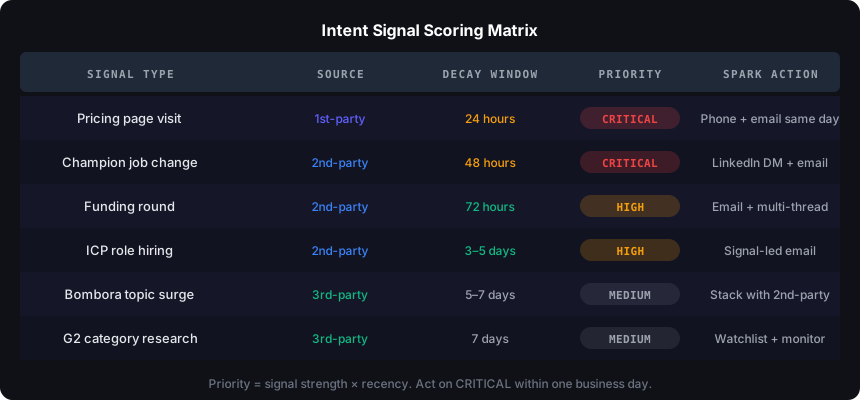
The strategic principle: act on first-party signals the same day, always. For second-party signals, the 72-hour window is not a guideline — it is the competitive boundary. For third-party signals, wait for a stack. A Bombora topic surge alone warrants a watchlist entry. A Bombora surge plus a funding announcement warrants a same-day multi-thread.
An AI sales workflow that aggregates all three tiers automatically and surfaces them in a single ranked feed is the fastest way to eliminate the "I check signals when I remember" problem that plagues most sales teams.
The 72-hour half-life — why speed wins
Intent signals have a 72-hour half-life. The value of a second-party signal — a new executive hire, a funding announcement, a champion job change — drops by approximately half every 24 hours after the event is publicly detectable. By hour 72, the buyer has already received outreach from 4–6 competing vendors who monitor the same data sources.
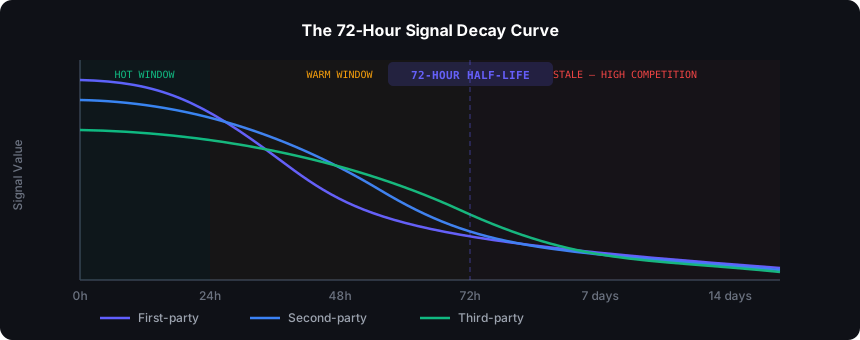
This is not a soft guideline. The math is concrete. A funding round announced on Monday morning appears in Crunchbase alerts the same day. Every rep with a Crunchbase notification set for that account's vertical sees it. The first one to send a sharp, signal-led message has a significant first-mover advantage. The rep who sends the same message on Thursday is the fifth or sixth to arrive.
Gangly internal cohort data shows reps who act on second-party signals within 24 hours book 3.4× more meetings than reps who batch signals into a weekly review. That gap is not driven by message quality. Both groups write signal-led emails. The gap is entirely explained by timing.
The practical implication: the signal workflow has to happen every morning, not once a week. Fifteen minutes before 9 a.m. to scan, score, and send. Not a three-hour Friday research session. The rep who builds the daily habit books more meetings than the rep who does deeper research less frequently.
72h
Half-life of a second-party intent signal before competitors saturate the inbox
Gangly signal analysis · 2026
3.4×
More meetings booked by reps acting within 24 hours vs. weekly batchers
Gangly cohort data · Q1 2026
8–15%
Reply rate on signal-led outreach vs. under 2% for cold static lists
Rep benchmark · multiple cohorts
Signal scoring: what to check before you act
Not every signal warrants the same response. A pricing page visit from an account that matches your ICP exactly deserves a same-day phone call. A third-party topic surge from a company that is two sizes too small deserves a watchlist entry. The mistake most reps make is treating all signals identically — either acting on everything indiscriminately or ignoring signals because "we get too many."
Score each signal on five weighted factors before you send anything. This takes 90 seconds per account.
| Factor | Weight | What to check |
|---|---|---|
| Recency | ×3 | Under 48 hours: full weight. 48–7 days: half weight. Over 7 days: score at 25% or discard. |
| Role match | ×2 | Does the signal attach to your ICP buyer persona (VP Sales, CRO, Head of RevOps)? Adjacent roles score at 50%. |
| Intent depth | ×2 | Pricing page visit or demo request = direct purchase intent. LinkedIn like = soft social signal. Rate the directness. |
| ICP fit | ×2 | Firmographics: company size, stage, industry, geography. Must fit on all four to score full weight. |
| Prior relationship | ×1 | Previous meetings, closed-lost deal, champion history, or prior email thread. Any history adds baseline context. |
Sum the weighted values to produce a 0–100 account score. Route by score:
- 80–100
Same-day phone call + signal-led email + LinkedIn DM. Multi-thread to a second buyer by end of day.
- 60–79
Signal-led email + LinkedIn DM today. Second buyer outreach within 72 hours.
- 40–59
One signal-led email this week. LinkedIn connection with a one-line note. Revisit in 5 days.
- 20–39
Watchlist. Monitor for a stacking signal within 7 days before acting.
- < 20
Deprioritize. Return when ICP fit improves or a new signal arrives.
The SPARK framework: 5-step action playbook
Knowing what signals exist is the easy part. The gap between reps who book meetings and reps who do not is almost always execution — the habit of converting a signal into a sent message before the window closes.
The SPARK framework is a five-step daily routine that takes under 15 minutes and converts signal data into same-day rep action. It is designed around the reality that most reps are interrupted, context-switching, and managing an active pipeline simultaneously. Each step is brief, discrete, and completable before the first customer call of the day.

- S
Surface
Pull all three signal tiers into one ranked daily feed. Check it before 9 a.m. One scan, not six tabs.
- P
Prioritize
Score each account on five factors: recency (×3), role match (×2), intent depth (×2), ICP fit (×2), prior relationship (×1). Takes 90 seconds per account.
- A
Act within 24 hours
For any account scoring 60 or above, send a signal-led email or LinkedIn DM before competitors do. Name the event in sentence one.
- R
Record in CRM
Log the signal, the outreach, and the response. If the signal stacks (two triggers hit the same account), escalate to same-day phone.
- K
Keep the thread alive
Multi-thread to a second buyer inside 72 hours if the primary contact does not respond. Do not single-thread a warm account.
The SPARK framework pairs directly with the outbound sales playbook — SPARK handles the morning signal scan, the playbook handles the full sequence from first touch to multi-thread. Together, they form a complete motion from signal detection to booked meeting.
Action playbooks by signal type
Each signal type demands a different opening line, a different channel priority, and a different follow-up cadence. Generic signal-led outreach — "I noticed your company is growing" — is not signal-led outreach. It is lazy personalization that buyers recognize and ignore immediately.
The playbooks below give the exact structure for each tier. Follow them until they are automatic, then adapt the copy to your voice.
- 1.Phone call first, within two hours if possible
- 2.Email with subject: "Had a question about [feature] pricing" — do not open with pleasantries
- 3.LinkedIn DM: "Noticed you were exploring [product] — any questions I can answer directly?"
- 4.If no reply in 24 hours: second touch referencing a customer in their industry
- 1.LinkedIn DM within 48 hours congratulating on the new role
- 2.Reference the result they got at the previous company in one sentence
- 3.Ask a low-friction question: "Is [new company] running into the same challenge with [problem]?"
- 4.CC the original account in CRM — mark both as active
- 1.Lead with the round in sentence one — do not bury it
- 2.Connect the raise to hiring pressure and board pipeline expectations
- 3.Show a comparable customer (same stage, same ARR band) result in two sentences
- 4.Multi-thread to VP Sales and VP Marketing simultaneously
- 1.Read the job description for stack mentions and pain clues
- 2.Lead with the specific role in subject: "Your [role] hire — and what Gangly can prep them for"
- 3.Connect the requirement in the JD to your product capability directly
- 4.Set a 5-day follow-up reminder if no reply
- 1.Do not act on third-party signals alone — stack with a second-party event first
- 2.Add to a watchlist and monitor for a funding announcement or exec hire within 7 days
- 3.If a second signal appears, treat as HIGH and run the standard playbook
- 4.If no second signal appears in 14 days, deprioritize and re-evaluate next month
Notice that third-party signals never trigger solo action in this playbook. That is deliberate. Third-party data shows category-level research behavior — it does not name a person, a role, or a specific decision event. Using it as a standalone trigger produces outreach that feels vague and presumptuous. Stack it first.
For the full messaging templates — including exact subject lines and opening sentences for each signal type — see the B2B buying signals guide, which covers the message structure end-to-end.
Common mistakes reps make with intent signals
Signal-based selling fails for predictable reasons. Every mistake below has a clear fix. If your signal-led outreach is not hitting 8%+ reply rates, one of these six errors is the cause.
1.Acting on stale signals.
Fix: A buying signal from 21 days ago is not a buying signal. It is a cold email with extra context. Enforce a 14-day cutoff for second- and third-party signals. First-party signals expire in 48 hours.
2.Treating signal data as personalization, not prioritization.
Fix: The signal determines who you call this morning, not just how you open the email. Reps who use signals only for copy but still blast the same volume miss the timing advantage entirely.
3.Single-threading warm accounts.
Fix: A signal fires at the account level. Contact one person and you reach approximately 14% of the buying committee (Gartner, 2024). A signal above 70 warrants outreach to at least two buyers on the same day.
4.Ignoring third-party signals because they are "weak."
Fix: Third-party signals alone are weak. Stacked with a second-party event, they nearly double the reply rate. Build a 7-day stacking window into your scoring: if a third-party signal precedes a funding announcement, the score jumps by 20 points.
5.Not recording signal context in the CRM.
Fix: Reps who fail to log the signal lose the thread the moment the deal passes to a second rep. Every signal-driven touch must be logged with the signal type and date. This also powers team-level reporting on which signals close.
6.Acting on every signal equally.
Fix: Not all signals are worth the same urgency. A pricing page visit from a Series A SaaS company that matches your ICP is worth a same-day phone call. A topic surge from a company that is two sizes too small is worth a watchlist entry, not an all-in sequence.
How Gangly connects signals to rep action
Every framework in this article is only as good as the infrastructure behind it. Most reps fail at signal-based selling not because the logic is wrong but because the operational layer — checking six separate tools, scoring by hand, writing from scratch, logging manually — takes 45 minutes and gets skipped on busy days.
Gangly is built to remove that gap. Signal Detection aggregates all three signal tiers — first-party product and website activity, second-party job changes, funding, and executive hires, and third-party intent data from platforms including Bombora and G2 — into a single ranked daily feed. The scoring logic applies the five-factor model automatically. The feed surfaces before 8 a.m. so the first thing a rep sees is a ranked list of today's warm accounts, each with the specific triggering event attached.

One click from the feed opens Outreach Writer, which drafts a signal-led email or LinkedIn DM grounded in the specific event — naming the hire, the round, or the page visit in the opening sentence. The rep reviews, edits, and sends. When the meeting is booked, Call Prep builds an account brief in minutes. Live Coaching provides real-time guidance on the call. Post-call Notes are captured and auto-synced to Salesforce without the rep touching the CRM.
The result is what Gangly calls the connected sequence: signal → outreach → call prep → live coaching → notes → CRM. No context is lost between steps. No signal gets abandoned because the rep ran out of time before lunch. The 72-hour window stays actionable.
Reps using Gangly complete the full SPARK framework — Surface through Keep — in under 12 minutes each morning. That is the difference between a signal practice and a signal habit.Book a demo to see Signal Detection live →