
 By Siddharth Gangal
TL;DR
- Leads contacted inside 5 minutes close at 32% — 2.6 times higher than leads contacted after 24 hours (12%). The decay is steep and non-linear; every hour of delay costs real quota.
- The average B2B company responds in 47 hours. That is not a staffing problem — it is a routing, prioritization, and context problem that process can fix.
- In 2026, speed without context loses to context with speed. The reps who win are not the fastest dialers — they are the first to reach out with a message grounded in the specific signal that triggered the lead.
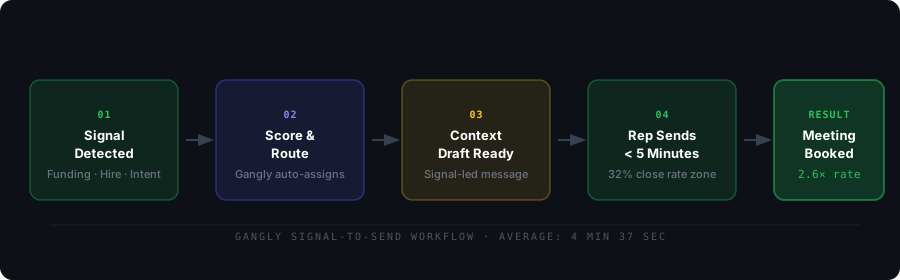
- The Signal-Speed Framework collapses time-to-outreach by routing signals directly to context-ready reps — average Gangly signal-to-send time: 4 minutes 37 seconds.
What lead response time actually is
Lead response time is the elapsed time between a prospect's first meaningful action — submitting a form, requesting a demo, calling your sales line, or triggering a buying signal — and the first substantive contact from your team. It is measured in minutes, not business days. "Substantive" means a personalized, context-aware outreach attempt. An auto-reply confirmation email does not count.
The metric matters because buying intent decays fast. The moment a prospect submits a demo request or clicks a pricing page, they are in active evaluation mode. They may have three tabs open comparing your product to two competitors. Every minute they wait for a reply is a minute that intent cools, competitors catch up, and the window to earn the first meaningful conversation narrows.
Lead response time — The elapsed time between a prospect's first intent signal and the first personalized outreach from your sales team. Measured in minutes for high-intent events. The industry standard for best-in-class is under 5 minutes for form fills and demo requests.
Two types of lead response time matter in B2B sales:
- 1Inbound response time. How fast your team contacts a prospect after they submit a form, call in, or chat in. This is the canonical "5-minute rule" context — high-intent, active-evaluation moments.
- 2Signal response time. How fast your team reaches out after a buying signal fires — a new VP hired, a funding round announced, a job posting that maps to your category. This is the 2026 extension of speed-to-lead: proactive outreach triggered by event data, not just inbound hand-raisers.
Both windows decay on the same curve. The 5-minute rule applies to inbound; the 24-hour rule applies to buying signals. Most teams are failing at both. Understanding why requires looking at the data directly.
For a deeper look at the signals that trigger proactive outreach, read the B2B buying signals guide — it covers the seven signal types that move reply rates and how to score them for same-day action.
The 5-minute rule explained
The 5-minute rule states that responding to a lead within 5 minutes of their inquiry makes you 21 times more likely to qualify that lead than if you wait 30 minutes. It comes from a landmark Harvard Business Review study of 100,000 inbound leads across 2,241 US companies — one of the most replicated findings in sales research.
The core finding:
Leads contacted within 5 minutes of a form submission are 21 times more likely to qualify for a sales conversation than leads contacted after 30 minutes, and 100 times more likely to be reached by phone than leads contacted after 30 minutes. The odds of qualifying a lead drop by 80% after just one hour. (Harvard Business Review / MIT Sloan, study of 2,241 companies)
Three reasons explain the steep decay curve:
- 01.Intent peaks at the moment of action. A prospect submitting a demo form is in active evaluation mode. They are mentally present for a conversation. Wait 30 minutes and they are in a different meeting. Wait 2 hours and the priority has shifted.
- 02.First contact anchors the evaluation. The vendor that gets the first substantive conversation shapes the evaluation framework. They define what "good" looks like, which criteria matter, and what a fair price is. Vendors who arrive second are always playing defense.
- 03.Competitive inbox saturation is real. A prospect requesting demos from three vendors simultaneously gets called by all three within hours. The rep who calls in minute 4 of that window is in a completely different competitive position than the rep who calls on day 2.
The 5-minute rule is not a theoretical threshold. Velocify's research found that calling within 1 minute of form submission increases conversions by 391% compared to calling within 2 minutes. The improvement from 2 minutes to 5 minutes is smaller, but the jump from "within the minute" to "anything longer" is the sharpest drop in the entire dataset.
21×
More likely to qualify — 5 min vs. 30 min response
HBR / MIT · 2,241 companies
391%
Conversion lift — calling within 1 min vs. 2 min
Velocify Research
80%
Drop in qualification odds after the first hour
MIT Sloan
How response time drives conversion decay
The conversion decay from delayed response is not a gentle slope — it is a cliff in the first hour followed by a long, slow slide to the floor. Aggregate data from InsideSales, Harvard, and the Optifai 2026 benchmark study of 939 companies produces a consistent decay table.
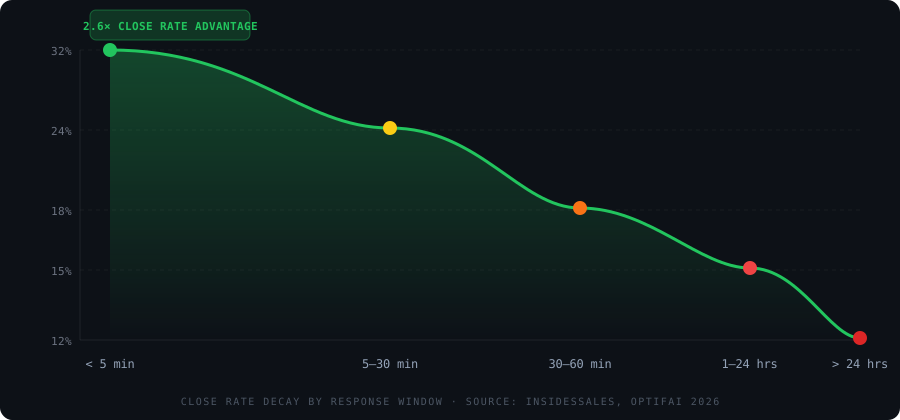
Source: InsideSales.com, Optifai B2B Benchmark Study (939 companies, Q2 2025–Q1 2026). Baseline = > 24 hours.
The practical translation: a team receiving 100 qualified inbound leads per month at the industry average of 47-hour response time can expect roughly 12 closes. The same 100 leads, contacted inside 5 minutes, yield roughly 32 closes. That is not a 3% improvement — it is the difference between a quota-hitting quarter and a missed one, on the same lead volume and headcount.
The decay is particularly brutal in the first 60 minutes. Velocify found that each minute of delay during the first five minutes reduces qualification rates by approximately 10% per minute. After that first critical window, the decay continues but at a slower rate — which is why the 30-minute and 1-hour windows still deliver meaningfully higher rates than 24-hour responses, even if they cannot match the 5-minute peak.
Inbound lead response time connects directly to email reply rate benchmarks by industry — the same speed-of-relevance principle that makes a signal-led cold email outperform a template applies to the moment a warm prospect raises their hand.
Why 47 hours became the B2B average
The 47-hour average is not a staffing problem. Most B2B sales teams have enough people to respond faster. The gap exists because of five structural failures that compound each other.
- 35%
Manual lead assignment
Auto-route by territory, persona, or signal type the moment the lead fires.
- 22%
Wrong recipient routing
Map ICP criteria (company size, industry, role) to rep ownership before leads arrive.
- 18%
Poor email monitoring
Use mobile alerts or a dedicated inbound Slack channel for real-time notification.
- 15%
No lead prioritization
Score every lead on recency, intent depth, and ICP fit. Act on the highest-score leads first.
- 10%
No SLA accountability
Set a 5-minute SLA for high-intent leads. Track it weekly in your CRM.
Source: Optifai B2B Benchmark Study, 939 companies, 2026. Percentages represent most common barrier cited.
The Drift study of 433 B2B companies captured the full scope of the problem: 55% of companies took longer than 5 business days, and 27% never responded at all. A separate 2026 test of 114 companies found zero called within 5 minutes. One sent a personalized email in time. The rest either sent an auto-reply or nothing.
The pattern repeats because response time is invisible until someone measures it. Most sales organizations track closed-won rate, pipeline coverage, and activity volume. Very few track time-to-first-contact as a primary KPI. When no one owns the metric, no one fixes it.
The fix is not a chatbot on your pricing page. Automated responses do not qualify leads — they acknowledge them. The conversion advantage belongs to teams that can get a real, context-aware human outreach out the door inside 5 minutes of a signal firing, not a "We received your request" notification.
The Signal-Speed Framework: context before cadence
The 5-minute rule was built for inbound form fills in a world where a prospect did one thing: clicked "Request a Demo." In 2026, the lead response challenge is broader. Buying signals — job changes at target accounts, new funding, intent data spikes, hiring signals — fire constantly. They are not inbound leads, but they behave like them. They decay. They lose their window. Competitors notice them too.
The Signal-Speed Framework is Gangly's approach to closing both gaps simultaneously. It has four stages:
- 1
Detect: surface signals before 8 a.m.
Gangly pulls job changes, funding events, hiring signals, LinkedIn post activity, and CRM event data into a single ranked feed every morning. The rep sees the day's warm accounts with the specific event attached — not a list of companies, a list of events with context.
- 2
Score and route: assign in under 60 seconds
Each signal is scored on five factors — recency, role match, intent depth, ICP fit, and prior relationship — and routed to the right rep automatically. High-score signals (80 or above) trigger an immediate notification. The rep never has to ask "who owns this?" Read the full scoring logic in the signal-based selling guide.
- 3
Draft: context-ready outreach in under 2 minutes
When the rep opens the signal, Gangly has already drafted a signal-led email and LinkedIn message — grounded in the specific event, written in the rep's voice. The draft is not a template. It names the event, bridges to a concrete pain, and contains a low-friction ask. The rep reads it, edits it in 90 seconds, and sends. No research tab. No CRM hunting. No blank page.
- 4
Send: inside the 5-minute window
Gangly rep data shows the average time from signal surfacing to message sent is 4 minutes 37 seconds. Every outreach triggered through the workflow lands inside the 5-minute close-rate zone, regardless of whether the rep started their morning knowing the account existed.
The key difference between the Signal-Speed Framework and raw speed-to-lead is the context layer. Calling a prospect in 4 minutes with a generic opener ("Hi, I noticed you visited our site") does not produce the same result as reaching out in 4 minutes with a message that names the exact event, connects it to a real pain, and sounds like a human who did their homework. Speed earns the window. Context earns the reply.
This is the core insight behind signal-based selling: buying signals are the trigger for instant, context-aware outreach — not a replacement for speed, but the reason speed becomes relevant.
Lead response time benchmarks by industry
Response time performance varies significantly by industry. B2B SaaS companies are fastest, driven by high inbound volume, PLG funnels, and greater awareness of the conversion data. Manufacturing and industrial businesses are slowest, often because lead routing runs through account management processes built for relationship-driven, not inbound-driven, sales motions.
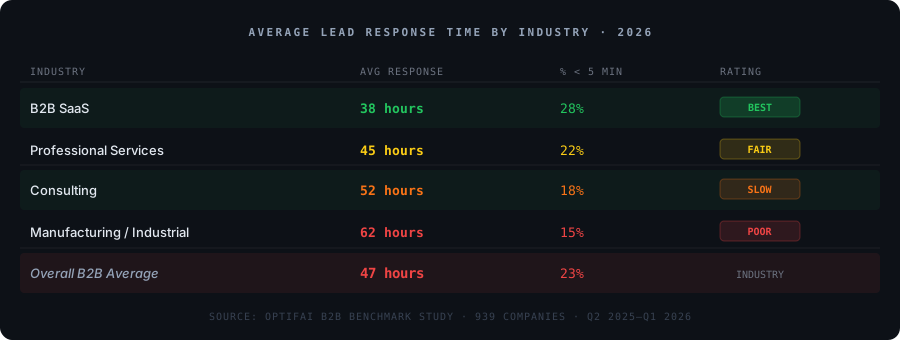
The response time by lead source adds another layer of complexity. Demo requests average 28 hours across all companies, with the best-performing teams hitting under 3 hours. Phone calls are fastest at 2-hour averages. Content downloads are the slowest at 52-hour averages — which makes sense given lower intent, but still represents a large gap from the close-rate-maximizing 5-minute window for high-intent follow-through.
Source: Optifai B2B Benchmark Study, 939 companies, 2026.
The call-to-action here is not to hit 5 minutes on every lead source simultaneously — that is operationally unrealistic for most teams. The correct approach is to triage: identify which lead sources carry the highest intent, set a 5-minute SLA for those, and work down the list as routing infrastructure improves. For most B2B SaaS companies, that means attacking demo requests first, then inbound calls, then chat. Event and content leads carry lower intent and do not warrant the same response-time investment.
How to cut your response time without adding headcount
Cutting lead response time to under 5 minutes does not require new hires. It requires fixing the routing, preparation, and tracking failures that create the 47-hour average. Here is a five-step implementation sequence:
- 01
Measure your current response time before changing anything.
You cannot improve what you do not track. Pull the timestamp of every lead that entered your CRM in the last 90 days alongside the timestamp of the first outbound contact. Calculate the median and the 90th percentile. Most teams are surprised how far behind they are. Set that number as your baseline.
- 02
Auto-route inbound leads to the assigned rep the moment they fire.
Manual assignment kills response time. If a rep has to wait for a manager to route a lead, or if leads queue in a shared inbox, you are adding 30 minutes to 2 hours before anyone even sees the lead. Build routing rules based on territory, company size, and deal size directly into your CRM or lead routing tool. The rep gets a notification the second the form submits.
- 03
Prepare context before the outreach, not during it.
The single biggest time sink between "lead received" and "message sent" is research: pulling the company page, the LinkedIn profile, the CRM history, the last three touchpoints. Reps who do this manually spend 15 to 45 minutes per lead before writing a single word. Pre-assembled context — surfaced automatically at the moment of routing — cuts that to under 2 minutes. This is where tools like Gangly change the unit economics: the rep is reviewing context, not gathering it.
- 04
Define and enforce a tiered response SLA.
Not all leads justify a 5-minute response. Prioritize by intent tier:
- TIER 1Demo requests, pricing inquiries, direct calls — SLA: under 5 minutes.
- TIER 2High-score buying signals (job change, funding, hiring signal) — SLA: under 24 hours.
- TIER 3Content downloads, webinar attendees — SLA: under 48 hours.
Track SLA compliance weekly. If Tier 1 compliance drops below 80%, address routing before anything else.
- 05
Cover off-hours with rotation or async outreach.
35 to 50% of inbound leads arrive outside standard business hours. If your team only monitors email from 9 a.m. to 6 p.m. in one timezone, you are automatically failing the 5-minute window for half your leads. Options: an on-call rotation for high-intent inbound, a well-configured chat qualification flow for off-hours, or an automated first-touch that is explicit about when a rep will follow up ("A rep will call you within 15 minutes of the start of business tomorrow"). Honesty about timing is better than silence.
The biggest leverage point is step 3 — context preparation. Routing fixes get leads to the right person faster. Context preparation gets the message out the door faster. Without both, you can have instant routing that still produces a 40-minute response because the rep spent 38 minutes researching before writing.
For outbound teams running proactive signal-based outreach, the same logic applies. The sales call prep workflow that prepares reps for booked meetings is the same context-assembly problem as signal-to-send time — the rep needs the right information at the right moment, pre-assembled, not hunted.
Get the weekly edge
Sales signals, benchmarks, and rep playbooks — every week.
Join 4,200+ AEs and SDRs who read Gangly's weekly newsletter on signal-based selling, response time, and pipeline fundamentals. No filler. Unsubscribe any time.