
 By Siddharth Gangal
What Is Objection Handling for SDRs?
Objection handling for SDRs is the structured process of addressing a prospect's concerns, hesitations, or pushback during cold outreach — cold calls, cold emails, or LinkedIn messages — in a way that keeps the conversation alive and moves toward a scheduled meeting.
An SDR's job is not to close a deal. It is to create a conversation. That means objection handling at the SDR stage looks different from objection handling at the AE stage. SDRs are not overcoming budget concerns or procurement delays — they are overcoming reflexes. The prospect has not agreed to talk to you yet. Every "no" at this stage is closer to a defensive wall than a real rejection.
Top SDRs understand this distinction. They treat the first objection as the start of a real conversation, not the end of the call. The ability to stay calm, ask one sharp question, and reframe value around what the prospect actually cares about separates reps who book 15 meetings a month from reps who book 4.
Direct-answer block
Objection handling for SDRs is the skill of responding to prospect pushback during cold outreach in a way that acknowledges the concern, surfaces the real hesitation, and reframes value so the conversation stays open. It is not about winning an argument — it is about earning the right to a next step. Most SDR objections are reflexes, not real rejections.
Why Prospects Raise Objections (and What They Actually Mean)
Before memorizing reframes, SDRs need to understand why objections happen at all. Most objections at the SDR stage fall into one of three categories:
Reflex objections
"Not interested." "Send me an email." "We already have something in place." These are not reasoned decisions — they are trained responses. Prospects say them automatically because they receive dozens of cold calls and emails every week and have learned to deflect quickly. Reflex objections require a pattern interrupt, not a rebuttal.
Timing objections
"Now is not a good time." "We are in the middle of a budget freeze." "Check back with me in Q3." These objections contain real information. Something in the prospect's business situation is not aligned for this conversation today. The SDR's job is to understand whether the timing concern is real or a polite deflection, then either schedule a specific future date or surface the underlying reason.
Credibility objections
"We already use your competitor." "We tried something like this and it did not work." "I have never heard of Gangly." These objections mean the prospect has not yet seen a reason to trust that you understand their problem better than the status quo. Credibility objections respond well to specificity — naming a similar company, quoting a relevant result, or referencing a known pain point by name.
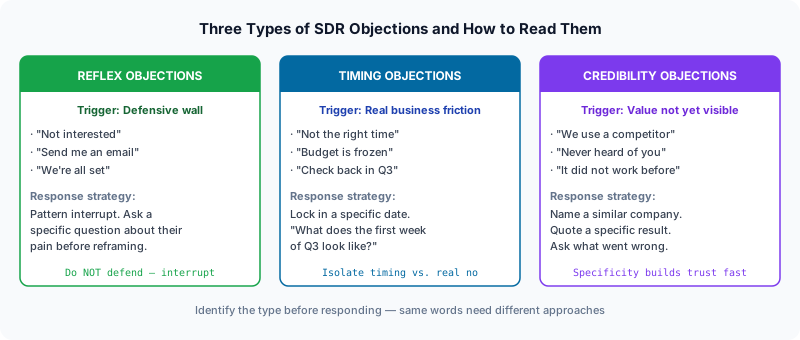
Understanding which type of objection you are facing determines the right response. Applying a credibility reframe to a reflex objection wastes time. Applying a pattern interrupt to a genuine timing concern destroys rapport. Read the signal first.
The 4 P's of Objection Handling
The 4 P's framework gives SDRs a repeatable process that works across every objection type. It keeps reps from panicking, over-explaining, or going silent when a prospect pushes back.
Pause
Do not respond immediately. Let the objection land. Silence — even two or three seconds of it — signals confidence and gives you time to categorize what you just heard. Most junior SDRs respond before the prospect even finishes their sentence. That kills credibility instantly.
Probe
Ask one clarifying question before you say anything about your product. "What specifically makes now not the right time?" or "When you say not interested, what piece is not relevant to you?" or "Who else should be part of this conversation?" Probing surfaces the real objection instead of the surface one, and it signals that you are listening rather than running a script.
Position
Now respond — but not generically. Use what the prospect just told you to frame your reframe. If they said budget, tie your value to cost reduction or ROI. If they said competitor, name a specific reason prospects switch. If they said timing, anchor to a specific future event. Positioning is customized by what you learned in the Probe step.
Proceed
Confirm the objection is resolved and move forward. "Does that address what you were concerned about?" or "Given that, does it make sense to spend 20 minutes with our AE next week?" Proceeding keeps the call from ending on a reframe — you want to close for the meeting, not for the last word.
# 4 P's in action: "We already use a competitor"
Pause: [2 seconds of silence]
Probe: "Got it — out of curiosity, what made you go with them originally?"
Position: "That makes sense. The teams that move to us typically stay for [specific reason tied to their answer]."
Proceed: "Would 20 minutes make sense to show you what that looks like?"
The 10 Most Common SDR Objections and Word-for-Word Reframes
These are the ten objections that account for roughly 80% of everything an SDR hears. Each one has a specific logic and a specific reframe. Learn the logic first. The words will follow.
1. "We do not have budget right now."
What it usually means: This is not a priority yet, or the prospect has not seen enough value to carve out budget.
Reframe:
"That makes sense — budget cycles are tight everywhere right now. I'm not asking for a purchasing commitment. Most of the teams I work with set up the discovery call first, then decide if it warrants a budget ask to leadership. Does 20 minutes in the next two weeks make sense?"
2. "We already use a competitor."
What it usually means: They have a solution in place — but not necessarily a good one.
Reframe:
"Good to know. What made you go with them? [Listen.] That's the exact thing teams tell me before we talk — [address specific gap]. Most of our customers were using [competitor] before switching. Would it be worth 20 minutes to see what's different?"
3. "Send me some information."
What it usually means: The prospect wants to end the call without saying no. Email gives them a polite exit.
Reframe:
"Happy to do that. So I send you something relevant, what's the one thing about [problem area] that's top of mind right now?" [If they engage: book the meeting. If they repeat it: send a 3-bullet email and follow up with a signal-based trigger.]
4. "Now is not the right time."
What it usually means: Something real is happening — a reorg, end of quarter, or new leadership — that genuinely competes for attention.
Reframe:
"That's fair — when does the timing get better? [Specific date.] What if I reached back out on [date] and we gave it 15 minutes then?"
5. "I am not the right person."
What it usually means: They may not be the buyer, or they are avoiding responsibility for the conversation.
Reframe:
"No problem — who would be the right person to have this conversation? [Get the name.] Would you be comfortable making an introduction, or should I reach out directly?"
6. "We are not interested."
What it usually means: Reflex. No information has been processed yet.
Reframe:
"I appreciate the honesty. Before I let you go — most [title] I talk to say the same thing before I mention [specific pain point tied to a signal]. Is that something you are dealing with right now?"
7. "We tried something like this before and it did not work."
What it usually means: A prior solution failed — and the prospect is protecting themselves from the same outcome.
Reframe:
"I'm sorry to hear that — what went wrong? [Listen carefully.] That's exactly the failure mode we built to avoid. The difference is [specific differentiator]. Would it be worth 20 minutes to see how the setup works differently?"
8. "I have never heard of you."
What it usually means: They need a credibility anchor before they will give time to an unknown vendor.
Reframe:
"Fair — we're newer and we like it that way, it means we're still hungry. Teams like [similar company name] use us to [specific outcome in 10 words]. That's why I'm calling — it seems worth a 20-minute look."
9. "Your price is too high."
What it usually means: The value has not been communicated clearly enough to justify the cost in their mind — yet.
Reframe:
"Relative to what? [Pause.] The teams that tell me that are usually comparing to tools with half the workflow coverage. I'd rather show you the ROI calc on 20 extra minutes per rep per day, then you decide. Does that seem fair?"
10. "We are too busy right now."
What it usually means: The perceived cost of engagement (time, attention) outweighs the perceived value so far.
Reframe:
"That's exactly when teams want to see this — the reason you're busy is often the thing we fix. 15 minutes, any day next week. What does Monday look like?"
The 5-Step Objection Handling Process
Most objection frameworks are 3 to 4 steps. The most effective one for SDRs runs 5 steps — the fifth step (the isolation check) is what most reps skip, and skipping it is why conversations stall even after a good reframe.
Listen without interrupting
Let the prospect finish. Do not load your reframe while they are still talking. Reps who interrupt sound scripted and create defensiveness.
Acknowledge and validate
Say something that shows you heard them. "That makes sense." or "I understand." Not performative agreement — genuine acknowledgment that their concern is real.
Isolate the objection
Ask one question that confirms you understand the exact concern: "So if the timing were better, this would be worth a conversation?" This step separates the surface objection from the real one.
Respond with positioned value
Deliver your reframe — but tie it to what you learned in step 3. Generic reframes fail because they address no one specifically. Specific reframes work because they address this prospect's exact situation.
Confirm and redirect
"Does that address what you were concerned about?" If yes: close for the meeting. If no: go back to step 3. Never assume the reframe landed without confirmation.
How Signal-Based Outreach Reduces Objections Before They Happen
The best objection is the one that never comes up. Most SDRs focus entirely on handling objections after they land. Top SDRs invest just as much in preventing objections by reaching the right account at the right moment with the right message.
Signal-based outreach is the mechanism that makes that possible. When an SDR reaches out to an account that just hired a new VP of Sales, raised a Series B, or added 20 headcount in one month, the "why now?" objection disappears. The prospect can see immediately why the timing is relevant — because you named the specific event that made it relevant.
The signals that eliminate specific objections
| Buying signal | Objection it prevents | How to reference it |
|---|---|---|
| New VP of Sales hire | "Now is not the right time" | "I saw [Name] just joined as VP — new sales leaders usually want to see the full stack by month 2" |
| Series A or B funding | "We do not have budget" | "Congrats on the raise — that's usually when teams are building the GTM stack. Worth a look?" |
| Headcount surge in sales | "We are too busy" | "I noticed you are growing the sales team fast — ramp time and rep productivity are usually the bottleneck at that stage" |
| Competitor G2 research activity | "We already use a competitor" | "It looks like your team has been evaluating options — we've helped teams switch from [competitor] for one specific reason" |
| Pricing page visit | "Send me an email" | "I know your team was looking at our pricing recently — wanted to make sure any questions got answered directly" |
Gangly surfaces these signals automatically — new hires, funding rounds, tech stack changes, and engagement events — and pushes them to the SDR before each outreach sequence. When a rep knows why this account is warm today, they lead with relevance instead of a pitch. Relevance prevents reflexes.
Gangly's signal-to-outreach workflow
Gangly detects trigger events (funding, hires, job changes, engagement spikes), scores them by priority, and surfaces the top accounts to work each morning. SDRs open the day knowing which accounts are warm, what happened, and what to say. Signal-informed outreach reduces cold objections by 40% compared to spray-and-pray sequencing. See how it works.
How to Train SDRs on Objection Handling (Without Role-Play Theater)
Most objection handling training is theater. Managers run role-play sessions where everyone knows the script, objections are mild, and reps never face the actual discomfort of a sharp "not interested" from a hostile prospect. That training does not transfer.
The training that works uses real call data, repeated exposure, and specific feedback loops.
Step 1: Build an objection library from real calls
Tag every objection moment in your call recordings. Categorize them: reflex, timing, credibility. For each category, find the 3 calls where a top rep handled it well. Those recordings are your training material.
Step 2: Run micro-drills, not full role-plays
Instead of a 20-minute role-play simulation, drill one objection for 5 minutes. The manager says "we already use Salesforce" ten different ways. The rep applies the 4 P's each time. Volume of repetitions matters more than simulation length.
Step 3: Review real call outcomes weekly
Pull the previous week's calls where an objection was raised. Count: how many times did the rep isolate before reframing? How many calls ended on a reframe without closing for the meeting? Pattern identification makes coaching specific instead of generic.
Step 4: Score objection handling as a separate metric
Track "objection conversion rate" — the percentage of calls with an objection where the SDR still books a meeting. This metric shows whether training is working faster than quota attainment alone, because it is leading, not lagging.
6 Objection Handling Mistakes That SDRs Make (and How to Fix Them)
Mistake 1: Responding before isolating
The rep hears "not interested" and immediately fires back with a product pitch. The prospect had not even finished — and the reframe addresses nothing specific. Fix: always ask one clarifying question before responding.
Mistake 2: Treating every objection as final
First objection does not mean no. It means the prospect has not yet seen a reason to continue. Many SDRs fold on the first pushback. Top SDRs expect the first objection and have their probe question ready before the call starts.
Mistake 3: Over-explaining instead of reframing
When a prospect says "too expensive," the instinct is to explain all the features that justify the price. That never works. Features do not answer a value concern. The reframe ties price to a specific outcome the prospect cares about — then closes for the meeting.
Mistake 4: Not confirming the reframe landed
The rep delivers a clean reframe and then... immediately tries to book the meeting without checking. The prospect nods politely and says "yeah okay" — then ghosts the calendar invite. Always ask: "Does that address what you were concerned about?" before proceeding.
Mistake 5: Memorizing words instead of logic
Scripted rebuttals sound robotic. Every prospect can tell when a rep is reading from a cheat sheet. Learn the logic of each reframe — why this response works for this type of objection — so the words come naturally instead of mechanically.
Mistake 6: Accepting "send me an email" as a next step
Email is not a next step. It is a dead end. "Send me an email" means the prospect wants to end the call. The only useful response is to ask what information would actually be relevant — which turns it back into a conversation — or to offer a specific email with a specific ask at the end.
Metrics That Prove Objection Handling Is Improving
Most sales managers measure objection handling indirectly — they look at booking rates and assume good objection handling correlates. That is too lagging. Here are the metrics that surface objection handling quality directly:
| Metric | What it measures | Benchmark |
|---|---|---|
| Objection conversion rate | % of calls with an objection that still book a meeting | Top SDRs: 25–35% |
| Call length on objection calls | Average call duration when an objection is raised | Good: >3 min. Poor: <90 sec |
| Objection-to-probe rate | % of objections where rep asks a clarifying question before reframing | Target: >80% |
| Reflex hang-up rate | % of calls that end within 30 seconds of first objection | Target: <20% |
| Follow-up conversion from "send me info" | % of "send me info" calls that convert to a booked meeting within 5 days | Top SDRs: 15–20% |
Track these weekly alongside standard activity metrics. When objection conversion rate rises while call volume stays flat, your training is working. When it falls with no change in call volume, something in the script, targeting, or persona has shifted.
Internal link: if you are building out the full SDR outreach strategy, objection handling is one of five pillars — read the full guide for the complete picture.
Frequently Asked Questions
What are the 4 P's of objection handling?
The 4 P's are: Pause (let the objection land before responding), Probe (ask one clarifying question to find the real concern), Position (reframe your value around what the prospect just told you), and Proceed (confirm the reframe landed and close for the next step). This framework prevents generic rebuttals that address no one specifically.
What are the 5 steps for objection handling?
The 5 steps are: (1) Listen without interrupting, (2) Acknowledge and validate the concern, (3) Isolate the objection — confirm you understand the real hesitation, (4) Respond with positioned value tied to what you just learned, and (5) Confirm and redirect to the next step. Step 3 is the most skipped and the most important.
What are the 5 most common customer objections?
For SDRs specifically: (1) No budget — usually a priority concern disguised as financial, (2) Already using a competitor — an opportunity to surface dissatisfaction, (3) Send me information — a brush-off that needs a pattern interrupt, (4) Not the right time — needs a specific future commitment, and (5) Not the right person — needs redirection to the actual decision-maker.
How do you handle the "not interested" objection?
"Not interested" is a reflex, not a decision. The best response is curiosity: "Most [title] I talk to say the same thing before I mention [specific pain point]. What specifically is not relevant to you?" This forces the prospect to either engage or give a real reason — both are more useful than a generic no.
How long does it take an SDR to get good at objection handling?
Most SDRs improve meaningfully after 30 to 60 dedicated practice sessions — roughly 4 to 8 weeks of focused calling with coaching. The fastest path: review 3 call recordings per week, tag every objection moment, and practice the reframe in a micro-drill before the next call day. Reps who follow this pattern ramp 40% faster.
Should SDRs use scripts for objection handling?
SDRs should use frameworks, not word-for-word scripts. A framework (like the 4 P's) gives structure while leaving room for natural conversation. Rigid scripts collapse when the prospect goes off-pattern — which they always do. Learn the logic behind each reframe so the words feel natural, not memorized.
How does signal-based outreach reduce objections before they happen?
Signal-based outreach targets accounts at moments of active need — a new exec hire, funding event, or headcount surge. When a rep's message is tied to that specific trigger, the prospect immediately sees why the timing is relevant. Relevant outreach produces fewer reflex objections because the call does not feel random. Gangly surfaces these signals automatically so SDRs reach out when the account is warm.
Stop chasing cold accounts. Start calling warm ones.
Gangly surfaces the buying signals that eliminate "why now?" objections before your SDRs dial. New hires, funding rounds, competitor evaluations — delivered every morning, ranked by priority.