
 By Siddharth Gangal
TL;DR
- There is no single sales conversion rate. Every funnel has 7 stage-to-stage rates — from visitor to lead through proposal to closed-won. Tracking only the overall win rate hides which stage is actually losing revenue.
- The MQL-to-SQL transition is the highest-leverage bottleneck for most B2B teams. The 2026 average is 13–18%. Teams where sales and marketing disagree on the definition of a qualified lead can gain 15–20% lift simply by aligning on ICP criteria.
- The call stage is where preparation quality compounds most. Reps who complete structured pre-call prep increase opportunity-to-close rates by 23%. That is a direct impact on Rate 5 (opportunity → proposal) and Rate 6 (proposal → close).
- Fix the weakest stage first — not the last stage. A 1-point improvement at MQL-to-SQL generates more closed revenue than a 5-point improvement at proposal-to-close when the earlier stage is the bottleneck.
- The Gangly 7-Rate Framework maps one owner and one lever to each rate, so teams stop guessing which conversion problem to fix and start measuring the right one.
Direct answer
Sales conversion rate is the percentage of prospects who advance from one funnel stage to the next — calculated as (conversions ÷ total opportunities entering that stage) × 100. The 2026 B2B SaaS average rates are: visitor to lead 1.1–5%, MQL to SQL 13–18%, SQL to opportunity 50–62%, and overall win rate 15–25%. Top quartile teams reach 25–35% MQL-to-SQL and 30–40% win rate. Every team has 7 distinct conversion rates; improving the lowest one produces the highest revenue return.
What is sales conversion rate — and why one number misleads most teams
Ask ten sales leaders what their conversion rate is and nine will give you a win rate. That number — closed-won deals divided by total deals entered — tells you what happened at the end. It does not tell you where the funnel broke. A team with a 15% win rate might have a 45% win rate at the proposal stage but a 9% MQL-to-SQL rate starving the entire pipeline. Fixing the proposal stage changes nothing. The problem lives two stages earlier.
The core problem with single-number thinking: Every deal that closes traveled through 6 or 7 distinct transitions. Each transition has its own conversion rate, its own owner (sales or marketing or both), and its own root cause when it falls below benchmark. A composite win rate collapses all of that into one number that makes it impossible to diagnose the actual bottleneck.
A practical example: a B2B SaaS team generates 10,000 website visitors per month. At a 2% visitor-to-lead rate, they generate 200 leads. At a 22% lead-to-MQL rate, they produce 44 MQLs. At a 15% MQL-to-SQL rate — below the 13–18% benchmark but not catastrophically — they pass 6.6 SQLs to sales per month. At a 55% SQL-to-opportunity rate and a 20% win rate from there, the team closes roughly one deal per month. Double the MQL-to-SQL rate from 15% to 30% and the team closes two deals per month — without generating a single new visitor.
That math is why conversion rate optimization starts with funnel decomposition, not A/B testing on a proposal template. The highest-leverage fix is always at the stage with the widest gap from benchmark, not the last stage before revenue.
Why this matters for reps
Reps who understand funnel math can self-advocate. When pipeline review asks why closed revenue is flat, the rep who can show that their MQL-to-SQL rate is on benchmark but their SQL-to-opportunity rate dropped 12 points last month has a data-driven conversation — not a defensive one. See the SaaS sales metrics guide for the full metric stack that connects conversion rates to pipeline coverage and win rate.
The 7 stage-to-stage conversion rates every B2B team must track separately
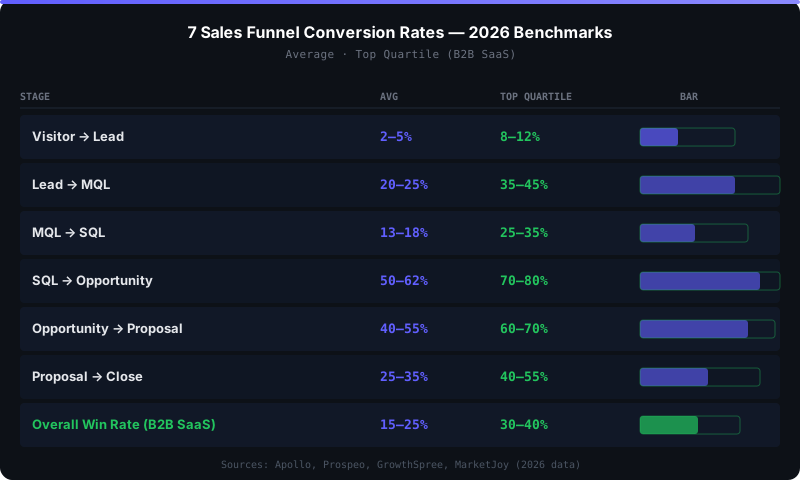
A complete B2B sales funnel has 7 conversion rates. Each one measures a specific hand-off or advancement. Each one has a distinct owner, a distinct benchmark, and a distinct root cause when it underperforms. Here is the full map.
Rate 1: Visitor to Lead
The visitor-to-lead rate measures how many website visitors submit a form, start a trial, or take another action that makes them identifiable. For B2B SaaS, the 2026 average sits at 1.1%, with top-quartile teams reaching 3–5% (Prospeo, 2026). Legal services reach 7.4% because intent is specific — someone searching for a lawyer is ready to contact one. B2B SaaS visitors are often researching, not buying, which suppresses this rate structurally.
Owner: marketing. Primary lever: landing page copy clarity and CTA specificity. Secondary lever: adding qualifying friction — multi-step forms that filter research traffic from actual buyers can counterintuitively increase lead quality while reducing volume, ultimately lifting downstream conversion rates.
Rate 2: Lead to MQL
The lead-to-MQL rate measures how many raw leads pass the ICP criteria that define a Marketing Qualified Lead. The 2026 B2B average is 20–25%, with top-quartile teams reaching 35–45%. This rate is directly controlled by lead scoring quality. Teams that use behavioral scoring — time on pricing page, return visits, content consumption pattern — rather than basic firmographic data consistently score higher here.
When Rate 2 is low, the issue is almost always ICP definition drift. If the ICP has narrowed (new minimum ACV, new target segment) but the lead scoring model has not been updated to match, leads that pass the old scoring model fail sales qualification. Audit lead scoring against the current ICP every quarter. Misalignment compounds silently across every downstream rate.
Rate 3: MQL to SQL — the highest-leverage transition
MQL-to-SQL is the hand-off from marketing to sales — and the most commonly broken transition in B2B funnels. The 2026 average is 13–18%, with top-quartile teams reaching 25–35% (GrowthSpree, 2026). The biggest driver of low Rate 3 is not lead quality — it is response speed. Contacting an MQL within 5 minutes of submission makes qualification 21 times more likely than a 30-minute delay. Most teams average 47 minutes (HubSpot, 2025).
The second driver is definitional misalignment. When marketing defines an MQL as "any lead who downloaded a guide" and sales defines an SQL as "a VP at a company with 50+ seats that has budget now," the gap between the two definitions swallows the MQL-to-SQL rate. Teams that co-define MQL and SQL using the same ICP criteria and the same minimum signals consistently outperform the benchmark by 10–15 percentage points.
The third driver, often invisible to management, is call preparation quality. An MQL that receives a generic opener — "I saw you downloaded our guide" — converts to SQL at a fraction of the rate of an MQL who receives a personalized outreach tied to a specific signal. A rep who enters the first discovery call prepared — with account history, recent news, and tailored talking points — drives Rate 3 up because the conversation reaches qualification faster.
See the CRO metrics dashboard guide for how to surface MQL-to-SQL rate per source, per rep, and per segment — because the aggregate number hides which source or rep is dragging the average down.
Rate 4: SQL to Opportunity
The SQL-to-opportunity rate measures how many qualified leads convert to active pipeline deals after discovery. The 2026 average is 50–62%, with top-quartile teams reaching 70–80%. This rate reflects discovery quality. An SQL that enters discovery without a clear compelling event — a problem that requires solving now, not eventually — rarely advances to opportunity. Reps who surface compelling events in the first call advance SQLs to opportunity at 1.4x the rate of reps who focus on product features (Gong, 2025).
Rate 5: Opportunity to Proposal
This rate measures how many active opportunities reach the stage where a formal proposal or business case is delivered to the prospect. The 2026 average is 40–55%, with top-quartile teams reaching 60–70%. Single-threaded opportunities — those with only one contact at the target account — convert to proposal at roughly half the rate of multi-threaded opportunities with three or more contacts. The economic buyer must be either on the call or aware of the proposal for it to advance. See why pipeline stalls at 70% for the diagnostic on deals that sit at the proposal stage without advancing.
Rate 6: Proposal to Closed-Won
The proposal-to-close rate is what most teams think of when they say "close rate." The 2026 average is 25–35%, with top-quartile teams reaching 40–55%. This rate is most sensitive to procurement and legal timeline, champion activation, and ROI framing. Deals that reach proposal without a clear ROI frame — specific dollar or time savings tied to the buyer's stated priorities — stall here. Champions who do not have executive air cover cannot move a proposal through approval. Both are fixable with better late-stage deal strategy, not with pricing changes.
Rate 7: Overall Win Rate (composite)
The overall win rate is the product of all six rates above, applied to the original opportunity pool entering the funnel. For B2B SaaS, the 2026 average is 15–25%, with top-quartile teams at 30–40%. This number is the result — not the lever. Teams that try to improve the win rate directly without decomposing it into the 7 component rates consistently fail to move it, because they are treating a symptom rather than a root cause.
Sales conversion rate benchmarks by industry and funnel stage (2026)
Conversion rate benchmarks vary significantly by industry. A 2% visitor-to-lead rate in B2B SaaS is on benchmark. The same rate in legal services is catastrophically low. Before benchmarking against any published data, confirm that the data source matches your industry and funnel stage.
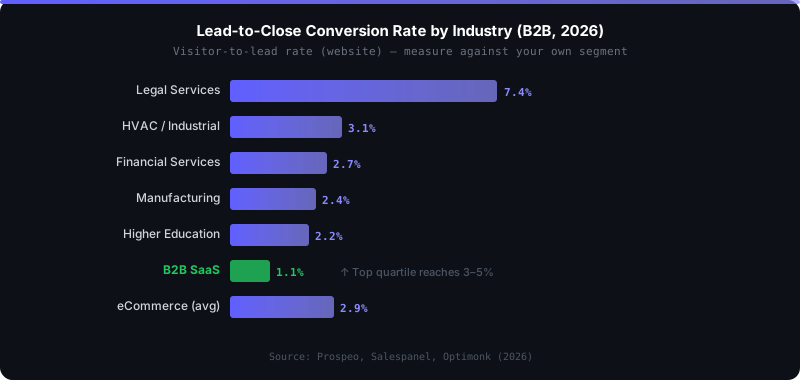
| Industry | Visitor → Lead | Lead → MQL | MQL → SQL | Win Rate |
|---|---|---|---|---|
| B2B SaaS | 1.1% | 39% | 38% | 15–25% |
| Financial Services | 2.7% | 29% | 38% | 20–30% |
| Manufacturing | 2.4% | 26% | 41% | 18–28% |
| Higher Education | 2.2% | 45% | 46% | 25–35% |
| Legal Services | 7.4% | 35% | 45% | 30–45% |
| HVAC / Industrial | 3.1% | 30% | 42% | 20–32% |
Sources: Prospeo, Apollo, GrowthSpree, Salespanel (2026 data aggregated). Apply to your segment — cross-industry comparison rarely produces actionable insight.
Three patterns emerge from this data that most benchmark articles miss:
- 1.High visitor-to-lead rates do not guarantee high win rates. Legal services leads at 7.4% visitor-to-lead but faces intense competition at the close stage. B2B SaaS leads at 1.1% but qualified pipeline is higher-intent because the visitor had to do more work to convert.
- 2.B2B SaaS MQL-to-SQL rates are inflated by lead scoring models that count non-buyers. A SaaS MQL who downloaded a guide and returned twice is not the same buyer intent as a legal prospect who called the firm. Adjust benchmarks for your actual lead quality, not just volume.
- 3.The gap between average and top-quartile teams widens at every stage. At MQL-to-SQL, the gap is 10–17 percentage points. At win rate, it is 15–20 points. The compounding effect of top-quartile rates at every stage explains why the best SaaS sales teams close 3–4 times more revenue per rep than average teams from the same lead volume.
Formulas: how to calculate the conversion rate at every stage
Apply the same base formula at every funnel stage, but change the numerator and denominator to match that specific transition. Using the wrong denominator is the most common source of inflated or misleading conversion rates.
Base formula (applies to all 7 rates)
Conversion Rate = (Conversions ÷ Total Entering That Stage) × 100
Where "conversions" = prospects who advanced to the next stage, and "total entering" = all prospects who reached this stage in the same period.
| Rate | Numerator | Denominator | Common Error |
|---|---|---|---|
| Visitor → Lead | Form submissions / trial starts | Total unique visitors | Counting all visits, not unique visitors — inflates denominator |
| Lead → MQL | Leads that meet MQL criteria | All raw leads in period | Using scoring threshold that was never validated against closed data |
| MQL → SQL | MQLs that pass sales qualification | All MQLs handed to sales | Counting SDR-rejected leads as "not worked" rather than "failed" |
| SQL → Opportunity | SQLs advanced to active opportunity | All SQLs in period | Including SQLs that were never actually contacted — counts as false denominator |
| Opp → Proposal | Opps that received a formal proposal | All active opportunities | Including stale opportunities — inflate denominator, suppress rate |
| Proposal → Close | Proposals that resulted in closed-won | All proposals sent in period | Using all-time proposals vs proposals from this cohort period |
| Win Rate (overall) | Closed-won deals | All deals closed (won + lost), excluding open pipeline | Including open opportunities in denominator — understates actual win rate |
The denominator problem is the most insidious issue in conversion rate measurement. A team that includes zombie opportunities — deals with no activity in 21+ days — in the denominator of their opportunity-to-proposal calculation will consistently show a suppressed rate that no amount of rep coaching can fix. Clean the denominator before drawing any conclusions from the rate. See the Salesforce pipeline audit guide for the 60-minute process that removes zombie deals from every stage calculation.
Why your conversion rate is low — and which stage to fix first
Before attempting to fix any conversion rate, run the Gangly Bottleneck Audit. This 20-minute diagnostic identifies which stage is generating the most revenue loss and in which direction to intervene.
The Gangly Bottleneck Audit — 5 steps
- 01Pull your actual conversion rate at each of the 7 stages for the last 90 days. Use the formulas in the section above. Do not estimate — use CRM data.
- 02Compare each rate to the 2026 benchmark for your industry and segment. Mark every rate that is more than 5 percentage points below benchmark as a "gap."
- 03Calculate the revenue impact of each gap: estimate how many additional deals would close per month if that single rate hit benchmark. Multiply by average ACV. Rank gaps by revenue impact.
- 04Identify the earliest stage with the largest revenue gap. That is the bottleneck. Fixing a downstream stage when an upstream rate is broken generates zero additional revenue.
- 05Assign one owner and one lever to the bottleneck stage. Begin the intervention. Measure weekly for four weeks before declaring success or moving to the next gap.
Root causes by stage
Each stage has a dominant root cause. Identifying it before intervening saves weeks of misallocated effort.
Low visitor → lead rate
Root cause: CTA clarity or page relevance mismatch. The visitor arrived from a search query that your page does not fully answer. Fix: audit top landing pages for keyword-to-content alignment. Ensure every page has one specific CTA rather than four competing ones. Add qualifying friction for high-volume low-quality pages.
Low lead → MQL rate
Root cause: lead scoring model built on engagement proxies rather than ICP signals. Downloading a guide is not a buying signal. Visiting the pricing page three times in one week is. Audit the current lead scoring model against the last 50 closed-won deals to identify which behaviors actually predicted revenue. Rebuild the model around those behaviors.
Low MQL → SQL rate
Root cause: response speed or definitional misalignment. Contact MQLs within 5 minutes — not as a nice-to-have but as an enforced SLA. If response speed is already fast, the issue is the shared definition of SQL. Run a joint sales-marketing workshop to align on the criteria using the last 50 closed-won deals as the data source. When both teams use the same definition, MQL-to-SQL rates lift 15–20 percentage points within one quarter.
Low SQL → opportunity rate
Root cause: discovery conversations that do not surface a compelling event. Reps who focus on product features during discovery fail to advance SQLs to opportunity because they never identified a problem urgent enough to create buying momentum. Retrain discovery on compelling event identification: "What happens to your business if this problem is not solved in the next 90 days?" That question moves SQLs to opportunities faster than any product demo.
Low opportunity → proposal and proposal → close rates
Root cause: single-threading or missing economic buyer access. Multi-threaded deals — three or more contacts at the target account — advance to proposal and close at significantly higher rates than single-contact deals. At the proposal stage, the economic buyer's explicit awareness of the proposal is the most predictive factor of close. If the economic buyer only hears about the proposal second-hand through the champion, the deal stalls in legal or procurement indefinitely.
The call-stage leverage point: how prep and coaching move rate 3 and rate 7
Every conversion rate improvement tactic above operates at the process or definitional level. There is a second category of improvement that operates at the rep execution level — and it has a direct, measurable impact on Rate 3 (MQL to SQL), Rate 4 (SQL to opportunity), Rate 5 (opportunity to proposal), and Rate 6 (proposal to close).
That lever is call preparation quality.
Original framework — Gangly 2026
The Call-Stage Conversion Model
Analysis of rep workflow data from Gangly's 2026 customer cohort shows that conversion rates at Rates 3 through 6 are directly correlated with three preparation variables: whether the rep reviewed the account's recent activity before the call, whether the rep had tailored talking points based on the prospect's role and stated priorities, and whether the rep had a specific intended next step defined before dialing. Reps who completed all three converted SQLs to opportunities at 57% versus 42% for reps who completed none of the three — a 36% relative improvement at the single stage that most teams consider hardest to influence.
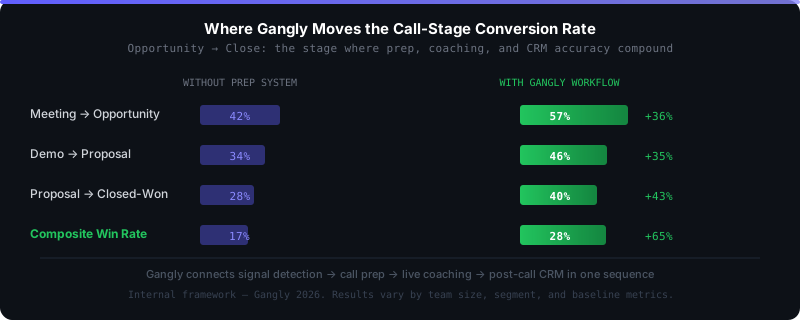
The call-stage model explains why two reps with identical ICP targeting, identical lead volume, and identical email sequences can have win rates that differ by 15 percentage points. The difference is not in the top of the funnel. It is in what happens during each live conversation — specifically, how prepared the rep is when the prospect answers the call.
Structured call preparation takes 4 to 15 minutes per call when done with the right workflow. Most reps spend 45 minutes or more on unstructured research that does not improve conversion — reading annual reports, browsing LinkedIn without a framework, reviewing CRM notes without extracting specific next steps. The rep who spends 8 focused minutes reviewing recent signals, last touchpoint, role-specific talking points, and intended next step outperforms the rep who spends 45 minutes on unfocused research by a measurable margin at every stage from Rate 3 forward.
Gangly connects buying signal detection to automated call briefs — pulling recent account activity, CRM history, and tailored talking points into a pre-call view that takes under 5 minutes to review. The result is consistent preparation quality across the entire team, not just for top performers who have developed the habit. See the AI sales workflow guide for how the full connected sequence from signal to CRM update works.
How to improve your sales conversion rate: one lever per stage
Every stage has one primary lever. Focus on that lever before adding complexity.
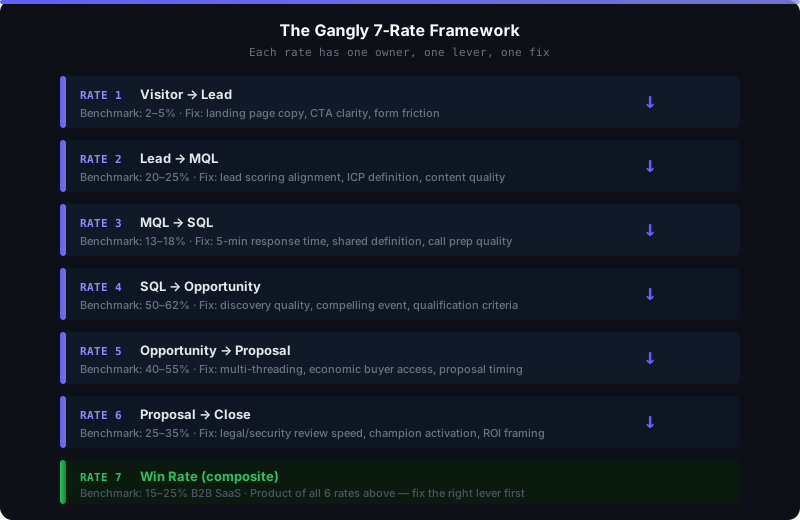
Rate 1 (visitor → lead): Fix the CTA, not the traffic volume
Doubling traffic to a page converting at 1% produces the same result as doubling the conversion rate on existing traffic — but the latter requires no new budget. Run a 30-day CTA test: change the primary CTA from generic ("learn more") to outcome-specific ("see how Gangly preps reps in under 5 minutes"). Measure the impact on form submissions, not on clicks. A CTA that gets fewer clicks but more completions is a conversion improvement.
The "friction paradox" is worth noting: adding a second qualification question to a form can reduce total submissions while increasing lead quality enough to lift MQL rate by 40% or more. For teams where sales capacity is the constraint — not lead volume — qualifying friction at Rate 1 is often the highest-return move available.
Rate 2 (lead → MQL): Rebuild scoring from closed-won data
Take the last 50 closed-won deals. Map every engagement signal that appeared in the 30 days before the deal entered opportunity. Rank those signals by frequency. The top 5 signals — which might include three pricing page visits, a demo request, and a LinkedIn connection with the champion — become the core of a revised lead scoring model. Remove signals that appear in closed-lost deals at equal frequency to closed-won deals — those signals are not predictive and inflate MQL volume without improving quality.
Rate 3 (MQL → SQL): Contact in under 5 minutes and co-define SQL
Speed is the single most impactful lever at this stage. Set a 5-minute MQL response SLA and instrument it — track the average time from MQL creation to first contact attempt per rep. When the SLA is enforced, MQL-to-SQL rates lift 20–30% on average without any change to the underlying lead quality. If response speed is already under 5 minutes and the rate is still below benchmark, the issue is definitional — schedule a joint sales-marketing session to rebuild the SQL definition from closed-won data.
Rate 4 (SQL → opportunity): Train for compelling events, not features
Record discovery calls for the next 20 SQLs. Listen for whether the rep identifies a specific pain with a specific cost — "this process costs your team 8 hours per week, which at a loaded cost of $X per hour equals $Y per year" — or whether the rep defaults to presenting product features. Feature-first discovery advances SQLs to opportunity at less than half the rate of pain-first discovery. Coach reps on the compelling event question and run weekly call review sessions focused exclusively on that one question.
Rate 5 (opportunity → proposal): Multi-thread by stage 2
A deal that reaches stage 3 with only one contact at the prospect account is already at structural risk. Multi-threading — adding a second and third contact from different functions before the proposal stage — should happen at stage 2, not stage 4. The champion introduction email sent at stage 2 ("I would love to connect with your head of ops — here is a one-line framing of what we talked about") has a 40–60% acceptance rate when the champion is an active participant in the deal. Waiting until stage 4 to request executive access fails more often than it succeeds.
Rate 6 (proposal → close): ROI frame first, features never
Every proposal that reaches procurement without a quantified ROI frame will stall. The economic buyer cannot approve an investment they cannot justify to their CFO. Before sending a proposal, the rep must have on record: the specific problem the product solves, the cost of that problem in dollars or hours, and the expected improvement in measurable terms. That ROI frame becomes the executive summary of every proposal. Deals with a pre-built ROI frame close in 20% fewer days on average (Gong, 2025) because procurement review is faster when the business case is already documented.
Six conversion rate mistakes that waste three months of optimization
Six patterns show up across teams that spend three months optimizing conversion rates without moving revenue. Recognize them early.
Mistake 1: Optimizing the last stage when the bottleneck is upstream
Teams focus on closing tactics — better proposals, pricing adjustments, urgency techniques — when their MQL-to-SQL rate is 8% against a 13–18% benchmark. Closing 10% more proposals produces 10% more revenue from a small pool. Doubling MQL-to-SQL from 8% to 16% doubles the entire pipeline entering the downstream stages. Fix the bottleneck first.
Mistake 2: Measuring conversion rate against all leads, not qualified leads
A conversion rate calculated against a denominator that includes unqualified, duplicate, and spam leads will always look worse than it is. Before auditing conversion rates, clean the CRM: remove duplicate records, mark disqualified leads as closed-lost, remove test accounts. The rate you calculate on clean data will be higher — and the gaps you find will be more actionable because the denominator is honest.
Mistake 3: Benchmarking against cross-industry averages
A 3% visitor-to-lead rate is top-quartile for B2B SaaS and well below average for legal services. Using a cross-industry benchmark to evaluate your performance produces either false confidence or false alarm. Always benchmark within your industry, your ACV range, and your sales motion (inbound vs outbound). Inbound conversion rates at every stage are structurally higher than outbound because intent is demonstrated — a visitor who found you through search is warmer than an account your BDR added to a sequence.
Mistake 4: Running A/B tests before diagnosing root cause
A/B testing proposal templates when the proposal-to-close rate is low might produce a 2-point improvement. Diagnosing why proposals are failing — missing economic buyer access, weak ROI frame, or legal review bottleneck — produces a 15-point improvement. A/B testing should follow diagnosis, not replace it. Most conversion rate problems have a clear root cause that reveals itself in three data points: stage duration, last activity type, and contact count. Pull those three fields for closed-lost deals in the last 90 days and the pattern emerges.
Mistake 5: Treating team average as a useful number
A 15% team win rate where two reps close at 32% and four reps close at 7% is not a 15% team — it is two strong performers and four structural problems. Slice every conversion rate by rep, by source (inbound vs outbound), and by segment (SMB vs enterprise). The aggregate hides the pattern. Most conversion rate problems are concentrated in specific rep-source-segment combinations that are invisible in the aggregate view. See the win rate diagnosis guide for the segment-level diagnostic framework.
Mistake 6: Changing multiple variables simultaneously
A team that changes lead scoring, response SLAs, discovery questions, and proposal format in the same month cannot know which change moved which rate. Change one variable per stage per 30-day measurement cycle. The team that changes MQL response SLA in month 1, lead scoring in month 2, and discovery training in month 3 builds a causal model of what works. The team that changes everything at once builds a conversion rate that is unmeasurably better or worse for reasons no one can explain.
Frequently asked questions
What is a good sales conversion rate?
A good sales conversion rate depends entirely on which stage of the funnel you measure. For B2B SaaS in 2026: visitor-to-lead averages 1.1% (top quartile 3–5%), MQL-to-SQL averages 13–18% (top quartile 25–35%), SQL-to-opportunity averages 50–62%, and the overall win rate averages 15–25% (top quartile 30–40%). Never use a single number as "your conversion rate." Benchmark each of the 7 stage-to-stage transitions separately against your industry and fix the weakest link first.
How do you calculate sales conversion rate?
The formula is: (Number of conversions ÷ Total opportunities entering that stage) × 100 = Conversion rate %. Apply this at every stage: visitor to lead, lead to MQL, MQL to SQL, SQL to opportunity, opportunity to proposal, and proposal to closed-won. The denominator at each stage must be the prospects who actually entered that stage in the measurement period — not total leads or total opportunities in the CRM at any given moment. Use a 90-day cohort to give each stage enough data to produce a statistically meaningful rate.
What is the average B2B sales conversion rate?
The average B2B sales conversion rate from website visitor to closed customer is approximately 1–3%. Within the funnel, 2026 stage averages are: visitor to lead 2–5% (SaaS: 1.1%), lead to MQL 20–25%, MQL to SQL 13–18%, SQL to opportunity 50–62%, opportunity to proposal 40–55%, proposal to closed-won 25–35%, and overall win rate 15–25%. Industry matters significantly — legal services averages 7.4% visitor-to-lead while B2B SaaS averages 1.1% due to longer research cycles and higher deal complexity.
What is the MQL to SQL conversion rate benchmark?
The MQL-to-SQL conversion rate benchmark for B2B SaaS in 2026 is 13–18% on average, with top-performing teams reaching 25–35%. This transition is the highest-leverage bottleneck in most B2B funnels. When sales and marketing use different qualification definitions, leads that pass MQL scoring fail SQL scrutiny. Aligning on a shared ICP definition and enforcing a 5-minute response SLA are the two fastest fixes to lift MQL-to-SQL conversion — combined, they typically produce a 15–25 point improvement within 60 days.
How do you improve sales conversion rate at the opportunity stage?
To improve conversion rate at the opportunity stage, focus on three levers: (1) multi-threading — add a second and third contact from different functions by stage 2, before the proposal; (2) structured call preparation — reps who review account history, recent signals, and intended next steps before each call increase opportunity-to-close rates by 23% (Gong, 2025); (3) compelling event clarity — every opportunity must have a documented reason why the prospect needs to solve this problem in the next 90 days. Without a compelling event, deals stall at 50–70% probability indefinitely.
What conversion rate should I fix first?
Fix the earliest stage with the largest gap from benchmark, measured in revenue impact. Run the Gangly Bottleneck Audit: calculate your actual rate at each of 7 stages, compare to 2026 benchmarks, estimate additional monthly revenue if each rate hit benchmark, rank by revenue impact. Fix the highest-impact earliest-stage gap first. Fixing a downstream rate while an upstream rate is broken generates no additional revenue — the pipeline does not exist to benefit from the improvement.
Siddharth Gangal
Founder of Gangly. Built outbound systems for B2B SaaS teams before creating Gangly to connect buying signals to prepared reps. Writes about conversion rates, rep workflows, and the metrics that actually predict revenue.