
 By Siddharth Gangal
TL;DR
- Sales productivity KPIs measure output per unit of selling time — not just activity counts. A rep making 100 calls per week is active, not productive, if zero calls convert.
- Leading KPIs (selling time, outreach volume, lead response, meetings booked) predict future revenue. Lagging KPIs (quota attainment, win rate, revenue per rep) confirm what already happened.
- Selling time per week is the master metric. B2B reps average only 28% selling time (Salesforce, 2026). Fix it first — every other KPI follows. Raise selling time from 28% to 40% and you add the equivalent of one rep per 7-person team without hiring.
- Use the priority matrix to diagnose which KPI to fix first — pipeline drying up? Check selling time. Low close rate? Check win rate and call prep. Long cycles? Check pipeline velocity.
What are sales productivity KPIs?
Sales productivity KPIs are measurable ratios that express how much selling output a rep or team generates per unit of selling input — time, headcount, or dollar of cost. They are distinct from sales activity metrics, which simply count actions (calls made, emails sent, demos run). Activity metrics tell you a rep was busy. Productivity KPIs tell you whether that work is converting.
Definition: A sales productivity KPI is a ratio of output to input. The cleanest form is revenue per selling hour: total closed revenue divided by hours spent directly selling. A rep closing $600K on 800 selling hours produces $750 per hour. A rep closing the same $600K on 1,400 hours produces $428 per hour. Same output, very different productivity.
The confusion between activity metrics and productivity KPIs is widespread — and expensive. A manager tracking "calls per week" as a productivity KPI is measuring input, not output. That rep could triple their calls and still miss quota if the pitch is wrong or the prospect list is garbage. True productivity KPIs always have output in the numerator.
The second confusion: treating all KPIs as equal. Some KPIs tell you what will happen (leading indicators). Others confirm what happened (lagging indicators). Fixing a lagging KPI problem by adjusting lagging metrics is like steering a car by watching the rearview mirror. The section below draws that line clearly.
For a broader view of how these KPIs fit into the overall metric stack, read the SaaS sales metrics guide which covers all 20 KPIs across four tiers.
Leading vs. lagging KPIs — the critical difference
Every sales KPI belongs to one of two categories: it either tells you what is about to happen, or it confirms what already happened. Mixing the two leads to reactive management — by the time the lagging metric drops, the problem is 30 to 90 days old and one full selling cycle has been lost.
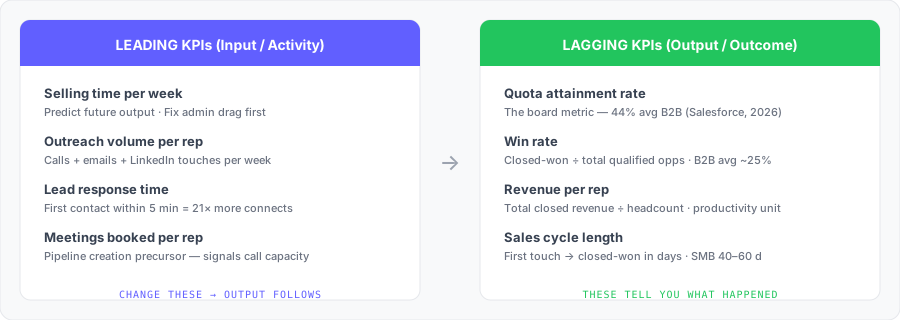
| Dimension | Leading KPIs | Lagging KPIs |
|---|---|---|
| What they measure | Inputs and behaviors today | Outcomes from 30–90 days ago |
| When to check | Daily and weekly | Monthly and quarterly |
| Examples | Selling time, outreach vol, lead response time, meetings booked | Quota attainment, win rate, revenue per rep, sales cycle length |
| Manager action | Intervene now to change outcome | Diagnose root cause of past miss |
| Rep action | Change behavior this week | Understand which inputs failed |
The rule of thumb: if a KPI can be influenced by changing a rep's behavior today, it is leading. If it reflects the result of behaviors that already occurred, it is lagging. A well-run sales team tracks both — the leading KPIs on dashboards reps see every morning, the lagging KPIs in monthly reviews and board decks.
Teams that track only lagging KPIs do post-mortems. Teams that track leading KPIs do interventions. The difference between a team that misses quota by 15% and one that finishes at 102% is rarely close rate talent — it is almost always the discipline to watch leading KPIs weekly and act on them before the quarter ends.
The master metric: selling time per week
If you could track exactly one sales productivity KPI and nothing else, it should be selling time per week — the percentage of a rep's working hours spent in direct selling activity: prospecting, outreach, calls, demos, and deal progression.
28%
Average time B2B reps spend actually selling per week
Salesforce State of Sales · 2026
41%
Share of rep time consumed by admin tasks — the single biggest productivity killer
Salesforce research · 2025–26
2,600
Extra selling hours per year gained by raising a 10-rep team from 28% to 40% selling time
Gangly calculation · 2026
Here is why selling time is the master metric: it is the one input that cascades into every other KPI downstream. A rep spending 28% of their week selling cannot generate the same outreach volume, meeting count, and pipeline as a rep spending 40% — even if both reps have identical skill. The math does not allow it.
Run the calculation for your team:
Selling time formula: (Hours in direct selling activities) ÷ (Total work hours in period) × 100
Example: Rep works 40h/week. Spends 11.2h selling = 28% selling time.
Target: Raise to 16h selling = 40% selling time. That is 4.8 extra selling hours per week per rep.
At a 10-rep team: 48 extra hours per week × 50 weeks = 2,400 additional selling hours per year.
Where does the time go? Admin kills it. Manual CRM entry, post-call note-writing, pulling prospect research before a call, building sequences one-by-one — these tasks individually look small but collectively eat 41% of a rep's day. That 41% is not a productivity problem. It is an admin problem wearing a productivity costume.
The implication for managers: before you buy more pipeline tools, more data enrichment software, or run more enablement sessions, audit how each rep spends their week. Identify the top three time sinks. Eliminate or automate them. Only then do the other KPIs become levers worth pulling.
For a deep audit of the specific admin tasks consuming rep time and how to remove them, read the sales admin time study.
The 6 leading sales productivity KPIs
These six KPIs predict revenue 30 to 90 days out. Track them daily and weekly. When one drops, intervene immediately — do not wait for quota attainment to confirm the problem.
Selling time per week
Formula: (Hours spent on direct selling activities) ÷ (Total work hours) × 100
Benchmark: 28–35% — top teams hit 40%+
Fix it: Audit how each rep spends 8 hours. Identify the top three non-selling time sinks — manual CRM entry, pre-call research, follow-up note-writing — and eliminate or automate each one.
Outreach volume per rep per week
Formula: (Calls made + emails sent + LinkedIn touches) ÷ Working days in period
Benchmark: AEs: 40–60 touches/week · SDRs: 80–120 touches/week
Fix it: Set a floor by channel, not just a total. Three calls plus two email sequences per day beats ten emails-only if your ICP picks up the phone.
Lead response time
Formula: Average minutes from lead creation to first contact attempt
Benchmark: Under 5 minutes for inbound · Under 60 minutes for signal-triggered outbound
Fix it: Route hot inbound leads to the first available rep automatically. For signal-triggered outbound, use Gangly's Signal Detection to surface warm accounts at 8 a.m. so reps act before competitors reach the same inbox.
Meetings booked per rep per week
Formula: Total qualified meetings confirmed ÷ Number of active reps in period
Benchmark: SDRs: 8–15/week · AEs: 4–8/week (qualified discovery calls)
Fix it: Compare meetings booked to outreach volume. A high-volume, low-meeting rep has a messaging or targeting problem. A low-volume, decent-meeting rep has a time problem.
Call-to-meeting conversion rate
Formula: (Meetings booked) ÷ (Total call attempts) × 100
Benchmark: Cold calling: 1–3% · Warm/signal-led: 8–15%
Fix it: Pull call recordings from low-conversion reps. The first 15 seconds usually reveals the issue: generic cold opener, wrong ICP, or a hook that does not connect to a real pain.
Pipeline created per rep per quarter
Formula: Sum of all qualified opportunity values created in period by rep
Benchmark: 3–5× quota in new pipeline per quarter for healthy coverage
Fix it: See the full pipeline coverage analysis in the pipeline coverage ratio guide.
The 5 lagging sales productivity KPIs
Lagging KPIs confirm whether past inputs worked. They belong in board reviews, QBRs, and manager diagnostics — not on daily rep dashboards where they create anxiety about results that are already baked in. Track all five monthly.
Quota attainment rate
Formula: (Actual revenue closed) ÷ (Quota target) × 100
Benchmark: 44% of B2B reps hit quota in 2026 — down from 63% in 2021 (Salesforce)
Fix it: Do not start with quota attainment when diagnosing. Start with selling time, then outreach volume, then meeting rate. Attainment is the report card, not the curriculum.
Win rate
Formula: (Closed-won deals) ÷ (Total qualified opportunities) × 100
Benchmark: B2B average: 20–28% · Top quartile: 35–45%
Fix it: Segment win rate by deal source — signal-led vs cold prospecting, inbound vs outbound, AE vs territory. A 10-point gap between sources tells you exactly where to route more volume.
Revenue per rep
Formula: (Total revenue closed by team) ÷ (Number of quota-carrying reps)
Benchmark: B2B SaaS: $400K–$800K for mid-market AEs · Enterprise: $800K–$2M+
Fix it: Track alongside revenue per selling hour to separate a headcount problem from a time-use problem. If revenue per rep is flat but revenue per selling hour is up, you need more reps. If revenue per selling hour is down, you need to reclaim time first.
Average sales cycle length
Formula: (Sum of days from opportunity created to closed-won) ÷ (Number of closed-won deals)
Benchmark: SMB SaaS: 30–60 days · Mid-market: 60–120 days · Enterprise: 90–180 days
Fix it: See benchmark data by segment in the sales productivity benchmarks guide.
Pipeline velocity
Formula: (Number of qualified opportunities × Win rate × Average deal size) ÷ Average sales cycle in days
Benchmark: Varies by ACV. Track trend, not absolute number — 10%+ QoQ improvement = healthy
Fix it: Run the formula for the last four quarters. Whichever variable declined the most is your constraint this quarter. Focus all rep coaching and enablement on that one lever.
KPI priority matrix — what to fix first
When productivity is low, most teams try to fix everything at once. That spreads manager attention thin and produces incremental movement on all fronts instead of decisive improvement on one. Use this matrix to identify the single highest-impact intervention given the symptom you are seeing.
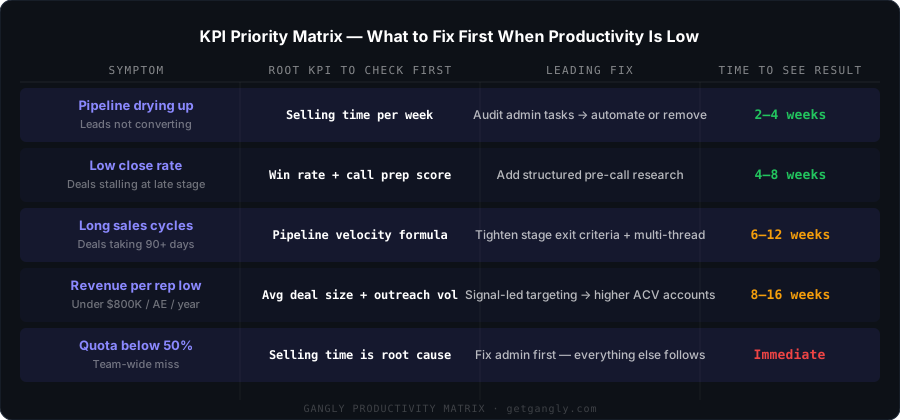
Notice that every symptom in the matrix eventually traces back to selling time or an input behavior. The matrix is not an invitation to do five things in parallel. Pick the top symptom your team is experiencing right now, work the root KPI for four weeks, then move to the next row.
The exception: if quota attainment is below 50% team-wide, that is an emergency signal that requires an immediate selling-time audit across the whole team — not an individual rep intervention. Below 50% attainment at the team level means the system is broken, not individual reps. Fix the system (admin, tool complexity, bad targeting) before any individual coaching.
For full SDR-specific metric benchmarks and how to interpret them by role, see the SDR metrics guide.
Measurement cadence: daily, weekly, monthly
Checking a leading KPI monthly is the same as not checking it. Checking a lagging KPI daily creates anxiety about outcomes that cannot be changed. Cadence is not a preference — it is part of the measurement system. The right cadence for each KPI determines whether the data drives action or just fills dashboards.
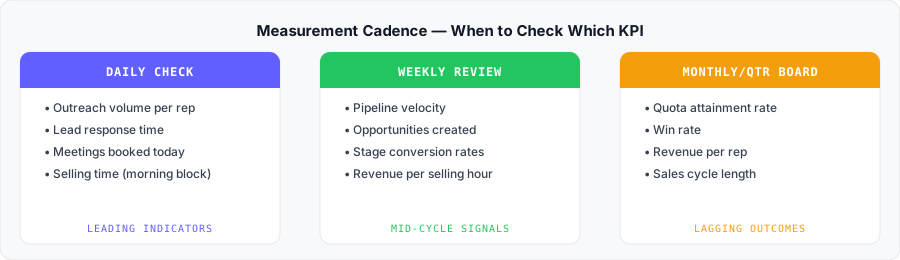
| KPI | Type | Check cadence | Owner | Action trigger |
|---|---|---|---|---|
| Selling time per week | Leading | Daily (Monday morning) | Rep + Manager | Below 30% → immediate admin audit |
| Outreach volume | Leading | Daily | Rep | 2-day dip → manager 1:1 |
| Lead response time | Leading | Daily (auto-flagged) | Operations | Above 5 min → routing fix |
| Meetings booked | Leading | Weekly | Rep + Manager | 3-week drop → ICP or messaging review |
| Pipeline velocity | Mid-cycle | Weekly | Manager | 10%+ drop → identify which lever declined |
| Win rate | Lagging | Monthly | Manager + CRO | Below 20% → call recording review |
| Quota attainment | Lagging | Monthly + QBR | CRO + Board | Below 50% team-wide → system audit |
| Revenue per rep | Lagging | Monthly + QBR | CRO | QoQ decline → selling time audit |
| Sales cycle length | Lagging | Monthly | Manager | 10+ day creep QoQ → qualification review |
The "action trigger" column is the critical piece that most dashboards omit. A KPI without a defined trigger is just a number on a screen. Before publishing any KPI to a dashboard, define: what value causes a human to do something? If the answer is "we will look at it and discuss," the KPI belongs in a report, not a live dashboard.
Review cadence in the context of team productivity data in the sales productivity benchmarks guide, which includes median KPI values by company size, segment, and sales motion.
How Gangly recovers selling time to move every KPI
Gangly was built specifically around the selling-time problem. The five tasks that consume the most rep time outside of direct selling — signal monitoring, pre-call research, post-call note-writing, CRM updates, and follow-up sequencing — are automated in a single connected workflow.
The Gangly Selling-Time Framework
Five tasks. One connected sequence. Zero re-keying between steps.
- 1
Signal Detection
Surfaces warm accounts daily — ranked by score — so reps spend 15 minutes targeting instead of 60 minutes hunting through CRM and LinkedIn.
- 2
Outreach Writer
Drafts a signal-led email or LinkedIn message in the rep's voice based on the specific account event. Rep reviews and sends in under 3 minutes.
- 3
Call Prep Engine
Pulls account history, stakeholder context, and talking points before a scheduled call. Prep time drops from 45 minutes to under 10.
- 4
Live Coaching
Surfaces objection handles, competitor responses, and talk tracks on-screen during the call. No post-call searching for the right response.
- 5
Auto-Notes + CRM Sync
Transcribes the call, writes structured notes, and pushes updates to the CRM automatically. Zero manual re-keying after the call ends.
The result of connecting these five steps: reps in Gangly's early customer cohort moved from 28% to 38–42% selling time within the first 8 weeks. That 10-14 percentage point shift corresponds to 4–5 extra selling hours per rep per week. On a 10-rep team, that is 40–50 extra hours per week directed at conversations with buyers — without adding headcount, without a new hire ramp, without changing quota targets.
Every other KPI in this guide is downstream of that shift. Outreach volume goes up because signal monitoring is automated. Meeting bookings increase because outreach is more targeted and personalized. Win rate improves because call prep is thorough. Sales cycle shrinks because CRM data is clean and follow-up is timely. Revenue per rep rises because the same headcount is now spending more hours in front of qualified buyers.
Selling time is the master metric. Gangly is the lever. See how the workflow connects →
Sales Productivity Playbook
Get the weekly signal-led selling digest.
One email per week: one KPI, one benchmark, one fix. No fluff. Unsubscribe any time.