
 By Siddharth Gangal
What is AI sales enablement?
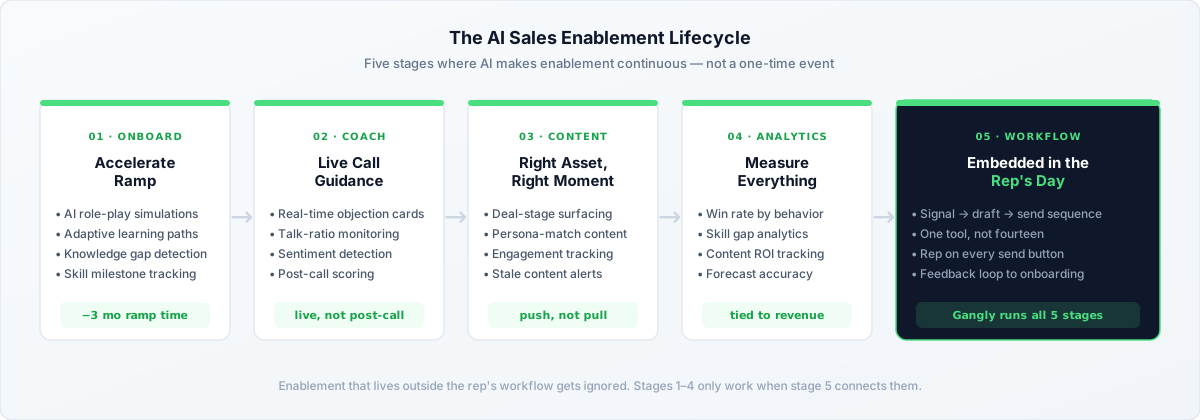
AI sales enablement is the practice of using artificial intelligence to equip sales reps with the right skills, content, and coaching at the right moment across the full revenue cycle. That phrase — "at the right moment" — is the entire difference between AI enablement and what most teams call enablement today.
Traditional enablement is periodic and manual. A new hire sits through onboarding week. The team receives a product update deck after a new release. A manager reviews a call recording on Thursday and shares feedback on Friday. The rep applies that feedback — or does not — the following week.
AI enablement collapses the feedback loop from days to seconds. An AI role-play system scores the rep's objection handling in real time and prescribes a targeted simulation before the next call. A live coaching layer fires a competitive reframe during the active call — not after it ends. A content recommendation engine pushes the matching case study into the CRM draft at the exact moment the rep is composing a follow-up email.
According to a 2025 Gartner analysis, 63% of enablement teams using AI-augmented tools report higher revenue impact than peers using traditional programs. Experian increased win rates by 25% after deploying AI-driven coaching and content recommendations. Iron Mountain cut new-hire ramp time by three months using AI simulations.
Those results are real. They are also not automatic. The gap between teams that see them and teams that spend on AI tools and see nothing comes down to one question: is the AI embedded in the workflow the rep already runs, or does it sit in a separate system the rep must remember to visit?
Sales enablement — defined
Sales enablement is the process of providing sales reps with the resources, training, and information they need to engage buyers effectively. Example: a competitive battle card surfaced during a pricing objection is sales enablement in action.
This guide covers four stages where AI changes enablement outcomes — onboarding, call coaching, content delivery, and analytics — and then the organizational layer that determines whether any of it sticks: workflow integration. For the performance side, see the complete breakdown of sales enablement metrics.
Onboarding acceleration: how AI cuts ramp time by months
Sales onboarding is where most companies leave the most money on the table. The Bridge Group puts median time-to-productivity for AEs at 3.2 months. CSO Insights data shows that companies with formal onboarding programs hit quota at rates 10+ percentage points higher than those without. Yet most onboarding programs are still built around the same format: a week of presentations, a shadow period, and then the rep is live.
AI changes two things in onboarding that no amount of deck-polishing can fix.
Adaptive skill paths replace linear course completion
A traditional onboarding LMS gives every rep the same modules in the same order. A rep who spent five years in enterprise SaaS completes "Introduction to B2B Selling" before they can access anything else. An SDR promoted into an AE role skips discovery training because the system shows the module as "previously completed."
AI-driven adaptive paths assess actual skill levels through assessments and call simulations, then assign only the modules where gaps exist. A rep strong in cold outreach but weak in multi-threaded deal management gets routed directly to those scenarios. Completion time drops. Behavior change — the actual goal — improves because the rep practices against their specific weaknesses rather than reviewing material they already know.
For 2026 benchmarks on onboarding by role and what accelerated programs actually produce in quota attainment lift, read the full sales onboarding statistics guide.
AI role-play simulations replace shadow calls
Shadow calls teach reps by observation. AI role-play simulations teach reps by doing — and doing repeatedly until the behavior is ingrained. A rep can run 40 pricing-objection scenarios in a two-hour session, receive a score on each, and review transcript feedback without consuming a single manager-hour.
The key calibration requirement: the AI persona must match the company's actual ICP. A SaaS startup selling to mid-market RevOps teams needs simulations featuring a skeptical RevOps Director asking about integration complexity — not a generic "enterprise buyer." Teams that deploy generic simulations produce reps who practice the wrong conversation. The simulation should be built from real call recordings, past win/loss transcripts, and ICP interview data.
Iron Mountain's deployment of AI simulation tools reduced new rep ramp time by three months — roughly the difference between a Q1 hire hitting quota in Q2 versus Q3. On a $100K OTE rep, that represents approximately $25K in accelerated quota production and a $33K reduction in cost-of-vacancy.
Ramp time reduction
3 months
Iron Mountain deployed AI simulation tools and cut new-hire time-to-productivity by 3 months. The lever was ICP-calibrated personas, not generic ones.
Win rate lift
25%
Experian increased win rates by 25% after deploying AI coaching and content recommendation workflows (Gartner, 2025).
Revenue impact
63%
of enablement teams using AI-augmented programs report higher revenue impact than peers using traditional programs (Gartner, 2025).
In-the-moment call coaching: guidance during the live call
Live call coaching is where AI sales enablement separates itself most sharply from every traditional approach. Post-call review has value. It teaches the rep what to do differently next time. Live coaching changes what the rep does in this conversation — the one that is happening now, with the prospect who is on the line right now.
The mechanism is straightforward. A software layer listens to the call transcript in real time, detects trigger phrases — "this is expensive," "we already use [competitor]," "I need to loop in legal" — and surfaces the matching coaching card on the rep's screen. The rep sees the objection reframe, the competitive stat, or the legal-process talking point. The buyer hears a confident, specific response. The deal moves forward.
Gong's 2021 call data analysis showed that reps who used competitive talking points during pricing objections won at a materially higher rate than those who improvised. The problem was that reps could not recall the specific stat in the moment — only post-call review confirmed it existed. Live coaching closes that gap by surfacing the stat before the rep needs it, not after they forgot it.
What live call coaching actually covers
- 1Objection reframes. When a buyer says "the timing is off," the coaching card surfaces the reframe: "timing objections in B2B most often signal a priority question, not a calendar question — ask what Q3 initiative ranks above this." The rep does not improvise. The card does the heavy lifting.
- 2Competitive intelligence. A buyer mentions a specific competitor. The system pulls the competitive battle card for that vendor — win stats, differentiation points, the three questions that expose the competitor's weakness — without the rep leaving the call to search for it.
- 3Talk-ratio monitoring. If the rep's talk ratio exceeds 60% for more than four consecutive minutes, the system surfaces a prompt: "Ask an open question." Reps who dominate call time consistently underperform on discovery outcomes (Gong, 2021). The real-time cue is what changes the behavior in this call.
- 4Next-step reminders. Calls that end without a confirmed next step go dark at 3.8× the rate of calls that end with a calendar invite (Gong data). The coaching layer surfaces a prompt in the final five minutes: "Lock the next step before you close." Simple, measurable, and consistently missed without the prompt.
For a full breakdown of how AI-driven call coaching works end to end — from live prompts to post-call scoring to manager review queues — see the dedicated guide on AI sales coaching.
Content recommendations at deal stage
Content is the part of sales enablement that gets built the most and used the least. Forrester research consistently shows that over 60% of content created by marketing for sales goes unused. The problem is not content quality. The problem is content discovery. Reps cannot find the right asset at the right moment, so they reuse the two decks they already know or send nothing.
AI content recommendations solve this with a push model instead of a pull model. Instead of requiring reps to search the content library ("do we have a case study for financial services clients at the security review stage?"), the system reads the current deal's metadata — industry, buyer title, deal stage, previous email content, objections raised on calls — and surfaces the top three assets directly in the rep's CRM or email composer.
The rep does not visit a portal. The asset appears where they already are. That shift from pull to push is why teams running AI content recommendations report 2–3× higher content usage rates compared to teams with manual content libraries.
How deal-stage content matching works
A well-configured content recommendation engine matches assets across four deal-stage dimensions:
| Deal Stage | Buyer Priority | Best Content Type | What AI Matches On |
|---|---|---|---|
| Discovery | Problem validation | Industry benchmark report | Buyer industry + title |
| Demo / Eval | Solution proof | Case study matching ICP profile | Company size + use case |
| Proposal | Value justification | ROI calculator + business case template | Deal size + buyer role |
| Security / Legal | Risk reduction | Security whitepaper, compliance doc | Objection trigger on transcript |
| Competitive | Differentiation | Battle card for named competitor | Competitor name in transcript/email |
Content engagement data — did the prospect open the case study, how long did they spend on it, did they forward it — feeds back into the AI model. Assets that drive engagement at specific stages get weighted higher in future recommendations. Assets that get sent and ignored get demoted. The library improves over time without manual curation.
One configuration requirement: content metadata must be clean. If assets are tagged with wrong deal stages or outdated product versions, the AI will surface them anyway — and the rep will lose confidence in the system after two bad recommendations. Metadata hygiene is an organizational discipline, not an AI problem.
Performance analytics that tie to revenue
Most enablement teams track the wrong metrics. They report content views, course completions, and rep attendance at training sessions. These are activity metrics. They tell you whether the program ran. They do not tell you whether it produced revenue.
Highspot's 2025 State of Sales Enablement report found that 55% of organizations cannot effectively tie enablement initiatives to GTM outcomes. That is not a data availability problem in 2026 — every conversation intelligence platform captures call transcripts, content engagement, and rep behavior. It is a measurement design problem. Teams collect the data but do not connect it to the deals.
The three metrics that prove AI enablement is working
- 1. Rep ramp time (days to first closed deal). The single most measurable enablement outcome. If AI role-play and adaptive onboarding are working, this number drops. Track it by cohort — reps hired before AI onboarding vs. reps hired after — and the attribution is direct. A three-month reduction in ramp time on a $120K OTE rep produces roughly $30K in additional quota production per rep hired.
- 2. Win rate by behavior cluster. Segment deals by whether the rep ran specific behaviors — used a battle card on the call, sent a case study within 24 hours of demo, locked a next step before ending the call. Deals where the rep ran all three behaviors should close at a materially higher rate than deals where the rep skipped them. If they do not, the behaviors are wrong. If they do, the behaviors become required enablement steps.
- 3. Content-to-close rate. Which assets appear in the opportunity timeline of deals that close vs. deals that stall? An enterprise case study that appears in 67% of closed-won deals in the $100K+ ACV segment and only 14% of closed-lost deals is a high-signal asset. Prioritize it in AI recommendations. The inverse — an asset that appears equally in won and lost deals — contributes nothing and should be deprioritized.
Secondary metrics worth tracking include talk-ratio improvement by rep cohort, objection-handling score trends over time, and CRM data completeness rate (which determines AI model accuracy for content matching). For the complete framework on what to measure and how to benchmark against industry data, read the guide on sales enablement metrics.
Embedded enablement vs. separate platform: why it matters
Here is the question every enablement investment decision comes down to: does the AI live inside the workflow the rep already runs, or does it require the rep to change their behavior to use it?
Standalone enablement platforms — even excellent ones with strong AI features — require a behavioral change. The rep must open the portal. The rep must search for the content. The rep must remember to log a call in the coaching system. Self-paced learning completion rates across enterprise platforms average 20–30%. The remaining 70–80% of reps use the tool at onboarding, complete enough modules to satisfy a manager check, and never return.
Embedded enablement works because it requires no behavioral change. The coaching card appears during the call the rep was already taking. The content recommendation appears in the CRM the rep was already updating. The prep brief appears in the rep's morning feed, which they were already reading. Adoption is high not because reps are disciplined but because the system is in the path of their existing workflow.
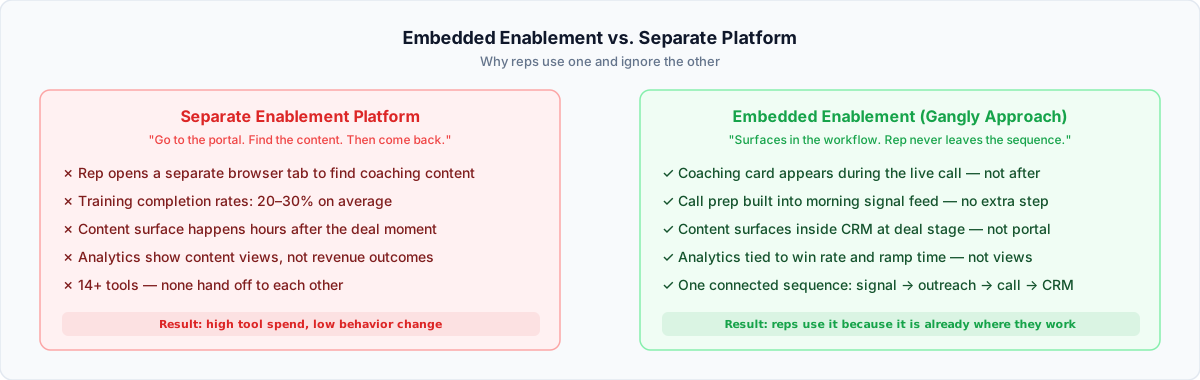
This distinction matters for every enablement tool purchase decision. Before buying a standalone platform, ask: where will reps encounter this tool in their existing workflow? If the answer is "they will need to go there separately," discount the adoption projection by 70%. If the answer is "it surfaces in HubSpot, in Zoom, and in their inbox draft," the adoption math improves substantially.
For more on how AI changes the full sales workflow end-to-end — from signal detection through CRM update — see how AI sales workflows work.
The Enablement Workflow Framework: Gangly's connected approach
Most companies run enablement as four separate functions managed by four separate teams on four separate platforms. Marketing owns the content library. Sales ops owns the onboarding LMS. RevOps owns conversation intelligence. The CRM team owns data. None of them hand off to each other. The rep assembles the fragments manually — or ignores most of them.
Gangly is built on a different premise: enablement only compounds when every stage feeds the next in a single connected sequence. Call coaching data feeds the skill gap model that drives onboarding assignments. Content engagement data feeds the recommendation engine that surfaces assets during the next deal. Analytics from closed deals feed the battle card update cycle. Everything runs inside the rep's daily sequence rather than in parallel systems the rep must maintain.
The Enablement Workflow Framework — Gangly's 5-stage connected sequence
- 01
Signal detection feeds the morning brief.
The rep's day starts with a ranked feed of warm accounts — job changes, funding events, intent signals, CRM activity triggers. Call prep briefs are already drafted. The enablement system knows which accounts are hot before the rep opens their inbox.
- 02
Outreach drafts surface with the right content attached.
Signal-led outreach drafts are generated in the rep's voice. The content recommendation engine attaches the matching asset based on the signal type and account context. The rep edits, approves, and sends. No portal visit. No manual attachment.
- 03
Call prep and live coaching run as one layer.
The prep brief — pulled from CRM history, recent signals, past call transcripts — is ready before the rep joins the Zoom. During the call, the live coaching layer monitors the transcript and surfaces objection cards, competitive responses, and next-step prompts. The rep stays on mic.
- 04
Post-call notes and CRM update before the call window closes.
The CRM note is drafted from the transcript before the rep has closed their laptop. Deal stage, next steps, and follow-up tasks sync to HubSpot, Salesforce, or Pipedrive with one click. The call transcript feeds the content recommendation engine and the coaching analytics dashboard.
- 05
Analytics loop back into onboarding and coaching targets.
Call scoring data identifies which reps struggle with which objection types. That data drives the next simulation assignment in the onboarding and ongoing coaching path. The rep who lost three deals on pricing objections in Q2 gets a pricing simulation in the next coaching sprint — not a suggestion to "review the pricing deck."
The result of the connected sequence: enablement becomes a background process rather than an event. Reps improve continuously because the system identifies gaps from live deal data and closes them before those gaps cost another deal. Managers spend coaching time on judgment and strategy — not on reviewing whether the rep completed this month's LMS modules.
See how Gangly runs this sequence or explore Gangly's pricing tiers for teams from Starter to Scale.
Six mistakes that kill AI enablement programs
AI enablement fails predictably. The failure modes below account for the majority of programs that spend six figures on tools and report no measurable outcome improvement after twelve months.
- 01Treating enablement as a one-time event
A two-day onboarding and a quarterly product update is not enablement. It is orientation. AI enablement only compounds when it is continuous — feeding coaching back into training, training back into content, content back into deal outcomes.
- 02Building a separate tool reps must visit
The fastest way to kill adoption is to put your AI enablement system behind a separate login. Reps already live in the CRM, the inbox, and the dialer. Any system that requires them to tab-switch will hit 20–30% usage at best.
- 03Measuring content views instead of outcomes
Enablement leaders who report "74% of reps viewed the competitive battle card" are measuring inputs. The metric that matters is whether deals involving that battle card close at higher rates. AI makes that measurement possible. Most teams skip it.
- 04Deploying role-play without calibration
AI role-play simulators are powerful — Iron Mountain cut ramp time by three months using them. But simulators trained on generic buyer personas produce generic reps. Calibrate the persona to your ICP before your first session, not after six months of bad habits.
- 05Using post-call coaching instead of live coaching
Post-call analysis helps managers coach next time. Live coaching helps reps win this call. The Gong data (2021) showed that filler words and weak talk tracks were the top call killers — both fixable in real time if the system surfaces them live. Post-call review alone cannot do that.
- 06Skipping the data quality layer
AI sales enablement runs on call recordings, CRM data, and behavioral signals. If CRM fields are incomplete and calls are not recorded, the AI has nothing to learn from. Fix the data pipeline before the enablement layer, not after.