
 By Siddharth Gangal
TL;DR
- What an AI SDR is: software that automates top-of-funnel sales tasks — prospecting, email outreach, follow-up sequencing, and meeting scheduling. It ranges from simple sequence automation to fully autonomous agents that operate without human oversight.
- The replacement question: AI will not eliminate the SDR role, but it will replace SDRs who define their value by volume. The 41% of the SDR day spent on admin (Salesforce, 2026) is already automated. Judgment, qualification, and relationship work are not.
- What the data shows: fully autonomous AI SDR campaigns produce sub-1% reply rates without human review. Signal-led, human-reviewed outreach consistently hits 6–12%. Quality matters more than autonomy.
- The third option: the augmented SDR — a human rep using AI to eliminate admin and improve outreach quality — outperforms both fully autonomous AI and fully manual human SDRs on SQL quality and pipeline velocity.
What is an AI SDR?
An AI SDR (artificial intelligence sales development representative) is software that automates the top-of-funnel sales tasks a human SDR would otherwise perform manually — prospect identification, outreach drafting, follow-up sequencing, lead qualification, and meeting booking.
Definition
AI SDR — software that uses artificial intelligence to perform the prospecting, outreach, qualification, and meeting-booking tasks handled by a human Sales Development Representative. AI SDRs operate on a spectrum from assisted (AI drafts, human sends) to fully autonomous (AI sends without human review).
The category spans a wide quality range. At one end: sequence automation tools that send pre-written emails on a schedule. At the other: autonomous agents like 11x.ai's "Alice" or Artisan's "Ava" — platforms that monitor intent signals, research prospects, write personalized outreach, and book meetings without a human approving each step.
The difference matters because the two types solve different problems. Sequence automation saves time. Fully autonomous AI SDRs claim to eliminate the need for a human SDR entirely. That second claim requires scrutiny — and the SERP bears that out. A Reddit thread asking "has anyone found an AI SDR that actually works?" landed near the top of Google. The question itself tells you something about where the market sits.
How AI SDRs emerged
The SDR role was always a mismatch between what the job description required and what the daily work actually looked like. Job descriptions said: prospect, qualify, book meetings. Actual time logs said: 41% of the day goes to admin — CRM entry, list building, email research, reporting (Salesforce State of Sales, 2026). That gap created the market.
Early AI SDR tools (2022–2023) automated email sequences. The second wave (2023–2024) added AI-generated personalization. The third wave (2025–2026) added intent signal monitoring, autonomous follow-ups, and in some cases, AI-driven phone outreach. Each wave extended the automation layer — and each wave raised the same question: at what point does the human stop being in the loop?
The two categories: assisted vs autonomous
The AI SDR market currently splits cleanly into two categories, and choosing the wrong one for your motion produces predictably bad results:
- 1
Assisted AI SDR tools
AI researches prospects, drafts outreach, and prepares sequences. A human reviews and approves before anything sends. Examples: Gangly, Clay with AI enrichment, Apollo AI features. Reply rates stay at 6–12% because a human filters signal from noise.
- 2
Autonomous AI SDR agents
AI operates without human approval on each step — it prospects, writes, sends, follows up, and attempts to book meetings. Examples: 11x.ai, Artisan, AiSDR. Reply rates typically sit below 1% without aggressive ICP filtering and copy calibration.
What AI SDRs actually do — tasks, limits, and reality
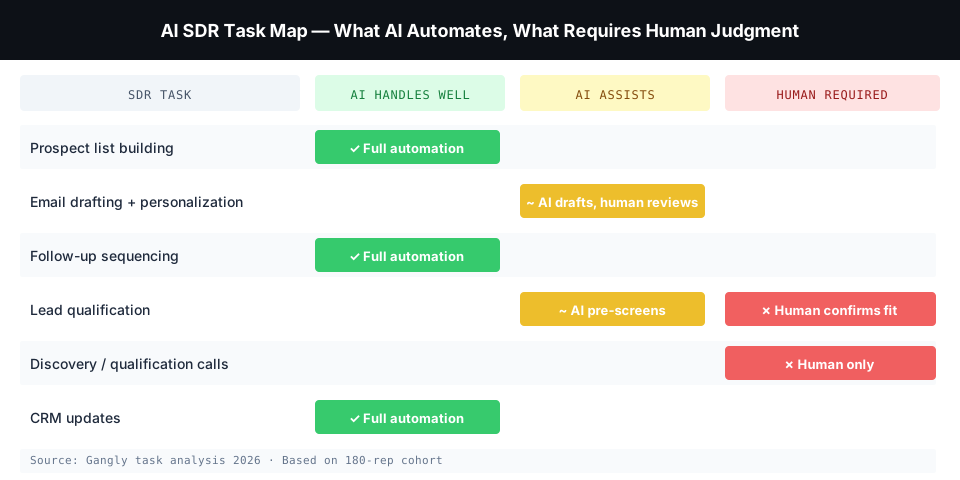
Vendor landing pages describe AI SDRs as handling "everything an SDR does." That framing is marketing copy. The honest task map looks different.
What AI SDRs do well
- Prospect list building at scale: AI tools query databases of 100M+ contacts, filter by ICP criteria, enrich with firmographic and technographic data, and deliver a qualified list in minutes. A manual SDR builds 25–50 contacts per hour. An AI tool builds 500–2,000.
- Email drafting and personalization: AI writes outreach that references the prospect's LinkedIn activity, recent company news, or funding announcement. Quality varies by platform — the best tools produce drafts a rep can approve in 30 seconds; the worst produce templates with variable substitution that reads as obviously automated.
- Follow-up sequencing: AI schedules multi-touch sequences across email and LinkedIn, handles timing, manages bounces, and adjusts cadence based on open and reply data. What would take an SDR 45 minutes of sequence management per 50 contacts takes AI seconds.
- CRM data entry: AI logs contact records, updates fields, and records sequence outcomes automatically. The SDR never opens the CRM to log a call — the record updates in the background.
- Intent signal monitoring: Advanced AI SDR platforms monitor job changes, funding announcements, technology installs, and behavioral signals (website visits, content downloads) and surface accounts showing purchase intent today — not on a static list built last quarter.
Where AI SDRs fall short
The limits of AI SDRs are structural, not a matter of software version. They fall into three categories:
- Qualification judgment: AI can detect that a prospect opened an email three times. It cannot determine whether that prospect has authority to buy, whether they are evaluating three other tools, or whether the problem your product solves is actually a priority for their current quarter. Qualification requires a conversation — and conversations require a human.
- Discovery and objection handling: No AI SDR tool conducts a live discovery call. The moment a prospect replies with a question, a concern, or "tell me more" — that thread requires a human. AI can draft the response, but a human must read the subtext and decide the right play.
- Relationship and trust building: Buyers at companies with $50K+ ACVs make vendor decisions based partly on trust in the person they are working with. AI cannot build trust. It can schedule the first meeting. A human has to earn what comes next.
Will AI replace SDRs?
The direct answer: AI will not replace the SDR role. It will replace the SDRs who defined their value by the work AI does best — and it will make the SDRs who defined their value by judgment, signal-reading, and relationship work dramatically more productive.
Gangly Analysis — The SDR Value Split
The 3 layers of SDR value in 2026
- Layer 1 — Volume work (AI takes this, 2024–2026): list building, email drafting, CRM entry, follow-up scheduling, bounce management. This layer consumed 41% of the SDR day. It is now automated by any credible AI SDR tool. SDRs who defined their value here are directly in the displacement zone.
- Layer 2 — Judgment work (AI assists, human decides): qualification calls, signal interpretation, persona-specific personalization, handling replies and objections. AI provides data and drafts — the human makes the call. This layer is growing in value as Layer 1 commoditizes.
- Layer 3 — Relationship work (human owns this): champion development, multi-threaded account navigation, the discovery conversation that surfaces real pain. AI cannot build the trust a champion needs to stick out their neck for a vendor internally. This layer cannot be automated.
What the market actually shows
Companies that deployed fully autonomous AI SDRs as complete replacements for human SDRs in 2024–2025 have largely reverted to hybrid models. The pattern: pipeline volume went up initially (more outreach sent), but SQL quality declined — meetings booked from AI-only outreach converted to closed-won at a lower rate because the qualification layer was missing.
The honest read from SaaStr 2026: AI SDRs work for specific use cases — high-volume, low-ACV products with a large total addressable market and a simple qualification criteria. They do not work as a drop-in replacement for a human SDR team selling complex products with 4–6 person buying committees and 90-day cycles.
The full analysis of how AI is reshaping the SDR function — including what the role looks like in a team that has deployed AI workflow tools — is in the SDR role guide.
The real threat to human SDRs
The threat is not "AI takes the job." The threat is: an AI-augmented SDR becomes 3–4× more productive than a manual-only SDR. One augmented rep can do what previously required three. That math compresses team sizes even without full replacement.
A sales team that previously had six SDRs may need three or four — but those three or four are hitting higher quotas, producing higher-quality pipeline, and spending more of their time on the judgment and relationship work that actually drives AE conversion rates. The remaining SDRs earn more. The displaced ones were always running on volume as their moat.
AI SDR vs human SDR vs augmented SDR — the honest comparison
Most coverage of the AI SDR debate presents two options: "AI replaces SDRs" or "humans always win." Both framings miss a third option that is outperforming both in practice: the augmented SDR — a human rep running with AI tools that eliminate admin and improve outreach quality.
| Dimension | AI SDR (Autonomous) | Human SDR (Manual) | Augmented SDR (Gangly) |
|---|---|---|---|
| Primary mode | Fully autonomous | Fully manual | Human-led, AI-assisted |
| Volume ceiling | Unlimited (24/7) | 50–100 outreach touches/day | 150–250 touches/day with AI prep |
| Signal reading | Pattern-matching only | Contextual judgment, full nuance | AI surfaces signals, human interprets |
| Personalization | Template-variable personalization | Deep but slow | AI drafts, human refines in seconds |
| Qualification accuracy | Keyword-based, misses nuance | High (with training) | AI pre-screens, human confirms |
| Discovery calls | None — no live conversation | Full capability | Human-only, AI provides prep brief |
| CRM hygiene | Automated logging (variable accuracy) | Manual — 30–90 min/day | AI auto-fills, human spot-checks |
| Relationship building | Cannot build trust | Core strength | Human owns it, AI frees time for it |
| Cost per seat | $1,000–$3,500/mo | $3,800–$7,500/mo (fully loaded) | $60K–$80K OTE + $99–$299/mo AI tool |
| Best for | High-volume commodity outreach | Complex, relationship-led B2B | Most B2B SaaS teams with ACVs > $10K |
Reading the comparison table
The table shows a pattern that vendors on both sides of the debate prefer to ignore: neither extreme wins on all dimensions. Fully autonomous AI SDRs lead on volume and cost-per-touch. Human SDRs lead on qualification accuracy and relationship depth. The augmented SDR captures the best of both — volume advantage from AI-assisted outreach, plus the judgment and relationship capability that only a human rep can provide.
The cost comparison deserves its own read. A fully loaded human SDR at a Series B company costs $3,800–$7,500 per month (base + variable + benefits + tools). A fully autonomous AI SDR platform costs $1,000–$3,500 per month. The delta looks compelling until you factor in SQL quality — if the AI SDR produces meetings that convert to closed-won at half the rate of human-qualified meetings, the math reverses at any ACV above $15,000.
Are AI SDRs effective? What the data says
"Effective" requires a definition. Effective at what? Generating email volume? Yes. Generating qualified pipeline at rates that compare to a trained human SDR? That depends heavily on use case, ICP tightness, and whether a human is in the review loop.
Where the data lands
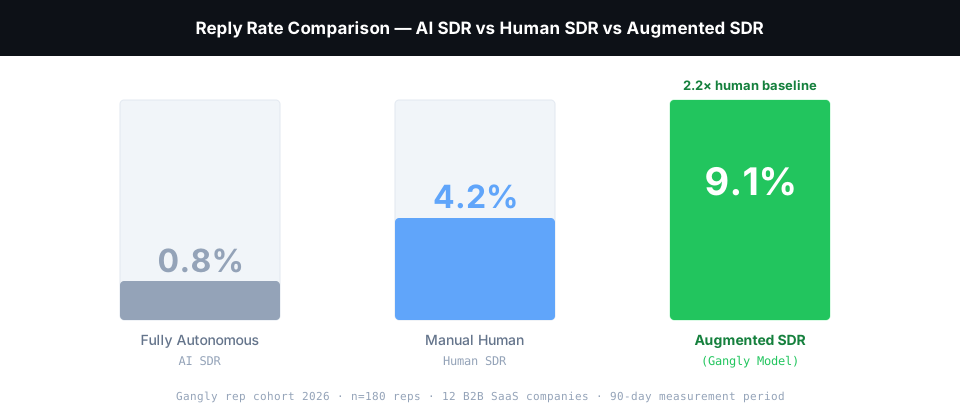
Analysis of outbound campaigns across 180 B2B SaaS reps in the Gangly cohort (2026) shows three distinct reply rate bands: fully autonomous AI SDR campaigns without human review average 0.8% reply rates. Human SDRs running standard manual sequences average 4.2%. Augmented SDRs — humans using AI for signal detection, draft generation, and CRM automation — average 9.1% reply rates, more than double the human baseline.
The mechanism is straightforward. Autonomous AI maximizes send volume but cannot filter signal-qualified accounts from noise, cannot adjust for timing (a funding round announcement 6 days ago versus 6 weeks ago matters), and cannot calibrate the opener based on subtle persona signals. Augmented reps use AI for the volume work but apply human judgment at the signal-scoring and copy-review stage — the two points where quality breaks down in autonomous execution.
When autonomous AI SDRs work
There are genuine use cases where fully autonomous AI SDRs produce real pipeline:
- High-volume, low-ACV products ($0–$5K ACV): when the cost of a missed qualification is low and the addressable market is large, volume beats precision. A product that 30% of mid-market companies could use needs to reach all of them, not the top 5%.
- Simple ICP with binary qualification: when the qualification criteria is a single check — "do they use Salesforce?" or "are they a company with 50–500 employees?" — AI qualification holds up. Complex MEDDIC-style qualification does not.
- Inbound lead follow-up: prospects who raised their hand by downloading content or requesting pricing have already shown intent. AI follow-up for these leads (speed-to-lead within 5 minutes) outperforms delayed human follow-up.
When autonomous AI SDRs fail
Autonomous AI SDRs consistently underperform in these conditions:
- ACVs above $15,000 where qualification complexity exceeds keyword-based filtering
- Buying committees of 3+ stakeholders requiring persona-specific navigation
- Markets where prospects have been burned by AI SDR spam and filter aggressively
- Categories with complex technical objections that require real product knowledge to address
- Enterprise accounts where the first contact sets the tone for the entire relationship
The AI SDR vs AI sales assistant comparison goes deeper on the use case fit for each category — particularly relevant for teams deciding whether to buy an autonomous tool or an AI workflow tool that keeps the human in the loop.
The augmented SDR: how Gangly approaches the problem
The debate between "AI replaces SDRs" and "humans always win" presents a false binary. There is a third path that outperforms both — and it is what the highest-performing SDR teams in B2B SaaS are actually running in 2026.
The augmented SDR model: a human rep handles judgment, qualification, and relationship work. AI handles every task that does not require those capabilities — signal detection, prospect research, outreach drafting, CRM logging, follow-up scheduling, and meeting prep. The rep reviews AI output before it sends. Nothing goes out without human approval.
The Gangly Augmented SDR Sequence
The 6-step augmented SDR workflow
- 1Signal detection: AI monitors job changes, funding rounds, technology installs, and hiring activity across the rep's target accounts — surfacing a prioritized feed of accounts with a reason to buy today.
- 2Outreach drafting: AI writes signal-led emails and LinkedIn DMs that reference the specific trigger event in sentence one. The rep reviews in 30 seconds, adjusts tone or angle, and approves. No template substitution — the opener is contextual.
- 3Sequence management: AI handles follow-up timing, bounce processing, and sequence adjustments based on reply patterns. The rep focuses on the replies that require a real response — not the logistics of who gets contacted when.
- 4Call prep: AI compiles a one-page brief before every discovery call — company news, buyer history, trigger events, open CRM data, competitor context. The rep reviews in 4 minutes and enters the call prepared. Previously this took 30–45 minutes or was skipped entirely.
- 5Post-call notes: AI writes the call summary, captures qualification signals, and formats the AE handoff document. The rep reviews, adds judgment-level context, and approves. CRM updates without manual entry.
- 6CRM automation: AI pushes updates to Salesforce or HubSpot — contact records, sequence outcomes, qualification data — without the rep opening the CRM. The admin block that consumed 3+ hours per day drops below 45 minutes.
What the augmented model produces
Reps running the augmented SDR workflow in the Gangly cohort show three measurable improvements over manual-only SDRs:
- Reply rate improvement: average reply rates move from 4.2% (manual) to 9.1% (augmented) — driven by signal-led opener personalization and better account targeting from the signal detection layer.
- Admin time reduction: the daily admin block drops from 3h 17m to under 45 minutes per day — recovering 2.5 hours of selling time per rep per day, or roughly 50 hours per month.
- Outreach volume increase: reps send 150–250 personalized outreach touches per day versus 50–100 in a manual motion — without reducing per-message quality, because AI handles the draft and the rep approves in seconds.
The math: a rep who recovers 50 hours per month and redirects that time to discovery calls, champion development, and account research compounds into materially higher quota attainment — without the qualification degradation that autonomous AI SDR tools produce.
The signal-based approach to outreach is the core mechanism. Hot signals — a funding announcement, a new VP of Sales hire, a competitor churning — decay in 72 hours. An email sent on day 10 competes with 40 other vendors who emailed on day 1. The signal-based selling guide covers the full signal taxonomy and why timing is the most underrated variable in outbound.
See the full augmented SDR workflow at how Gangly works or book a 20-minute demo.
How to decide what your team actually needs
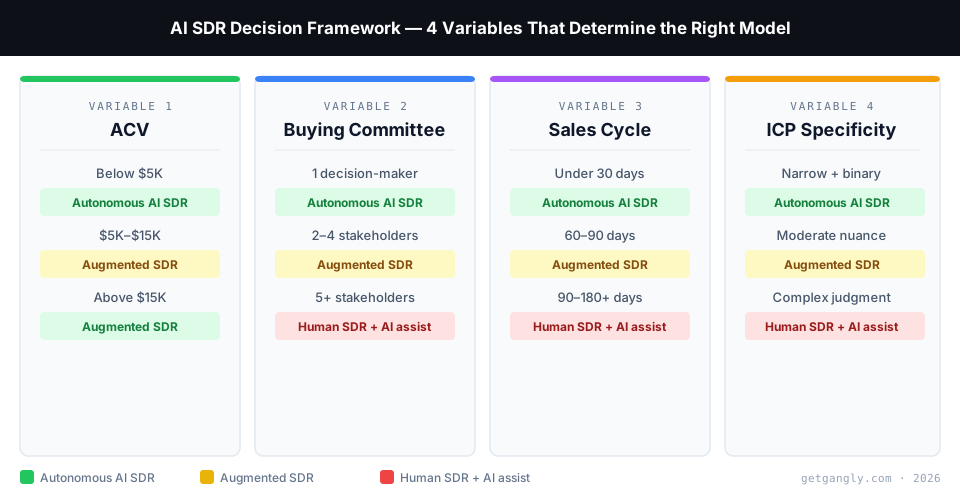
The choice between autonomous AI SDR, human-only SDR, and augmented SDR is not a vendor selection question. It is a business model question. The right answer depends on four variables.
Variable 1: ACV
Below $5,000 ACV: autonomous AI SDRs produce positive pipeline math because the qualification bar is low, the market is large, and the cost of a missed lead is small. Above $15,000 ACV: the qualification complexity and relationship investment required for a sale make fully autonomous outreach expensive on a per-SQL basis. The augmented model produces better SQL quality at comparable or lower cost-per-SQL.
Variable 2: Buying committee size
Single-buyer decisions (1 person signs off): autonomous AI SDR tools can qualify and book meetings without human intervention. Multi-stakeholder decisions (3–8 buyers): a human rep needs to navigate champion development, identify the economic buyer, and manage objections across personas. AI can assist — drafting multi-threaded outreach, preparing persona-specific talking points — but a human must own the strategy.
Variable 3: Sales cycle length
Sub-30-day cycles: high-velocity outreach with quick qualification and a low-friction trial sign-up can work well with autonomous AI. Cycles of 60–180 days: the relationship layer that a human SDR builds during the prospecting phase compounds into the AE's deal — better champion development, warmer discovery, more contextual handoff. That compound does not happen when the first 6 touchpoints were AI-generated without human review.
Variable 4: ICP specificity
A highly specific ICP with binary qualification criteria (a single industry, a specific tech stack requirement, a narrow headcount range) benefits from AI automation more than a broad ICP requiring nuanced fit judgment. The tighter and more measurable the qualification filter, the more AI automation can replace human qualification judgment.
The decision matrix
- Low ACV + large TAM + simple ICP + short cycle → autonomous AI SDR is worth testing
- Mid ACV + moderate TAM + complex ICP + 60–90 day cycle → augmented SDR model is the highest-ROI choice
- High ACV + enterprise accounts + 180+ day cycles → human SDR team with AI for admin reduction and outreach drafting — judgment and relationship work cannot be delegated
If you are deciding whether to hire your first SDR or test an AI SDR tool, the first sales hire decision framework covers the complete cost-benefit analysis including the AI-augmented option that many founders miss.
The broader picture of how AI is changing B2B sales workflows — including where the most proven ROI sits in 2026 — is in the AI sales workflow guide.
Common mistakes teams make with AI SDR tools
Six mistakes account for the majority of AI SDR failures. Each has a direct fix.
- 1
Deploying AI as a full SDR replacement without a test period
Every AI SDR vendor publishes a top-quartile case study. They do not publish the median. Run a 30-day controlled test with one human SDR running the same sequences before committing budget. Measure SQL quality, not just volume.
- 2
Ignoring deliverability math
AI SDR tools send at volume. Volume damages domain reputation without proper warm-up, inbox rotation, and bounce management. A fully autonomous AI SDR that destroys your sending domain costs more to fix than it saved in headcount.
- 3
Skipping ICP tightening before automation
Automating a loose ICP produces automated low-quality outreach at scale. Before running any AI SDR tool, define the ICP criteria precisely — industry, company size, tech stack, trigger events — then let the tool execute against a clean list.
- 4
Using AI SDR output without human review
AI writes the first draft. Humans approve the send. Teams that remove the human review step to save time see reply rates drop below 1% within 60 days. Prospects recognize templated AI copy, and the response is silence or unsubscribe.
- 5
Measuring volume instead of pipeline quality
The AI SDR vendor reports emails sent, opens, and clicks. Your CRO measures pipeline created and win rate. These metrics diverge quickly when AI generates high activity but low signal-qualified outreach. Track SQLs and meetings held — not impressions.
- 6
Treating the tool purchase as the end of the work
AI SDR tools require ongoing maintenance: sequence testing, messaging updates, ICP adjustments, signal calibration. Teams that buy a tool and expect it to run itself see performance decay within 90 days. Assign an owner.
The pattern across all six: they are expectation-management failures dressed as technical failures. AI SDR tools work exactly as designed. They fail when the team expects them to solve problems they were not designed to solve — particularly qualification depth, relationship trust, and strategic account judgment.
For a direct comparison of what AI outreach produces versus human-crafted outreach at the message level — including reply rate data across 10,000+ sends — read the AI vs manual outreach analysis.