
 By Siddharth Gangal
TL;DR
- Definition: an SDR (Sales Development Representative) is a sales professional who handles prospecting, outreach, and qualification — converting cold contacts into booked meetings for Account Executives. SDRs do not close deals. They build the pipeline that AEs close.
- Time reality: job descriptions claim SDRs spend most of their day on outreach. The actual breakdown: 41% of each day goes to admin — CRM entry, research, reporting, and internal meetings. This is the gap most SDR guides ignore.
- KPIs: SDRs are measured on SQLs generated, meetings booked, pipeline created ($), show rate, and sequence reply rate. At Series B+ companies, top-performing SDRs source $150,000–$300,000 in pipeline per month.
- Career path: strong SDRs promote to AE in 12–18 months. OTE jumps from $45–75K as an SDR to $120–180K as an AE. The fastest path: consistent quota attainment, clean handoffs, and demonstrated discovery skills.
What is the SDR role?
An SDR (Sales Development Representative) is a sales professional responsible for the top of the revenue funnel — identifying potential buyers, reaching out to them, and qualifying them before passing the opportunity to an Account Executive. SDRs do not close deals. Their job ends when a qualified meeting is on the AE's calendar.
The role exists because the activities required to fill a pipeline — prospecting, cold outreach, and lead qualification — are distinct from the activities required to close a deal — discovery, negotiation, and multi-stakeholder relationship management. Splitting the function lets each specialist operate at full capacity. SDRs build volume at the top. AEs convert depth in the middle and bottom.
At most B2B SaaS companies, the SDR role is the designated entry point into a sales career. No prior closing experience is required. What the role does require: the ability to research fast, write clearly, handle rejection without flinching, and qualify ruthlessly — discarding poor-fit accounts before they waste the AE's calendar.
Definition
SDR (Sales Development Representative) — a sales role focused on outbound prospecting, multi-channel outreach, and lead qualification. SDRs generate Sales Qualified Leads (SQLs) and book discovery meetings for Account Executives. The SDR role sits at the top of the funnel; it does not include closing responsibilities.
SDR vs BDR — the title confusion
The terms SDR and BDR are frequently used interchangeably. At companies that distinguish them: SDRs typically handle inbound lead qualification — MQLs generated by marketing — while BDRs run pure outbound prospecting to cold accounts. In practice, most companies apply one title to both functions. Read the detailed breakdown in the BDR day in the life guide.
SDR vs AE — where the role ends
The SDR's job is complete when a qualified meeting is booked. The AE takes ownership from there — discovery, solution positioning, negotiation, legal, procurement, and close. SDRs who try to do the AE's job (selling product features on a qualification call) usually produce poor-quality SQLs and underperform on quota. The handoff is the SDR's product. How to make the promotion from SDR to AE is covered in the SDR to AE promotion guide.
What SDRs actually do — day-to-day responsibilities
The standard job description lists prospecting, outreach, and qualification. That is accurate but incomplete. The full scope of the SDR role includes seven distinct functions — and the ones that consume the most time are not always the ones listed first.
- 1
Prospect identification
Research target accounts against the ICP — firmographics (company size, industry, tech stack) and buyer signals (hiring posts, funding rounds, role changes). SDRs build the top of the funnel from scratch.
- 2
Cold outreach
Email, phone, and LinkedIn DM in multi-touch sequences. A quota-carrying SDR typically runs 40–100 dials per day and 50–80 emails, depending on motion and company stage.
- 3
Lead qualification
Determine whether a prospect meets the criteria to become a Sales Qualified Lead (SQL). Common frameworks: BANT (Budget, Authority, Need, Timeline) and MEDDIC. The SDR owns this judgment call.
- 4
Discovery conversations
Short calls (10–20 minutes) to uncover business pain, decision-making authority, and project timeline. The SDR confirms the account is a real opportunity before handing it to an AE.
- 5
Meeting booking
Set qualified appointments on the AE calendar with full context: buyer profile, pain point surfaced, company history, and any objections raised. A warm handoff — not just a calendar invite.
- 6
CRM hygiene
Log every call, email, and conversation outcome. Maintain contact records. Update lead status. This is the invisible overhead most SDR job descriptions mention but severely underestimate.
- 7
Inbound lead routing
At many companies, SDRs also handle marketing qualified leads (MQLs) — speed-to-lead matters here. Research shows contacting an MQL within 5 minutes increases qualification rates by 21× versus a 30-minute delay (Harvard Business Review).
The seventh function — CRM hygiene — is worth isolating. Most SDR job posts mention it in passing as "maintaining accurate records." In practice, it absorbs between 30 minutes and 2 hours of every SDR day, depending on whether the rep has workflow tooling that handles updates automatically or relies on manual entry after the fact.
The quality of the handoff to the AE depends entirely on the quality of the CRM data. A meeting booked without context — no pain noted, no qualification criteria documented, no conversation summary — forces the AE to re-qualify from scratch. That wastes the AE's prep time and signals to the prospect that the company does not listen.
SDR day in the life — the real time breakdown
Here is where the SDR role gets honest. The official job description and the actual workday look different. The gap is not laziness — it is structural. Admin tasks expand to fill available time unless the rep has systems that contain them.
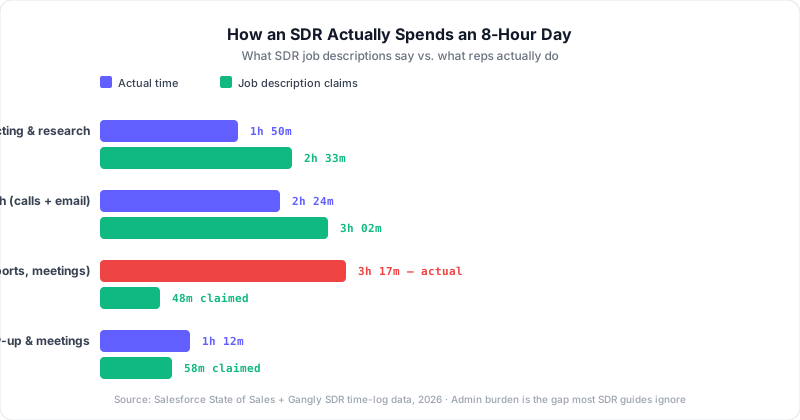
The real SDR day breaks into four blocks:
Block 1: Morning signal scan and outreach prep (8:00–9:30 am)
Strong SDRs start the day by reviewing which accounts triggered a buying signal overnight — a funding announcement, a new hire post, a competitor churn signal. They prioritize those accounts for same-day outreach. Weaker SDRs open their email, react to whatever landed, and reach for the same stale list they worked yesterday.
Signal triage takes 15–30 minutes with the right tooling. Without it, a rep can spend the first 90 minutes of the day "researching" without ever sending a single message. The buying signals B2B guide covers the full signal taxonomy.
Block 2: Outreach block (9:30 am–12:00 pm)
The prime calling window for reaching most decision-makers is 9:30 am–11:30 am and 4:00 pm–5:30 pm in the prospect's time zone. Most SDRs run their dial block in the morning. Email and LinkedIn DMs are woven in throughout the day on a sequenced cadence.
A high-activity SDR at a Series B company runs 60–100 dials, 30–50 emails, and 10–20 LinkedIn messages per day. An SDR at an early-stage company with a higher ACV product typically does fewer dials (40–60) with deeper personalization per account.
Block 3: Admin and internal tasks (split across the day)
This is the block most SDR guides gloss over. Salesforce's State of Sales report (2026) documents that sales reps spend 41% of their working day on non-selling activities. For an SDR, that translates to roughly 3 hours and 17 minutes of every 8-hour day on CRM updates, list building, email research, tool configuration, team meetings, and reporting.
That is not a personal failing — it is a system design problem. Every minute an SDR spends entering data manually is a minute not spent in conversation. This is the exact problem reducing sales admin time addresses, and it is the primary reason AI workflow tools produce measurable ROI for SDR teams.
Block 4: Discovery calls and follow-up (1:00–4:00 pm)
Booked meetings typically run in the early afternoon. An SDR on track for quota has 1–4 discovery or intro calls per day. Each call needs 5–10 minutes of prep and 10–15 minutes of post-call work (notes, CRM update, AE handoff documentation, follow-up email). At volume, that compounds quickly.
SDR KPIs, quotas, and metrics
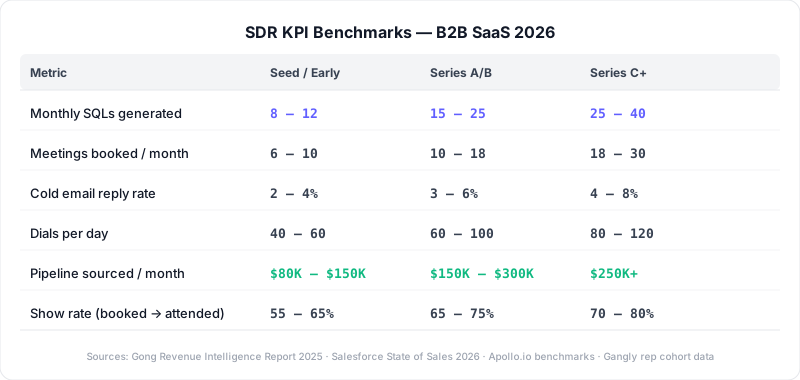
SDR performance is measured on a short list of output metrics. The right metrics vary by company stage, ACV, and motion. Here are the six that matter most.
SQLs generated
The primary quota metric for most SDR roles. An SQL is a lead that has been qualified against the ICP and accepted by the AE as worth a discovery call. SQL definitions vary by company — some require only a confirmed meeting, others require BANT criteria met. Know the definition before you accept the quota.
Meetings booked and show rate
Meetings booked is the activity metric. Show rate (meetings attended / meetings booked) is the quality metric. A 90% show rate on 10 meetings is worth more than a 55% show rate on 20. SDRs who send strong confirmation sequences and add value in the confirmation message consistently run show rates 15–20 points above the mean.
Pipeline sourced ($)
The dollar value of pipeline generated from SDR-sourced meetings. At Series B+ B2B SaaS companies, top-performing SDRs source $150,000–$300,000 in new pipeline per month. This metric connects the SDR directly to revenue and makes the role's business case visible to leadership.
Sequence reply rate
Reply rate on outbound sequences — positive and negative combined. Cold outbound across all channels averages a 2–4% reply rate. Signal-led outreach with genuine personalization in sentence one consistently hits 6–12%. If a rep's reply rate sits below 2% for 30+ days, the issue is messaging — not volume.
Meeting-to-SQL conversion rate
Of the meetings an SDR books, what percentage does the AE accept as a real opportunity? A low conversion rate (below 50%) signals a qualification problem — either the SDR is booking soft meetings to hit the activity number, or the SQL definition is too loose. A high conversion rate (above 80%) means the SDR is qualifying well.
What does SDR quota look like?
SDR quotas are set in one of three ways: meetings booked per month (most common), SQLs per month (more rigorous), or pipeline created per month (most aligned with revenue). Typical quota ranges for a B2B SaaS SDR running outbound:
- Seed / early stage: 8–12 qualified meetings per month
- Series A / B: 12–20 qualified meetings or 15–25 SQLs per month
- Series C+ / growth: 20–35 SQLs or $200,000+ pipeline per month
The quota-to-OTE ratio for SDRs follows the standard 4–6× pipeline rule: an SDR should generate 4–6× their OTE in pipeline each month. An SDR earning $60,000 OTE should source $240,000–$360,000 in new pipeline monthly at a healthy company. Details on SDR pay structures are covered in the SDR compensation guide.
SDR tools and tech stack
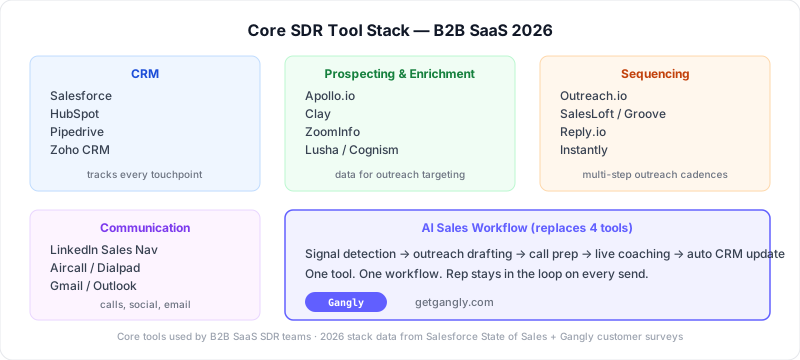
An SDR at a modern B2B SaaS company typically manages 4–7 tools simultaneously. Each tool owns a slice of the workflow. The problem: those slices rarely connect. A rep switches tabs 30–40 times per hour, losing context at every handoff.
CRM (non-negotiable)
Salesforce, HubSpot, and Pipedrive are the dominant platforms. The CRM is where every contact, conversation, and next-step lives. An SDR who falls behind on CRM hygiene produces pipeline data the company cannot trust. The CRM hygiene playbook covers what good looks like in practice.
Prospecting and enrichment
Apollo.io, ZoomInfo, Clay, Lusha, and Cognism provide contact data, firmographic data, and technographic data. These tools answer the question "who should I reach out to and how do I reach them." Quality matters more than quantity — a list of 500 perfectly matched ICP accounts outperforms 5,000 loosely filtered contacts every time.
Sequencing
Outreach.io, Salesloft, Groove, Reply.io, and Instantly handle multi-step, multi-channel outreach cadences — the automated scheduling of emails, call reminders, and LinkedIn tasks over a 21–30 day window. Without a sequencer, reps manually track follow-up timing in a spreadsheet, which they inevitably abandon.
Signal monitoring
The most underused category in the SDR stack. Signal tools watch for buying triggers — job changes, funding rounds, hiring activity, competitor churn, technology installs — and surface the accounts worth contacting today. SDRs running signal-based outreach book 3–5× more meetings per dial than those working static lists (Gong Revenue Intelligence Report, 2025).
AI workflow tool
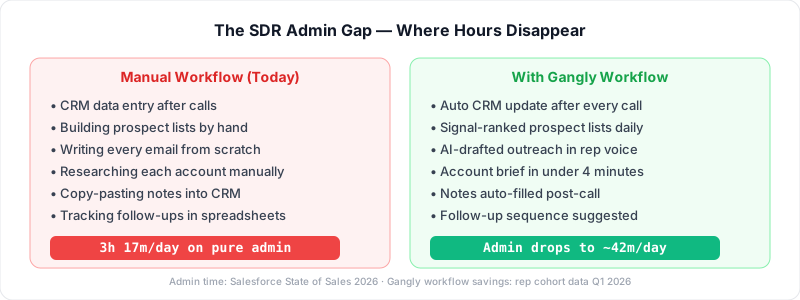
The newest category — and the one replacing multiple point tools. An AI workflow tool like Gangly connects signal detection, outreach drafting, call prep, and CRM update into a single sequence. The rep reviews and approves at each step. The admin work is handled automatically. The result: the admin block drops from 3+ hours to under an hour per day, and outreach quality improves because the rep has more time to personalize. See how it works at how Gangly works.
SDR career path — from rep to AE and beyond
The SDR role is the clearest on-ramp into a B2B sales career. The path from SDR to AE is well-traveled, and the timeline is shorter than most candidates expect.
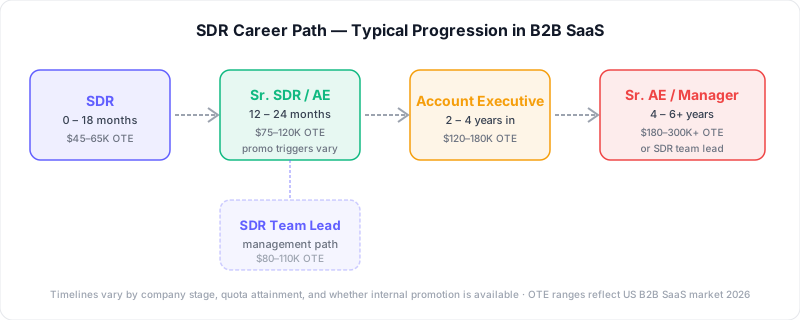
SDR (0–18 months)
The first job in sales. Focus: master prospecting mechanics, outreach cadence, and live qualification. Hit quota for three consecutive months. Learn the ICP cold. Build genuine product knowledge without crossing into AE territory on discovery calls. OTE range: $45,000–$75,000 depending on company stage, location, and industry.
Senior SDR (12–30 months)
An optional step at companies that create it. Senior SDRs handle more complex accounts (larger companies, longer buying cycles), mentor junior reps, and often take on enterprise prospecting motions. OTE: $70,000–$95,000. Some SDRs skip this step entirely, jumping directly to an AE role after 12–15 months.
SDR Team Lead (alternative path)
For SDRs who prefer management over individual contributor work, the team lead role develops coaching, onboarding, and playbook-building skills. OTE: $80,000–$110,000. It is not a stepping stone to AE — it is a different career track pointing toward SDR Manager, VP of Sales Development, and eventually VP of Sales.
Account Executive (18–36 months in)
The most common destination for high-performing SDRs. AEs own the full sales cycle: discovery, solution positioning, multi-stakeholder navigation, negotiation, and close. OTE at mid-market AE level: $120,000–$180,000. The promotion decision hinges on three signals: consistent quota attainment (3+ consecutive months above 90%), demonstrated discovery skills (can the SDR run a real discovery call and identify a compelling event?), and clean handoffs (do the AEs trust the pipeline the SDR generates?). The full playbook is in the SDR to AE promotion guide.
Common SDR mistakes that stall careers
Six mistakes account for the majority of underperformance in the SDR role. Each has a specific fix.
- 1
Confusing activity with output
Sending 200 emails a day at a 0.5% reply rate produces fewer SQLs than 40 targeted emails at 8%. Volume is a trailing indicator. Personalization and signal timing drive the leading ones.
- 2
Skipping the CRM update until end of day
Notes written 6 hours after the call lose 70% of specificity. That specificity is what makes the AE handoff worth anything. Update the CRM inside 20 minutes of every conversation.
- 3
Treating every prospect identically
The same opener to a VP of Sales and a Director of IT is a mistake. Persona mapping — knowing which pain lands with which title — separates SDRs who hit 120% quota from those who hit 60%.
- 4
Stopping a sequence too early
Research consistently shows 80% of sales require 5+ touches, but most SDRs abandon a prospect after 2–3 attempts. The right number is 8–12 touches over 21–30 days, across multiple channels.
- 5
Handing off bad meetings to avoid looking idle
An unqualified meeting handed to the AE is worse than no meeting at all. It wastes AE time, damages the SDR's credibility, and poisons the pipeline report. Qualification is the SDR's one non-negotiable job.
- 6
Ignoring trigger signals
Most SDRs work static lists. The best SDRs work accounts that just got a reason to buy — a funding round, a leadership hire, a competitor churning. Signal-based timing multiplies reply rates by 3–5× (Gong, 2025).
The common thread across all six mistakes: they are structural problems disguised as effort problems. Adding more dials does not fix a messaging problem. Logging calls at end-of-day does not fix a qualification problem. The fix is always systemic — change the system, not just the output.
How AI is changing the SDR role in 2026
The SDR role is undergoing the most significant transformation in its 30-year history. The question is not whether AI changes the role — it already has. The question is which SDRs benefit and which ones get displaced.
The Gangly SDR Transformation Framework
The 3-Layer SDR Stack
- Layer 1 — Volume work (AI takes this): list building, contact enrichment, email drafting, CRM data entry, follow-up scheduling. AI handles these tasks at 10× the speed with consistent quality. SDRs who defined their value here are at risk.
- Layer 2 — Judgment work (SDR + AI collaboration): qualification calls, objection handling, signal interpretation, persona-specific personalization. AI assists, the rep decides. This layer is expanding, not shrinking.
- Layer 3 — Relationship work (SDR owns this): champion development, multi-threaded account management, discovery calls that uncover real pain. AI cannot replicate the trust built in a live conversation. This is where promotions come from.
What AI tools now handle for SDRs
The admin-heavy work that consumed 41% of the SDR day is the primary target for AI automation. Specifically:
- Signal detection — AI monitors job changes, funding rounds, and buying signals daily, surfacing the accounts worth contacting today
- Email drafting — AI writes signal-led outreach in the rep's voice, referencing the specific trigger event in sentence one
- CRM updates — AI fills contact records, logs conversation outcomes, and updates stage fields without manual entry
- Sequence management — AI tracks follow-up timing, handles bounce processing, and suggests sequence adjustments based on reply patterns
- Call prep briefs — AI compiles a one-page account brief before every discovery call, pulling company news, buyer history, and competitor context
The new SDR value equation
Before 2024, the SDR who sent 200 emails a day had an advantage over the one who sent 50 — volume was hard to achieve manually. Today, volume is trivial. Every SDR can send 200 emails a day with two clicks. The advantage now belongs to the rep with the highest signal-to-noise ratio: the most relevant message to the most timely account, reviewed and approved by a human who cares about the outcome.
SDRs who thrive in 2026 are systems thinkers who use AI to remove admin and redirect the recovered time into judgment-intensive work — better qualification, real personalization, multi-threaded account development. SDRs who resist AI tooling and rely on volume alone are operating a shrinking competitive advantage. The full analysis is in the AI SDR vs AI sales assistant comparison.
How Gangly fits the SDR workflow
Gangly is built as the full-sequence AI sales workflow for SDRs, BDRs, and AEs. Signal Detection surfaces the accounts that just got a reason to buy and delivers a prioritized feed before the SDR opens their email in the morning. Outreach Writer drafts signal-led emails and LinkedIn DMs in the rep's voice — referencing the specific trigger in sentence one. Call Prep builds a one-page brief before every discovery call in under four minutes.
After the call, Notes and CRM Update writes the summary, fills the qualification fields, and pushes the update to Salesforce or HubSpot without the rep entering a single field. The admin block that previously consumed 3+ hours per day drops to under an hour. The rep has more time for the work that drives the promotion — live qualification conversations. See the complete workflow at how Gangly works or book a 20-minute demo.