
 By Siddharth Gangal
TL;DR
- What it is: BANT (Budget, Authority, Need, Timeline) is a four-criteria lead qualification framework IBM created in the 1960s to help hardware reps triage inbound inquiries in under five minutes. It remains one of the most recognized sales frameworks, but it was built for a world with one decision-maker and no subscription pricing.
- Where it holds up: Need remains the strongest letter. Budget and Timeline still surface useful information when used as conversation starters, not checkboxes. BANT is a valid TOFU filter for SDRs qualifying inbound leads before passing to an AE.
- Where it breaks down: Authority assumes a single buyer — but the average enterprise deal today involves 11 stakeholders (Gartner, 2025). Timeline relies on stated intent rather than actual buying signals. BANT has no mechanism for detecting urgency from external trigger events.
- What to use instead: For full-cycle AE deals, replace BANT with MEDDIC. For signal-led outbound, layer buying signal detection on top of qualification to find prospects who are already in motion.
What is BANT qualification?
BANT qualification is a B2B sales framework that helps reps determine whether a prospect is worth pursuing by evaluating four criteria: Budget (can they afford the product?), Authority (do they make the buying decision?), Need (does your product solve their problem?), and Timeline (when will they buy?). IBM developed BANT in the 1960s for hardware sales teams qualifying inbound inquiries. A prospect who meets all four criteria is considered BANT-qualified and worth moving into the sales pipeline.
The appeal of BANT is its speed. A trained rep can work through all four elements in a five-minute phone call. That speed made BANT the default qualification framework for decades, and it still appears in sales training programs, CRM qualification fields, and SDR playbooks worldwide.
But speed is not the same as accuracy. A rep who rushes through four questions and marks a prospect "BANT-qualified" has a checkbox — not a deal. This guide covers what each letter actually surfaces, where the framework breaks down in modern SaaS environments, and what precision-focused reps use to supplement or replace it.
Read this before your next discovery call. The goal is not to abandon BANT — it is to use it for what it was designed to do, and stop asking it to do what it cannot.
Related reading
Compare BANT to the full-cycle qualification framework in MEDDIC vs BANT: Which Qualification Framework Fits Your Team.
Where BANT came from — IBM, 1960s hardware sales
IBM created BANT to solve a specific problem: hardware reps were wasting time on prospects who could never buy. In the 1960s, an IBM mainframe cost between $160,000 and $2.5 million — roughly $1 million to $20 million in today's dollars. The sale required a formal capital expenditure approval, a single decision-maker with budget authority, and a defined implementation date tied to a hardware delivery window.
BANT mapped directly to that reality. Before a rep traveled across the country for a sales call, they needed to confirm: does this company have capital budget? Is the person I am meeting the one who signs? Do they have an actual data center problem? And do they have a procurement window on the calendar?
Those four questions were rational filters for that sales environment. IBM's hardware business operated in a world where:
- Purchases required formal capital budget approval cycles
- One executive — typically a CFO or VP of Operations — made the final call
- Timelines were tied to physical installation windows, not abstract "Q3 plans"
- The product was tangible hardware, not a subscription that could be cancelled in 30 days
The world of B2B SaaS in 2026 looks nothing like that. Products cost $50 to $500 per seat per month. Purchasing decisions involve cross-functional committees. Implementation takes minutes, not months. And "budget" is now a line item on a monthly operating expense report, not a six-month procurement cycle.
BANT was not designed to qualify a $299/month sales workflow tool sold to an AE who found it on a Product Hunt launch. The framework survived because the four letters remain memorable, trainable, and broadly relevant. But reps who apply BANT without adjusting for its original context will miss deals that are actually ready to buy.
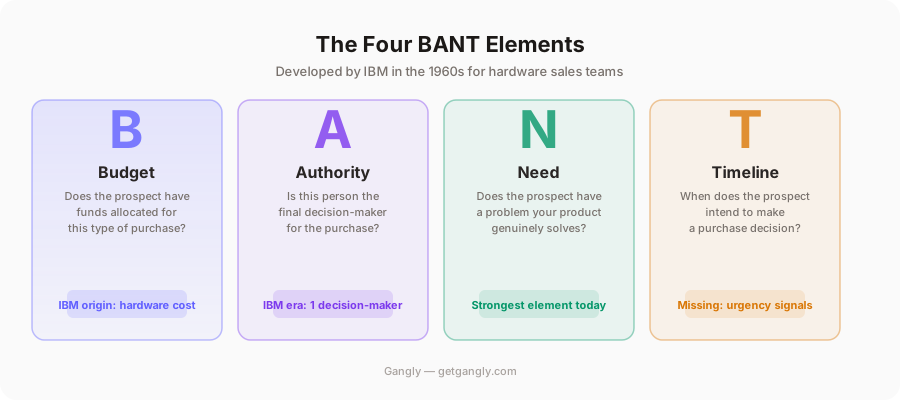
B-A-N-T: what each letter means (with discovery scripts)
Each BANT element answers one qualification question. Below is the definition, the most useful discovery question, and the honest limitation that modern reps need to understand before they rely on the answer.
Budget
What it measures
Determine whether the prospect has funds available for the type of purchase you represent.
Discovery script
"Do you have a budget set aside for solving this problem?"
Honest limitation
In SaaS, most tools are monthly OpEx. A $500/month subscription does not require a capital expenditure approval the way a $250,000 IBM mainframe did in 1965. Asking "what is your budget?" too early signals that you are an order-taker, not a value seller.
Authority
What it measures
Confirm that you are speaking with the person who can sign the contract.
Discovery script
"Are you the person who makes the final purchasing decision?"
Honest limitation
The average enterprise deal involves 11 stakeholders (Gartner, 2025). Searching for "the decision-maker" misses the economic buyer, the champion, the influencer, and the blocker who kills deals after demo. Authority is a committee, not a person.
Need
What it measures
Confirm that the prospect has a genuine pain point that your product addresses.
Discovery script
"What specific problem are you trying to solve?"
Honest limitation
This is the strongest BANT letter. Need is real. The flaw is that most reps stop at identifying the need instead of tying it to a compelling event — the date by which the problem becomes personally costly. Need without urgency is a wish list.
Timeline
What it measures
Establish the prospect's purchasing timeframe to prioritize effort.
Discovery script
"When are you planning to make a decision?"
Honest limitation
Stated timelines are fiction. "Q3" means nothing if no buying signal triggered the conversation. A rep who detects a funding round, a new VP of Sales hire, or a contract renewal date has real timing data. A rep who asks "when are you thinking?" gets a polite guess.
What BANT gets right
Before dismissing BANT entirely, give credit where it is due. The framework survives because it captures real qualification dimensions that matter regardless of era. Here is where BANT still earns its place in a rep's toolkit.
Need is the strongest letter in the room
The N in BANT is timeless. A prospect without a genuine problem your product solves is not a prospect — they are a time sink. Qualifying need in the first conversation prevents the most common rep mistake: building relationships with buyers who will never buy because they do not actually have the problem you solve.
The modern extension of Need is not to stop at problem identification. Ask why the problem exists, what the team has already tried, and what happens personally to the contact if the problem remains unsolved by end of quarter. Those follow-up questions transform Need from a checkbox into urgency data.
Budget starts the value conversation early
Asking about budget in early discovery is not crass — it is efficient. A rep who surfaces budget constraints in the first call can adjust their pitch before building a full custom demo for a prospect who was never going to get sign-off. The key is to reframe the question from "how much do you have?" to "what would solving this be worth to your team this year?"
That reframe moves the conversation from affordability to value. It also surfaces the economic buyer's threshold — the number at which a purchase requires additional approval layers — without making the prospect feel like they are being screened.
BANT works as an SDR triage filter
For a BDR or SDR qualifying inbound leads before passing them to an AE, BANT is a fast, reliable minimum bar. The four questions separate prospects who deserve a 45-minute discovery call from those who need to be nurtured for six months. Used at the top of the funnel, BANT does exactly what it was built to do.
The problem starts when the same four questions are used at stage 3 of a pipeline to justify a forecast entry. That is the wrong tool for the job. BANT qualifies for pipeline entry. MEDDIC qualifies for forecast confidence. The two frameworks serve different stages.
Timeline surfaces urgency gaps before they surprise you
Even an unreliable stated timeline provides information. A prospect who says "sometime this year" is signaling lower urgency than one who says "we need this running before our sales kick-off in September." The gap in urgency should change how aggressively a rep invests time — not how accurately the timeline is trusted.
BANT verdict: strong TOFU filter, weak full-cycle framework
Use BANT to decide whether a lead deserves a discovery call. Once the deal enters the pipeline, upgrade to MEDDIC for forecast-grade qualification.
Where BANT fails in modern SaaS sales
BANT was built for a world that no longer exists. The four gaps below are structural — they cannot be fixed by asking better questions within the framework. They require a different framework.
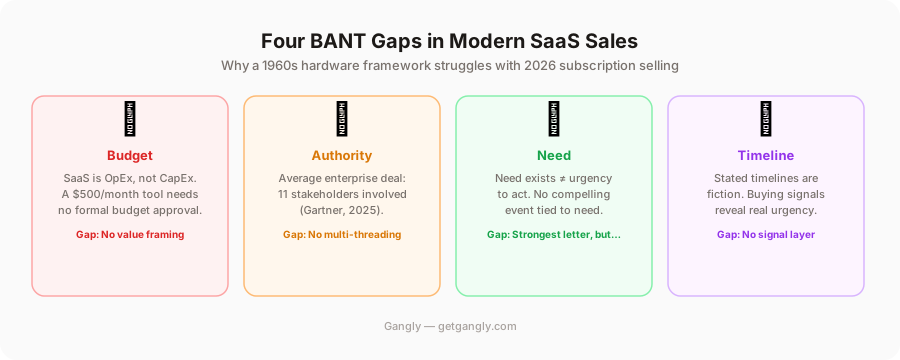
Gap 1: The single decision-maker assumption
BANT asks: "Are you the decision-maker?" That question made sense when IBM sold to a CTO who could approve a mainframe purchase on their own authority. In 2026, the average enterprise software deal involves 11 stakeholders at the point of decision (Gartner, 2025). Those stakeholders include an economic buyer, a procurement officer, legal, IT security, the direct champion, and a group of end-user influencers.
A rep who "qualifies authority" by confirming that one person has "decision-making power" is building on a false foundation. The economic buyer who signs the contract is often not the person who drives the evaluation. The champion who advocates internally is often not the one with budget authority. Treating authority as a single-person attribute is how reps get ambushed by late-stage procurement reviews they never saw coming.
The fix is to replace "authority" with stakeholder mapping. Before the end of call 1, you should know every person who will be involved in the evaluation and sign-off process. The buying committee is the unit of analysis, not the individual.
Gap 2: No mechanism for real urgency
Timeline in BANT captures stated intent. It does not capture actual urgency. A prospect who says "we are thinking about this for H2" has given you a polite guess, not a commitment. Real urgency comes from external events: a new competitor in the market, a contract renewal date, a board mandate, a new VP who wants to show early results, or a quarter-end miss that forced a process review.
Buying signals — job postings, funding announcements, technology changes, leadership transitions — surface real urgency before a prospect even answers the phone. BANT has no field for this data. A rep who relies on Timeline alone will consistently misforecast deals that stall because the stated urgency never had an external event anchoring it.
Gap 3: Budget logic does not translate to SaaS OpEx
IBM's original Budget question assumed capital expenditure: a large one-time purchase that required board-level approval and a formal procurement process. SaaS tools are operational expenditure. A $299/month subscription can be approved by a team manager with a corporate credit card. A $50,000 annual contract still requires procurement review, but the approval path looks nothing like a hardware purchase cycle.
The modern version of Budget qualification is not "do you have a budget?" — it is "what would solving this be worth to your team this year, and what level of spend requires additional sign-off?" Those two questions surface the value anchor and the approval threshold simultaneously. They also prevent the scenario where a rep builds a $150,000 proposal for a team whose manager can approve $20,000 without escalating.
Gap 4: No ROI or success metrics layer
BANT has no letter for the business case. It does not ask: what does success look like in numbers? A deal that scores 4/4 on BANT can still stall at the point of economic buyer approval if the champion cannot answer "what is the ROI on this investment?" MEDDIC's M — Metrics — fills this gap explicitly. The economic buyer signs when they see a quantified return, not when they hear that their team needs the product and has some budget.
BANT vs MEDDIC: honest comparison
BANT and MEDDIC are not competing frameworks for the same job. They qualify at different stages and at different levels of depth. Understanding the difference prevents the most common qualification error: using BANT to justify a pipeline entry that MEDDIC would disqualify.
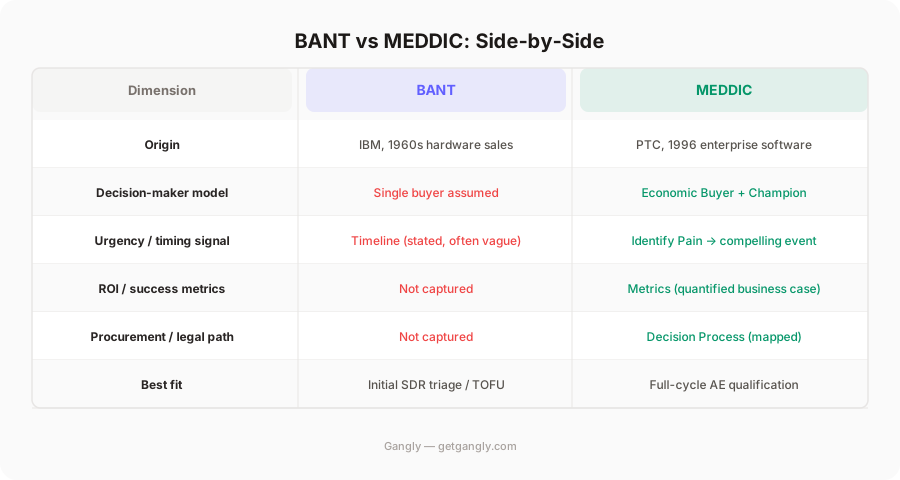
| Dimension | BANT | MEDDIC |
|---|---|---|
| Origin | IBM, 1960s hardware | PTC, 1996 enterprise software |
| Number of elements | 4 | 6 (or 7–8 with variants) |
| Decision-maker model | Single buyer assumed | Economic Buyer + Champion mapped |
| Urgency mechanism | Stated Timeline only | Identify Pain → compelling event |
| ROI / success metrics | Not captured | Metrics (quantified business case) |
| Procurement / legal path | Not captured | Decision Process (mapped) |
| Internal advocacy | Not captured | Champion (identified + tested) |
| Best fit | SDR inbound triage (TOFU) | Full-cycle AE qualification (MOFU–BOFU) |
| Time to complete | 5 minutes | Multiple calls (60–90 days) |
The practical decision rule: use BANT to decide if a lead deserves a discovery call. Use MEDDIC to decide if a deal deserves a forecast entry. Teams that skip MEDDIC and rely on BANT throughout the pipeline end up with inflated pipeline numbers and missed quarters.
Read the full breakdown in MEDDIC Sales Methodology: The Complete Guide — including discovery scripts for all six elements and the 0–60 deal scorecard.
The Signal-Qualification (SQ) Framework
The core flaw in BANT is that it relies on what a prospect tells you rather than what they are already doing. A prospect who says "we are looking at tools like yours for Q3" has given you a stated intention. A prospect whose company just posted three RevOps hiring roles, announced a $40 million Series B, and hired a new VP of Sales is already in motion — whether or not they have answered your calls.
The Signal-Qualification (SQ) Framework layers buying signal detection on top of the four BANT dimensions to produce qualification data that does not depend on self-reporting. Here is how it works:
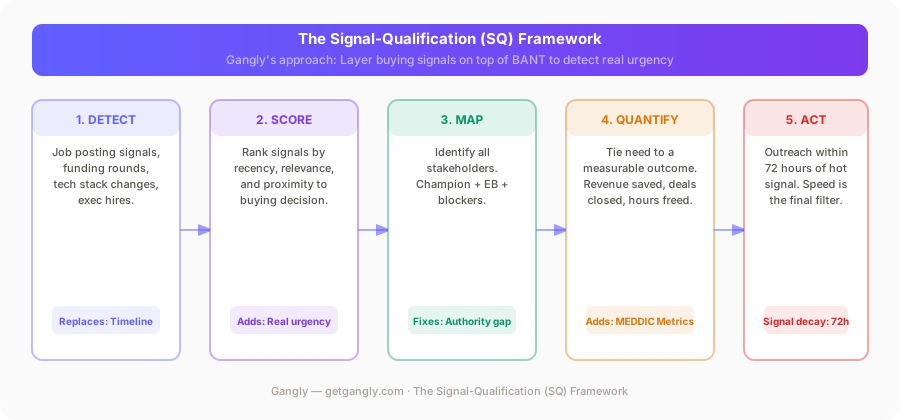
Step 1: Detect — find external trigger events before outreach
Before the first cold call, check for buying signals in the account: new executive hires in the job title that buys your product, recent funding rounds, headcount growth in the relevant department, technology stack changes, job postings for roles that suggest a process overhaul is underway.
What this replaces: Timeline. A company hiring three SDRs and a new VP of Sales has a real timeline — they need their reps productive immediately. You do not need to ask when they plan to buy.
Step 2: Score — rank signal strength before spending time
Not all signals carry equal weight. A company that posted a single BDR role six months ago has weaker signal than one that posted four AE roles, hired a new CRO, and raised a Series B last month. Score signals by recency (signals decay — the average buying signal loses 60% of its urgency value after 72 hours), relevance to your product, and proximity to the actual buying decision.
What this replaces: Budget. A company that just closed a $40M funding round has money. The question is not whether budget exists — it is whether the problem your product solves made it onto the investment thesis list.
Step 3: Map — identify all stakeholders before the discovery call
Use LinkedIn and the company's public org chart to identify every stakeholder who will be involved in the evaluation before you make the first call. Map the economic buyer, likely champion, key influencers, and potential blockers. Walk into the discovery call knowing who else needs to be in the room.
What this fixes: The single decision-maker assumption in BANT's Authority element.
Step 4: Quantify — tie need to a measurable outcome in the first call
BANT's Need element stops at problem identification. The SQ Framework requires you to tie the need to a number in the first conversation: how many reps struggle with this problem, how many hours per week does it cost, what does it mean in revenue terms if the problem persists for another 12 months?
What this adds: MEDDIC's Metrics element — the quantified business case that the economic buyer needs to approve the investment.
Step 5: Act — outreach within 72 hours of a hot signal
Signal decay is real. A company that just announced a new VP of Sales will have 15 vendors in their inbox within the week. The rep who reaches out on day 1 with a relevant, signal-informed message gets the response. The rep who sends the same template on day 10 competes with every other vendor who already had the conversation.
What this does: Converts qualification data into outreach timing. Speed is not a hustle metric — it is a qualification variable that determines whether your message lands in a window of actual buying intent.
How Gangly fits into this framework
Gangly surfaces buying signals from across the web — job postings, funding events, technology changes, executive hires — and routes them to reps with outreach drafted and call prep completed. The SQ Framework describes what great reps do manually. Gangly runs it automatically for every account in the territory. See how Gangly works.
Modern qualification checklist: what to use instead
The goal is not to replace BANT with a longer acronym. The goal is to replace four checkbox questions with eight discovery threads that produce qualification data you can actually trust. Here is the checklist Gangly recommends for full-cycle AEs managing multi-stakeholder deals.
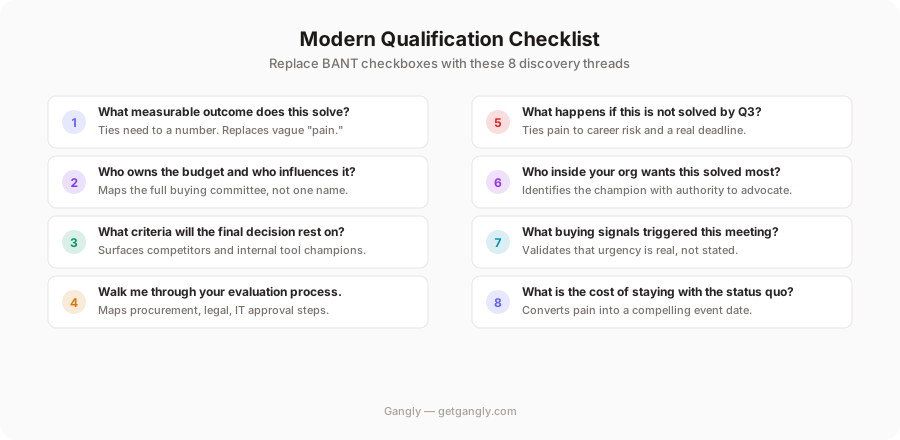
The eight discovery threads
"What measurable outcome does this solve?"
Replaces vague pain identification with a quantified business case. If the prospect cannot name a number, the need is not urgent enough to act.
"Who owns the budget, and who influences it?"
Maps the full buying committee — not just one name. Follow up with: "Who else gets pulled into decisions like this?"
"What criteria will the final decision rest on?"
Surfaces competing vendors and internal champions of rival tools early — before they ambush the deal at the evaluation stage.
"Walk me through your evaluation and approval process."
Maps every procurement, legal, and IT security step — the paper trail that kills Q4 deals when you discover it in November instead of August.
"What happens to you personally if this is not solved by Q3?"
Connects pain to career consequence and reveals urgency. This answer is the most reliable timeline data you will collect in the entire deal.
"Who inside your org wants this solved most and will advocate for it?"
Identifies the champion — and tests whether they have the authority and will to advocate when you are not in the room. A champion who "thinks the CFO will approve this" is not a champion.
"What buying signals or events triggered this conversation?"
Validates that the urgency behind the call is real, not a polite exploratory conversation. The answer should connect to a specific event: a new hire, a missed target, a new mandate from leadership.
"What is the cost of staying with the status quo?"
Converts pain into a compelling event. If the answer is "not much," the deal is low urgency regardless of what the prospect told you about their timeline.
These eight questions do not need to be asked in a single call. Spread them across two or three early-stage conversations. The goal is to fill every field before you enter the deal in your CRM pipeline. A deal with four gaps is not a pipeline entry — it is a discovery objective.
Common BANT mistakes that kill deals
These six mistakes show up in almost every pipeline review. Each one has a specific fix that takes less than two minutes to implement on the next call.
Running BANT as an interrogation, not a conversation
Fix
BANT questions fired in sequence feel like a qualifying exam. Weave each element into a natural discovery thread. Budget comes after you establish value, not before.
Treating "the decision-maker" as a single person
Fix
Map the full buying committee on call 1. Ask: "Who else gets pulled into a decision like this?" Then ask that person the same question. Stop when you have every stakeholder named.
Accepting a stated timeline at face value
Fix
Ask what event is driving the timeline. A contract renewal, a board meeting, or a new hire creates a real deadline. No event = no real timeline. Treat it as an early-stage lead, not a forecast entry.
Using BANT to justify the deal instead of qualify it
Fix
A 2/4 BANT score is a signal to disqualify or to spend one more targeted call filling the gaps — not a reason to push harder. The framework is a disqualification tool as much as a qualification tool.
Qualifying once at stage 1 and never re-scoring
Fix
Economic buyers change. Budgets freeze. Champions leave. Re-score every BANT element after each call. A deal that scored 4/4 in January can drop to 2/4 by March if the champion moves to a new company.
Skipping the "so what" on Need
Fix
Need without consequence is noise. Ask: "What happens to you personally if this is not resolved by the end of the quarter?" The answer reveals urgency — or its absence. That answer belongs in the CRM, not just in your memory.
From Gangly
Qualification data without the manual work
Gangly surfaces buying signals, preps your reps with account research before every call, and logs qualification data to the CRM automatically. The SQ Framework described in this guide — built by hand. Gangly runs it at scale, for every account in your territory.
Siddharth Gangal
Founder, Gangly · Builder of sales workflow systems for AEs and BDRs
Gangly turns buying signals into prepared reps — covering outreach, call prep, live coaching, notes, and CRM updates in one connected sequence. Built for the rep who is tired of stitching together five tools to do one job.