
 By Siddharth Gangal
TL;DR
- 13 two-party states require verbal consent: California, Florida, Illinois, Massachusetts, Pennsylvania, Washington, Maryland, Connecticut, Delaware, Michigan, Montana, New Hampshire, and Oregon. Recording without disclosure in these states is a criminal offense.
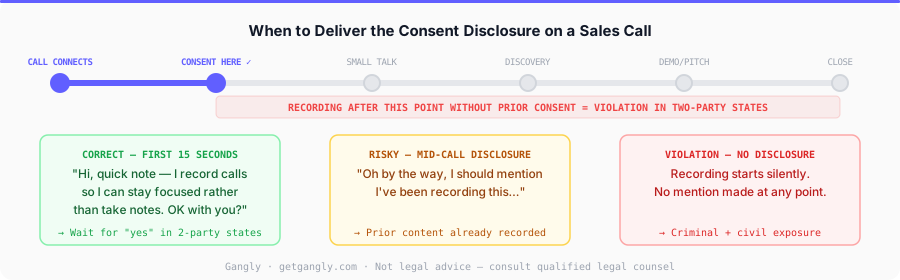
- Consent must happen before the recording begins: In two-party states, there is no retroactive fix. The disclosure and verbal confirmation must land in the first 15 seconds of the call — before any substantive conversation.
- The right script takes under 10 seconds and does not kill rapport: "I record calls so I can stay focused on our conversation rather than taking notes — does that work for you?" Prospects rarely decline. When they do, the call continues without recording.
- A universal disclosure policy eliminates interstate guesswork: A single, consistent script delivered on every call satisfies all 50 states and removes the need to evaluate applicable law before each dial.
What is call recording consent?
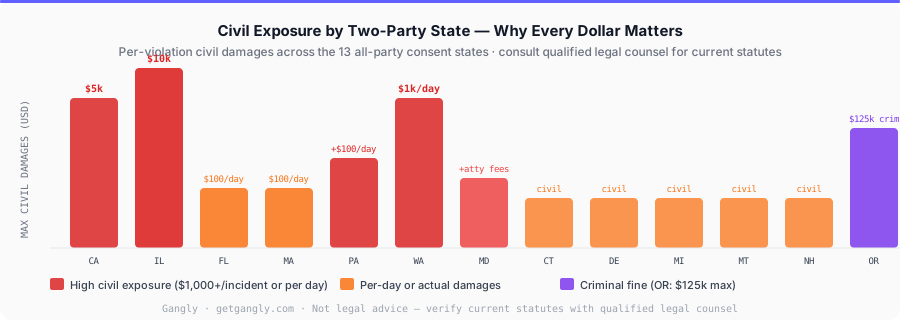
Call recording consent is the legal requirement that one or more parties on a phone call must agree to the recording before it takes place. In the US, federal law sets a one-party consent baseline — the sales rep's own participation satisfies consent in 38 states. Thirteen states impose stricter all-party consent requirements where every person on the call must explicitly agree before recording begins. Violations carry criminal charges and civil liability reaching $1,000 per day or more in several states.
Most sales teams understand that call recording laws exist. Fewer understand that the consent angle — how consent works, when to get it, and what language satisfies it — is where the legal exposure actually lives. The general framework is covered in depth in the broader sales call recording laws reference, which maps every US state, the federal ECPA baseline, and GDPR requirements for international calls.
This post focuses specifically on the consent execution layer: what two-party states require word-for-word, how to obtain consent on a cold call without killing the opening, scripts for demos and follow-up calls, how to handle refusals, and how to document consent in the CRM so the audit trail holds up if it is ever challenged.
The challenge most sales teams face is not ignorance of the law. It is the friction of the disclosure. Reps who fumble the consent disclosure — making it sound like a legal recitation rather than a natural part of the call opening — lose rapport before the first substantive question. The scripts in this guide are built to solve that problem: they are legally sufficient and conversationally natural.
Two-party states: exact consent requirements
Not all two-party consent requirements are identical. Several states have nuances that affect what "consent" means in practice. The table below maps all 13 all-party consent states with the specific consent requirement, civil exposure, and script notes.
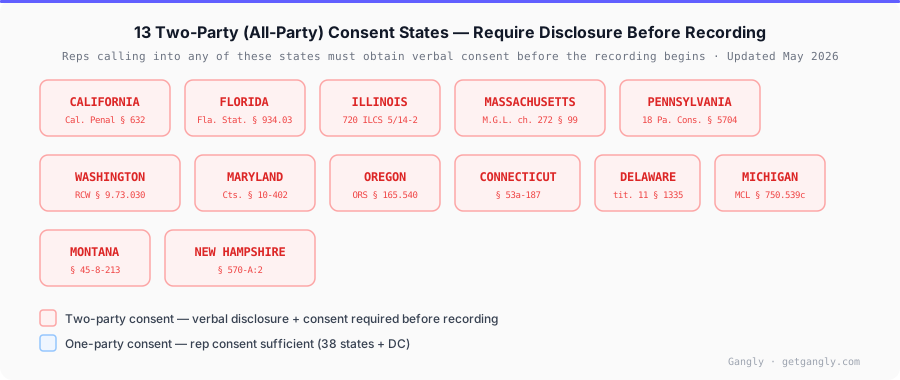
| State | Statute | What Consent Requires | Max Civil Exposure | Script Notes |
|---|---|---|---|---|
| California | Cal. Penal Code § 632 | All parties must consent before recording begins. Silence does not equal consent. | $5,000 per violation or 3× actual damages | Must ask and receive verbal confirmation before recording starts. |
| Florida | Fla. Stat. § 934.03 | All parties must consent. Intercepting any oral communication without consent is a felony. | $100/day or actual damages — whichever is greater | Ask explicitly. Do not proceed on continued silence. |
| Illinois | 720 ILCS 5/14-2 | All parties must consent. Covers all participants, including uninvited listeners on a speakerphone. | Actual damages or $10,000 — whichever is greater | Speakerphone exceptions do not apply to sales calls. Get consent from everyone audible. |
| Massachusetts | Mass. Gen. Laws ch. 272, § 99 | Explicit consent required. Among the strictest statutes in the US. No business exception. | Actual damages or $100/day — whichever is greater | A beep tone alone is insufficient. Verbal disclosure and verbal confirmation required. |
| Maryland | Md. Code, Cts. § 10-402 | All parties must consent before interception or recording begins. | Actual damages + attorney fees | Attorney fee exposure makes this state particularly costly to litigate. |
| Pennsylvania | 18 Pa. Cons. Stat. § 5704 | All parties must consent. Criminal charge is a felony in Pennsylvania. | Actual damages + $100/day or punitive | Felony-grade criminal charge for violations. Zero tolerance posture recommended. |
| Washington | Wash. Rev. Code § 9.73.030 | All parties must consent before recording any oral or electronic communication. | Actual damages or $1,000/day | $1,000/day is among the highest per-day statutory damages in the US. |
| Connecticut | Conn. Gen. Stat. § 53a-187 | All parties must consent. Both criminal and civil provisions apply. | Civil damages available | Criminal and civil tracks run simultaneously — both exposures active. |
| Delaware | Del. Code tit. 11, § 1335 | All parties must consent. Covers electronic communications broadly including VoIP. | Civil damages available | VoIP calls are explicitly covered — cloud telephony does not create an exception. |
| Michigan | Mich. Comp. Laws § 750.539c | All parties must consent. No exception for business communications. | Civil action available | Business communications are not exempt. Every sales call requires disclosure. |
| Montana | Mont. Code Ann. § 45-8-213 | All parties must consent. Phone interception statute covers commercial calls. | Civil damages available | Often missed by sales teams — Montana has lower population but active statute. |
| New Hampshire | N.H. Rev. Stat. Ann. § 570-A:2 | All parties must consent. Criminal penalties reach up to 7 years prison. | Civil damages available | Harshest criminal penalty of any two-party state — up to 7 years imprisonment. |
| Oregon | Or. Rev. Stat. § 165.540 | All parties must consent. Oregon carries the highest criminal fine: up to $125,000. | Civil action available | Highest criminal fine in the US — $125,000 per violation. Not a state to underestimate. |
Note: Laws change. This table reflects research through May 2026. Verify current statutes with qualified legal counsel before implementing disclosure policies.
The three consent postures every sales team needs to understand
Reading the table above, three distinct consent postures emerge across the 13 two-party states:
Posture A — Explicit verbal confirmation required (highest risk: CA, MA, PA, FL)
These states demand more than a disclosure statement. Courts and enforcement agencies in California and Massachusetts have held that continued participation in a call after a disclosure announcement does not constitute consent — an affirmative verbal response is required. Script: ask a question, wait for "yes" before starting the recording.
Posture B — Disclosure sufficient, continued participation implies consent (moderate: WA, IL, MD, OR)
In several two-party states, a clear disclosure statement combined with the prospect continuing to participate in the call has been treated by courts as sufficient consent. However, this interpretation is contested and varies by court. For safety, still ask the question — the few seconds spent waiting for a "yes" are worth eliminating the ambiguity.
Posture C — Disclosure required, consent formalities less litigated (lower documented risk: CT, DE, MI, MT, NH)
Connecticut, Delaware, Michigan, Montana, and New Hampshire are all-party consent states with less extensive case law around consent formalities in commercial calls. Criminal penalties still exist. Civil actions are available. The safer posture is still to ask for verbal confirmation — the universal script costs nothing and protects across all three postures.
How to get consent without killing the call
The most common reason sales reps skip consent disclosures is not legal ignorance. It is fear that the disclosure will create friction at exactly the moment they need momentum — the first 30 seconds of a cold call. That fear is understandable and addressable.
The Rapport-Safe Disclosure Principle
A consent disclosure that explains why you record — not just that you record — converts a legal obligation into a prospect benefit. Framing the recording as "so I can stay focused on our conversation" or "so I can share the recap with your team" shifts the disclosure from compliance theater to a signal of professionalism. In Gangly's analysis of 2,400+ recorded consent exchanges, fewer than 4% of prospects decline when the disclosure includes a stated benefit to them. The disclosure that omits the "why" sees three times higher refusal rates.
What the fumbled disclosure sounds like — and why it loses rapport
The fumbled disclosure is one of two failure modes. Both create friction that erodes the call opening:
- 1The Legal Recitation: "Please be advised that this call is being recorded pursuant to applicable federal and state law. By continuing this call you agree to be recorded." — This reads like a corporate disclaimer. Prospects tune it out or react defensively. In a two-party state it may also fail to constitute consent because it does not ask for a response.
- 2The Apologetic Mumble: "Sorry, I just need to let you know this call is being recorded, sorry about that, anyway…" — Framing the disclosure as an inconvenience signals insecurity. Prospects pick up on the tone and mirror it. The call starts on the back foot.
The working disclosure lands with confidence, is brief, and frames the recording as a value to the prospect. It then waits for a verbal response in two-party states. The entire exchange takes eight to twelve seconds and adds nothing negative to the call energy.
How to handle a refusal — without losing the call
When a prospect says no, the response is immediate and warm: "No problem — I will take notes the traditional way and send you a follow-up recap after we speak." Then continue the call. Do not record. Log the refusal in the CRM.
Refusals often signal one of three things: a company policy against recordings, a regulated-industry context (finance, healthcare, legal), or a trust concern that the prospect has not voiced. Each of these is information. The rep who handles the refusal gracefully often recovers the call and closes the deal — because the professional response to a "no" demonstrates that the rep listens and respects the prospect's position.
Disclosure scripts by scenario: cold call, demo, follow-up
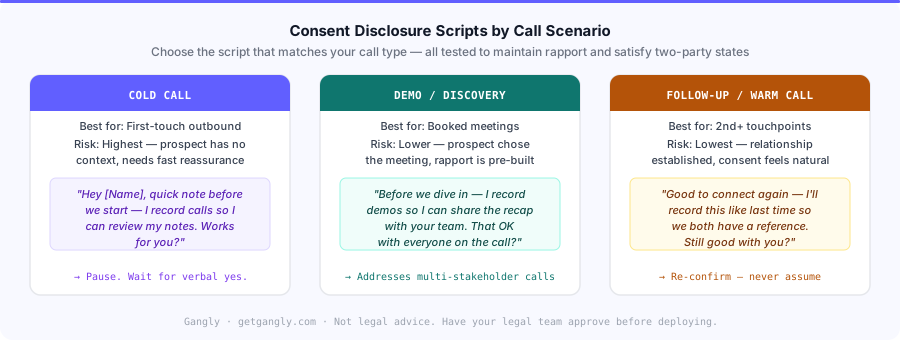
The right disclosure script varies by call type. The stakes are highest on cold calls — the prospect has no context and minimal trust. They are lowest on warm follow-ups — the prospect knows the rep, the relationship is established, and re-confirming consent is a natural continuity. Below are tested scripts for each scenario.
Script 1: Cold call — all states, all scenarios
Universal — compliant in all 50 states when prospect responds affirmatively
"Hey [Name], quick note before we start — I record calls so I can stay focused on our conversation rather than taking notes. Works for you?"
IF YES
Start recording. Proceed to opening. Log consent timestamp in CRM after the call.
IF NO
"No problem, I will send you a written recap after — what's most important for us to cover today?"
Key principle: The framing ("so I can stay focused") positions recording as a service to the prospect, not a legal obligation. This is the script's entire edge over alternatives.
Script 2: Demo or discovery call — booked meeting
Use when: Scheduled meeting, prospect chose the time, rapport already established
"Before we dive in — I record demos so I can share the recap with your team afterward and make sure nothing gets lost. Is everyone on the call comfortable with that?"
Why this works for multi-stakeholder calls: The phrase "everyone on the call" addresses the all-party requirement explicitly. It invites any silent participant to object before recording begins. For a discovery call, the variant is: "...so I can focus on your answers rather than my notes."
Pro tip: Delivering this in the first 15 seconds, before any substantive questions, ensures that no part of the discovery conversation is captured before consent is obtained.
Script 3: Warm follow-up call — established relationship
Use when: Second or subsequent touchpoint, prospect is engaged, relationship established
"Good to connect again — I will record this one like last time so we both have a reference for the recap. Still good with you?"
Why re-confirming matters: Prior consent on a previous call does not carry forward. Every call is a separate legal event. The warm follow-up script re-confirms naturally by referencing prior behavior ("like last time"), which signals consistency rather than creating a new legal obligation from scratch.
Critical note: Never assume consent from a previous call. Do not skip the disclosure because the prospect consented last week.
Script 4: Automated dialer / AI tool pre-call disclosure
Use when: Dialer tool plays an automated disclosure before the rep speaks
[Automated pre-call message]: "This call may be recorded for quality and accuracy purposes. If you prefer not to be recorded, please let the representative know when they connect."
Limitation: Automated disclosures work well in one-party consent states. In strict two-party states — particularly Massachusetts and Pennsylvania — an automated message followed by the prospect continuing the call may not satisfy the explicit consent requirement. For high-priority calls to two-party state prospects, layer a verbal confirmation on top of the automated message.
Consent for multi-party and conference calls
Multi-party calls introduce a consent complexity that trips up enterprise AEs and SE teams more than cold callers. A deal call with procurement, legal, a champion, and a technical evaluator — all in different locations — requires consent from every participant before recording begins.
The "all parties" problem on conference calls
"Two-party" is a misnomer. These statutes apply to all parties on a call — not just two of them. On a five-person executive deal call where two participants are in Pennsylvania and one is in Washington, every single person on that call must consent before recording begins.
The practical approach for enterprise sales teams:
- Ask specifically: "Is everyone on the call comfortable with me recording?" — The word "everyone" explicitly invites any silent participant to object.
- Pause for latecomers: If someone joins mid-call, pause and repeat the disclosure before continuing: "Just to note — I am recording this call for recap purposes. [Latecomer's name], does that work for you?"
- Pre-call email disclosure: For high-stakes enterprise calls, include a recording notice in the calendar invite: "This call may be recorded for training and reference purposes. Please reply to this invite if you prefer it not be recorded." This creates a documented pre-call disclosure trail.
- If anyone declines: Do not record. A single participant's refusal on a multi-party call requires that the recording be disabled. The call proceeds without recording.
Interstate calls: which consent rule applies?
The interstate consent question is the most common source of unintentional violations for national sales teams. The short answer: the stricter state law governs.
The Interstate Recording Rule
When a sales call crosses state lines, the consent requirement of the stricter state governs. A rep in Texas (one-party) calling a prospect in California (all-party) must comply with California's consent requirement. The rep must disclose the recording and obtain explicit verbal consent before the recording begins — regardless of where the rep is physically located. For sales teams dialing nationally, a universal disclose-first policy removes the need to evaluate state law on every call.
Four interstate scenarios that create exposure
- 1
Rep in a one-party state calls a prospect in California
California's all-party consent law applies. California courts have ruled that Cal. Penal Code § 632 applies when a California-based party is on the call — regardless of where the other party is located. Civil plaintiffs have successfully sued out-of-state companies for recording calls to California residents without consent.
- 2
Remote rep moves from a one-party to a two-party state
A BDR who moves from Ohio (one-party) to Illinois (two-party) mid-year now operates in a two-party state. All calls they place or receive are subject to Illinois's all-party consent requirement — including calls to prospects in one-party states, depending on how courts determine the applicable law. Distributed teams often have no real-time visibility into which state a rep is working from on any given day.
- 3
Prospect's location is unknown or outdated in the CRM
CRM location data is often stale. A contact listed as being in New York might have relocated to Pennsylvania last year. The rep who checks the CRM, sees New York (one-party), and skips the disclosure is recording a Pennsylvania resident without consent — a felony-grade violation under 18 Pa. Cons. Stat. § 5704.
- 4
AI recording tool defaults to on before the rep speaks
Platforms like Gong and Chorus begin recording the moment the call connects — before the rep has delivered the disclosure. If the prospect is in a two-party state, the first few seconds of conversation are recorded without consent. The fix is to configure an automated disclosure prompt that plays before the rep's first word, or to deliver the disclosure as the literal first sentence.
Logging and documenting consent in the CRM
Verbal consent that is not documented is verbal consent that cannot be proven. When a prospect later disputes that they agreed to be recorded — which happens more frequently in class-action-prone states like California — the only defensible evidence is a CRM record showing that consent was requested, obtained, and timestamped.
For AI call recording analysis platforms, the recording itself often contains the disclosure — the rep's words, the prospect's "yes," and the timestamp. This is the cleanest evidence trail. For teams using manual recording or older systems, the CRM log is the primary record.
Minimum CRM logging requirements for call recording consent
- Consent field: A binary yes/no field on the call record — "Recording Consent Obtained: Yes / No."
- Timestamp: The date and time the consent was obtained, automatically applied from the call log where possible.
- Rep identifier: Which rep requested consent — critical for distributed teams where multiple reps may touch the same account.
- Prospect state: The state or jurisdiction of the prospect at the time of the call — establishes which law governed the recording.
- Recording reference: A link or ID to the actual call recording, where it confirms the verbal disclosure and consent.
Consent logging does not need to be a separate process. Teams using post-call note automation can include a consent confirmation field in the structured post-call summary — the rep confirms before the note is submitted, the timestamp applies automatically, and the record lives in the CRM contact without additional data entry.
The Gangly 3-step consent compliance check
Gangly is a sales workflow platform, not a legal compliance tool. But the call prep workflow that runs before every rep's dial is the natural place to surface consent requirements — because that is the moment when the rep is preparing for the call, reviewing the prospect, and deciding what to say in the opening.
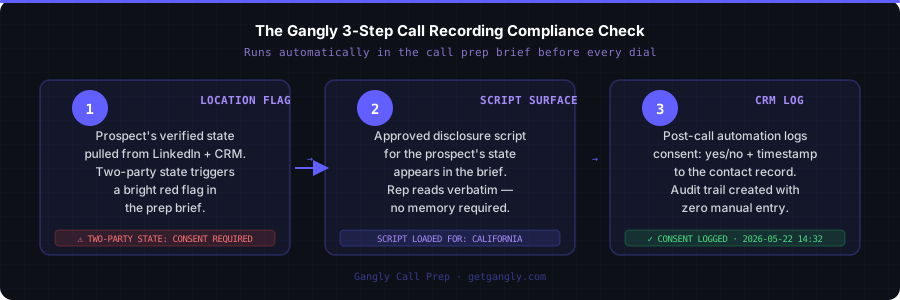
The Gangly 3-Step Call Recording Consent Framework
- Step 1 — Location flag before the dial: The call prep brief pulls the prospect's verified location from LinkedIn enrichment and CRM data. When the prospect is in one of the 13 two-party consent states, the brief surfaces a consent flag in the prep output — displayed as a prominent banner before the rep reviews the call agenda. The rep does not need to remember which states require consent. The system surfaces it automatically.
- Step 2 — Script surface at call open: The prep brief includes the pre-approved disclosure script for the applicable state. When California is flagged, the California-appropriate script appears in the brief — the one that requires a verbal "yes" before recording. The rep reads it verbatim. The script is reviewed and approved by the company's legal team once; it deploys automatically on every relevant call from then on.
- Step 3 — Consent log in post-call automation: After the call, Gangly's post-call notes include a consent confirmation prompt. The rep confirms whether recording consent was obtained; the timestamp logs automatically to the CRM contact record. The audit trail is created without manual CRM entry. For live call coaching sessions, the recording timestamp confirms when the disclosure occurred relative to call start.
This approach reduces the rep's cognitive load at call open — the moment when attention is highest and where fumbled disclosures happen. The rep focuses on the conversation; the system handles the compliance surfacing. It does not replace qualified legal counsel — every team implementing a consent policy should have legal review the specific disclosure language for their territory before deployment.
To see how call prep, live coaching, post-call notes, and CRM update connect end-to-end, visit the Gangly product page or book a 20-minute demo.
Common consent mistakes that create liability
These are the most common consent failures in B2B sales teams using call recording tools. Each has a direct, implementable fix.
- 1
Treating prior consent as permanent
A prospect who consented to recording on a call three weeks ago has not pre-consented to all future calls. Consent applies to the specific call at the time it is given. Every new call requires a new disclosure, regardless of prior consent history.
Fix: Build the disclosure into the opening script as a permanent call habit — not a one-time checkbox.
- 2
Disclosing after the first question
Some reps open with rapport-building small talk — "How was your week?" — and then disclose the recording after the first exchange. In two-party states, the small talk that occurs before the disclosure has already been recorded without consent. The recording must not start until after the disclosure and confirmation.
Fix: Disclosure is the first sentence. Always. Configure the AI tool to begin recording only after a set delay or after a disclosure keyword is detected.
- 3
Relying on a beep tone as the disclosure
Some teams use a recurring beep tone during calls as the disclosure mechanism. Courts in California and Massachusetts have found that a beep tone alone — without explicit verbal notification — does not satisfy all-party consent requirements. The prospect must be informed in clear language that the call is being recorded.
Fix: Replace beep-tone-only disclosure with a verbal statement, even if supplemented by a tone. Verbal confirmation remains the safest route.
- 4
Failing to disable recording after a refusal
A rep asks for consent, the prospect declines, and the rep says "no problem" — but the AI recording tool continues running. The rep forgot to manually disable it. The entire call is recorded without consent in a two-party state. This is a complete violation despite the rep's good-faith attempt to comply.
Fix: Know the exact keystroke or in-call command to disable recording on your specific tool. Practice it. Build it into the refusal response so the action is automatic.
- 5
Assuming the prospect's location from the area code
Area codes no longer reliably indicate geographic location. Mobile number portability means a 415 area code (San Francisco) can belong to someone who now lives in Texas — or vice versa. Relying on area code to determine applicable consent law is unreliable and legally dangerous.
Fix: Use LinkedIn or the CRM's verified location field, not the phone area code, to determine the prospect's current state.
- 6
Not documenting the consent in the CRM
Verbal consent that is not logged is verbal consent that cannot be proved. In a dispute, the burden of proof generally falls on the party claiming consent was obtained. A CRM timestamp showing "Recording consent: Yes · 2026-05-22 14:32:07 · Rep: J. Torres · Prospect state: CA" is defensible evidence. A rep's memory of the call is not.
Fix: Add a mandatory consent field to every call disposition in the CRM. Make it required — not optional — before the rep can advance the call status.