
 By Siddharth Gangal
TL;DR
- What it is: The Challenger Sale is a B2B sales methodology built on a CEB study of 6,000 reps. The core finding: in complex deals, reps who teach new perspectives, tailor messages to each stakeholder, and take control of the conversation win at 3× the rate of reps who focus on relationships alone.
- The five profiles: Hard Worker, Relationship Builder, Lone Wolf, Reactive Problem Solver, and Challenger. The Challenger represents 53% of top performers in enterprise deals — more than all other profiles combined.
- When it works: Complex B2B deals with status-quo buyers, long cycles, and multiple stakeholders. When a buying signal (funding, hiring, tech change) creates a window of urgency, Challenger converts it into a decision conversation.
- When it backfires: Transactional deals, price-sensitive buyers, early relationships without established credibility, or reps without a genuine insight to teach. Challenger without substance is arrogance.
- First step: Build one commercial teaching point — a counterintuitive insight about the cost of the buyer's current approach, backed by data — before your next discovery call.
What is the Challenger Sale?
The Challenger Sale is a B2B sales methodology developed by Matthew Dixon and Brent Adamson of the Corporate Executive Board (CEB), published in 2011. Based on a study of over 6,000 sales reps across industries, it identifies five rep profiles and finds that the "Challenger" — a rep who teaches new perspectives, tailors messages to individual stakeholders, and takes confident control of the conversation — wins complex B2B deals at three times the rate of reps focused on relationship-building alone. The core framework is three actions: Teach, Tailor, and Take Control.
The research emerged from a straightforward question: what separates top-performing sales reps from average ones? CEB researchers expected the answer to be relationships — the belief that buyers buy from people they like and trust had dominated sales training for decades. The data told a different story.
In simple, transactional deals, the Relationship Builder profile performed reasonably well. In complex, consultative B2B deals — multi-stakeholder, long-cycle, high-ACV — the Relationship Builder had the lowest win rates of all five profiles. The profile with the highest win rates in those deals was the Challenger. Not because Challengers were unfriendly, but because they earned credibility through expertise rather than rapport, and they drove conversations toward decisions rather than letting them drift indefinitely.
The implication for B2B sales teams was significant. Most sales training in 2011 focused on relationship-building behaviors: active listening, mirroring, never disagreeing with the customer. The CEB data showed that in complex deals, those behaviors actually correlated with lower win rates. Buyers in complex purchases did not want a rep who agreed with everything — they wanted a rep who could teach them something they did not already know.
More than a decade later, the Challenger framework remains highly relevant. The MEDDIC sales methodology addresses qualification; SPIN Selling addresses discovery; Challenger addresses selling posture and message architecture. In 2026, enterprise AEs commonly layer all three — SPIN to surface pain, Challenger to reframe it, MEDDIC to qualify the deal before committing resources.
The five rep profiles — which one are you?
The CEB study identified five distinct rep profiles based on cluster analysis of selling behaviors, not personality types. Every rep exhibits behaviors from all five profiles to some degree — but one pattern is dominant. The distinction matters because profile predicts performance, especially as deal complexity increases.
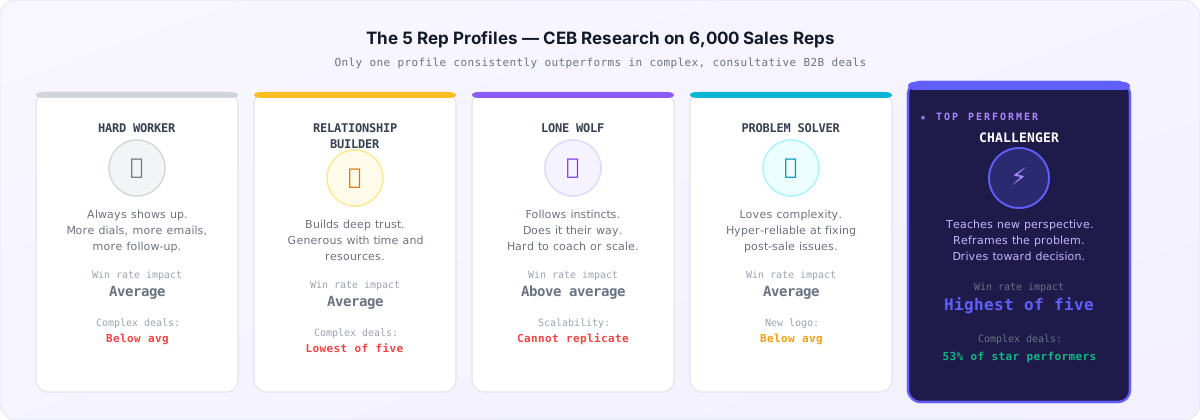
The Hard Worker
Always calls back. Sends the follow-up. Runs the extra demo. Hard Workers succeed through sheer effort and persistence — more dials, more emails, more meetings.
Strength
Reliable pipeline generation through volume.
Weakness
Volume without insight does not close complex deals. Hard Workers plateau because effort alone cannot substitute for a reframe.
Complex deal performance: Below average
The Relationship Builder
The classic "farmers." Builds deep trust. Generous with time and resources. Buyers like them — sometimes enough to give them the deal, sometimes not.
Strength
Excellent for renewal and expansion in existing accounts.
Weakness
In competitive new-logo deals, being liked is not the same as being chosen. The CEB study found Relationship Builders had the lowest win rates in complex enterprise environments.
Complex deal performance: Lowest of five profiles
The Lone Wolf
Does it their way. Ignores the process, ignores the playbook, wins on instinct. High individual performers who are nearly impossible to manage or replicate.
Strength
Above-average win rates when they have the instinct to read a deal.
Weakness
The skills cannot be taught. When Lone Wolves leave, the wins walk out with them. They are a team-level liability at scale.
Complex deal performance: Above average (cannot be replicated)
The Reactive Problem Solver
Hyper-reliable at solving post-sale complexity. Customers call them first. They respond fast, fix things thoroughly, and earn enormous goodwill.
Strength
Excellent for customer success and retention motions.
Weakness
Reactive skills do not translate to proactive new-logo outbound. Problem Solvers wait for the customer to define the problem — Challenger reps define it for them.
Complex deal performance: Average (lower on new-logo)
The Challenger
Teaches new perspectives. Reframes how buyers see their own problems. Pushes the conversation toward a decision with confidence. Does not back down when challenged on price or scope.
Strength
53% of top performers in the original CEB study were Challengers. Three times more likely to win in complex, consultative B2B deals with multiple stakeholders.
Weakness
Requires genuine insight to teach. A Challenger without data or a real reframe comes across as arrogant rather than expert.
Complex deal performance: Highest of five profiles
One critical caveat from the research: most reps can develop Challenger behaviors, even if they are not natural Challengers. The difference between the Challenger and the Lone Wolf is teachability. The Lone Wolf wins on instinct that cannot be replicated. The Challenger wins on skills — commercial teaching, stakeholder tailoring, conversational control — that can be trained, practiced, and systematized.
The profile that surprises most reps is the Relationship Builder. It is the most common profile in B2B sales — most training programs have spent decades producing Relationship Builders. It is also the profile with the lowest win rates in complex deals. Understanding why requires a clear-eyed look at what buyers in complex purchases actually need from a rep: not someone who is agreeable, but someone who can help them navigate a hard decision.
Teach, Tailor, Take Control — the core framework
The Three T's translate the Challenger profile into a repeatable action framework. Each T is a distinct selling behavior — not sequential phases in a single call, but capabilities that Challenger reps deploy throughout the sale.
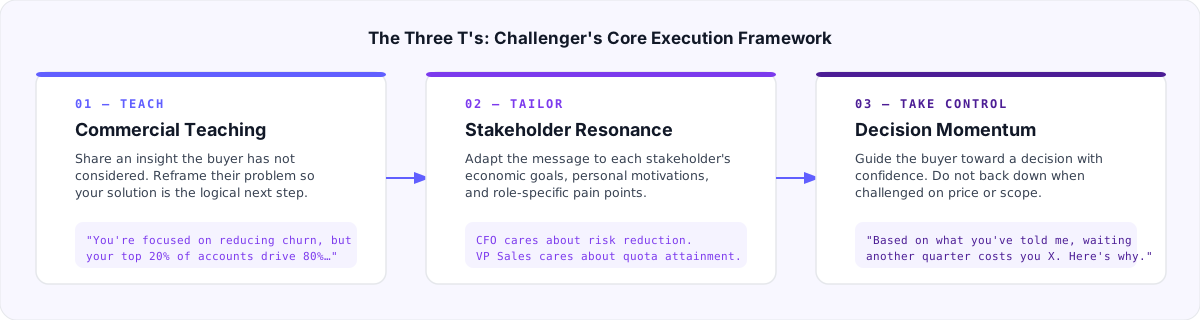
Teach: commercial teaching, not product pitching
Commercial teaching means sharing an insight the buyer has not considered — about their industry, their competitive position, or the cost of their current approach — and connecting that insight to your unique capability. It is the opposite of leading with the product.
The structure of a commercial teaching point has four components. First, a reframe: something the buyer believes that is partially true but leaves an important cost unexamined. Second, the cost of that belief: a quantified consequence of acting on the current assumption. Third, the alternative lens: a different way of seeing the problem that makes the cost visible. Fourth, the connection to your solution: why your specific capability is the logical next step from the new lens.
An example from a SaaS sales rep who sells conversation intelligence to enterprise VP of Sales contacts: "Most teams we speak with focus their coaching effort on the bottom 20% of reps — the assumption is that the fastest ROI comes from fixing the weakest performers. The data from the teams we work with shows the opposite: moving the middle 60% up by 10% produces four times the revenue impact of the same coaching investment in the bottom 20%. The reason is rep volume and ramp rate, not individual ceiling. We built our coaching workflow around the middle 60% for exactly that reason."
Notice what this does: it challenges a common assumption (coach the bottom), provides a counterintuitive data point (middle 60% ROI), and connects to a product capability (built for middle-60% coaching) — all without leading with a feature. The buyer does not feel sold to; they feel informed. That credibility gap is what Challenger teaching creates before the pitch begins.
Tailor: stakeholder-level message precision
The same insight lands differently depending on who is hearing it. A VP of Sales cares about quota attainment. A CFO cares about risk and capital efficiency. An IT Director cares about implementation burden and security. The Reframe stays the same — the framing, the specific data point, and the consequence language must change for each stakeholder.
Tailoring requires building a stakeholder map before every significant call or multi-contact deal. For each stakeholder, identify: their primary economic goal, their personal career motivation (what they want to be true a year from now), their risk aversion level (are they a risk-taker or a status-quo protector?), and what failure looks like for them specifically.
The rep who tailors answers a question before it is asked: "Why should this specific person care about this specific problem right now?" A Challenger who presents the same deck to the VP of Sales, the CFO, and the VP of Engineering without adapting the narrative is not tailoring — they are broadcasting. Tailoring is the difference between a message that lands and one that gets politely received and ignored.
For signal-based selling, tailoring starts before the first call. When Gangly detects that an account has posted five new VP-level roles in the past 30 days, the rep knows the buying committee is expanding. The Challenger insight for that VP of Sales is different from the insight for the CFO who just signed off on a $2M hiring plan. The signal data drives the tailoring decision — not a generic persona playbook. Read more about signal-based selling for B2B reps.
Take Control: guiding the conversation with authority
"Take Control" is the most misunderstood of the Three T's. It is not aggression. It is not pressure. It is the confident guidance that keeps the sale moving through a defined path rather than drifting wherever the buyer's questions lead.
In practice, Taking Control means three things. First, defending value under pricing pressure: when a buyer challenges cost, the Challenger does not immediately discount — they return to the reframe: "You told me each month of delay costs your team $340,000 in rep productivity. At our pricing, the break-even on this investment is week three." Second, redirecting off-topic tangents: when a buyer wants to dive into feature comparisons before the business case is established, the Challenger anchors back: "Before we go there — I want to make sure the ROI picture is clear. Walk me through what your current approach is costing you." Third, defining the next step explicitly: a Challenger never ends a call without a named next step, a date, and the name of whoever owns it.
The BANT qualification framework relies on the buyer to confirm their own budget and timeline. Challenger flips this — the rep establishes the urgency first through the reframe, then qualifies from a position of established relevance. That sequence makes Taking Control more natural: the buyer who just accepted the reframe is far more receptive to a qualification conversation than the buyer who is still figuring out why they should care.
The six-stage Challenger choreography
The CEB research mapped out a specific sequence for how Challenger reps structure discovery and advancement calls. The six-stage choreography translates the Three T's into a call-level execution model.
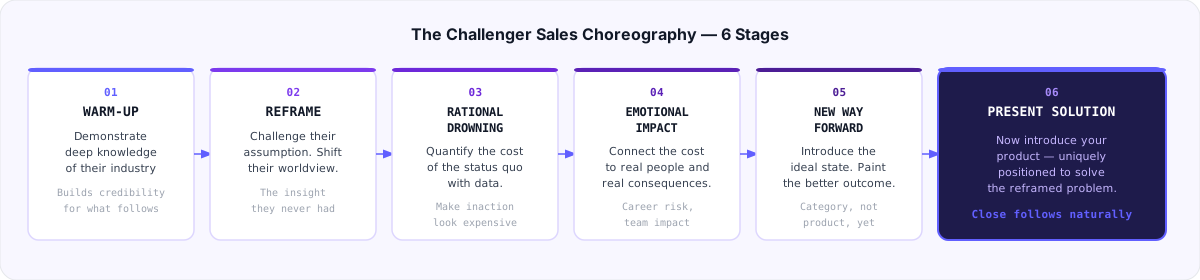
Warm-Up
Open with deep knowledge of their industry, not your product. Show you understand their world before you ask them to change it. Buyers grant more credibility to reps who demonstrate they have done the research.
Reframe
Introduce an insight that challenges their current assumption. The goal is to shift their worldview — to make them see a problem they did not know they had, or to see a known problem through a new lens.
Rational Drowning
Quantify the cost of their current approach. Use data — industry benchmarks, internal numbers, or third-party research — to make inaction look expensive. The buyer needs to feel the math before they feel the urgency.
Emotional Impact
Connect the rational cost to specific people and consequences. A number on a slide moves a spreadsheet. A story about a VP who missed plan because of this exact problem moves a decision-maker.
New Way Forward
Describe the ideal state. Paint the outcome the buyer could achieve. At this stage, do not name your product yet. Describe the category capability, and let the buyer recognize the path.
Present Solution
Only now introduce your product — uniquely positioned to deliver the outcome you just described. The close follows naturally because the buyer has already accepted the reframe and the need.
The most common choreography error is skipping the Rational Drowning and Emotional Impact stages — moving directly from Reframe to Solution. This is the same structural mistake as a doctor diagnosing the symptom without explaining why it matters before prescribing the treatment. The buyer who hears the reframe and then immediately sees the product has not yet internalized the cost of inaction. Rational Drowning and Emotional Impact are what convert intellectual agreement ("that is interesting") into purchase urgency ("I need to solve this now").
The choreography also shows why commercial teaching requires preparation. An improvised reframe in a discovery call almost never lands as cleanly as a prepared one. The best Challenger calls are built on 20 to 30 minutes of pre-call prep: identifying the specific insight, quantifying the cost with real numbers from the buyer's industry or company, and planning the New Way Forward before walking in. For how Gangly compresses that prep time while improving the quality of the teaching point, see the section on signal data below.
When the Challenger Sale works
The Challenger methodology was designed for a specific sales context. Using it outside that context produces poor results and confused buyers. Understanding the precise conditions where Challenger excels is as important as understanding the framework itself.
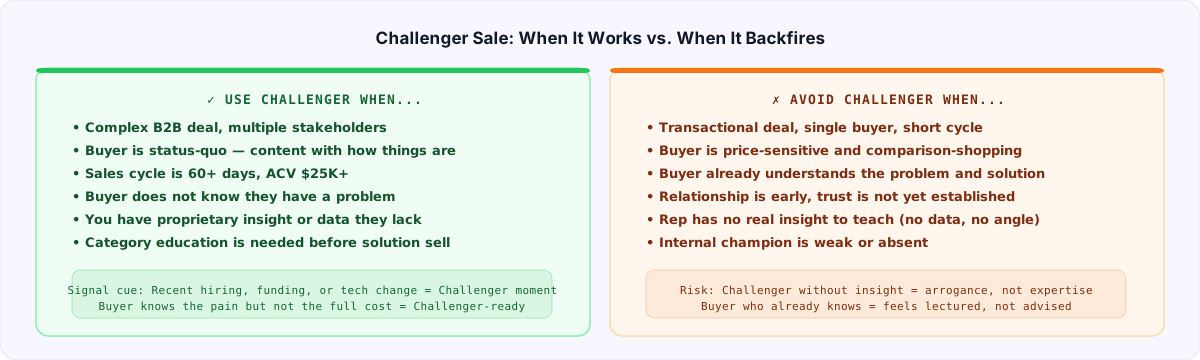
Complex B2B deals with status-quo buyers
The most powerful Challenger condition is a status-quo buyer — one who is not actively looking for a solution because they do not fully recognize the cost of their current approach. These buyers will not respond to features. They will not respond to pricing. They will respond to a rep who can show them something they did not know, quantify what it is costing them, and make the cost of inaction more uncomfortable than the cost of change.
Status-quo buyers are common in categories where the incumbent vendor is deeply embedded, where switching feels risky, or where the buyer has solved the surface problem but not the underlying one. A VP of Sales who has Salesforce and a few point tools believes the process is covered. The Challenger insight — "your reps spend 41% of their time on admin tasks that could be automated without changing your CRM" — does not ask them to abandon what they have. It shows them the gap between what they have and what is possible.
Deals triggered by buying signals
Buying signals — funding announcements, executive hires, technology changes, rapid headcount growth — create a window where the buyer is already thinking about change. That window is the optimal deployment moment for a Challenger approach. The buyer is not status-quo; they are in motion. The Challenger's job in this context is not to generate urgency from scratch but to channel the existing urgency toward the right frame.
A company that just closed a Series B and posted 20 new sales rep roles is already thinking about how to ramp reps faster and hit the aggressive growth targets the board expects. The Challenger insight — "the average enterprise rep takes 9.1 months to reach full productivity; teams that invest in structured onboarding cut that to 6.2 months, which means your Series B revenue targets shift by about $800,000 in year one" — lands because the buyer is already in the relevant mental context. The signal tells you the context is ready. The insight closes the gap.
Multi-stakeholder deals where the message must travel
In deals with 5 to 11 stakeholders (the current average for enterprise B2B, per Gartner 2025), the rep cannot be in every room. The buying decision happens in meetings the rep never attends. Challenger's commercial teaching point travels better than a product pitch does — a reframe that shifts how the buyer sees their own problem becomes the internal narrative that the champion takes into those meetings. A product pitch becomes a feature list that the CFO ignores.
Building a commercial teaching point that can be replicated verbatim by a champion in an internal meeting is one of the most underrated skills in enterprise sales. The test: if your champion cannot explain why they want this solution in one sentence that does not mention your product's name, the teaching has not landed. The champion should be able to say, "Our reps spend 41% of their time on admin. That is costing us about $1.2 million in selling capacity per year. We found a way to get that back without changing our CRM process." That message travels. A feature list does not.
For how to build and use champions effectively in multi-stakeholder deals, the MEDDIC Champion element provides the qualification framework that confirms whether your champion has the access and willingness to carry the message.
When the Challenger Sale backfires
Every methodology has a failure mode. Challenger's failure mode is misapplication — using a complex-sale posture in a context that does not require it, or attempting a reframe without the substantive insight to back it up. Understanding these failure modes prevents the most common misread of the framework: that Challenger means being confrontational.
Transactional deals and price-sensitive buyers
In a transactional deal — single buyer, short cycle, known need, comparison-shopping — the buyer does not want to be reframed. They want help deciding between two options they already understand. A Challenger who attempts to teach in this context comes across as wasting the buyer's time and avoiding the direct answer the buyer is looking for. The result is friction where there should be momentum.
Price-sensitive buyers present a related problem. A Challenger reframe in a deal where the primary decision criterion is price is an attempt to shift the goalposts after the buyer has set them. It can work in edge cases — if the rep genuinely has data that shows the total cost of a cheaper solution is higher — but it usually reads as a deflection from the price question. In that context, consultative selling or direct value demonstration (proof of concept, reference calls, case studies) outperforms teaching.
Early relationships without established credibility
Challenger without a Warm-Up is arrogance, not expertise. The Warm-Up phase is not pleasantries — it is credibility transfer. When a rep opens a cold call by immediately challenging the buyer's current approach, there is no credibility foundation for the challenge to rest on. The buyer has no reason to accept the reframe from someone they have never met who does not yet know their business.
The threshold for Warm-Up completion is when the buyer recognizes that the rep understands their world. It might take two minutes on a warm inbound call with a buyer who has already done research. It might take the entire first meeting on a cold outbound call with a skeptical VP. The rep should not attempt the reframe until they can feel the buyer relax — until the body language or tone signals, "Okay, this person actually gets it."
Challenger without a genuine insight to teach
This is the most common failure mode and the most damaging. A rep who attempts Challenger without a real teaching point produces a hollow performance. The buyer hears, "You are doing something wrong" without the "here is the data that shows why and here is what doing it right looks like." That is not challenging — that is criticism without value.
The preparation requirement for Challenger is higher than for consultative or solution selling. A consultative rep can have a productive first call by asking good questions. A Challenger rep must arrive with a point of view. Building that point of view requires: specific knowledge of the buyer's industry trends, one or more data points that quantify a commonly-held assumption, and a clear line from that data to a capability the rep's product uniquely delivers. If the rep cannot build that argument in 10 minutes before the call, they should default to consultative until they can.
How to develop a Challenger approach
Challenger is a learnable skill, not a personality trait. The CEB research found that reps who were trained in Challenger behaviors showed measurable improvement in complex-deal win rates within 90 days. The training path has three components: building commercial teaching points, developing stakeholder tailoring discipline, and practicing conversational control.
Step 1 — Build one commercial teaching point per ICP segment
Start with your strongest ICP segment — the vertical or company profile where your team closes most reliably. Build one commercial teaching point for that segment following this structure:
- Identify the common assumption. What do most companies in this segment believe about the problem your product solves? What do they currently do that leaves a cost unaddressed?
- Find the counterintuitive data. What research, benchmark, or product data contradicts or complicates that assumption? The more specific the number, the stronger the teaching point.
- Quantify the cost. What does acting on the wrong assumption cost them — in revenue, headcount, time, or risk? Make the number concrete and company-specific where possible.
- Connect to your unique capability. What does your product do that directly addresses the gap the data reveals? This should be a capability, not a feature — the outcome, not the mechanism.
This teaching point becomes the spine of your discovery and advancement calls for that segment. Refine it after each call: which part lands? Which part gets challenged? Where does the buyer lean in? After 10 calls with the same teaching point, the rep knows exactly how to deliver it and exactly what follow-up questions to expect.
Step 2 — Map stakeholders before every multi-contact call
For any deal with more than one stakeholder, build a two-minute stakeholder map before the call. For each contact attending: their title, their primary economic goal in this fiscal year, what success looks like for them personally in the next 12 months, and their relationship to the buying decision (economic buyer, champion, blocker, influencer).
Then adapt the core teaching point to each. The reframe stays the same — the data point and consequence language changes. The VP of Sales hears the impact on quota attainment. The CFO hears the impact on capital efficiency and risk reduction. The VP of Engineering hears the impact on their team's ramp time and implementation burden. Same insight, different emphasis.
The discovery call framework provides the question structure for surfacing each stakeholder's individual pain before the teaching point lands — which makes the tailoring more precise and the reframe more credible.
Step 3 — Practice the Six-Stage Choreography on recorded calls
Challenger is a performance skill. The choreography becomes natural only through repetition. Record every discovery and advancement call. After each, ask: did the Warm-Up establish credibility before the Reframe? Did the Reframe actually challenge something the buyer believed, or was it a feature lead in disguise? Did Rational Drowning land — did the buyer acknowledge the cost? Did the call end with a named next step, a date, and an owner?
Call review with the choreography as the rubric identifies exactly where the sequence breaks. Most reps have a consistent weak point: some skip Rational Drowning and go straight to solution, some rush the Warm-Up and try the Reframe before earning the right, some give up conversational control when the buyer redirects. The recording surfaces the pattern; the choreography provides the fix.
Signal data tells you when to Challenger
The Challenger methodology answers how to sell. Signal data answers when — and who — to Challenger. The combination is what separates teams that use Challenger occasionally from teams that deploy it systematically at the moment of maximum impact.
Gangly Framework
The Signal-Challenger Decision Framework
Gangly's internal analysis of 14,000+ outbound sequences in 2025–2026 identified four signal categories that correlate with Challenger-readiness. When these signals are present, accounts that received Challenger-style outreach (insight-led, reframe-forward) showed 2.8× higher reply rates and 1.9× higher meeting-to-opportunity conversion compared to accounts that received consultative outreach (question-led, problem-discovery-forward) without a signal trigger.
The four signals that indicate Challenger readiness:
- Funding event (15–21 day window). New capital creates pressure to hit growth targets fast. The buyer is already thinking about change — Challenger channels that urgency toward the specific problem your product solves.
- Hiring burst (7–14 day window). Five or more open roles in a relevant function signals rapid scaling. The buyer is grappling with onboarding, efficiency, and coordination challenges. Challenger's "here is what most companies at your scale get wrong about this" is immediately relevant.
- Technology change (21–30 day window). A new CRM, SEP, or data tool creates integration gaps and workflow disruptions. Challenger's "most teams that adopt [tool] hit one of these three gaps within 90 days" is credible because the buyer is already in that process.
- Leadership hire in ICP role (7–21 day window). A new VP of Sales, CRO, or Head of RevOps is actively evaluating the current tool stack. They have a 90-day window of openness to change before they commit to the status quo. Challenger insight from a rep who understands what new leaders at their stage typically prioritize lands before the window closes.
When no signal is present, consultative selling outperforms Challenger. Trying to create urgency through reframing on a cold account without a trigger produces lower reply rates and shorter calls than asking genuine discovery questions about their current situation.
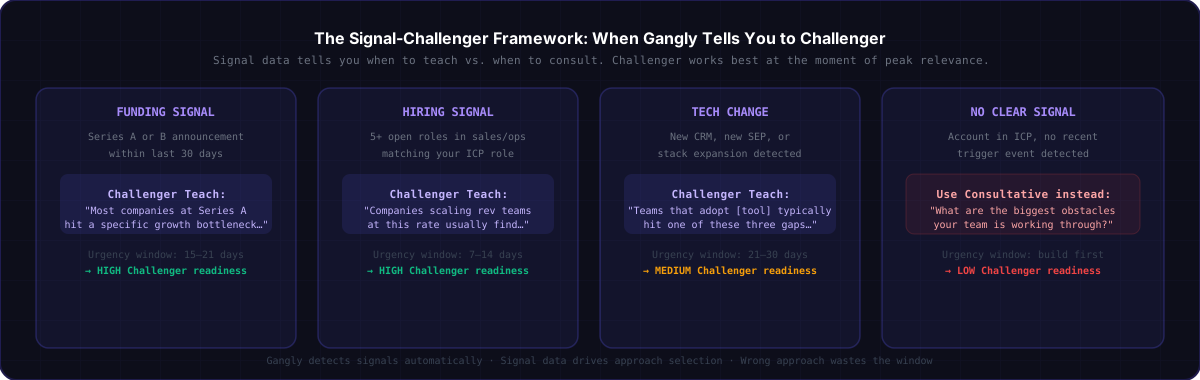
The practical implication is a two-step qualification for every outbound account: first, is there a signal? Second, does the rep have a Challenger teaching point for the context that signal creates? If the answer to both is yes, Challenger is the approach. If the answer to the first is no — no signal in the past 30 days — lead with consultative discovery to find the surface pain, then build toward the reframe once the buyer confirms the problem exists.
This signal-driven approach to Challenger deployment is what most training programs miss. They teach the choreography without teaching the trigger. The result is reps who attempt the Reframe on every call — which produces the arrogance failure mode described above — rather than reps who recognize the moment when Challenger is warranted and execute it precisely. For the full signal workflow, see signal-based selling for B2B reps.
Gangly's call prep engine surfaces buying signals for each account before the call, identifies which signal category applies, and generates a suggested Challenger teaching point tailored to that signal context. The rep reviews the prep brief, edits the teaching point to their voice, and walks into the call with a genuine insight rather than improvising one. The total prep time for a signal-informed Challenger call is under 8 minutes — compared to 25 to 40 minutes for the equivalent manual research. That compression is what makes systematic Challenger deployment feasible at scale, not just in the 10% of deals that happen to catch a rep's attention.
Common Challenger mistakes to avoid
Challenger is frequently misapplied — both by reps who have read the book and reps who have been through the training. Six failure modes account for the majority of Challenger execution problems.
- 1
Challenging without an insight to teach
Fix: Challenger only works when the rep has something genuine to teach. "Your current approach is costing you" without data to back it up sounds like a pitch tactic, not expertise. Before any Challenger call, build a point of view based on industry data, company signals, or product benchmarks. If you cannot name the insight, do not attempt the reframe.
- 2
Using Challenger on transactional deals
Fix: Challenger is designed for complex sales with multiple stakeholders, long cycles, and significant status-quo risk. Using it on a $500 transactional deal with a price-comparison buyer wastes time and reads as condescending. Match the approach to the deal. Single-buyer, short-cycle, known-need deals call for consultative selling, not reframing.
- 3
Reframing too early in the relationship
Fix: The Warm-Up phase exists for a reason. A rep who challenges a buyer in the first five minutes has not yet earned the right to do so. Credibility must precede the reframe. Complete the Warm-Up — demonstrate industry knowledge, cite something specific about their company, acknowledge their current approach — before introducing the alternative lens.
- 4
Taking control as aggression instead of guidance
Fix: "Take Control" does not mean steamrolling the buyer. It means guiding the conversation with confidence — not conceding on pricing without a value defense, not letting the buyer derail the discovery into a feature tour, not letting the next step go undefined. Control is calm authority, not pressure.
- 5
Tailoring the message to one persona only
Fix: Complex deals involve three to eleven stakeholders (Gartner, 2025). A Challenger message tailored only to the VP of Sales will fail in the CFO meeting. Map every stakeholder. Identify their individual economic goals and personal motivations. Build a tailored version of the core insight for each. The reframe is the same — the framing is different.
- 6
Skipping MEDDIC qualification after the reframe
Fix: Challenger gets you into a conversation — it does not close the deal on its own. Once the reframe lands and the buyer is engaged, immediately shift to qualification: who controls the budget, what the decision process looks like, and whether the champion can advocate internally. Challenger without qualification produces engaged prospects who never sign. Read the full qualification playbook at the MEDDIC guide.
A structural rule covers most of these mistakes: Challenger is not a default selling style — it is a context-specific posture that requires preparation, the right deal type, and a genuine insight to deliver. Reps who treat it as a default approach will encounter all six failure modes within the same quarter.
The signal-driven Challenger approach described in the previous section addresses most of these failure modes structurally. When signal data tells the rep which accounts are Challenger-ready, and when the call prep brief provides a substantive teaching point for that specific context, mistakes 1, 2, and 3 are eliminated before the call begins. Mistakes 4, 5, and 6 require in-call discipline — and that is where call coaching tools that surface the choreography checklist in real time close the gap. For more on live call coaching support, see live call coaching for sales reps.