
 By Siddharth Gangal
TL;DR
- Average reply rate: 3.43% (Instantly, 2026). The top 10% of campaigns hit 10.7%+. That gap is not budget or headcount — it is four disciplined choices: under 80 words, advanced personalization, 4–7 touchpoints, and clean domain reputation.
- Average open rate: 27.7–44% depending on dataset (Snov.io / Cleverly, 2026). Industry extremes range from 19.3% (Consumer Goods) to 50% (Recruiting). Treat open rate as directional — Apple MPP inflates the figure for Apple Mail users.
- The first follow-up alone lifts replies by 49% (Belkins, 2025). Yet 44% of reps stop after one touch. The majority of pipeline from cold outbound belongs to the minority who persist through a 4–7 step sequence.
- Advanced personalization generates 18% reply rates vs. 3.43% industry average (Cleverly, 2026). Only 5% of senders personalize every message. The 95% sending templates compete for the bottom of the reply-rate distribution.
- Wednesday is the peak reply day (5.8%). The optimal send window is 9:30–11:30 a.m. in recipient local time. Send at the wrong time and the right message still misses.
Direct answer
Cold email statistics for 2026 show an average open rate of 27.7–44%, an average reply rate of 3.43%, and a top-decile reply rate of 10.7%+. The best send day for replies is Wednesday (5.8%). Sequences of 4–7 touchpoints outperform shorter and longer cadences. Advanced personalization lifts reply rates to 18%. Every statistic on this page is sourced from named primary research published between 2024 and 2026. For year-specific benchmarks including delivery trends, see the companion post on cold email statistics 2026.
Cold email statistics at a glance: the 60-second summary
Three numbers frame the cold email landscape in 2026. Reply rate: 3.43% industry average, 10.7%+ for the top decile. That 3x gap between median and elite performance is not explained by tool choice or list size. It is explained by four inputs that compound: personalization depth, email length, sequence structure, and domain health.
Follow-up persistence: 44% of reps stop after one outreach attempt. The first follow-up alone generates a 49% lift in reply rate. The rep who stops at one touch is leaving approximately half of the available replies from that campaign on the table — permanently.
Personalization gap: only 5% of cold email senders personalize every message. The remaining 95% send templates. Advanced personalization achieves 18% reply rates in 2026 — more than five times the industry average. The methodology gap between template senders and signal-led senders is now larger than any list-size advantage.
2026 Cold Email Snapshot
3.43%
Avg. reply rate
27.7%
Avg. open rate
10.7%+
Top 10% reply
18%
With adv. personalization
The ten sections below break each variable down with sourced data tables, category-specific insights, and the specific rep behavior each number points to. If you need broader context across all outbound channels, the sales statistics 2026 roundup covers cold email alongside cold calling, pipeline, AI adoption, and CRM data.
Cold email open rate statistics: benchmarks, industry data, and what moves the number
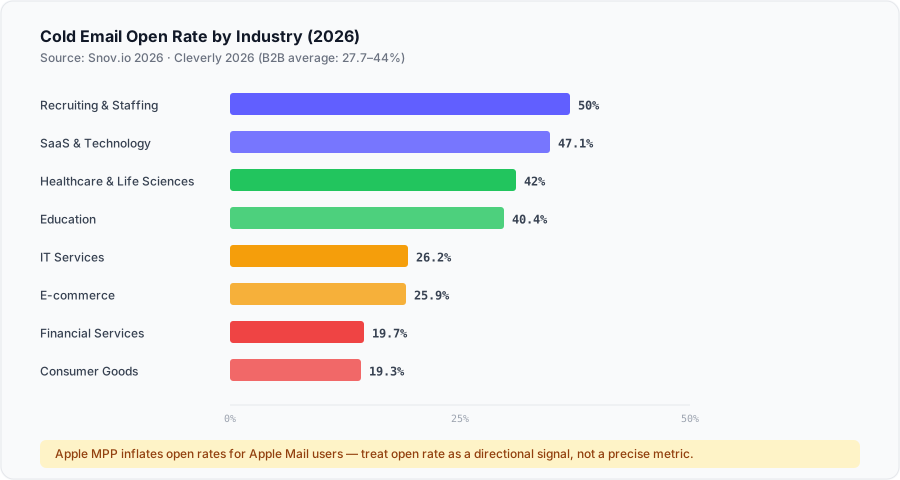
Cold email open rate data in 2026 carries a measurement caveat every sender needs to understand: Apple Mail Privacy Protection (MPP) pre-loads tracking pixels for Apple Mail users, registering an "open" before the recipient has read a word. This means a portion of every reported open rate figure reflects Apple's infrastructure, not a human decision. Treat open rate as a directional signal — useful for comparing your own campaigns over time, not as a precise measure of engagement.
With that context: Snov.io's 2026 dataset puts the average B2B cold email open rate at 27.7%. Cleverly's platform-wide figure is 44% across all campaign types. A "good" cold email open rate sits between 40–60%. Elite campaigns exceed 65%. The C-level targeting split is smaller than most assume: C-suite recipients open at 28.1%, while non-C-level recipients open at 27.3% — a 0.8 percentage point difference that is statistically negligible at most list sizes.
The most actionable open rate finding: 64% of recipients decide whether to open or delete an email based on the subject line alone. Not the sender name, not the preview text, not the body — the subject line. This number means that if open rate is below target, the body copy is likely not the problem.
| # | Stat | What it measures | Source |
|---|---|---|---|
| 01 | 27.7% | Average B2B cold email open rate across all industries | Snov.io, 2026 |
| 02 | 44% | Platform-wide average open rate reported by B2B campaigns in 2026 | Cleverly, 2026 |
| 03 | 40–60% | Open rate range for a "good" cold email campaign in B2B | Cleverly, 2026 |
| 04 | 65%+ | Open rate threshold for elite cold email campaigns | Cleverly, 2026 |
| 05 | 28.1% | Cold email open rate when targeting C-level executives | Snov.io, 2026 |
| 06 | 27.3% | Cold email open rate when targeting non-C-level executives | Snov.io, 2026 |
| 07 | Tuesday | Single best-performing send day for cold email open rates (28.2%) | Snov.io, 2026 |
| 08 | 64% | Of recipients decide to open or delete based on subject line alone | Snov.io, 2026 |
What this means for reps
If open rate is below 30%, the problem is usually one of three: subject line relevance, sender domain reputation, or list hygiene. The subject line fix is the fastest — 64% of open decisions are made before the body is read. For a full breakdown of open rate benchmarks by campaign type, see cold email open rate benchmarks.
Cold email reply rate statistics: average, top performers, and what separates them
Reply rate is the metric that separates campaigns that generate pipeline from campaigns that burn TAM. The industry average in 2026 is 3.43% — consistent across Instantly's benchmark report of billions of sends and Cleanlist's independent analysis at 3.1%. Both datasets agree on the range: below 2% means something is broken; above 5% means the campaign is in the top quartile; 10.7%+ means elite execution on all four key variables.
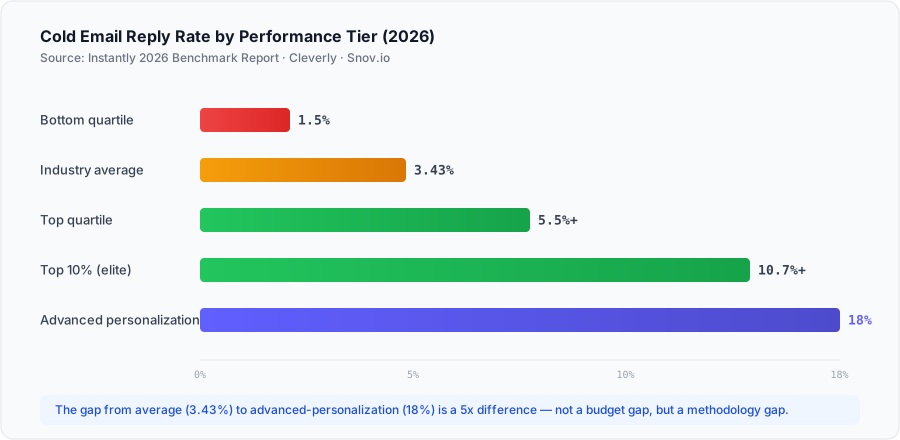
The 5x gap between the industry average (3.43%) and advanced personalization campaigns (18%) is the most important data point in cold email for 2026. It is not explained by send volume — elite senders often send fewer emails than average performers. It is not explained by list quality alone. It is explained by message relevance: the degree to which the opening line, value proposition, and timing connect to something happening in the recipient's world right now.
The distribution by sequence position is equally revealing. 58% of all replies come from the first email. But the remaining 42% come from follow-up steps — and the first follow-up alone adds 49% more replies relative to a one-touch campaign. The reps in the top quartile are not writing better emails than the average; they are sending more of them at the right cadence. For per-vertical reply rate data, see cold email reply rate benchmarks by industry.
| # | Stat | What it measures | Source |
|---|---|---|---|
| 01 | 3.43% | Industry average cold email reply rate across all campaigns in 2026 | Instantly, 2026 Benchmark Report |
| 02 | 3.1% | Average cold email response rate per Cleanlist analysis of B2B data | Cleanlist, 2026 |
| 03 | 5.5%+ | Reply rate threshold for the top quartile of cold email campaigns | Instantly, 2026 Benchmark Report |
| 04 | 10.7%+ | Reply rate for top-10% elite cold email campaigns | Instantly, 2026 Benchmark Report |
| 05 | 5.1% | Average response rate per Snov.io benchmark dataset (2026) | Snov.io, 2026 |
| 06 | 58% | Of all cold email replies come from the first email in a sequence | Instantly, 2026 Benchmark Report |
| 07 | 42% | Of total replies generated by follow-up steps 2 through end of sequence | Instantly, 2026 Benchmark Report |
| 08 | 9% | Average reply rate for campaigns using three-email sequences with one follow-up | HubSpot, 2025 |
| 09 | 23% | Of sales professionals say cold email is the best channel for reaching prospects | HubSpot, 2025 |
| 10 | 21% | Of salespeople say cold email produces the most leads of any outbound channel | HubSpot, 2025 |
What this means for reps
A reply rate below 2% is a diagnostic flag, not a baseline. Audit in this order: deliverability first (is the email reaching the inbox?), subject line second (is it being opened?), opener third (is it being read past the first line?), CTA fourth (is the ask unclear or too high-friction?). Fix in that order. The cold email reply checklist covers each step.
Subject line statistics: the data behind opens and clicks
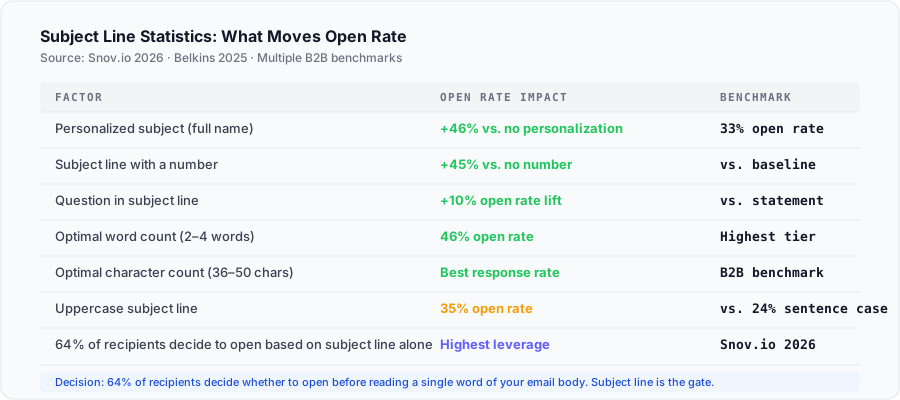
Sixty-four percent of cold email recipients decide whether to open or delete based on the subject line alone. Not the sender name, not the email preview, not the body — the subject line is the gate. The data on what makes that gate open consistently points to four levers: personalization, brevity, specificity, and framing.
Personalized subject lines achieve a 46% open rate versus 35% for generic subject lines — a 31% relative improvement (Snov.io, 2026 / Belkins, 2025). Subject lines with a specific number outperform baselines by 45%. Subject lines framed as questions generate 10% higher open rates than declarative statements. The sweet spot for word count is 2–4 words (46% open rate). The sweet spot for character count is 36–50 characters for response rate optimization.
Two counterintuitive findings from the data: uppercase subject lines achieve a 35% open rate versus 24% for sentence case — a finding that contradicts the conventional "never use all caps" advice. And full-name personalization in the subject line reaches 33% open rate, compared to 9% for first-name-only. Including the last name signals that the sender actually knows who they are writing to, rather than using a mail-merge variable.
| # | Stat | What it measures | Source |
|---|---|---|---|
| 01 | 64% | Of recipients decide whether to open an email based on subject line alone | Snov.io, 2026 |
| 02 | 46% | Open rate for emails with personalized subject lines vs. 35% for generic ones | Snov.io, 2026 / Belkins, 2025 |
| 03 | +45% | Open rate lift from subject lines that include a specific number | Snov.io, 2026 |
| 04 | +10% | Open rate lift from posing a question in the subject line | Snov.io, 2026 |
| 05 | 2–4 words | Optimal subject line word count for highest open rates (46%) | Snov.io, 2026 |
| 06 | 36–50 chars | Optimal character count for subject line response rates | Snov.io, 2026 |
| 07 | 35% | Open rate for uppercase subject lines vs. 24% for sentence-case | Snov.io, 2026 |
| 08 | 33% | Open rate for first-name-only subject line personalization | Snov.io, 2026 |
What this means for reps
Build subject lines in this order: (1) find a specific fact about the prospect, (2) turn that fact into a 2–4 word hook with the full name or company, (3) test question-form vs. statement-form against a matched list, (4) confirm character count stays under 50. The full subject line swipe file and data is in cold email subject lines that get opens.
Email length statistics: how word count affects reply rate
Cold email length data is consistent across every major benchmark source in 2026: shorter wins. Elite senders keep emails under 80 words (Instantly, 2026). Snov.io's dataset identifies under 100 characters as the highest-response body length at 5.4% reply rate. The 50–125 word range generates the strongest reply rates across a broader B2B sample.
The paragraph count data is equally direct: 1–2 paragraphs generates the highest 3.8% response rate. Sentence-level data points in the same direction — sentences under 10 words perform best. The mechanism is cognitive load. A recipient scanning a cold email on a mobile screen takes approximately 2–3 seconds before making a delete decision. A wall of text is not persuasive; it is friction.
Two format findings with high practical value: emails with no attachments generate 2x higher reply rates than emails with attachments. Attachments trigger spam filters and add the cognitive burden of an unknown file. Single-CTA emails outperform multi-CTA emails consistently. Every additional ask dilutes the primary ask. One clear, low-friction next step — "Is Tuesday a good time for 15 minutes?" — outperforms "check out our deck, book a call, or reply if you want to learn more."
| # | Stat | What it measures | Source |
|---|---|---|---|
| 01 | < 80 words | Optimal cold email body length — elite senders stay under 80 words | Instantly, 2026 Benchmark Report |
| 02 | 50–125 words | Word count range with the highest reply rates across B2B campaigns | Multiple benchmarks, 2025–2026 |
| 03 | < 100 chars | Highest response rate body length by character count (5.4%) | Snov.io, 2026 |
| 04 | 1–2 paragraphs | Optimal paragraph count for highest response rate (3.8%) | Snov.io, 2026 |
| 05 | < 10 words | Best-performing sentence length within cold email body copy | Snov.io, 2026 |
| 06 | 2x | Higher reply rate for emails with no attachments vs. emails with attachments | Snov.io, 2026 |
| 07 | 1 CTA | Campaigns with a single call-to-action outperform multi-CTA emails | Instantly, 2026 Benchmark Report |
What this means for reps
Run a length audit on any underperforming campaign before changing anything else. If the email runs over 120 words, cut to 80. Remove any attachment. Reduce to one CTA. In most cases, that three-step edit recovers significant reply rate without changing a word of the message itself. For full data see the post on how long a cold email should be based on send data.
Best send time statistics: day, hour, and sequence timing
Cold email send timing data in 2026 is among the most consistent findings across all benchmark sources. Tuesday and Wednesday are the peak days. Mid-morning in the recipient's local time zone is the peak window. Friday generates the most out-of-office auto-replies of any weekday.
Snov.io's 2026 dataset shows Tuesday produces the highest open rate at 28.2%, while Wednesday produces the highest reply rate at 5.8%. Monday has the lowest reply rate of weekdays (5.1%), equal to Friday — but Monday is the best day to launch new sequences, where "launch" means starting the first step, not necessarily the one that gets read first. Instantly recommends Monday sequence launches precisely because the inbox is fresh after the weekend.
The optimal send time window is 7:00–11:00 a.m. in the recipient's local time zone (Snov.io, 2026), with the peak reply window narrowing to 9:30–11:30 a.m. (Cleverly, 2026). The implication for teams with global lists: schedule sends by recipient time zone, not sender time zone. A 9:30 a.m. send in the sender's EST timezone arrives at 2:30 a.m. for PST recipients — outside every effective sending window.
| # | Stat | What it measures | Source |
|---|---|---|---|
| 01 | Tuesday | Best single day for cold email opens — 28.2% open rate | Snov.io, 2026 |
| 02 | Wednesday | Best day for cold email replies — 5.8% reply rate and peak engagement | Snov.io, 2026; Instantly, 2026 |
| 03 | Monday | Best day to launch new sequences — highest send volume, fresh inbox | Instantly, 2026 Benchmark Report |
| 04 | 7–11 a.m. | Optimal local send time window — highest opens and replies in this block | Snov.io, 2026 |
| 05 | 9:30–11:30 | Peak reply window in recipient local time zone (best results mid-morning) | Cleverly, 2026 |
| 06 | Friday | Highest auto-reply surge day — elevated out-of-office responses | Instantly, 2026 Benchmark Report |
| 07 | Mon / Fri | Lowest reply rates — 5.1% each, compared to Wednesday peak of 5.8% | Snov.io, 2026 |
What this means for reps
Schedule sends in recipient local time. Target Tuesday–Wednesday for peak engagement. Aim for 9:30–11:00 a.m. arrival. Avoid Friday for new sequences — save Friday for follow-up touches to accounts already in a sequence. If the sending platform delivers timing at the sequence level, set it by time zone, not by account.
Follow-up sequence statistics: how many touches, what cadence
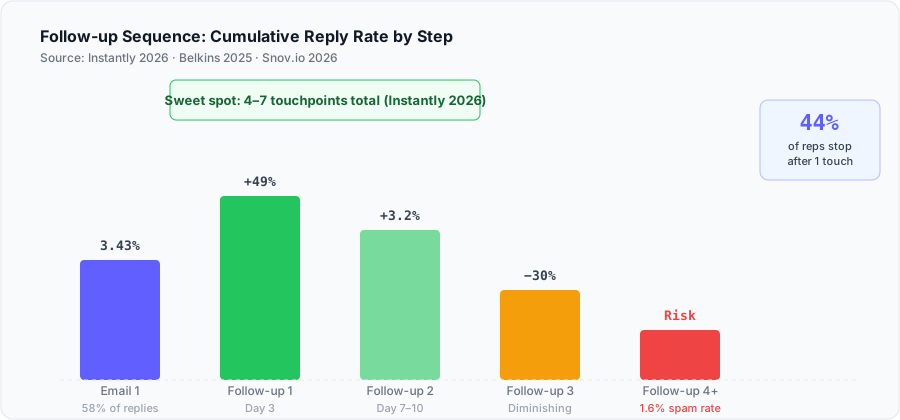
Follow-up sequence data is where the gap between average and top-quartile reps is most visible. Forty-four percent of reps stop after one outreach attempt (GrowthList, 2025). The first follow-up alone generates a 49% increase in reply rate (Belkins, 2025). This means the median rep is leaving approximately half of the available replies from every campaign on the table by stopping too early.
The optimal sequence structure from Instantly's 2026 data is 4–7 touchpoints total. The first email contributes 58% of all replies. Follow-up 1 adds the 49% lift. Follow-up 2 adds 3.2% more. Follow-up 3 drops response rate by 30% — diminishing returns begin. Follow-up 4+ triggers a 1.6% spam complaint rate, which damages domain reputation and reduces deliverability for all subsequent sends.
The optimal follow-up timing is 3 days after the initial email. Two-email sequences (initial plus one follow-up) generate 6.9% average response rates — nearly double the industry average for single-touch campaigns. The data on 80% of deals requiring 5–12 follow-ups (GrowthList, 2025) refers to the full sales engagement sequence, not the cold outreach sequence specifically — but the principle holds: persistence within a well-structured cadence is the behavior that separates closed revenue from missed pipeline.
| # | Stat | What it measures | Source |
|---|---|---|---|
| 01 | +49% | Reply rate increase generated by the first follow-up email alone | Belkins, 2025 |
| 02 | 6.9% | Average response rate for a 2-email sequence with one follow-up | Snov.io, 2026 |
| 03 | +3.2% | Additional responses gained from a second follow-up email | Snov.io, 2026 |
| 04 | −30% | Response rate drop from a third follow-up — diminishing returns begin | Snov.io, 2026 |
| 05 | 4–7 | Optimal touchpoints per cold email sequence for maximum reply rate | Instantly, 2026 Benchmark Report |
| 06 | 3 days | Optimal time between initial email and first follow-up | Snov.io, 2026; Cleverly, 2026 |
| 07 | 1.6% | Spam complaint rate triggered by a 4th follow-up email | Snov.io, 2026 |
| 08 | 44% | Of reps quit after just one outreach attempt, leaving pipeline on the table | GrowthList, 2025 |
| 09 | 80% | Of deals require 5–12 follow-up touchpoints before a decision is made | GrowthList, 2025 |
What this means for reps
Structure every cold sequence as 4–7 touches. Day 0: send. Day 3: first follow-up. Day 10: second follow-up with a different angle. Day 17: third and final follow-up with a breakup line. Stop at 4 touches. Do not add a 5th — the spam rate jump at step 4 is not worth the marginal reply gain. Each follow-up should reference the previous without repeating it. One new hook per touch.
Personalization statistics: the performance gap between generic and signal-led
Personalization is the highest-return variable in cold email — and the most underused. Only 5% of cold email senders personalize every message (Cleverly, 2026). The remaining 95% send templates with name and company variables substituted in. The data is unambiguous about what that choice costs: the difference between 3.43% average reply rate and 18% advanced personalization reply rate is 5.25x performance.
Advanced personalization — beyond first name and company — means opening with a specific reference to something happening in the prospect's world: a recent funding announcement, a new hire in a relevant role, a job posting that signals a workflow problem, a piece of published content they wrote, a technology change visible in their tech stack. These signals make the opening line of the email factually specific rather than structurally specific. The buyer cannot easily tell themselves "this person is using a template" when the email opens with an accurate reference to their quarterly earnings call.
The mechanism for the 142% reply lift from multiple custom fields is compounding signal density. A single personalized field creates a moment of recognition. Multiple personalized fields — opener referencing a news event, body copy referencing a specific pain point for their role, CTA tied to a timeframe relevant to their business cycle — create a message that reads as written for this person today. That specificity is what separates a 3% campaign from an 18% campaign.
Gangly's Outreach Writer builds this context automatically. When a buying signal fires — a new VP of Sales hired, a job posting for a role Gangly helps, a funding event — Gangly drafts an opening line grounded in that specific event. The rep reviews, adjusts the tone, and sends. The research that takes a rep 15–20 minutes per account to gather manually takes Gangly under 60 seconds. The result is personalization at volume without the manual research tax.
| # | Stat | What it measures | Source |
|---|---|---|---|
| 01 | 18% | Reply rate from campaigns with advanced personalization beyond first name | Cleverly, 2026 |
| 02 | 133% | Reply rate increase from personalization — 7% with vs. 3% without | Multiple benchmarks, 2026 |
| 03 | +142% | Reply rate lift from multiple custom personalization fields per email | Cleverly, 2026 |
| 04 | +50% | Open rate lift from personalized subject lines vs. generic subject lines | Cleverly, 2026 |
| 05 | 5% | Of cold email senders personalize every message — 95% send templated sends | Cleverly, 2026 |
| 06 | 73% | Of B2B decision-makers say message relevance is important or very important | Multiple B2B benchmarks, 2026 |
| 07 | 2–4x | Higher reply rates from individually personalized emails vs. generic sends | Mailshake, 2025 |
| 08 | +10% | Average conversion rate improvement attributable to personalization alone | Snov.io, 2026 |
What this means for reps
Every template send is a choice to operate in the bottom quartile of reply rates. Advanced personalization is not a luxury for enterprise accounts — it is the single methodology change with the highest documented return in cold email. The full framework for building signal-led openers is in the cold email copywriting framework. For deep personalization beyond the opener, see cold email personalization beyond "I saw you posted".
Deliverability statistics: bounce rates, spam placement, and inbox reach
Deliverability is the foundation that all other cold email metrics sit on. A 3.43% reply rate assumes the email reached the inbox. The average global inbox placement rate across B2B cold email campaigns is 83–84% (Cleverly, 2026). The target for a well-configured sending setup is 90–95%+. The gap between 83% placement and 95% placement represents approximately 1 in 8 emails never reaching the recipient at all — a silent quota on campaign performance that no amount of subject line testing can fix.
The bounce rate threshold matters more than most reps realize. The average hard bounce rate across B2B campaigns is 7.5% (Snov.io, 2026). The safe threshold is below 2% (Instantly, 2026). Above 2% bounce rate, domain reputation degrades. Gmail's spam threshold is 0.1% — above that, Google's systems begin routing emails to spam folders. Forty-eight percent of cold email senders report bounce rates between 2–5% (HubSpot, 2025), meaning nearly half of all senders are operating above the safe threshold.
The domain warm-up protocol is the entry requirement for cold email at scale. Instantly's 2026 data recommends 4–6 weeks of gradual volume ramp — starting with 5–10 emails daily and increasing incrementally — before sending at full campaign volume. Sending at volume from a cold domain is the fastest way to reach spam folder across the recipient universe. For a detailed warm-up protocol, the cold email warm-up guide covers the full timeline and tool setup.
| # | Stat | What it measures | Source |
|---|---|---|---|
| 01 | 83–84% | Average global inbox placement rate across B2B cold email campaigns | Cleverly, 2026 |
| 02 | 90–95%+ | Target inbox placement rate for a well-warmed domain with clean lists | Cleverly, 2026 |
| 03 | < 2% | Safe bounce rate threshold — above this damages domain reputation | Instantly, 2026 Benchmark Report |
| 04 | 7.5% | Average hard bounce rate across B2B cold email campaigns | Snov.io, 2026 |
| 05 | 4–6 weeks | Domain warm-up timeline before sending cold email at volume | Instantly, 2026 Benchmark Report |
| 06 | 0.1% | Gmail spam rate threshold — above this triggers inbox filter adjustments | Google Postmaster Tools, 2025 |
| 07 | 48% | Of cold email senders report bounce rates between 2–5% | HubSpot, 2025 |
| 08 | 2.17% | Average unsubscribe rate across B2B cold email campaigns | Snov.io, 2026 |
What this means for reps
Check bounce rate before diagnosing open or reply rate. If bounce rate is above 2%, fix the list first — verify email addresses before adding them to a sequence. Use a dedicated sending domain (not your primary business domain) with complete DMARC, DKIM, and SPF authentication. Monitor Google Postmaster Tools for spam rate. A deliverability problem looks like a subject line problem until you check inbox placement. Full setup in cold email deliverability.
Cold email statistics by industry: open and reply rate benchmarks
Industry-level cold email benchmarks reveal a counterintuitive pattern: high open rates do not predict high reply rates. SaaS and Technology leads all verticals with a 47.1% open rate — but produces one of the lowest reply rates in the dataset at 0.5–2.4%. Legal Services has a below-average 27.3% open rate — but leads all verticals with a 10% reply rate. The explanation is inbox competition density. Technology buyers receive more cold email than any other buyer segment. Legal professionals receive less. The signal-to-noise ratio in legal inboxes is higher, so a relevant, well-personalized email stands out more.
Recruiting and Staffing leads on open rate (50%) and posts strong reply rates (5.8–7.2%), making it the highest-performing vertical across both metrics. Healthcare achieves a mid-range performance on both axes. Financial Services and Consumer Goods sit at the bottom of both metrics — Financial Services is heavily regulated with strict communication policies, and Consumer Goods buyer inboxes reflect the highest volume-to-signal ratio.
The practical implication: if the sending vertical has high open rates and low reply rates (SaaS), the body copy and offer relevance need work. If the vertical has low open rates and strong reply rates (Legal), the subject line is the bottleneck. Address the metric that lags the vertical benchmark before changing strategy entirely.
| Industry | Open Rate | Reply Rate | What to watch |
|---|---|---|---|
| Recruiting & Staffing | 50% | 5.8–7.2% | Highest open rates across B2B verticals |
| SaaS & Technology | 47.1% | 0.5–2.4% | High opens, low reply — inbox saturation |
| Healthcare & Life Sciences | 40–45% | 3–5% | Mid-tier on both dimensions |
| Education | 40.4% | 2–4% | Strong opens; longer decision cycles |
| Legal Services | 27.3% | 10% | Highest reply rate in dataset |
| IT Services | 26.2% | 3.7% | Near-average on both metrics |
| E-commerce | 25.9% | 4.8% | Solid reply for the open rate |
| Financial Services | 19.7% | ~1.5% | Highly regulated, low engagement |
| Consumer Goods | 19.3% | ~2% | Lowest open rate in dataset |
Sources: Snov.io 2026 · Cleverly 2026. Industry categories use combined dataset methodology.
What this means for reps
Benchmark your campaign metrics against your vertical, not against the industry average. A 3% reply rate in Legal Services is below benchmark (the vertical averages 10%). A 3% reply rate in SaaS/Technology is above benchmark (that vertical averages 0.5–2.4%). The same number means opposite things depending on who you are selling to. Detailed vertical data at cold email reply rate benchmarks by industry.
The Signal Gap Framework: Gangly's model for reading what the data actually says
Every cold email statistic in this article points to the same underlying problem: the gap between what a rep knows about a prospect and what the prospect needs to hear. The Signal Gap Framework is Gangly's model for reading what the data says about where that gap comes from and how to close it.
The framework identifies three failure modes in cold email performance, each diagnosable from the metric pattern:
The Signal Gap Framework — Three Diagnostic Patterns
Pattern 1: Low open rate + low reply rate
Diagnosis: deliverability or subject line failure. The message is not reaching the inbox or not being opened. Fix deliverability first (bounce rate, spam rate, warm-up), then subject line (personalize, shorten, test question vs. statement). Body copy is not the bottleneck.
Pattern 2: High open rate + low reply rate
Diagnosis: signal gap in the body. The subject line attracted attention, but the opening line or value proposition did not connect to the prospect's current situation. This is the SaaS vertical pattern: 47.1% open rate, 0.5–2.4% reply rate. The fix is contextual relevance — what is happening in this prospect's world right now that makes your message timely?
Pattern 3: Average open rate + below-average reply rate
Diagnosis: sequence failure or CTA friction. The message is reaching the inbox and being opened at a normal rate — but the ask is too high, too vague, or structured around a low-urgency offer. Audit the CTA: is it one specific ask? Is it easy to say yes to? Interest-based CTAs ("does this match a challenge you are working on this quarter?") outperform calendar-link CTAs by 3–5x.
The Signal Gap Framework translates raw benchmark data into actionable diagnostics. Most cold email optimization advice starts with "write better subject lines" or "personalize more." Those are correct directives in the right context. The framework makes the context explicit: measure first, diagnose the pattern, fix the specific failure mode. Fixing the wrong variable wastes time and TAM.
Gangly is built around this diagnostic model. The platform surfaces the buying signals — funding events, job postings, technology changes, executive hires — that tell a rep exactly which accounts are in a Pattern 2 situation right now (high intent, low outreach relevance). Gangly then drafts an opening line grounded in that signal, addressing the gap directly. The outcome is personalization that is not manually time-intensive and not structurally generic — it is signal-led by design.
This is the one finding cold email statistics consistently confirm: the reps operating in the top 10% are not working harder than the median. They are working with more relevant information, deployed at the right moment, in the right message structure. The statistics do not describe a talent gap — they describe an information gap that technology can close.
Get the data before your competitors
Cold email benchmarks, signal research, and outbound tactics — weekly.
New data, new frameworks, and breakdowns of what is working in B2B outbound right now. No filler.
Primary Sources
- Instantly — Cold Email Benchmark Report 2026 (data from Jan 1 – Dec 18, 2025; 700k+ businesses)
- Snov.io — Cold Email Statistics 2026 (B2B benchmark dataset)
- Cleverly — Cold Email Statistics 2026 (100M+ email dataset)
- Belkins — Cold Email Response Rate Study 2025
- HubSpot — Sales Statistics 2025; Email Benchmarks 2025
- Cleanlist — Cold Email Response Rate Analysis, February 2026
- GrowthList — Follow-up Sequence Benchmarks 2025
- Mailshake — Cold Email Personalization Report 2025
- Google Postmaster Tools — Spam Rate Guidelines 2025
- Martal — B2B Cold Email Statistics 2026
Siddharth Gangal
Founder of Gangly. Building the Sales Workflow System that turns buying signals into prepared reps — outreach, call prep, live coaching, notes, and CRM updates in one connected sequence.