
 By Siddharth Gangal
TL;DR
- Definition: an enterprise AE (Account Executive) is a senior closing rep who manages complex, high-value deals with organizations of 1,000+ employees — navigating buying committees of 6–10 stakeholders across sales cycles that run 6–18 months and deal sizes from $100K to $1M+ ACV.
- The process gap: most enterprise AE articles focus on skills. This guide focuses on the four process pillars that actually drive attainment — multi-threading, champion development, executive alignment, and deal velocity management. Process accounts for 80% of the attainment gap between reps at the same skill level.
- Compensation: median enterprise AE OTE in US B2B SaaS is $270,000 (RepVue, May 2026) — base $140,000 + variable $130,000. Top performers at Series D+ and public companies regularly hit $400K–$600K+ with accelerators.
- How to succeed: build 3+ active stakeholder threads per account by week 2, enable your champion with executive language before any C-suite review, install a mutual action plan with a named close date, and use MEDDIC from the first discovery call.
What is an enterprise AE?
An enterprise AE (Account Executive) is a sales professional who closes complex, high-value deals with large enterprise organizations. Enterprise AEs manage full sales cycles of 6–18 months, navigate buying committees of 6–10 decision-makers, and work individual deals ranging from $100,000 to $1M+ in annual contract value. The role requires skills that differ substantially from smaller-account selling: multi-threading across departments, building and enabling internal champions, securing executive sponsorship, and managing deal velocity across a long cycle.
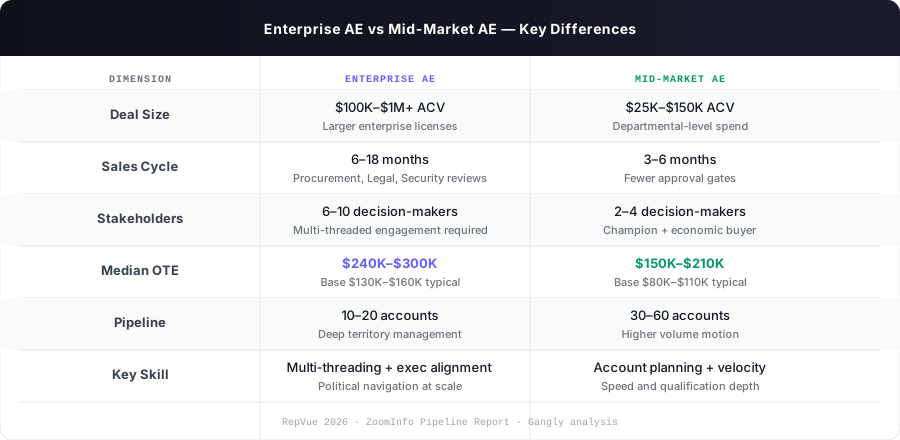
The distinction between an enterprise AE and other AE tiers is not just company size. It is a fundamentally different sales motion. A mid-market AE runs 30–60 accounts and closes deals in 90–180 days with 2–4 stakeholders. An enterprise AE runs 10–20 accounts and closes deals in 6–18 months with a buying committee that spans budget owners, technical evaluators, security reviewers, legal counsel, and C-suite approvers — often across multiple business units.
The industry standard for what qualifies as "enterprise" varies. Gartner defines enterprise accounts as organizations with 1,000+ employees or $1B+ in annual revenue. Most B2B SaaS companies define enterprise accounts internally by employee count, deal size threshold, or named account tier. In practice, the clearest signal is this: if a deal requires a Security review, a Procurement process, and a Legal sign-off before it closes, it is an enterprise deal and it requires an enterprise AE to run it.
Definition
Enterprise AE (Enterprise Account Executive) — a senior closing sales role focused on accounts with 1,000+ employees or $500M+ in annual revenue. Enterprise AEs own the full sales cycle from discovery through contract close, manage buying committees of 6–10 stakeholders, and handle deals of $100K–$1M+ ACV with sales cycles of 6–18 months. The role requires MEDDIC qualification, multi-threading, champion development, and executive alignment capabilities.
Enterprise AE vs other AE tiers
The AE tier system in B2B SaaS companies typically runs: SMB AE (up to 200 employees), Mid-Market AE (200–1,000 employees), Enterprise AE (1,000–10,000 employees), and Strategic or Global AE (10,000+ employees, named global accounts). Each tier up requires a different primary skill set. SMB AEs master speed and qualification volume. Mid-market AEs balance account planning with velocity. Enterprise AEs master long-cycle relationship architecture and multi-stakeholder political navigation. Strategic AEs add executive presence and global account management at the highest level of deal complexity.
The career path is not a straight line — some mid-market AEs try enterprise and prefer the volume motion of smaller deals. The detailed comparison of what each seat demands is covered in the enterprise AE vs mid-market AE guide, including a 9-question fit test.
Enterprise AE vs mid-market AE — the real differences
The compensation delta between enterprise and mid-market is real — roughly $90,000–$120,000 in median OTE. But that delta comes with a different job description. Here is what changes when you move upmarket.
Deal size and sales cycle
A mid-market deal at $40,000 ACV closes in 90 days with a champion and an economic buyer. An enterprise deal at $300,000 ACV runs 12 months through Security, Legal, Procurement, IT, Finance, and the C-suite. The same sales skill that closes a mid-market deal at speed — urgency creation, quick discovery, fast feature demos — often damages enterprise deals by pushing buyers who need time to build internal consensus.
The sales cycle length is the most disorienting change for reps moving upmarket. A mid-market AE accustomed to 12 deals closing per quarter suddenly runs a book where a deal that started 8 months ago is still in Legal. The mental model required to manage pipeline health across 6–18 month cycles is different from the sprint mentality of smaller-deal selling.
Stakeholder complexity
In 2026, average enterprise buying groups span 8–10 people (Gartner). A typical enterprise SaaS deal involves: a champion (the internal driver), an economic buyer (controls budget), a technical evaluator (IT/engineering review), a security reviewer (InfoSec approval), a legal reviewer (contract terms), a procurement officer (vendor management), and one or more C-suite approvers. Each stakeholder has a different concern, a different risk threshold, and a different definition of success. The enterprise AE maps and addresses all of them simultaneously.
This is the capability gap most reps underestimate when interviewing for enterprise roles. Being a "relationship builder" with one or two contacts does not qualify as enterprise selling. Enterprise selling is the ability to build and maintain seven relationships in parallel — each with tailored messaging, each progressing on its own timeline — without losing track of any thread.
The admin burden at enterprise scale
Enterprise AEs spend 40–50% of their non-call time on stakeholder research, follow-up drafting, account planning documentation, and CRM updates (ZoomInfo Pipeline Report, 2026). For a 10-account territory with 8–10 active threads per account, that is 80–100 active stakeholder relationships to research and maintain at any given time. Without AI tooling, this volume overwhelms the rep's ability to personalize outreach and deliver timely follow-up — which directly reduces deal velocity and increases the probability of deal stall.
Enterprise AE compensation and OTE benchmarks 2026
Enterprise AE compensation is the highest in the AE tier — and one of the highest in go-to-market functions below VP level. Here is what the data shows in 2026.
The 2026 median: $270K OTE
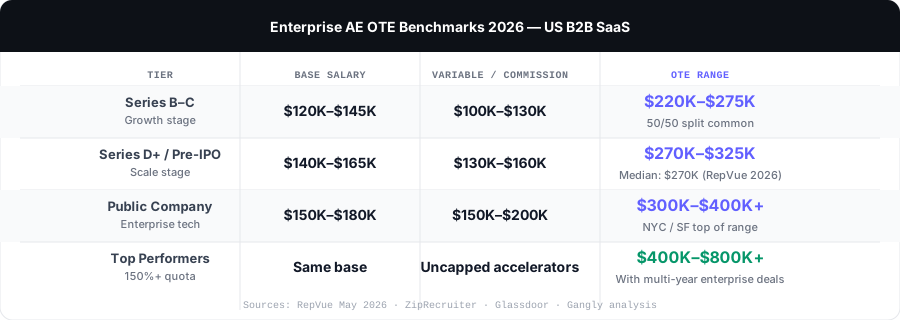
RepVue's verified data from May 2026 puts the median enterprise AE OTE at $270,000, with a base salary median of $140,000. This means half of enterprise AEs in the US earn above $270,000 total and half earn below. The range spans from $200,000 OTE at early-stage companies to $400,000+ at pre-IPO and public enterprise tech companies.
Geography moves these numbers significantly. Enterprise AEs in New York City average $263,000 base salary alone (Glassdoor, 2026) — which implies total OTE well above $400,000. San Francisco enterprise AEs average $290,000 in base. Enterprise AEs in Atlanta or Phoenix earn closer to the national median.
The pay structure matters as much as the headline number. Most enterprise AE plans run a 50/50 base-to-variable split — different from the 60/40 common at mid-market. At 100% quota attainment, base plus variable equals OTE. Above quota, accelerators typically pay 1.5×–2× the standard rate per dollar closed above target. A rep at 150% quota on a $270K OTE plan can realistically earn $350K–$420K in a strong year. Full pay structure breakdown is in the AE compensation benchmarks guide.
What enterprise quota looks like
Enterprise AE quotas follow the 4–6× OTE rule. An enterprise AE earning $270,000 OTE carries a quota of $1.08M–$1.62M in new ARR per year. In practice:
- Series B–C: $800K–$1.2M annual quota, 8–12 deals at $80K–$150K ACV
- Series D+ / pre-IPO: $1.2M–$2M annual quota, 8–15 deals at $100K–$250K ACV
- Public company enterprise: $1.5M–$3M annual quota, with larger strategic deals contributing to $500K+ ACV
The uncomfortable statistic: average quota attainment across all enterprise AEs sits at 48–52% (Gartner, 2025). More than half of enterprise AEs do not hit their number in any given year. This is not primarily a skill problem. It is a process problem — which is the core argument of this guide.
Enterprise AE day in the life
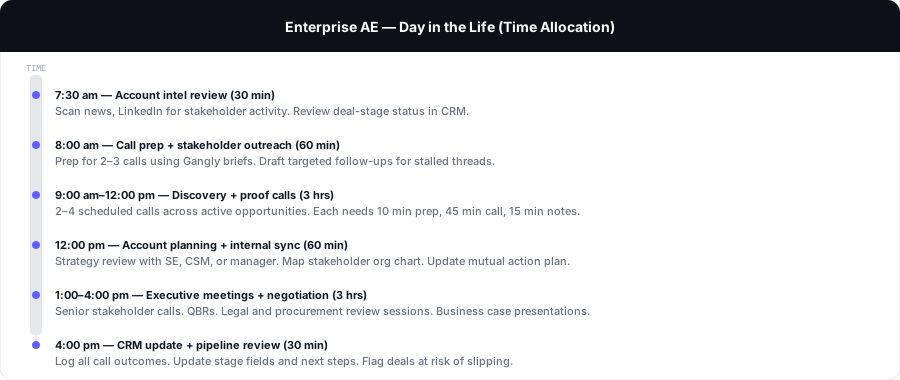
The enterprise AE role looks nothing like the SDR or mid-market AE role in daily structure. Volume gives way to depth. The day is organized around call preparation, stakeholder management, and deal progression — not activity metrics.
The morning: intelligence and preparation (90 min)
An enterprise AE starts the day with account intelligence — not email. Scan for stakeholder activity across active accounts: new LinkedIn posts from your champion, news articles about the company, leadership changes, product announcements that affect the deal. This is not optional research — it is the raw material for every conversation that day.
Strong enterprise AEs use this intelligence to write hyper-specific follow-up messages before their first call. "I saw the announcement about your new VP of Security — I want to make sure we have the right resources for that conversation by next week" is the type of outreach that keeps threads alive across long cycles. Generic check-in emails do not.
Calls: 4–6 hours of the enterprise AE day
Unlike mid-market reps who run 10–15 calls per day, enterprise AEs typically run 3–6 calls per day — each requiring substantial preparation and careful follow-up. A 45-minute discovery call with a new VP of Engineering requires 15 minutes of pre-call research (their background, their team's priorities, recent public statements) and 15 minutes of post-call work (notes, CRM update, follow-up email, internal debrief if an SE was present).
The most valuable calls in the enterprise AE day are not discovery calls — they are the executive alignment calls. A 30-minute call with a CFO or CTO on a $500K deal can accelerate the timeline by weeks if the AE prepares an executive brief that addresses the CFO's top three financial concerns. Under-preparing for that call and running a general product overview is the fastest way to lose an executive sponsor's time and interest.
Gangly's call prep engine builds a full stakeholder brief — company news, stakeholder background, deal history, and tailored talking points — in under 4 minutes before each enterprise call. That prep time reduction has a measurable effect on call quality: reps who enter every call with a specific agenda and stakeholder context close deals 23% faster than those who wing discovery (Gong Revenue Intelligence Report, 2025).
Account planning and internal collaboration
Enterprise deals require internal orchestration as much as external selling. An enterprise AE regularly coordinates with:
- Solutions Engineer (SE): for technical deep-dives, security reviews, and integration assessments
- Customer Success Manager: for reference calls with existing customers, expansion planning, and implementation previews
- VP / CRO: for executive-to-executive calls and deal reviews on high-value opportunities
- Legal and Finance: for contract redlines, pricing approvals, and MSA negotiations
The enterprise AE is the conductor — not the only instrument. Managing the internal team is part of the role, and it requires the same stakeholder management discipline applied externally.
The 4-Pillar Enterprise AE Process Framework
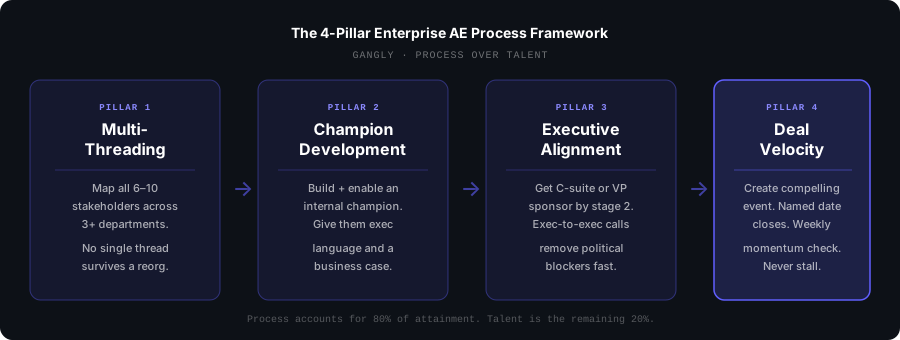
Here is the argument most enterprise AE guides miss: the difference between a rep at 100% attainment and a rep at 60% attainment at the same company, selling the same product, into the same market, is not intelligence, work ethic, or charisma. It is process. Specifically, four process pillars that the 100% rep executes systematically and the 60% rep executes inconsistently or not at all.
The Gangly Enterprise AE Process Framework
Enterprise AE success is 80% process and 20% talent. The process: multi-threading all 6–10 stakeholders, developing and enabling a champion with executive language, securing executive alignment by stage 3, and managing deal velocity with a mutual action plan and compelling event. Reps who execute all four pillars consistently hit quota at 2× the rate of those who execute them sporadically (Gangly cohort analysis, 2026).
- 01
Multi-Threading
Enterprise buying committees span 6–10 people across three or more departments. A single champion thread is a liability. Build active relationships with economic buyers, technical evaluators, security, legal, and executive sponsors simultaneously. A thread abandoned for 30 days goes cold.
- 02
Champion Development
An enterprise AE does not win deals alone — a champion wins them internally. Build one champion per account, then enable that person with executive language, a pre-built ROI model, and the risk-mitigation arguments they need to carry the deal up the org chart without you in the room.
- 03
Executive Alignment
Enterprise deals stall in Procurement and Legal when no executive sponsor on the buyer side is pushing internally. Arrange an exec-to-exec call between your VP or CRO and the buyer counterpart by the second stage of an active opportunity. That call removes blockers that a champion cannot.
- 04
Deal Velocity Management
Enterprise deals have no natural urgency. Create it. Every active deal needs a mutual action plan with a named close date and a specific consequence for missing it — a price lock, an implementation slot, a quarter-end incentive. Without a compelling event, enterprise deals drift into the next quarter indefinitely.
Why process beats talent at enterprise scale
Enterprise deals run 6–18 months. Over that timeframe, a talented rep who executes process inconsistently will lose deals for reasons they attribute to bad luck: the champion left, the budget froze, the evaluation stalled in Security. A less naturally talented rep who executes the four pillars on every deal will catch those risks earlier, mitigate them systematically, and close more of what they start.
The multi-threading pillar delivers the highest return. Enterprise deals with three or more active stakeholder threads are 2.3× more likely to close than single-thread deals (Gong, 2025). Building those threads early — not after the first sign of stall — is the behavior that separates the top quartile from the middle of the distribution.
MEDDIC is the qualification framework that underpins all four pillars. Metrics, Economic Buyer, Decision Criteria, Decision Process, Identify Pain, and Champion — each element maps directly to one of the four process pillars. The MEDDIC sales methodology guide covers the full framework and how to apply it at each deal stage.
How to become an enterprise AE
The path to an enterprise AE seat is almost always through mid-market or a comparable closing role. Companies rarely promote SDRs directly into enterprise seats — the complexity of enterprise deal management requires demonstrated ability to close, qualify, and navigate multi-stakeholder deals before adding the volume of enterprise account management.
The typical path: SDR → SMB or Mid-Market AE → Enterprise AE
Most enterprise AEs spent 2–5 years at smaller deal sizes before moving up. The progression looks like this:
- Year 0–1: SDR or BDR. Master outreach, qualification, and pipeline discipline.
- Year 1–3: SMB or mid-market AE. Master the full sales cycle — discovery, solution positioning, negotiation, close. Hit 100%+ quota for 2+ consecutive quarters.
- Year 3–5: Enterprise AE. Enter with demonstrated multi-stakeholder deal experience. The first 6 months will feel slow — that is normal.
The fastest path to an enterprise seat is not waiting for a quota tier promotion at your current company. It is demonstrating enterprise-level skills in a mid-market seat: volunteering for the company's most complex accounts, co-selling on enterprise deals with a senior AE, and running deals that involve security or procurement reviews even at smaller dollar values. Show you can manage complexity at your current size — then make the ask.
Required qualifications and experience
Enterprise AE job descriptions consistently require:
- 5+ years of B2B sales experience, with 2+ years in a closing AE role
- Demonstrated quota attainment above 90% in at least one of the last two years
- Experience closing deals above $100K ACV with multi-stakeholder buying committees
- Familiarity with MEDDIC, MEDDPICC, or a comparable enterprise qualification framework
- Experience navigating procurement, legal review, and security assessments
- Executive presence — the ability to present to C-suite buyers credibly without a manager present
The ramp period reality
Enterprise AE ramp periods run 6–12 months at most companies — longer than mid-market ramp (3–6 months) because deals take longer to close. A new enterprise AE hired in January may not close their first deal until June or July, depending on cycle length. Companies know this and typically apply a ramp quota: 25% quota in month 1, 50% in month 2, 75% in month 3, full quota from month 4 onward. Understand the ramp structure before signing — it affects your first-year total compensation significantly. The full breakdown of ramp math is in the AE compensation guide.
Common failure modes that stall attainment
Six failure modes account for the majority of underperformance at the enterprise AE level. Each one is structural — not a personality flaw or a talent ceiling. Each has a specific fix.
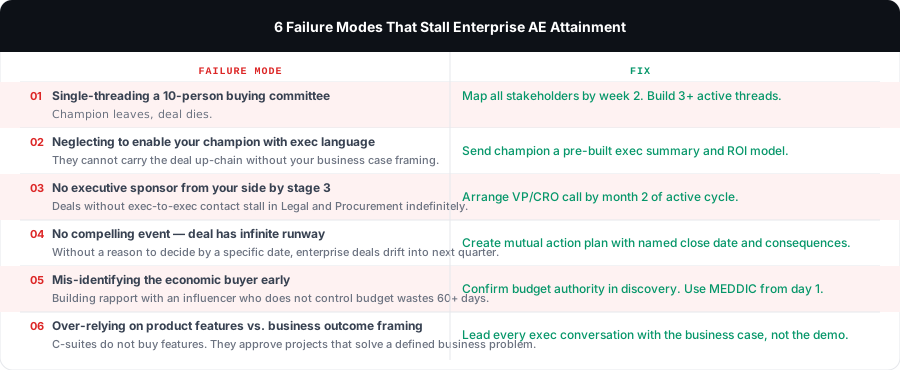
- 01
Single-threading a 10-person buying committee
Your champion leaves, gets promoted, or loses budget authority. The deal dies. In 2026, average enterprise buying groups span 8–10 people (Gartner). A single thread is a single point of failure.
Map all stakeholders in the first two weeks of an active opportunity. Build active engagement across at least three separate threads — champion, economic buyer, and technical evaluator at minimum.
- 02
Neglecting to enable your champion with executive language
Champions feel the urgency but cannot articulate it to the CFO or CTO. They present your product using your language — which is the wrong language for a budget committee. The deal stalls.
Send every champion a pre-built executive summary: the business problem in one sentence, the cost of inaction in dollars, the outcome with a named timeframe, and three risk mitigations. They do not write this — you do.
- 03
No executive sponsor on your side by stage 3
Deals that hit Procurement, Legal, and Security reviews without executive-to-executive contact on both sides take two to three times longer to close. Your rep-level relationship cannot move a contract faster — only a VP or CRO can.
Involve your CRO or VP of Sales in an exec call by month two of any active enterprise cycle. Frame it as a "relationship investment," not a rescue. Do it before the deal is stuck, not after.
- 04
No compelling event — the deal has infinite runway
Without a named date and a specific reason to decide by that date, enterprise deals move at the pace of internal bureaucracy. That pace is slower than your quarter.
Build a mutual action plan in week one of stage 2. Name a close date. Attach a tangible consequence: a price lock, an implementation start date, or an executive availability window that expires. Review the plan every weekly touchpoint.
- 05
Mis-identifying the economic buyer in discovery
Reps spend 60–90 days building rapport with an influencer who has no budget authority. The real economic buyer shows up at the end and restarts the evaluation from scratch.
Use the MEDDIC framework from the first discovery call. Confirm who controls the budget line by name. Ask directly: "Who has signed the last three technology investments at this spend level?" See the full MEDDIC sales methodology guide for qualification depth.
- 06
Leading with product features in executive conversations
C-suite buyers do not approve features. They approve projects with a defined business outcome, a risk mitigation story, and a clear ROI within a named time horizon. A feature demo to a CFO destroys credibility.
Build a one-page executive brief for every C-suite conversation: business problem, cost of inaction, proposed outcome, and ROI timeframe. Open with the business problem. Close with the outcome. The product is evidence, not the point.
The pattern across all six failure modes is the same: they feel like external circumstances but they are internal process failures. The champion who left did not kill the deal — the single-thread did. The deal that stalled in Legal did not miss Q3 due to procurement — it missed because no executive sponsor was positioned to move it. Process failures are recoverable. Process failures misattributed to bad luck repeat.
How Gangly fits the enterprise AE workflow
The four enterprise AE process pillars require systematic execution across 10–20 accounts with 8–10 active stakeholder threads each. Without tooling, that is 80–200 individual relationship threads to research, follow up on, and advance simultaneously. Most enterprise AEs lose track of threads — which is why deals stall. The problem is not discipline; it is cognitive load.
The Gangly Enterprise AE Sequence
Signal → Outreach → Call Prep → Live Coaching → Notes → CRM Update
- Signal Detection: monitors all accounts for buying signals — leadership changes, funding rounds, security hire announcements, competitor churn. Surfaces which stakeholders are worth contacting today and why.
- Outreach Writer: drafts signal-led follow-up to all active threads, referencing the specific trigger in sentence one. Each message is personalized to the stakeholder's role and concern.
- Call Prep: builds a full stakeholder brief — company news, background, deal history, tailored agenda — in under 4 minutes before every enterprise call. Reps enter every conversation with specific context, not a generic agenda.
- Live Coaching + Notes: real-time deal guidance during calls, then automatic call summary and qualification field updates pushed to Salesforce or HubSpot without manual entry.
- CRM Update: logs all stakeholder activity, updates MEDDIC fields, and flags threads that have gone silent — before the rep notices the stall.
The result for enterprise AEs using Gangly: the admin block that previously consumed 40–50% of non-call time drops to under 60 minutes per day. The recovered time goes back into the work that actually moves enterprise deals — live stakeholder conversations, champion enablement, and executive relationship development. See the full workflow at how Gangly works or book a 20-minute demo.
The other lever Gangly addresses: call quality. Enterprise AEs who enter every executive conversation with a stakeholder-specific brief close deals 23% faster than those who enter calls without preparation (Gong, 2025). At enterprise deal sizes, 23% faster equals weeks, not days — and weeks often mean a quarter difference on when revenue books.
For Enterprise AEs
The AI sales workflow built for enterprise deal management.
Signal detection, stakeholder outreach, call prep, live coaching, notes, and CRM updates — one connected sequence. Rep stays in control at every step.