
 By Siddharth Gangal
TL;DR
- →A founder sales playbook is the documented system that converts your instinct-driven first 20 deals into a repeatable motion — ICP, outbound, discovery, and handoff all in one place.
- →The four-stage founder motion moves from unstructured hustle (Stage 0) to documented process (Stage 1) to a team-ready handoff (Stage 2) to a signal-driven scale engine (Stage 3).
- →The biggest mistake founders make is hiring a sales rep before the playbook exists — 68% of first sales hires fail when there is no documented process to follow (First Round Capital, 2025).
- →Gangly's FSD Framework (Find, Signal, Document) gives founders a three-step system for capturing the tribal knowledge that makes founder-led selling work.
Eighty percent of first sales hires fail. That number comes from First Round Capital's analysis of 300 early-stage startups, and the pattern is consistent: a founder closes deals through relationships, credibility, and product knowledge. A new rep arrives and closes nothing. The founder blames the hire. The real problem is that the founder never wrote down how they sold.
A founder sales playbook is the fix. It is the documented system that converts the founder's instinct-driven first 20 deals into a repeatable motion that a team can execute. Without it, every sales hire starts from zero. With it, ramp time drops from six months to six weeks, forecast accuracy improves, and the founder can stop selling without watching revenue stall.
This guide covers the full playbook: ICP definition, outbound motion, discovery framework, objection responses, and the handoff system Gangly calls the FSD Framework. Each section includes specific steps, templates, and benchmarks based on what works at the pre-$1M ARR stage.
What is a founder sales playbook?
A founder sales playbook is a documented system that captures every decision, question, and pattern behind successful founder-led deals so that a sales team can replicate those results without the founder's involvement. It is not a generic sales process manual. It is not a list of product features. It is the specific combination of ICP definition, messaging framework, discovery questions, objection responses, and stage criteria that produced your best closed deals.
The distinction matters. Most sales playbooks describe process. A founder sales playbook describes reasoning. When a founder closes a deal, the decision to send a specific message at a specific time based on a specific signal is invisible to anyone watching. The playbook makes that reasoning explicit so that a rep following it makes the same decision without the founder in the room.
Definition
Founder Sales Playbook
A founder sales playbook is the documented ICP, messaging, discovery, and handoff system derived from a founder's first 20+ closed deals. It converts instinct into repeatable process, enabling a sales team to close at the same rate and quality as the founder without direct founder involvement.
The six components every founder sales playbook must include:
- ICP definition — specific criteria for accounts worth pursuing: company size, industry, growth signal, technology stack, and trigger events that create urgency.
- Positioning narrative — the three-sentence explanation of why a buyer should care about your product, why now, and why your company specifically. This is the opening message in every outbound touchpoint.
- Outbound sequence — channels, cadence, message templates, and the personalization signals that get replies. Include actual subject lines and first-line variants that have generated responses.
- Discovery framework — the questions you ask, the order you ask them, and the answers that qualify or disqualify an opportunity. Include the follow-up questions for each answer pattern.
- Objection responses — the five to eight objections that appear in every second deal, with specific response frameworks that have worked. Not generic techniques — your actual language.
- Stage definitions and exit criteria — what evidence must exist before a deal moves between stages. This prevents pipeline inflation and forecast errors when the first sales hire takes over.
The four-stage founder sales motion
Founder-led sales does not stay the same from first deal to $5M ARR. It moves through four stages, and the playbook requirements change at each stage. Most founders try to skip stages. That is where the errors happen.
| Stage | ARR Range | Primary goal | Playbook focus |
|---|---|---|---|
| Stage 0 — Zero Motion | $0 | First 3 paying customers | Founder network outreach, no playbook yet |
| Stage 1 — First Customers | $0 – $250K | Validate ICP and messaging | ICP definition, positioning, discovery questions |
| Stage 2 — Proven Motion | $250K – $1M | Document the repeatable pattern | Full playbook, handoff documentation |
| Stage 3 — Repeatable Motion | $1M+ | Scale with hired reps | Signal-based prioritization, coaching, optimization |
Stage 0: the hustle phase
Stage 0 sales happen through your network, former colleagues, and warm introductions. There is no playbook here because there is no pattern yet. Your job is to talk to as many potential buyers as possible, deliver the product to anyone willing to pay, and learn what problems you are actually solving.
Do not try to build a playbook in Stage 0. The pattern is not stable enough. Instead, keep a deal journal: after every conversation, write down three things — what the prospect said their problem was, what made them lean forward, and what almost killed the deal. That journal becomes the raw material for your Stage 1 playbook.
Stage 1: validating the motion
Stage 1 starts when you have three to five paying customers who came from outside your immediate network. You have evidence that someone who does not already trust you will pay for this product. Now the work is finding the pattern.
Pull your Stage 0 deal journal. Look for the prospects who closed fastest, paid most, and expanded earliest. Those are your ICP candidates. Look for the opening messages that got replies. Those are your positioning candidates. Look for the discovery questions that made buyers say "that is exactly our problem." Those are your framework candidates.
Stage 2: documenting the pattern
Stage 2 starts when you have closed 15 to 20 deals outside your network and can describe, in writing, the characteristics of accounts that close and the sequence of events that leads to a signature. This is when the playbook gets written in full.
Most founders delay Stage 2 documentation because it feels like overhead. It is not. Every week you spend selling without a documented playbook is a week your first sales hire will waste reconstructing what you already know. Write the playbook at Stage 2 and your first hire closes their first deal in week three instead of month three.
Stage 3: scaling with signal
Stage 3 is when the playbook becomes a platform. You have a documented motion, you have validated it with hired reps, and now the question is: how do you prioritize the accounts with the highest likelihood of converting?
This is where signal-based selling enters the founder playbook. Instead of working a static account list, reps work a signal-ranked account list — accounts scored by job changes, funding events, technology changes, and engagement signals. The outbound motion stays the same. The prioritization becomes intelligent.
ICP definition and positioning: the foundation every playbook needs
Every failed founder sales playbook fails for the same reason: the ICP is too broad. "Mid-market B2B SaaS companies" is not an ICP. It is an aspiration. An ICP has six specific criteria that, when all present simultaneously, predict deal velocity, deal size, and expansion likelihood.
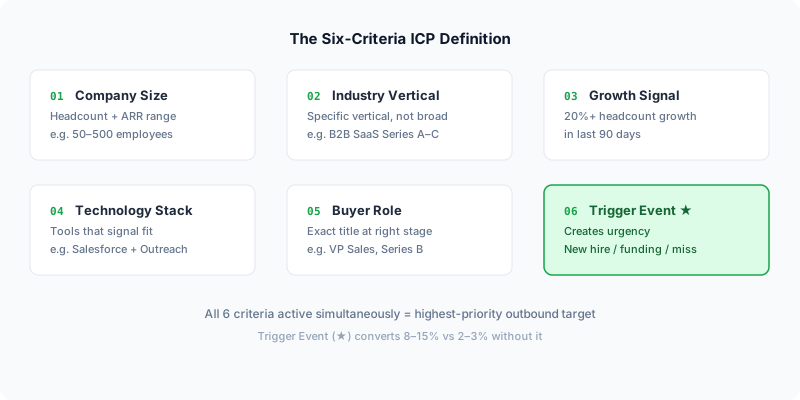
The six-criteria ICP definition
Build your ICP by scoring every deal you have closed on these six dimensions, then find the criteria that your fastest-closing, highest-ACV deals share:
- Company size. Headcount range and ARR range. Not "Series A to C" — actual numbers. For most early-stage B2B tools, this is 50 to 500 employees and $5M to $50M ARR.
- Industry vertical. The narrower the better. "Technology companies" is not an industry. "Series A to C SaaS companies selling to enterprise buyers" is an industry.
- Growth signal. What evidence tells you this account is in an active growth phase? Recent funding, headcount growth of 20%+ in the last 90 days, new office openings, job postings for roles that signal expansion.
- Technology stack. What tools does this company already use that signal fit? A company using Salesforce, Outreach, and Gong is further along the sales tech adoption curve than a company using spreadsheets.
- Buyer role. Exact title. Not "sales leader" — "VP of Sales at a Series B SaaS company with 10 to 30 AEs." The specific title drives the specific message.
- Trigger event. What happened recently that makes this company urgently interested in your solution? New funding, new VP of Sales hire, missed revenue quarter, headcount increase in the sales org. Trigger events create urgency that ICP criteria alone cannot.
The ICP definition drives every other playbook component. Your outbound sequence targets accounts matching the ICP. Your discovery questions uncover whether the trigger event is real. Your pricing anchors to the value your ICP gets. If the ICP is wrong, the entire playbook produces the wrong output.
Building the positioning narrative
Positioning for founder-led sales is different from marketing positioning. It is not a tagline. It is a three-sentence statement that answers three questions in a specific order: what problem does the buyer have right now, what outcome do they want, and why does your product deliver that outcome faster or better than the alternatives.
The framework:
- Sentence 1 — the problem. State the specific pain in the buyer's language. Not "sales teams struggle with productivity" — "your AEs spend 47% of their time on non-selling activities, which means your $200K rep is delivering $106K of selling capacity."
- Sentence 2 — the outcome. State the specific result the buyer wants. "You want your AEs focused on calls and deals, not on CRM updates and research."
- Sentence 3 — the mechanism. State how your product delivers that outcome and why the mechanism is different. "Gangly captures every signal, generates call prep briefs, and pushes CRM updates automatically — so reps spend zero minutes on admin and all of their time on revenue."
Test this narrative in your next 10 outbound messages. Measure reply rate. If reply rate is below 8%, the problem statement is wrong. Refine until the narrative lands.
Outbound motion and discovery: how founders run the first 50 calls
The outbound section of your playbook has three parts: the trigger-based prospecting system, the sequence structure, and the discovery framework. All three work together. A strong sequence that books calls with the wrong accounts is wasted. Strong discovery on calls booked from weak sequences is sparse. You need all three working.
Trigger-based prospecting
Cold outbound without a trigger event converts at 2 to 3%. Cold outbound with a trigger event converts at 8 to 15%. The math is not subtle. Your outbound motion must start with signal, not with a static account list.
The three trigger events that consistently drive outbound conversion for early-stage B2B tools:
- New VP of Sales hire. A new sales leader has a mandate to change something and a 90-day window to prove it. They are actively evaluating tools. Response time matters — the email sent on day one of their tenure competes with three vendors; the email sent on day 30 competes with thirty.
- Funding announcement. A Series A or B company just received capital to build out their sales team. They have budget, they have urgency, and they have board pressure to show revenue traction. This is a 45-day window.
- Headcount spike in sales roles. A company posting for 5+ SDR or AE roles simultaneously is building a sales team that does not yet exist. They need tools before those hires start — not after.
For each trigger, build a specific outbound message. The trigger is the opening line. "Congratulations on the Series B — you are likely now building the sales motion to justify that capital" is a better first line than any generic personalization because it connects to a real event with real consequences.
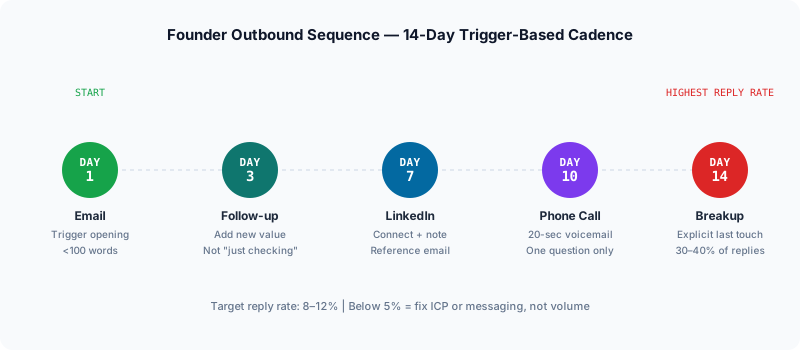
The founder outbound sequence
Your outbound sequence for the founder stage should be four to six touches over 14 to 21 days. More touches than that at the pre-product-market-fit stage indicates weak ICP or weak messaging — adding touches does not fix root problems.
Structure:
- Day 1 — Email. Trigger-based opening, two-sentence problem statement, one-sentence social proof (customer name or specific outcome), one clear CTA. Under 100 words.
- Day 3 — Email follow-up. Add one new piece of value — a relevant case study sentence, a specific data point, or a question that forces them to think. Not "just following up."
- Day 7 — LinkedIn connection + note. Short message referencing the email. Do not re-pitch. Say "I sent you an email last week about [specific problem]. Would love your perspective on this."
- Day 10 — Phone call. Leave a 20-second voicemail if no answer. Reference the trigger event. One question at the end: "Are you the right person to speak with about this, or is there someone else I should reach out to?"
- Day 14 — Breakup email. Say explicitly that this is your last outreach. Offer to share a specific resource with no strings attached. The breakup email consistently generates 30 to 40% of the replies from the sequence.
The discovery framework for founders
Founders have one advantage over sales reps in discovery: they know the product better than anyone. The trap is that they talk about the product before they understand the problem. The result is a demo of features that do not map to the buyer's actual pain.
Use a structured five-question discovery framework. Ask all five before showing anything:
- The current state question. "Walk me through how you handle [the process your product addresses] today." Listen for: tools used, time spent, manual steps, handoffs.
- The pain question. "What breaks down most often in that process?" Listen for: specific moments of failure, who feels the pain, what the consequence is.
- The impact question. "What does that cost you — in time, in revenue, in rep morale?" Listen for: quantified loss. If they cannot quantify, help them: "If an AE spends 2 hours a day on admin instead of selling, what does that translate to in closed revenue?"
- The priority question. "On a scale of 1 to 10, how important is solving this problem in the next 90 days?" If below 7, ask why. Below 5, disqualify or nurture. Above 7, continue.
- The outcome question. "What does success look like for you six months from now if this problem is solved?" Listen for: specific metrics — pipeline created, deals closed, admin time reduced. This answer becomes your ROI anchor in the proposal.
Document the answers to all five questions in your CRM immediately after the call. These answers drive your follow-up, your proposal, and eventually your case study. For help structuring the full discovery call workflow, see the discovery call framework.
The FSD Framework: Gangly's system for founder-to-rep handoff
The hardest part of building a founder sales playbook is not writing the content. It is capturing the invisible knowledge — the judgment calls, the pattern recognition, the read of a buyer's tone — that experienced founders make automatically. The FSD Framework gives founders a three-step system for making that invisible knowledge explicit.
Find the pattern
Review your last 20 closed deals. Score each on: time to close, ACV, and expansion in 6 months. Identify the top 8 and the bottom 8. Compare the differences.
Surface the signals
For every top-quartile deal, identify what triggered the initial outreach, what converted the first reply, and what moved each stage. Those are your playbook inputs.
Document the decision
For each signal, write the rule. Not "when I sense they are ready" — "when the buyer says X, send message Y. When the buyer says Z, ask follow-up question W."
The FSD Framework produces a decision tree, not a process map. A process map tells a rep what step comes next. A decision tree tells a rep what to do based on what the buyer says or does. The difference is the difference between a rep who follows steps and a rep who reads the room.
Applying FSD to the handoff
When your first sales hire starts, give them the FSD output on day one. Walk through it together on three recorded calls in their first two weeks — one you run (they observe), one they run with you present, one they run solo with a recording you review. The handoff is not a document drop. It is a coaching process built on the documented decisions.
Gangly's workflow automates the signal detection layer of the FSD Framework. Instead of manually monitoring LinkedIn, funding databases, and job boards for the triggers that feed your outbound, Gangly surfaces the signals automatically — so reps start each day with a ranked list of accounts showing the trigger events that match your playbook's ICP criteria.
The result: a rep following the FSD Framework with Gangly as the signal layer spends time executing the playbook, not building the account list. That is the difference between a first sales hire who contributes in week three and one who contributes in month four.
Using buying signals to prioritize your pipeline
The founder's instinct about which accounts to call first is, on average, correct. The problem is that instinct is not scalable and not teachable. Signal-based prioritization is the scalable version of founder instinct.
In a founder sales playbook, signal prioritization works at two levels: the account level (which accounts to work this week) and the deal level (which open opportunities need attention today).
Account-level signal prioritization
Score every account in your ICP universe on four signal types:
- Intent signals. Content consumption: the company's employees are reading about your product category, visiting competitor pages, or engaging with industry content that indicates they are evaluating solutions. These decay in 72 hours — an account consuming intent signals today is not the same account in a week.
- Trigger signals. Event-based: funding announced, new executive hire, headcount spike, product launch, acquisition. These have a 45-day active window before the buyer's attention shifts.
- Engagement signals. Direct interaction: opened your email, clicked a link, visited your pricing page, watched your demo video. These are the highest-conversion signals because the buyer is already in motion.
- Fit signals. ICP match: the account's size, industry, and technology stack match your criteria. Fit signals do not create urgency alone — they qualify the account for prioritization when combined with intent, trigger, or engagement signals.
An account with all four signal types active is a same-day outreach target. An account with fit signals only goes into a long-cadence nurture sequence. The intent signals guide covers how to score and act on each signal type in more detail.
Deal-level signal prioritization
Inside your open pipeline, signal prioritization identifies which deals need immediate action versus which can wait. Three signals indicate a deal is at risk and needs intervention today:
- Silence after proposal. If a buyer goes more than 5 business days without a response after receiving pricing or a proposal, the deal is cooling. Send a specific re-engagement message tied to a new piece of value — not a "just checking in."
- Champion engagement drop. If your primary contact's email open rate drops from consistent to zero across two consecutive touchpoints, they may have lost internal support or changed priorities. Multi-thread immediately.
- Competitive signal. If a deal that was progressing stalls after a meeting that involved a third party, check whether a competitor has entered the evaluation. Ask directly: "Are you evaluating other options at this stage? I want to make sure I address anything we have not covered."
For more on how to detect and act on deal-risk signals, see the full guide on signal-based selling.
Seven founder sales mistakes that stall revenue
Every founder makes these mistakes. Most make them more than once. The playbook is designed to prevent them from happening when a sales team takes over — but founders need to recognize them first in their own selling.
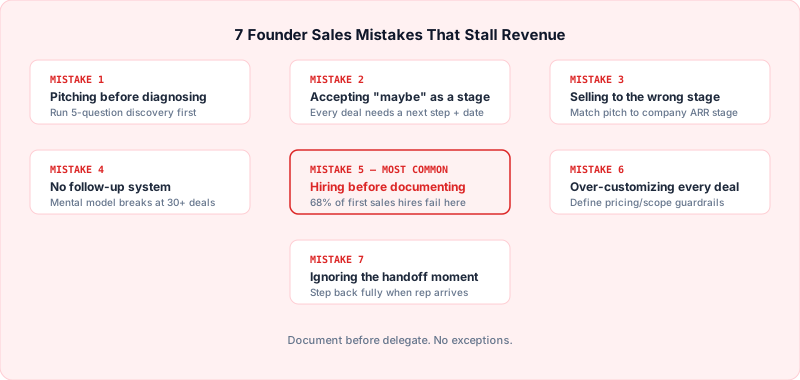
- Pitching before diagnosing. Founders know the product deeply and default to pitching. Buyers who receive a pitch before being heard do not become customers — they become ghosters. The fix: run the five-question discovery framework before opening a single slide.
- Accepting "maybe" as a pipeline stage. A deal at "we are thinking about it" is not a deal. It is a wish. Every open opportunity must have a specific next action with a specific date agreed to by the buyer. Without that, the pipeline is fiction.
- Selling to the wrong stage. A company at $50K ARR with 5 employees does not have the same problem as a company at $5M ARR with 50 employees. Founders who close a few deals at one company stage and then try to apply the same pitch to a different stage get confused when conversion drops.
- No follow-up system. Founders track follow-ups in their head. That works for 10 deals. At 30 open opportunities, the mental model breaks down and hot deals go cold because a follow-up was forgotten. Build a follow-up system — even a simple one — in week one of Stage 1.
- Hiring a sales rep before documenting the playbook. This is the most common and most expensive mistake. A rep without a playbook tries to reverse-engineer the founder's approach through observation, gets it wrong, and burns 6 months of runway. Document before hiring. No exceptions.
- Over-customizing every deal. Founders justify every custom deal with "this customer is strategic." Two years in, they have 30 customers on 30 different contracts, a support nightmare, and no repeatable pricing. Custom terms are acceptable. Custom pricing tiers, custom feature scopes, and custom SLAs are product decisions, not sales decisions. Define the boundaries before the first sales hire arrives.
- Ignoring the handoff moment. Founders who keep selling informally after hiring a sales rep create confusion, undermine the rep's authority with buyers, and prevent the rep from owning the relationship. When you hire, step back. Make the handoff clean, documented, and final.
Metrics that prove your playbook is working
A founder sales playbook without metrics is a hypothesis. These five metrics tell you whether the playbook is producing results or needs revision.
1. Outbound reply rate
Measure: replies per 100 outbound messages sent. Benchmark: 8 to 12% for a well-targeted founder outbound sequence. If below 5%, the problem is in the ICP or the messaging — not in the volume. Sending more does not fix a messaging problem. Revise the trigger-based opening line and the positioning narrative before adding touchpoints.
2. Discovery-to-proposal conversion
Measure: percentage of discovery calls that reach the proposal stage. Benchmark: 30 to 40% for B2B SaaS at $5K to $25K ACV. If below 25%, the problem is in the discovery framework — either the questions are not surfacing real pain or the qualification criteria are too loose and the wrong accounts are reaching discovery. Review recordings of your last 10 discovery calls. Find the moment the call starts going sideways.
3. Proposal-to-close rate
Measure: percentage of proposals that close within 60 days. Benchmark: 20 to 30% for early-stage B2B SaaS. If below 15%, the proposal is not landing — either the pricing is wrong relative to perceived value or the discovery did not establish clear ROI. Return to the outcome question in your discovery framework and make sure every proposal anchors the price to the buyer's stated cost of not solving the problem.
4. Sales cycle length
Measure: median days from first contact to closed-won. Benchmark: 30 to 60 days for $5K to $25K ACV deals. If above 90 days, either the ICP is wrong (wrong company size, wrong trigger event, wrong urgency level) or the stage definitions have no exit criteria and deals are sitting in stages too long. For benchmarks by deal size and industry, see the sales cycle length benchmark guide.
5. Rep ramp time after handoff
Measure: days from a new sales rep's start date to their first closed deal. Benchmark: 45 to 60 days with a documented playbook, 90 to 120 days without one. This metric validates the quality of the playbook itself. If ramp time is long, the playbook has gaps — specific components that are missing or documented too abstractly for a new rep to execute. Identify the gap by asking the rep what they do not know how to do and mapping that to the playbook section.
Built for Founders Doing Outbound
Turn buying signals into your first call
Gangly surfaces the job change, funding, and technology signals that trigger your ICP — then preps your reps for every call automatically. No extra admin. No missed signals.