
 By Siddharth Gangal
TL;DR
- ▸An implicit need is a buyer problem stated without desire for resolution — "our reporting is slow." An explicit need is a direct desire for change — "we need automated reporting." Only explicit needs reliably predict B2B deal closure.
- ▸SPIN Selling's four question types — Situation, Problem, Implication, Need-Payoff — exist specifically to move buyers from implicit dissatisfaction to explicit desire. Skipping implication questions leaves buyers permanently in the implicit stage.
- ▸Buying signals (hiring announcements, funding rounds, tech-stack changes, job postings) reveal implicit needs before the rep asks a single question — letting reps enter the conversation at exactly the right Problem question, not from scratch.
- ▸The conversion path has five steps: confirm the implicit need, quantify the cost, connect it to a stated priority, ask the Need-Payoff question, get verbal confirmation of the explicit need. Do not pitch solutions before step five.
What are implicit vs explicit needs in sales?
An implicit need is a statement by a buyer of a problem, frustration, or dissatisfaction with their current situation — without expressing a desire to change it. An explicit need is a direct statement of what a buyer wants or desires — a clear signal that they are ready to evaluate solutions. The distinction comes from Neil Rackham's SPIN Selling research conducted across 35,000 sales calls in 23 countries, published in 1988 and still the most cited methodology framework in complex B2B sales.
Most reps treat every buyer complaint as a buying signal. That is the first mistake. A buyer saying "our CRM data is always out of date" is expressing mild dissatisfaction. They have not asked anyone to fix it. They have not budgeted for a solution. They have not shared it with their VP. That complaint is an implicit need — real, but inert.
Contrast that with a buyer who says "we need real-time CRM updates without relying on reps to log manually, and we want to have this in place before Q3 closes." That is an explicit need. The buyer has named the problem, defined the desired outcome, attached a timeline, and signaled internal alignment. That buyer is in the buying zone.
| Dimension | Implicit Need | Explicit Need |
|---|---|---|
| What the buyer says | States a problem ("this is slow") | States a desire ("we need something faster") |
| Emotional driver | Mild frustration, acceptance of status quo | Clear discomfort that demands resolution |
| Urgency level | Low — can tolerate the situation | High — actively wants change |
| Deal signal | Too early to pitch solutions | Time to present your product |
| Sales response | Ask Implication questions to amplify pain | Use Need-Payoff questions to confirm value |
| Example phrase | "Our reporting takes too long" | "We need automated reporting" |
| SPIN stage | Problem (P) questions surface these | Need-Payoff (N) questions confirm these |
| Buying signal parallel | Behavioral signals reps detect externally | Direct request for demo, pricing, or evaluation |
Implicit vs explicit needs across 8 key dimensions · Based on SPIN Selling research (Rackham, 1988)
The practical consequence is significant. In small, transactional sales, an implicit need can be enough to close a deal — if the product costs $30 and switching it takes five minutes, mild dissatisfaction translates to a purchase. In complex B2B sales where the deal is $50K, involves a procurement process, requires three stakeholder approvals, and displaces an existing tool, only explicit needs move deals. Rackham's research showed that the number of explicit needs stated in a sales call is the single strongest predictor of deal outcome in major sales.
For B2B reps, this means one thing: every discovery call has a primary objective. Get the buyer from implicit dissatisfaction to an explicit statement of desire. Everything else — demos, pricing, proposals — should wait until that conversion happens.
The SPIN Selling framework that defined the distinction
SPIN Selling gives reps a four-question architecture specifically designed to move buyers from implicit to explicit needs. The acronym stands for Situation, Problem, Implication, and Need-Payoff. Each question type serves a distinct purpose in the need conversion sequence.
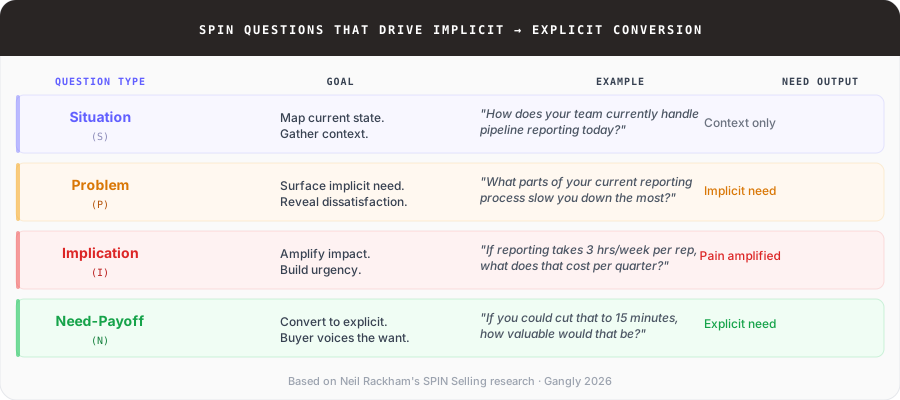
Example: "How does your team currently handle pipeline reporting today?"
Output: Context only
Example: "What parts of your current process slow you down the most?"
Output: Implicit need
Example: "If that takes 3 hours per rep per week, what does that cost per quarter?"
Output: Pain amplified
Example: "If you could cut that to 15 minutes, how valuable would that be?"
Output: Explicit need
Situation and Problem questions are where implicit needs first appear. A buyer answering a Problem question — "what parts of your current process cause the most friction?" — will almost always respond with an implicit need statement. They describe a pain point. They do not ask for help solving it. That is the raw material.
Implication questions are what Rackham identified as the most powerful question type in complex sales. They take an implicit need — "reporting takes too long" — and force the buyer to calculate the real cost: "If your five reps each spend three hours a week on manual reporting, that is 780 hours per year. At average fully-loaded rep cost, what does that equal?" When the buyer does that math out loud, the implicit dissatisfaction becomes a concrete business problem worth solving. That is the pivot point.
Need-Payoff questions complete the conversion. Instead of telling the buyer what they need, the rep asks the buyer to articulate the value of having it solved: "If that 780-hour problem went away, what would change for your team?" The buyer answers with an explicit need — a direct statement of desire. Research by Huthwaite International found that when reps use Need-Payoff questions consistently, the average number of objections per selling hour drops by 55%. The buyer has already convinced themselves.
For a deeper look at how to sequence all four question types across an entire discovery call, see the full SPIN Selling guide with 20+ worked examples and a full discovery call transcript.
How to identify implicit needs before your buyer does
Implicit needs are not hard to find — buyers express them constantly. What is hard is recognizing them for what they are: raw material, not a purchase signal. The skill is learning which implicit needs are worth developing into explicit ones, and which are peripheral complaints that will not move a deal.
Four language patterns mark an implicit need in a discovery conversation:
- 1
Problem statements without a desired outcome
"Our deal data is always incomplete" or "We lose track of follow-ups constantly." The buyer names what is wrong but offers no direction. This is the classic implicit need pattern.
- 2
Minimizing language
"It is not ideal," "it is a bit of a headache," "we manage." Minimizing language almost always wraps an implicit need. The buyer knows the problem exists but has not decided it warrants action.
- 3
Past-tense problem framing
"We tried to fix it before but never got around to it." Past-tense framing means the problem has been recognized but not prioritized. It is an implicit need that has survived through inertia.
- 4
Comparative dissatisfaction
"We know other teams do this better." The buyer has benchmarked themselves against a higher standard but has not committed to closing the gap. This is implicit need territory — dissatisfaction without desire for resolution.
Not every implicit need is worth developing. Prioritize the ones that map directly to your product's core value proposition, that affect a business metric your buyer is accountable for, and that are recent — a pain the buyer mentioned three years ago and tolerated is different from one they raised last quarter and still feel.
The key question when you hear an implicit need: "Is the cost of this problem large enough that the buyer would pay to eliminate it?" If the answer is yes, develop it. If not, acknowledge it and move on. Discovery calls that chase every implicit need become exhausting for buyers and produce no decision clarity.
For the complete bank of questions that surface implicit needs efficiently across all deal stages, see 50 Discovery Questions That Reveal Real Pain.
The conversion path: moving a buyer from implicit to explicit
Moving a buyer from implicit to explicit need is not a single question — it is a five-step sequence. Reps who try to jump from "you mentioned that is a problem" to "let me show you our product" skip the steps that build urgency, and they pay for it later with stalled deals, ghosted follow-ups, and committee objections that have nothing to do with the product.
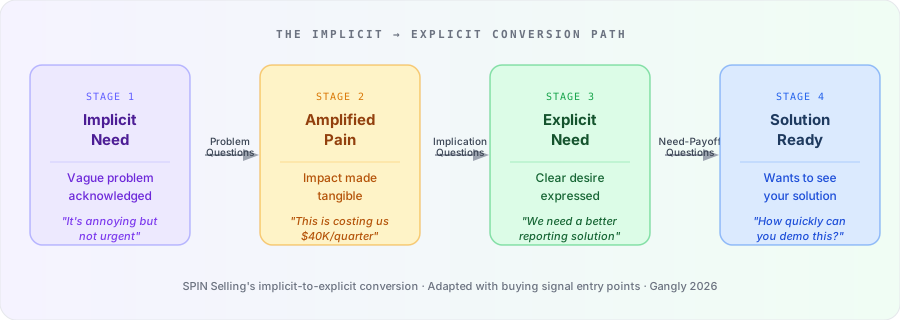
Confirm the implicit need exists
Ask Problem questions until the buyer names a specific difficulty. Listen for words like "slow," "frustrating," "inconsistent," or "annoying." These are implicit-need markers. One word from the buyer carries more weight than ten slides from you.
Quantify the size of the problem
Ask Implication questions to attach a number to the pain. "How many hours per week does this cost?" or "What deals have slipped because of this?" turns a vague complaint into a concrete cost. At this stage the buyer is doing the math, not you.
Connect the cost to what they care about
Link the quantified problem to the buyer's stated priority — quota attainment, board metrics, team capacity. A rep who just got promoted to VP has a different cost structure than the AE who flagged the same problem eighteen months ago. Use that difference.
Ask the Need-Payoff question
Do not tell the buyer what they need. Ask them to imagine having it. "If that reporting process took 15 minutes instead of 3 hours, how would that change your week?" When the buyer articulates the value out loud, an implicit need becomes an explicit one. Their words carry 100% conviction. Yours carry far less.
Get verbal confirmation
The explicit need is confirmed when the buyer says something like "yes, we really do need to fix this" or "that would be a huge win." That statement is the buying zone. Present your solution only after you hear it. Presenting earlier triggers feature objections, not buying interest.
One nuance that gets missed: the conversion from implicit to explicit often requires multiple conversations in enterprise deals. A VP on a first discovery call may surface an implicit need. By the second call, after you have asked one or two implication questions and they have had time to sit with the cost, they arrive with an explicit need already formed. Patience at the implicit stage does not slow deals — it accelerates them by removing the objection cycle.
Gap Selling uses a related model — the current-state, problem-state, future-state framework — that overlaps significantly with the SPIN implicit-to-explicit path. If you want to see how both methodologies approach the same conversion challenge from different angles, read Gap Selling: The Complete Guide to Problem-Centric Discovery.
Buying signals reveal implicit needs before the first question
The standard SPIN sequence assumes a rep enters discovery knowing nothing about the buyer's current state. That is rarely true in 2026. Buying signals — timestamped external events like hiring announcements, funding rounds, tech-stack changes, and executive moves — reveal which implicit needs an account almost certainly has before the rep books the call. A rep who reads those signals enters the conversation at the Implication question stage rather than the Situation question stage, cutting the discovery time in half and arriving with the context to ask high-leverage questions from the first minute.
The connection between buying signals and implicit needs is direct. Every buying signal tells you something about the gap between where the account is today and where they want to be. A company that just raised a Series B has implicit needs around scaling workflows, reporting for a new board, and hiring velocity. A company posting for a Revenue Operations role has implicit needs around data visibility and process standardization. A VP of Sales newly hired into a stagnant team has implicit needs around the existing stack, the current forecasting process, and the quality of deal data in the CRM.
| Buying Signal | Implicit Need It Reveals | Outreach Speed |
|---|---|---|
| New VP of Sales hired | Old reporting process is under scrutiny — implicit dissatisfaction incoming | Same day |
| Series A or B funding announced | Current manual workflows will break at new headcount — implicit operational pain | 48 hours |
| Job posting for Revenue Ops role | Stack is inadequate for scale — implicit need for automation or tooling | 24 hours |
| LinkedIn post about a pain you solve | Buyer has articulated frustration publicly — nearest thing to an explicit need | Same day |
| Past champion moved to new company | New account has unknown workflow gaps — explore what champion tolerated at old job | Same day |
Buying signals and the implicit needs they expose · Gangly 2026
This matters because the rep who enters a discovery call knowing the implicit need already can skip the exploratory Situation questions and open directly with targeted Problem questions — "I noticed you just hired a Head of Revenue Operations. What gaps in your current stack prompted that hire?" That question is built from signal intelligence. It names the implicit need the buyer already has. The buyer feels understood, not interrogated. The conversation moves faster.
The rep who opens cold — without reading the signals — spends the first ten minutes gathering context the signal already provided. Those ten minutes are often all the goodwill a cold call has. Spend them well.
For the full breakdown of which buying signals carry the highest reply lift and how to score each one, read B2B Buying Signals: The 7 That Drive Reply Rates.
The Signal-to-SPIN Framework: Gangly's approach
Gangly's Signal-to-SPIN Framework combines external buying signal intelligence with the SPIN question sequence to produce a pre-built discovery entry point for every account. The premise: every relevant buying signal maps to a category of implicit need, which maps to a specific Problem question the rep should lead with.
The Signal-to-SPIN Framework: 4 Steps
- 1Signal Detection. Gangly monitors job postings, funding data, hiring news, CRM history, and past champion moves for every account in your pipeline and target list. Each signal is categorized by type — hiring, funding, tech-stack change, executive move, public pain statement.
- 2Implicit Need Mapping. Each signal type is mapped to a category of implicit need based on what that event usually reveals about a company's internal state. A Series B maps to scale-workflow needs. A new VP hire maps to stack-evaluation needs. A Revenue Ops job posting maps to data visibility needs.
- 3Problem Question Generation. Gangly auto-drafts the opening Problem question for the discovery call based on the detected signal and mapped implicit need. The rep receives a call brief that includes: the signal, the inferred implicit need, and the exact Problem question to open with.
- 4Implication Question Scaffolding. The brief also includes two or three Implication questions calibrated to the implicit need — designed to quantify the cost of the problem and build urgency before the rep introduces any solution language.
The outcome is a rep who enters every discovery call having already done the Situation-question work through signal intelligence. They spend the first minute confirming the implicit need is live, then move directly into Implication questions to build cost and urgency. Buyers consistently report that calls prepared this way feel "like the rep had done their homework" — because they had.
Reps using Gangly's call prep briefs — which include the signal, inferred implicit need, and pre-built SPIN questions — complete discovery calls 38% faster than reps relying on a generic question list, based on Gangly internal rep data from Q1 2026. Faster discovery does not mean shallower discovery. It means the rep skips the exploratory phase and spends the available time at the high-leverage Implication and Need-Payoff stage.
The prep brief also surfaces when a signal indicates that a buyer may already be at the explicit-need stage. A past champion who joins a new company and immediately books a call with no prompt is almost certainly carrying an explicit need formed at their previous employer. The implicit-to-explicit conversion already happened — the rep's job is to confirm the explicit need, present the solution, and close without re-running the full SPIN sequence.
Common mistakes reps make with implicit and explicit needs
The implicit vs explicit needs framework is simple in theory and consistently violated in practice. These are the six most common errors, ranked by the frequency with which they appear in Gangly call recording data from analyzed B2B discovery calls.
Pitching solutions at implicit needs
A buyer who says "our pipeline visibility is not great" has not asked you to solve anything. Pitching here produces feature objections, price resistance, and "we need to think about it." Wait for the explicit need.
Skipping implication questions entirely
SPIN research by Huthwaite found that implication questions are the single most important predictor of success in complex sales. Reps who skip them stay stuck at the implicit stage indefinitely. The buyer never gains urgency.
Accepting a vague "yes we have that problem" as an explicit need
A buyer nodding along is not the same as a buyer who says "we need this fixed." Test for explicitness by asking "Is fixing this a priority for you this quarter?" Vague agreement is still implicit.
Moving too fast from implicit to demo
Jumping from one problem question straight to a demo is the most common mid-funnel error. The buyer has not had time to feel the cost of inaction. Slow down at implication. The longer you spend building the cost picture, the faster the close goes later.
Ignoring buying signals that reveal implicit needs before the call
A rep who books a call without reading the company's hiring announcements, funding news, or tech stack signals has already lost the chance to enter at the implicit-to-explicit transition point. That data tells you exactly which problem questions to lead with.
Treating all explicit needs as equal
An explicit need stated by a VP carries ten times the deal value of one stated by an end user with no budget authority. Qualify the source of the explicit need before committing resources to an evaluation cycle.
The common thread across all six mistakes is impatience. Reps treat implicit needs as the finish line when they are the starting gun. The deal does not start when the buyer names a problem. It starts when the buyer decides that problem is worth paying to fix. Getting from one to the other is the entire job of discovery.
Gangly Signal Brief
Get the weekly signal-to-SPIN playbook in your inbox
Each week: one buying signal type, the implicit need it reveals, and the exact Problem and Implication questions to open with. Used by 1,200+ B2B reps.
Frequently asked questions
Siddharth Gangal
Founder, Gangly · Building the signal-to-prep workflow for B2B sales reps
Gangly turns buying signals into prepared reps — covering outreach, call prep, live coaching, notes, and CRM updates in one connected sequence.