
 By Siddharth Gangal
TL;DR
- What it is: SPIN Selling is a discovery framework built on 35,000 sales calls across 23 countries. Four question types — Situation, Problem, Implication, Need-Payoff — guide reps to uncover buyer pain and build urgency before presenting any solution.
- Why it works: Buyers who articulate the value of a solution in their own words commit at a higher rate than buyers who are told the value by a rep. SPIN questions force the buyer to do that articulation. This is not persuasion — it is structured discovery.
- The critical stage: Implication questions are the ones reps skip most often and the ones that do the most work. Going from Problem to Need-Payoff without Implication produces intellectual agreement but not purchase urgency. Every rep who has heard "let us revisit next quarter" has usually skipped this stage.
- The 2026 update: SPIN still works. The entry point shifts based on signal data. When a buyer has a live funding event or hiring burst, you can compress Situation questions and start with Implication — the urgency context is already set. Gangly's signal engine tells you which question type to lead with before the call begins.
- First step: Audit your last five discovery call recordings. Count how many Implication questions you asked. If the number is under four, you are closing deals on hope rather than urgency.
What is SPIN Selling?
SPIN Selling is a B2B sales methodology developed by Neil Rackham and published in 1988, based on a 12-year research study of more than 35,000 sales calls across 23 countries. It identifies four question types — Situation, Problem, Implication, and Need-Payoff — that guide reps to uncover buyer pain and build urgency before presenting a solution. The core finding: in complex, high-value B2B sales, reps who ask more Implication and Need-Payoff questions close significantly more deals than reps who lead with features or product benefits.
The research behind SPIN emerged from a deceptively simple question: do the behaviors that produce small-sale success also produce large-sale success? Rackham and his team at Huthwaite (now Huthwaite International) tracked thousands of sales calls and coded every seller behavior — every question, every objection response, every closing attempt. What they found was that the techniques most commonly taught in sales training — benefit statements, feature lists, trial closes — actually correlated with lower win rates in complex, multi-stakeholder, high-ACV deals.
The behaviors that correlated with higher win rates in large deals were different: reps who asked more questions, particularly questions that expanded the consequences of the buyer's problems, won more often. They let the buyer articulate the value of a solution before they presented one. They built urgency from the inside out — through the buyer's own reasoning — rather than from the outside in through persuasion.
IBM was among the first major corporations to adopt SPIN Selling methodology after the book's publication. Internal data showed a 30% increase in sales conversion rates following SPIN implementation across their enterprise sales teams. The methodology became a standard in B2B sales training programs through the 1990s and 2000s, and it remains one of the most widely-cited sales research studies in the profession.
In 2026, SPIN Selling is not a historical artifact. The fundamental psychology of buyer behavior has not changed: buyers still commit more strongly to decisions they reach through their own reasoning than decisions they are told to make. What has changed is the entry point. Modern B2B buyers arrive at discovery calls far more informed than buyers in 1988. Many already know they have a problem — they have read reviews, compared vendors, and done internal research. The implication for how reps structure SPIN questions is significant, and we cover that in the signal-based sequencing section below.
Understanding SPIN also unlocks how it relates to other methodologies. The Challenger Sale is a posture and message framework that complements SPIN's discovery framework. MEDDIC is a qualification framework that runs alongside SPIN throughout the deal cycle. In 2026, top enterprise AEs typically use all three: SPIN to surface pain, Challenger to reframe it, MEDDIC to qualify the deal before committing resources.
The four SPIN question types — with 20+ worked examples
Each of the four question types serves a distinct purpose in the discovery sequence. They are not interchangeable. The sequence builds: Situation establishes the context that makes Problem questions credible, Problem questions surface the pain that makes Implication questions land with weight, and Implication questions build the urgency that makes Need-Payoff questions feel like relief rather than a setup for a pitch.
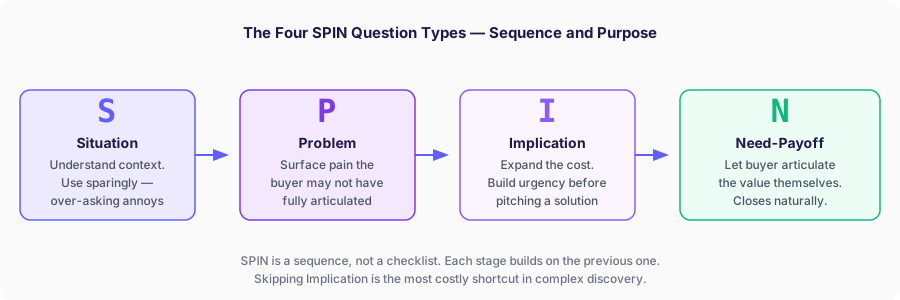
Situation Questions
Establish context. Understand how the prospect currently operates before probing for gaps.
When to use
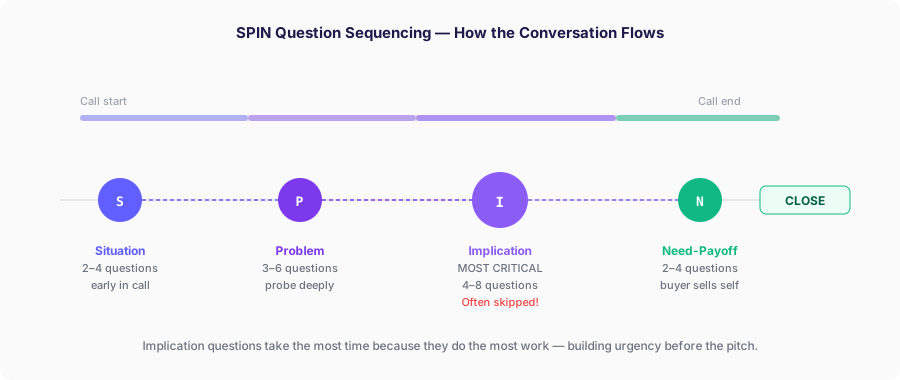
Early in the call. 2–4 questions maximum. Front-load research so you are not asking things you should already know.
Example questions
- ▶"How is your team currently managing the handoff from SDR to AE?"
- ▶"What tools are in your sales stack right now?"
- ▶"How many reps are actively running outbound sequences this quarter?"
- ▶"Walk me through how you prep for a discovery call today."
Watch out
Spending more than 15% of the call on Situation questions signals poor pre-call research. Buyers interpret this as wasted time.
Problem Questions
Surface difficulties, dissatisfactions, and friction points the buyer is living with — including ones they have normalized and stopped noticing.
When to use
After establishing context. Ask 3–6 Problem questions. Probe until you find pain the buyer confirms is real and consequential.
Example questions
- ▶"What is the most frustrating part of that handoff process right now?"
- ▶"Where are deals most likely to stall after your first meeting?"
- ▶"What does a rep miss when they go into a call without enough prep?"
- ▶"Which part of your current stack creates the most manual work?"
Watch out
Problem questions uncover pain but do not build urgency. Do not jump from here to a pitch — that is the most common SPIN shortcut, and it kills deal momentum.
Implication Questions
Expand the consequences of the problem. Build the urgency that makes inaction more painful than change. This is the highest-leverage question type in complex B2B sales.
When to use
After confirming at least one significant Problem. Spend 30–40% of discovery time here. 4–8 questions. Do not shortcut this stage.
Example questions
- ▶"If reps spend 45 minutes prepping for each call, what does that cost your team in pure selling time per week?"
- ▶"When a deal stalls at stage two, what does that typically mean for the quarter's forecast?"
- ▶"How does that manual CRM work affect your ramp time for new hires?"
- ▶"If that bottleneck persists another two quarters, what does that mean for the expansion targets you mentioned?"
Watch out
Implication questions are the ones reps skip most often. Going from Problem straight to Need-Payoff is the fastest way to lose urgency — the buyer agrees with the problem but does not feel the cost, so they defer the decision.
Need-Payoff Questions
Let the buyer articulate the value of a solution in their own words. When a buyer says why a solution matters, they are far more committed to acting on that belief than when a rep says it for them.
When to use
Only after the buyer has acknowledged the cost of the problem. 2–4 questions. The goal is for the buyer to describe the benefit before you pitch the product.
Example questions
- ▶"If your reps could prep for a discovery call in under 8 minutes instead of 45, what would that change about your pipeline volume?"
- ▶"What would it mean for your quarter if new hires hit full productivity in month 4 instead of month 9?"
- ▶"How much easier would your forecast conversations be if your CRM data was always current?"
- ▶"If that manual work were handled automatically, where would you redirect that rep capacity first?"
Watch out
Weak Need-Payoff questions — "Would that be helpful?" or "Does that sound valuable?" — are too generic to create commitment. Make them specific to the cost you surfaced in Implication.
A worked discovery call transcript using SPIN questions
Most SPIN guides list question examples in isolation. What they skip is how the sequence works in a real conversation — how one answer feeds the next question, how the rep tracks which stage they are in without making it obvious, and how the transition from Implication to Need-Payoff feels natural rather than scripted.
The following is a worked example of a SPIN discovery call. Context: an AE at a sales technology company speaks with a VP of Sales at a Series B SaaS company that recently posted eight new AE roles. The product is a signal-based call prep and coaching tool. The call is 35 minutes.
Discovery Call Transcript — Annotated with SPIN Stage
Rep:
"Before we get into specifics — I noticed you just posted eight AE roles in the last three weeks. Is that consistent with a broader GTM push this half, or is there something specific driving the hiring burst?"
VP Sales:
"Both, honestly. We closed our Series B in March and the board wants us at $8M ARR by Q4. That means we need to triple the team fast and have them productive by August."
Note: One Situation question opens the entire context. The rep used public signal data (hiring burst) to frame it — no need for four more Situation questions. Transition to Problem immediately.
Rep:
"August is tight. For the new hires who are starting in the next six weeks — what does your current onboarding look like for getting them ready for live discovery calls?"
VP Sales:
"Right now it is mostly shadowing and Salesforce training. We have a call library but nobody really uses it. The honest answer is they are getting dropped into pipeline around week four and learning by doing."
Rep:
"When they get dropped into pipeline in week four — what does 'ready' actually look like? Are they running discovery solo at that point?"
VP Sales:
"Solo, yes. We do not have bandwidth to shadow every call. So they are going in with whatever they picked up in the first month."
Note: Two Problem questions. The rep now has a confirmed pain: reps in live calls without adequate prep, starting in week four. Transition to Implication — the most important stage.
Rep:
"What does that mean in practice for your pipeline numbers? If a new hire goes into their first 10 discovery calls under-prepared — what is your typical conversion rate from those calls versus a tenured rep?"
VP Sales:
"Night and day. Our best AEs convert maybe 35% of qualified discovery calls to next steps. New hires in the first two months are probably at 12–15%. It takes about six months before they are consistently above 25%."
Rep:
"So for eight reps, that gap between 15% and 35% during the first six months — if each of them runs 20 discovery calls per month, what does that math look like on pipeline?"
VP Sales:
"[Pause.] That is... each rep missing roughly four meetings per month from what a tenured rep would book. Eight reps. Six months. That is close to 200 meetings we are not getting to second stage. At our ACV that is probably $1.5M to $2M in qualified pipeline we are burning through ramp."
Rep:
"And that $1.5–2M is baked into the $8M ARR target your board expects by Q4?"
VP Sales:
"Yes. It has to be. We cannot hit $8M without the new team performing."
Note: Three Implication questions. The buyer has now calculated, in their own numbers, that the ramp problem costs $1.5–2M against a mission-critical target. The urgency is buyer-generated, not rep-asserted. Now transition to Need-Payoff.
Rep:
"If your new hires could walk into every discovery call with a signal-based prep brief — already knowing the account's recent hiring activity, the tech stack, the last three touchpoints — and have a suggested opening question ready before the call starts, what would that do to that 15% conversion number in months one and two?"
VP Sales:
"If it moves them even to 22–25% in month one, that is eight to ten meetings per rep per month that are not being wasted. That is a completely different ramp curve."
Rep:
"And if you could compress the time from hire to 25%-plus conversion from six months to three — what does that mean for your Q4 number?"
VP Sales:
"That is the difference between making $8M and missing it. Let me see what you actually do."
Note: The buyer requested the demo. The rep never pitched. The Need-Payoff questions let the VP articulate the value in their own terms, tied to their own target. The solution presentation that follows now lands as the answer to a question the buyer asked, not a pitch the rep made.
Read this transcript against the failure modes it avoids. Zero features mentioned. Zero benefits stated by the rep. The product never appeared until the buyer asked to see it. The rep spent more than half the call in the Implication stage — because that is where the work happens. The buyer calculated the cost themselves, using their own numbers. When a buyer does that, the urgency is real, not constructed.
This is what separates SPIN from consultative selling in practice. A consultative rep in the same call might surface the same pain through gentle questioning. A SPIN rep goes further: they build out the full cost of that pain in the buyer's own quantitative terms before offering any solution. The difference in commitment level at the end of the call is significant.
Which SPIN question type to lead with
The standard SPIN guidance is to start with Situation questions. That guidance made complete sense in 1988 when reps had limited information about prospects before a call. In 2026, starting every discovery call with multiple Situation questions signals that you did not prepare — a credibility problem that compounds as the call continues.
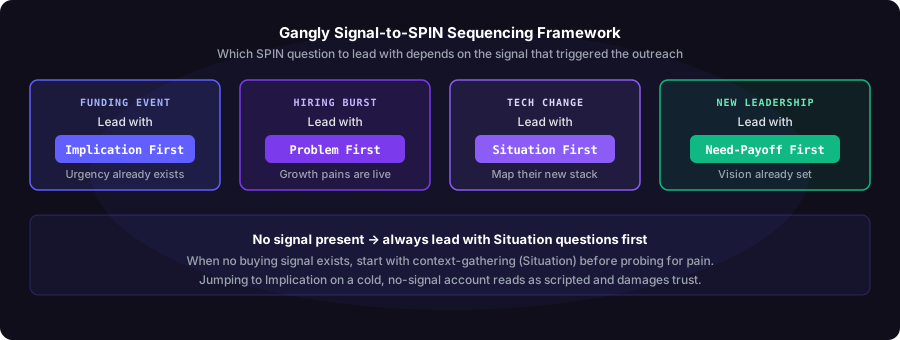
The correct 2026 rule: the question type you lead with depends on how much context you already have, and how urgency-ready the buyer is based on the signal that triggered your outreach. Here is the decision framework:
Cold outbound, no signal, unknown context → start with Situation
You have limited context about the account's current state. 2–3 Situation questions establish the baseline before you can probe for meaningful problems. Keep these tight and move quickly.
Hiring burst or tech change signal → start with Problem
The signal tells you the context — rapid scaling or a new tool implementation. You know the category of pain. Skip most Situation questions and probe directly for the specific pain within that context.
Funding event in the last 21 days → start with Implication
New capital creates immediate growth-target pressure. The buyer already has urgency. Open with a framing question that connects their funding context to a cost: "Most teams at your stage find that X becomes the binding constraint within 90 days of a Series B — is that showing up for you yet?"
New leader in ICP role in the last 21 days → start with Need-Payoff
A new VP of Sales or CRO has a 90-day window of open inquiry before they commit to the existing stack. They have already formed a vision of what good looks like. Open with outcome framing: "What does your ideal state look like for X by month three?" — then build backward through Problem and Implication to your solution.
The key insight: SPIN is not always a sequential four-stage process starting from Situation. The sequence is the default for cold, low-context calls. When signal data provides context, smart reps compress or skip the early stages and start where the buyer's urgency already is. The purpose of every SPIN question is to build toward a buyer-articulated need — and sometimes the buyer is already halfway there when the call starts.
This is also why pre-call research has not become less important in the age of AI — it has become more important. The rep who knows the account's funding history, hiring velocity, and tech stack can run a more effective SPIN sequence in 20 minutes than the rep who spends 10 of those minutes on Situation questions asking about things that are publicly available. For a full framework on call prep, read the discovery call framework guide.
SPIN vs Challenger Sale vs MEDDIC — the honest comparison
Three of the most-cited B2B sales methodologies — SPIN, Challenger, MEDDIC — are often treated as competing alternatives. They are not. They address different problems in the sale. Understanding which problem each one solves prevents the most common implementation mistake: applying one methodology to a situation it was not designed for.
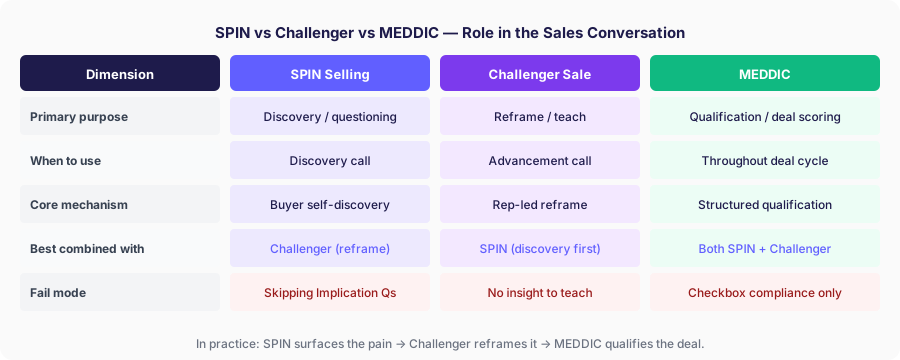
SPIN: the discovery engine
SPIN is a discovery framework. Its purpose is to guide the buyer to surface, name, and quantify their own pain before any solution is presented. The mechanism is buyer self-discovery: SPIN questions prompt the buyer to do the analytical work, which means the urgency they feel is self-generated rather than rep-asserted.
SPIN works best in early discovery calls where the buyer has acknowledged a general problem area but has not yet quantified the cost of that problem. It is weakest in situations where the buyer does not have the information needed to answer Implication questions accurately — in those cases, the rep needs to bring the data rather than wait for the buyer to generate it.
Challenger: the reframe engine
The Challenger Sale is a posture and message framework. Its purpose is to teach buyers new perspectives — to challenge the assumption that their current approach is the best available one — and to drive toward a decision with confidence. The mechanism is rep-led reframing: the rep brings a teaching point that shifts how the buyer sees their problem.
The natural combination: SPIN questions in discovery surface the specific pain that the Challenger reframe can then expand and redirect. A rep who has used SPIN to confirm that the buyer's ramp problem costs $1.5M per cohort can then deploy a Challenger insight — "most teams at your scale solve this by fixing the wrong variable — they train harder on product knowledge when the actual gap is pre-call context" — to reframe the problem in a way that points to the rep's specific capability.
MEDDIC: the qualification engine
MEDDIC is a deal qualification framework. Its purpose is to ensure the rep invests resources in deals that are actually closeable — by confirming Metrics (the quantified business case), Economic Buyer (access to the real decision-maker), Decision Criteria, Decision Process, Identified Pain, and Champion. The mechanism is structured qualification throughout the deal cycle.
MEDDIC does not replace SPIN — it confirms that the pain SPIN surfaced is attached to real budget authority and a real process. A deal where SPIN Implication questions produced a $1.5M number means nothing if the person who calculated that number cannot influence the purchase decision. MEDDIC verifies the deal structure; SPIN verifies the pain structure.
For a simpler qualification framework that works before MEDDIC is warranted, the BANT qualification guide covers where the older framework holds up and where it breaks down in modern SaaS sales.
Signal-based SPIN sequencing — the Gangly framework
Most SPIN implementations treat every discovery call the same: start with Situation, work through Problem, spend time on Implication, close with Need-Payoff. That default works when you know nothing about the account before the call. It produces mediocre results when you have rich signal data about the account's current state — because you waste call time establishing context the buyer expects you to already have.
Gangly Framework
The Signal-to-SPIN Entry Framework
Gangly's analysis of outbound sequences in 2025–2026 identified a consistent pattern: the question type you lead with should match the urgency level the buying signal creates. Leading with Implication on a cold, no-signal account reads as presumptuous and performs poorly. Leading with Situation on a freshly-funded account wastes the window of urgency the signal opened.
The signal-to-SPIN entry map:
- FFunding event (0–21 days): Enter at Implication. The board target is set. Cost-of-inaction framing lands immediately because the buyer is already in growth-pressure mode. Example opener: "Most teams at your stage find that rep ramp time becomes the binding constraint within 60 days of a funding close — are you seeing that show up yet?"
- HHiring burst (5+ roles, 0–14 days): Enter at Problem. You know the context (scaling team). Skip Situation questions about team size and stack. Probe directly for the specific friction points that appear at their scale and growth velocity.
- TTechnology change (new CRM, SEP, or data tool, 0–30 days): Enter at Situation — but targeted. You know the tech context. Ask one or two specific questions about the new tool's integration state before moving to the problems that typically appear during that transition period.
- LNew leadership in ICP role (0–21 days): Enter at Need-Payoff framing. The new leader has already formed a vision of what better looks like. Start with outcome questions: "What does your ideal state look like for [problem area] by month three?" Then build backward through Implication and Problem to confirm the pain behind the vision.
- ∅No signal present: Enter at Situation. The standard SPIN default applies. Use 2–3 Situation questions to establish context before moving to Problem. Do not attempt Implication framing without a confirmed problem — it reads as a scripted pitch tactic, not discovery.
Gangly's call prep engine surfaces the buying signals for each account before the call, identifies which signal category applies, and generates a suggested opening question and SPIN stage recommendation based on the signal context. The rep reviews the suggested entry point in the prep brief, adjusts to their voice, and walks into the call with a question that is already calibrated to the buyer's urgency level — rather than starting from scratch and hoping the first question lands.
The result is a faster path to Implication questions — the stage that drives urgency — without the credibility cost of asking Situation questions the rep should already know the answers to. Reps using signal-informed SPIN entry points reduce average time-to-Implication from 18 minutes to under 7 minutes on calls where a relevant signal is present. That compression matters because most decision-makers are willing to give a rep 35–45 minutes, not 60. Every minute saved in Situation territory is a minute available for Implication work.
Common SPIN mistakes to avoid
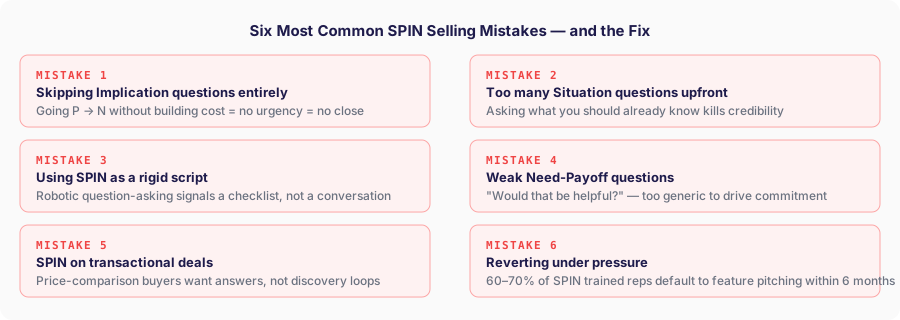
SPIN Selling has been in active use for nearly four decades. The implementation failure patterns are well-documented — and remarkably consistent across industries, company sizes, and rep tenures. Six mistakes account for the majority of SPIN execution problems.
- 1
Skipping Implication questions entirely
The most expensive shortcut in complex discovery. When reps move from Problem directly to Need-Payoff, the buyer acknowledges the pain but has not felt the full cost of inaction. The result: "That is interesting — let us reconnect next quarter." Implication questions are what convert intellectual agreement into purchase urgency. Spend 30–40% of your discovery call here. If the call runs short, cut Situation questions — never Implication.
- 2
Asking too many Situation questions at the start
Situation questions are necessary to establish context, but 6–8 of them in a row signals that you did not prepare. Modern B2B buyers expect you to arrive knowing their company size, their CRM, their recent hiring activity, and their public revenue targets. Every Situation question you ask about something you could have found in 10 minutes of research reduces your credibility before you even get to pain discovery. Limit Situation questions to 2–4 in most calls.
- 3
Treating SPIN as a rigid script
SPIN is a questioning framework, not a pitch deck. Reps who work through S, then P, then I, then N in mechanical order — with no regard for what the buyer actually says — sound like interviewers running a protocol. SPIN works when it is adaptive: you follow the buyer's answers, probe the thread that has the most energy, and let the natural conversation dictate which question type comes next. The sequence is a guide, not a conveyor belt.
- 4
Using weak Need-Payoff questions
"Would that be helpful?" is not a Need-Payoff question. "How much easier would it be if X?" is barely one. Strong Need-Payoff questions are specific, quantified, and tied directly to the cost you surfaced in Implication. "If your reps recovered 30 hours per week of selling time, what does that mean for this quarter's pipeline?" forces the buyer to calculate value themselves — which makes the commitment real. Generic Need-Payoff questions get polite agreement, not decisions.
- 5
Applying SPIN to transactional deals
A buyer who is comparison-shopping between two vendors on a $2,000 tool does not want a discovery conversation — they want a direct answer to a specific question. Putting them through an Implication sequence when they are already in Problem-acknowledged mode wastes their time and signals that you are not listening to where they are in the buying process. SPIN is designed for complex, multi-stakeholder, consultative deals where the buyer has not yet fully defined the scope of the problem.
- 6
Reverting to feature pitching under live call pressure
The research on SPIN implementation failure is consistent: 60–70% of trained reps revert to feature-centric presentations within six months because the habit is deeply conditioned. When a call gets tense, when a buyer asks a tough question, or when time pressure mounts, reps default to what they know: product features. The fix is not more training — it is live call coaching that prompts the rep to stay in questioning mode instead of defaulting to pitch mode when the buyer pushes back.
The most durable fix for mistakes 3 and 6 — robotic scripting and reversion to features under pressure — is live call coaching that surfaces question-type prompts in real time. When a rep gets a strong answer to a Problem question and the natural instinct is to pitch, a live coaching prompt — "Next: Implication — what does that cost them?" — redirects the conversation without breaking flow. This is the category of tool that makes SPIN sustainable at scale, not just in recorded demos and roleplay sessions.
Mistake 4 — weak Need-Payoff questions — has a structural fix: write your three strongest Need-Payoff questions before every call, tied specifically to the Implication cost you expect to surface. If your Implication questions are going to build around rep productivity cost, your Need-Payoff questions should ask specifically about the productivity outcome: "If your reps recovered 28 hours per week of selling time, what does that do to your pipeline coverage ratio this quarter?" Generic Need-Payoff questions get polite nods. Specific ones get decisions.