
 By Siddharth Gangal
TL;DR
- →Prospecting KPIs measure top-of-funnel activity quality — connect rate, reply rate, meeting book rate, show rate, and pipeline created. They are distinct from general SDR metrics because they isolate the prospecting motion before pipeline stage advancement.
- →The three tiers: Input KPIs (dials, sequences started), Process KPIs (connect rate, reply rate, show rate), Outcome KPIs (meetings held, pipeline created). Process KPIs are the most predictive. Most teams only track inputs.
- →The Prospecting Efficiency Score combines activity volume with conversion rate into a single composite number. A score above 85 correlates with signal-triggered outreach at scale.
- →Signal-triggered outreach moves connect rate from 3% to 9% and email reply rate from 2–3% to 8–15%, according to Gangly internal rep data from Q1 2026. The baseline KPI target changes when the motion changes.
What are prospecting KPIs?
Prospecting KPIs are measurable performance indicators that evaluate the effectiveness of top-of-funnel outreach activity. They track the inputs reps control (dials, emails sent, sequences started), the process efficiency those inputs produce (connect rate, reply rate, meeting book rate), and the pipeline outputs that result (meetings held, opportunities created, pipeline value in dollars). Every metric sits in one of three tiers: Input, Process, or Outcome.
The word "prospecting" is doing important work here. Prospecting KPIs are not general SDR metrics. They do not measure win rate, quota attainment, or average deal size — those are pipeline and revenue metrics that reflect the full sales cycle. Prospecting KPIs measure only the motion that fills the top of the funnel, before any account has a deal stage attached to it.
This distinction matters because a rep can look strong on general SDR metrics while the prospecting motion quietly collapses. If a high-performing AE sources referrals into the pipeline, the SDR's quota attainment number holds up — even though the SDR's own prospecting sequences produce zero booked meetings. Separate KPIs prevent that blind spot.
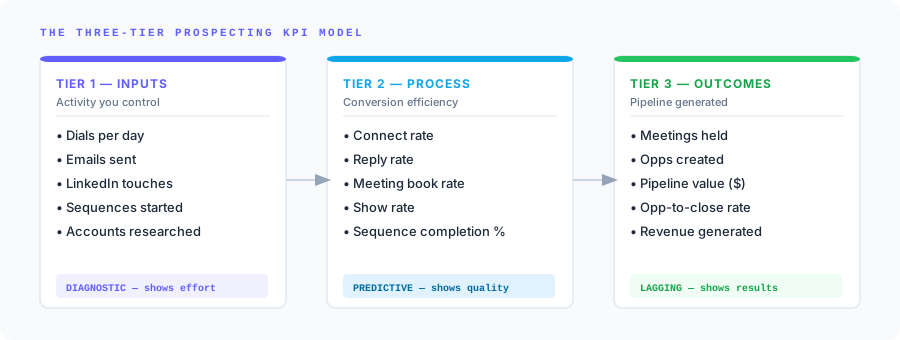
The three tiers serve different diagnostic purposes. Input KPIs tell you how hard a rep is working. Process KPIs tell you how effectively that work converts. Outcome KPIs tell you what the business gets. A manager who only looks at Input KPIs — dials and emails sent — is flying blind on what actually drives pipeline.
The single most under-tracked tier is Process. Connect rate, reply rate, and show rate are available in every modern sales engagement platform. Most teams never surface them in the weekly review because the manager is still looking at activity dashboards inherited from 2018. That is the gap this guide fixes.
Prospecting KPIs vs. general SDR metrics
The prospecting KPI versus general SDR metric split is the most important distinction in this guide. Understanding it prevents the most common measurement mistake in B2B sales: using lagging revenue metrics to diagnose a leading activity problem.
| Dimension | Prospecting KPIs | General SDR Metrics |
|---|---|---|
| What they measure | Top-of-funnel activity quality | Full pipeline and revenue performance |
| When they move | Daily and weekly | Monthly and quarterly |
| Who owns them | SDR / BDR | SDR + AE + Manager |
| Examples | Connect rate, reply rate, meeting book rate | Quota attainment, win rate, ACV, cycle length |
| Lead time | 1–14 days to detect a problem | 60–90 days to detect a problem |
| Fix speed | Adjust messaging, targeting, timing this week | Require full-cycle intervention |
The practical implication: if a rep is tracking for quota attainment and pipeline created but not tracking connect rate or reply rate, a broken prospecting motion can go undetected for eight weeks. By then, the pipeline gap is irreversible for the quarter. Prospecting KPIs are the early warning system. Run them weekly, act on them immediately.
For deeper context on the full SDR measurement stack — including how prospecting KPIs roll up into quota and pipeline metrics — read the guide to SDR metrics that actually predict attainment.
The 10 prospecting KPIs with formulas
Ten KPIs cover the full prospecting motion. Three are Input tier, four are Process tier, and three are Outcome tier. Track all ten but weight the Process tier KPIs in your weekly reviews — they are the leading indicators that predict everything in the Outcome tier.
Connect Rate
Formula
Live Conversations ÷ Dials × 100
2026 Benchmark
6–12% cold; 9–14% signal-triggered
Connect rate separates phone effort from phone results. Low dials with high connect rates beat high dials with low connect rates every time. If your connect rate is under 4%, your list quality is the problem — not your volume.
Email Reply Rate
Formula
Replies Received ÷ Emails Delivered × 100
2026 Benchmark
2–3% cold; 8–15% signal-triggered
Reply rate is the single best early indicator of message quality. A rate below 2% means the subject line, the first sentence, or the list quality has failed. A rate above 8% on cold outreach means you have a repeatable angle worth scaling.
Meeting Book Rate
Formula
Meetings Booked ÷ Prospects Contacted × 100
2026 Benchmark
1–2% cold; 5–8% signal-triggered
Meeting book rate is the bridge between activity and pipeline. It answers whether your outreach motion is producing commitments. Track this per channel — phone book rate versus email book rate — because they tell different stories.
Show Rate
Formula
Meetings Attended ÷ Meetings Booked × 100
2026 Benchmark
70–80% average; 80–88% signal-triggered
Show rate exposes how much conviction your outreach built. A booking from a signal-led email shows 15 percentage points higher than a booking from a generic cold pitch. Low show rates mean the prospect was not really sold on the relevance — fix the outreach, not the reminder sequence.
Sequences Started per Day
Formula
New Sequences Started ÷ Working Days
2026 Benchmark
8–15/day average SDR; 20–30/day top performers
Sequences started measures prospecting throughput. It is not the same as emails sent — it counts net-new accounts entering your pipeline motion. Reps who plateau at a low sequences-started number typically have a list-building problem, not a time problem.
Dials per Day
Formula
Total Outbound Dials ÷ Working Days
2026 Benchmark
40–60/day average; Bridge Group 2025 median: 44
Dials are the most visible input KPI but the least diagnostic on their own. Track dials alongside connect rate — high dials and low connects means bad list or bad timing. Signal-triggered dials on recently funded accounts or new hires convert 3× better with fewer total attempts.
Pipeline Created ($)
Formula
Sum of ACV for all Opps Created from Prospecting
2026 Benchmark
3–5× quarterly quota; $150K–$300K/month for mid-market SDR
Pipeline created is the most important outcome KPI for prospecting. It connects activity directly to revenue. Every week of lagging pipeline created is a 60–90-day warning signal for missed quota. Track it weekly, not monthly — weekly visibility lets you course-correct before the quarter is lost.
Meetings Held per Month
Formula
Qualified Meetings Attended by Both Parties
2026 Benchmark
12–15/month average SDR; 20–25/month top performer
Meetings held — not booked — is the outcome metric that actually counts. Bridge Group 2025 data puts the median at 14 held meetings per month per SDR. Separate held from no-shows in your CRM. A rep with 25 bookings and a 55% show rate is underperforming a rep with 18 bookings and an 85% show rate.
Opportunity Conversion Rate
Formula
Opps Created ÷ Meetings Held × 100
2026 Benchmark
25–40% for well-targeted ICP; 15–20% if list is broad
Opp conversion rate tells you if the meetings held were with the right people at the right accounts. A low rate means reps are booking meetings but not qualifying the ICP correctly. This KPI sits at the handoff between SDR and AE — both teams should track it and own it jointly.
Cost per Opportunity (CPO)
Formula
(Rep Salary + Tools Cost) ÷ Opps Created per Period
2026 Benchmark
$400–$800 per opp (SMB); $800–$2,000 (mid-market)
CPO forces you to connect human effort and tool spend to actual pipeline output. It is the KPI managers use to justify headcount and tool budgets. A rep whose CPO drops 40% after adopting signal-triggered prospecting makes the case for the tool budget better than any demo ever could.
For the related activity tracking layer — how to log and review these KPIs across CRM, sequencing tools, and call intelligence platforms — see the complete guide to sales activity metrics.
2026 benchmarks by role and segment
Benchmarks only mean something when they match your motion. An enterprise SDR selling a $60,000 ACV product will have structurally lower connect rates and meeting book rates than a PLG-focused BDR calling into SMB accounts. Use these as directional targets, not hard pass/fail gates.
The figures below combine Bridge Group's 2025 SDR benchmarks, Prospeo's 2026 outbound KPI data, and Gangly internal rep cohort data from Q1 2026.
| KPI | Average SDR | Average BDR | Top Performer |
|---|---|---|---|
| Connect rate (cold) | 6–8% | 8–12% | 12–15% |
| Reply rate (email) | 2–4% | 3–5% | 8–15% |
| Meeting book rate | 1–2% | 1.5–3% | 5–8% |
| Show rate | 72–78% | 75–80% | 82–88% |
| Meetings held / month | 10–14 | 12–18 | 20–25 |
| Sequences started / day | 8–12 | 10–15 | 20–30 |
| Opp conversion rate | 20–28% | 25–35% | 35–45% |
| Pipeline created / month | $80K–$150K | $120K–$220K | $250K+ |
Sources: Bridge Group SDR Benchmark 2025 · Prospeo Outbound SDR Metrics 2026 · Gangly internal rep data Q1 2026
The "top performer" column is not an outlier effect. The gap between average and top is primarily explained by outreach targeting quality — specifically, whether the rep is prospecting into accounts that have a recent signal versus accounts pulled from a static list. Top performers in the Gangly cohort run signal-triggered sequences as a default, not as an exception.
The Prospecting Efficiency Score
Individual KPIs tell partial stories. A rep with high dials and low connect rate is working hard in the wrong direction. A rep with a high reply rate but low sequences started is hitting quality but not volume. You need a single composite number that combines activity volume with conversion quality.
The Prospecting Efficiency Score (PES) is a composite metric that multiplies a rep's meeting-generation conversion rate by their pipeline attainment rate, producing a 0–100 score that reflects both volume and quality in a single number.
Formula
PES = (Meetings Held ÷ Sequences Started) × (Pipeline Created ÷ Pipeline Target) × 100
Component 1
Meetings Held ÷ Sequences Started
Measures end-to-end conversion quality
Component 2
Pipeline Created ÷ Pipeline Target
Measures output against quota
Output
Score of 0–100
Target ≥ 65 average; ≥ 85 top performer
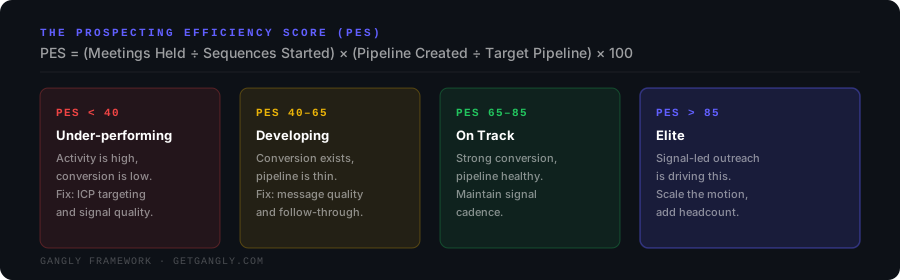
How to use PES in a weekly review: Pull each rep's sequences started in the week, meetings held in the week, pipeline created in the week, and pipeline target for the week (typically one-quarter of the monthly target). Calculate the score. Anything below 40 triggers a same-day coaching conversation. Anything above 85 gets documented as a model motion to replicate.
PES is most useful as a comparative tool across a team. It normalizes for the fact that high-volume reps and high-precision reps look completely different on individual KPIs but converge on a shared score that reflects efficiency. A rep with a PES of 78 who runs 12 sequences per day is more efficient than a rep with a PES of 55 who runs 30 sequences per day.
How signal-triggered outreach rewrites the baseline
Standard prospecting KPI benchmarks are built on cold, unresearched outreach. A rep dials into a static list, sends a template sequence, and measures results against industry averages. Those averages — 3% connect rate, 2–3% reply rate, 1–2% meeting book rate — reflect an outreach motion with no timing, no context, and no signal.
When outreach is timed to a buying signal — a new VP hired into the buyer function, a funding round announced, a job posting that names your category — the baseline KPI shifts dramatically. Gangly internal rep data from Q1 2026 shows connect rate moving from 3% to 9%, email reply rate from 2–3% to 8–15%, and meeting book rate from 1–2% to 5–8%. That is not a marginal improvement. It is a structural change in what "good" looks like.
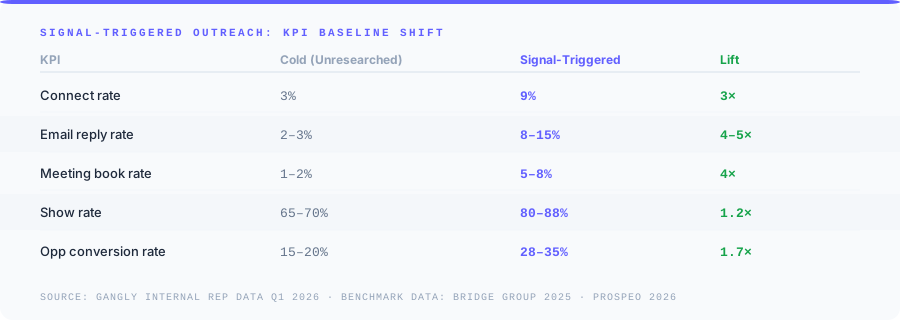
The mechanism is straightforward. A rep who reaches out to a Series B company three days after the funding round announcement is not interrupting the buyer — they are arriving at the exact moment the buyer is thinking about growth tooling, new hires, and hitting board expectations. The buying signal makes the first sentence of the email write itself, and the timing means the rep is one of the first voices in the buyer's inbox, not the fortieth.
The implication for KPI targets is concrete: if a rep's prospecting motion runs on signals, set different benchmarks. A signal-triggered connect rate target of 8–10% is realistic and should be expected. Holding that rep to a 6% cold benchmark understates what good looks like and removes the incentive to do the signal research.
For the full playbook on building a signal-triggered prospecting motion — including which signals to track, how to score them, and how to build the daily scanning habit — read the complete guide to B2B buying signals or the signal-based selling guide for B2B reps.
3% → 9%
Connect rate lift: cold vs. signal-triggered outreach
Gangly rep cohort · Q1 2026
5×
Reply rate increase on signal-led emails vs. cold templates
Gangly rep cohort · Q1 2026
21 attempts
Average BDR touches per contact in 2026, up from 17 in 2024
6sense 2025 BDR Benchmark
How to build your prospecting KPI dashboard
A prospecting KPI dashboard has one job: surface the right numbers in the right cadence so that a rep and manager can make a decision today, not next month. Most sales dashboards are built for reporting to leadership, not for daily decision-making by the rep. Build yours for the rep first.
What the daily rep view needs
Sequences started today vs. daily target
Are you hitting input volume? If not, the day is the correction opportunity.
Dials made and connects per dial
Know by noon whether your timing or list is causing a connect rate problem.
Replies received and reply rate vs. 7-day average
Flag messaging problems before the week ends.
Meetings booked today
One-line daily accountability.
What the weekly manager view needs
PES per rep (ranked)
Immediately shows who needs coaching and who should be studied.
Pipeline created vs. weekly target per rep
The outcome metric that matters most. Flag anyone below 60% by Wednesday.
Connect rate and reply rate vs. team average
Identify reps who need message coaching vs. list quality coaching.
Show rate per rep
A show rate below 68% means something is wrong with either the ICP targeting or the outreach quality.
Meetings held vs. meetings booked (show rate trend)
Watch for deterioration — it often precedes a pipeline miss by 4–6 weeks.
Tool stack for prospecting KPI tracking
The minimal stack for accurate prospecting KPI tracking combines three data sources:
| Source | KPIs Sourced | Update cadence |
|---|---|---|
| Sales engagement platform (Outreach, Salesloft, Apollo) | Sequences started, reply rate, open rate, email sent | Real-time |
| CRM (Salesforce, HubSpot) | Meetings booked, meetings held, opps created, pipeline value | Daily |
| Dialer (Aircall, Gong, Chorus) | Dials, connects, connect rate, call duration | Real-time |
| Gangly | Signal quality, PES tracking, workflow completion rate, outreach sent from signal | Daily feed |
Gangly connects the signal detection layer to the prospecting KPI layer. The daily feed surfaces accounts ranked by signal strength, auto-drafts the signal-led outreach, and tracks which sequences convert so the PES calculation happens automatically — without a rep manually pulling numbers from three tools. See how the Gangly workflow connects signals to KPIs →
Common mistakes reps make with prospecting KPIs
Six mistakes account for the majority of prospecting KPI failures. Every one of them is fixable within a single week.
Tracking dials instead of connects.
Fix: Dials are effort. Connects are results. A rep who makes 80 dials with a 2% connect rate produces fewer conversations than a rep who makes 50 dials with an 8% connect rate. Report on connects per day, not dials per day.
Measuring email sent volume instead of reply rate.
Fix: Sent volume is a vanity metric. A rep can send 200 emails per day to irrelevant contacts and show a high-activity dashboard while generating zero pipeline. Replace "emails sent" with "positive reply rate" as the primary email KPI.
Using monthly review cycles instead of weekly.
Fix: Pipeline created and meetings held should be reviewed every week. Monthly reviews catch problems 3–4 weeks too late. A rep who is 60% off pipeline target in week two needs coaching in week two — not at month close.
Conflating meeting booked with meeting held.
Fix: A booking is a calendar entry. A held meeting is a real conversation. Show rate at or below 65% is a red flag. Track both separately and calculate show rate by outreach channel — it will expose which sequences are booking uncommitted prospects.
Ignoring cost per opportunity.
Fix: CPO ties the entire prospecting stack to output. If your SDR team spends $18,000 per month on headcount and tools and creates 12 opportunities, CPO is $1,500. If signal-triggered prospecting doubles that to 24 opportunities, CPO drops to $750. That math drives budget decisions.
Setting KPIs without separating prospecting from general SDR metrics.
Fix: General SDR metrics (quota attainment, win rate, ACV) measure the full pipeline. Prospecting KPIs measure only top-of-funnel activity quality. Mixing them means a rep can hit quota through a great AE-sourced referral channel while the prospecting motion completely stalls — and the manager never sees it.
For an outbound system that prevents all six mistakes structurally — by embedding KPI tracking into the daily workflow rather than leaving it to manual reporting — see the outbound sales playbook and the full SDR metrics guide.