
 By Siddharth Gangal
TL;DR
- The SaaS sales cycle has 7 official stages — and 3 invisible stages most CRMs never log. The invisible ones (signal-to-outreach gap, multi-thread delay, champion-to-DM handoff lag) account for 30–40% of total cycle length at mid-market and enterprise.
- The median B2B SaaS cycle is 84 days (Optifai, 2025), but deal size drives a 12x range: SMB under $5K closes in 40 days, enterprise over $100K takes 6–12 months.
- Win rate drops from 47% to 21% when deals exceed 50 days without a clear next step (Outreach, 2025). Speed is not just efficiency — it predicts outcome.
- The COMPRESS Framework identifies seven levers for shortening the cycle: signal capture speed, multi-threading, mutual action plan, pre-call preparation, CRM lag removal, compelling event, and segmented measurement.
Direct answer
A SaaS sales cycle is the sequence of stages a B2B software company goes through to close a deal, from first identifying a prospect to signed contract. The standard cycle has seven stages: prospecting, qualification, discovery, demo and evaluation, proposal, negotiation, and close. The median duration is 84 days for B2B SaaS, with SMB deals closing in 14–40 days and enterprise deals running 6–12 months. Cycles have lengthened 22% since 2022, driven by larger buying committees and expanded security review requirements.
Free playbook
Get the SaaS Sales Cycle Cheat Sheet
Stage timing by ACV tier, the 3 hidden stages checklist, and the COMPRESS Framework — delivered to your inbox.
Subscribe free →What is a SaaS sales cycle — and why the 84-day average misleads most reps
The SaaS sales cycle is the full operational sequence from identifying a potential customer to receiving a signed contract. Every stage maps to a specific set of rep activities, stakeholder interactions, and decision points. Get one stage wrong, and the downstream stages stall or collapse.
The 84-day median is accurate as a blended average, but it is nearly useless as a target. Consider what it hides. A rep selling a $3K/year HR tool to a 20-person company is operating in a 14–30 day motion. A rep selling a $200K/year security platform to a Fortune 500 procurement team is in a 9–12 month motion. Average those two deals and you get something close to 84 days — but neither rep has any use for that number.
The cycle also has a beginning and an end that different teams measure differently. Most benchmark data — including the Optifai 2025 figure — starts the clock at opportunity creation, not at first marketing touch. A cold email that generates a reply and then a discovery call creates an opportunity on the day of the call, not on the day the email was sent. If you start counting from the first marketing attribution event, your cycles will look 20–50% longer than benchmark comparisons expect. Know your denominator.
Key definition
SaaS sales cycle length — the number of days between opportunity creation (the moment a rep qualifies a potential deal) and closed-won (signed contract). Measure separately for SMB, mid-market, and enterprise segments. A single blended average across segments is almost diagnostically useless.
One more reason the average misleads: it conflates cycle length with cycle health. A 120-day cycle at an enterprise-focused company is normal. A 120-day cycle for a team selling $8K ACV SaaS tools to 50-person companies is a process failure. Always benchmark against your own ACV tier and segment. The full sales cycle length benchmark by industry and deal size has the segmented data you need.
The 7 stages of the SaaS sales cycle — what happens at each one
The seven-stage model is the most widely used framework for mapping the SaaS sales cycle. Each stage has a clear entry trigger, a rep activity set, and an exit criteria. Exit criteria are critical — without them, deals drift between stages without momentum.
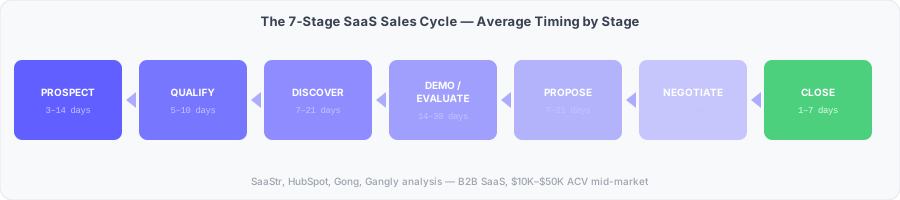
Stage 1: Prospecting (3–14 days)
Prospecting is the identification of accounts and contacts that fit your ICP. In modern B2B SaaS, prospecting is not a cold list-pull — it is a signal-driven filter. The best teams prioritize accounts showing buying intent: job posts for roles your tool addresses, technology changes detected via data enrichment, leadership transitions, or funding events that indicate budget availability.
The critical prospecting metric is not volume of accounts touched — it is signal-to-outreach speed. A buying signal has a half-life. Research from multiple sourced reports confirms that the majority of competitor outreach to the same signal-triggering account arrives within 48–72 hours of the event. A rep who reaches out on day 10 is not competing for the deal — they are competing for a conversation already had.
- Entry trigger: Account matches ICP and shows a buying signal (job post, funding round, technology change, intent spike).
- Rep activity: Enrich account, identify 2–3 stakeholders, research signal context, draft personalized first touchpoint.
- Exit criteria: Initial outreach sent. Reply or connection request accepted moves to Stage 2.
- Common mistake: Sending generic outreach to a list instead of signal-triggered outreach to a short, high-fit list.
Stage 2: Qualification (5–10 days)
Qualification confirms that the account has the budget, authority, need, and timeline to buy. The classic BANT framework is the standard starting point, though most modern teams extend it to include MEDDIC criteria (Metrics, Economic Buyer, Decision Criteria, Decision Process, Identify Pain, Champion). BANT qualification works for rapid SMB cycles; MEDDIC is worth the overhead for enterprise deals over $50K ACV.
The most common qualification failure is qualifying on need alone and skipping budget and timeline. A prospect who clearly needs your product but has no budget cycle opening for eight months is not a Stage 2 deal — it is a Stage 1 nurture. Keep it in the pipeline but do not run a full sales motion on a deal with no viable close date.
- Entry trigger: Prospect replied, accepted a call invite, or agreed to a discovery conversation.
- Rep activity: Pre-call research on the account, role, and recent company news. Discovery intro call (15–30 min). Confirm BANT or MEDDIC criteria.
- Exit criteria: Confirmed budget window, identified economic buyer, and a booked discovery call. Disqualify — or re-nurture — if criteria are not met.
Stage 3: Discovery (7–21 days)
Discovery is the highest-impact stage of the SaaS sales cycle. A rep who discovers deeply — understanding the prospect's current workflow, the specific cost of the problem, the internal politics around the buy, and the timeline driver — compresses every stage that follows. A rep who rushes through discovery to get to the demo adds weeks downstream.
The best discovery calls are prepared in advance. The rep arrives knowing the account's tech stack, recent news, job posts, and stakeholder backgrounds. That preparation converts what would be a 60-minute generic call into a 30-minute targeted conversation. Reps who prep thoroughly close at significantly higher rates than those who go into discovery blind. A proper sales call prep workflow takes under five minutes when the right signals and account data are pre-surfaced.
- Entry trigger: Qualified deal with confirmed budget window and booked discovery call.
- Rep activity: Deep account research. Run discovery call. Map current state, desired state, gap, cost of inaction, and decision process.
- Exit criteria: Documented champion, confirmed pain, defined success metrics, and a booked demo date. Send mutual action plan within 24 hours.
- Mutual action plan: A shared Google Doc or CRM note naming every step, owner, and date between now and close. Prospects who co-author the MAP are far more likely to close on schedule.
Stage 4: Demo and Evaluation (14–30 days)
The demo is not a product tour — it is a proof of fit. Every demo should be structured around the specific pain and success metrics uncovered in discovery. A generic feature walkthrough is a waste of the prospect's time and a signal that the rep did not listen. The best demos address exactly three to five pain points in sequence and end with a clear next step.
The evaluation period — trial, proof of concept, or reference calls — often extends Stage 4 for mid-market and enterprise deals. Set a defined evaluation timeline before starting. An open-ended trial with no end date becomes a stalled deal. The standard structure: a 14-day trial with a defined success criteria document, a mid-trial check-in call, and a debrief call at the end of the trial period.
- SMB timeline: Single demo call, immediate follow-up, and move to proposal within 5–7 days.
- Mid-market timeline: 1–2 demo calls, 14-day trial, proposal within 21–30 days.
- Enterprise timeline: Multi-stakeholder demos, security questionnaire, 30-day POC, proposal within 45–60 days.
Stage 5: Proposal (7–21 days)
The proposal stage converts the verbal agreement into a written commercial document. Speed matters here. Send the proposal within 24 hours of the final demo or debrief call. Every day of delay between verbal alignment and written proposal is a day the champion has to lose internal momentum.
The most common proposal mistake is over-engineering the pricing presentation. Prospects do not want to decode a 12-tier pricing matrix. They want to understand: what does this cost for my team, what do I get, and what happens if it does not work. Keep proposals to three pricing options maximum. Make the recommended option obvious.
Stage 6: Negotiation (5–14 days)
Negotiation in SaaS deals involves four components: commercial terms (price, seats, billing cadence), legal terms (MSA, DPA, SLA), security review (especially for mid-market and enterprise), and stakeholder alignment at the economic buyer level. Each component can extend the cycle independently. The rep who identifies all four blockers at Stage 3 discovery can pre-address them before Stage 6. The rep who discovers a legal requirement for the first time at Stage 6 adds four to six weeks to the deal.
- Prepare a security questionnaire response pack before Stage 4 — do not wait for the prospect to ask.
- Know your walk-away number and your discount ceiling before the negotiation call. Do not invent them on the fly.
- Get the economic buyer on a call before Stage 5. A champion-only negotiation stalls when the EB has a question the champion cannot answer.
Stage 7: Close (1–7 days)
Close is the execution stage, not the decision stage. The deal closes at Stage 3 or Stage 4 — at Stage 7, you are executing a decision already made. If a deal stalls at Stage 7, it means something was not actually agreed at an earlier stage. Go back and find the unresolved objection.
Signature mechanics matter. Send the contract on a Tuesday or Wednesday. Contracts sent on Friday close slower — the prospect puts them aside for the weekend and returns to them cold. Use electronic signature tools that send automatic reminders. Set a close date in the contract period that triggers urgency without pressure — for example, tie it to a pricing guarantee expiration date set 30 days out.
SaaS sales cycle benchmarks by deal size: the numbers by ACV tier
Deal size is the strongest single predictor of SaaS sales cycle length. More reliable than industry, lead source, or company size. The SaaStr benchmarks, validated by HubSpot and Optifai research, show a near-linear relationship: double the ACV, roughly double the cycle length. The driver is not product complexity — it is buying process complexity, which scales with the number of people who must approve the purchase.
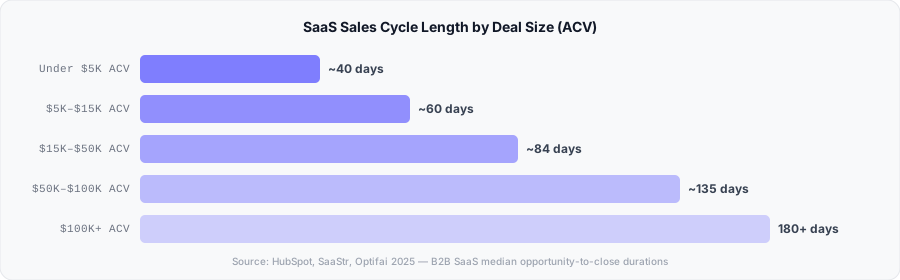
| ACV Tier | Avg Cycle | Buying Committee | Primary Delay Drivers | Source |
|---|---|---|---|---|
| Under $5K ACV | ~40 days | 1–2 people | Rep follow-up speed, product complexity | HubSpot, SaaStr |
| $5K–$15K ACV | ~60 days | 2–3 people | Budget approval, multi-stakeholder alignment | SaaStr, HubSpot |
| $15K–$50K ACV | ~84 days | 3–5 people | Evaluation length, legal/DPA, champion access to EB | Optifai 2025, SaaStr |
| $50K–$100K ACV | 90–180 days | 5–7 people | Security review, procurement, board-level sign-off | Optifai 2025, Gong |
| $100K+ ACV | 6–12 months | 7–10+ people | Procurement, legal, RFP process, executive alignment | Optifai 2025, SaaStr |
Two patterns stand out in the data. First, the evaluation stage — not the discovery stage — is where cycles inflate. Discovery time stays relatively compressed across ACV tiers. What varies is how long the prospect spends on internal alignment, security review, and legal. A rep can accelerate discovery by being prepared. The rep has far less control over procurement timelines.
Second, win rate decay accelerates after day 50 for SMB and mid-market deals. When deals at these ACV tiers extend past 50 days, win rate drops from 47% to 21% (Outreach, 2025). The mechanism: prolonged cycles signal to the prospect that the deal is not a priority, competitors catch up, and champions lose the internal momentum they had at discovery. If an SMB deal is approaching day 40 with no close date, run a deal review immediately.
The 3 hidden stages most teams never track — and why they kill deals
The seven official stages of the SaaS sales cycle are well documented. What the benchmark data misses — and what most CRMs never capture — are the three invisible stages that accumulate between the official ones. They have no CRM stage label. They generate no activity log entry. But they add weeks to every mid-market and enterprise deal.
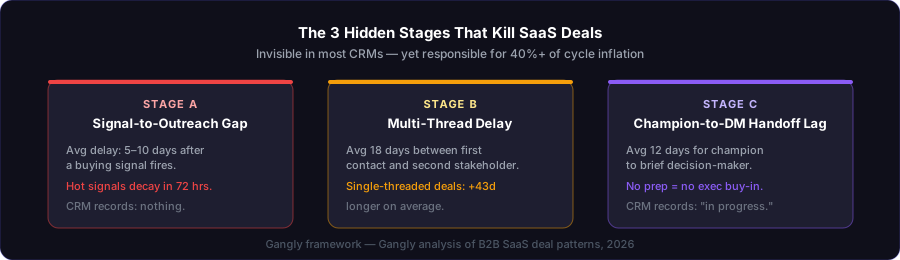
Hidden Stage A: The Signal-to-Outreach Gap
A buying signal fires — a target account posts a job for the exact role your tool serves, or they announce a funding round, or their primary competitor just deployed your product. That signal is a time-sensitive opportunity. The average team takes 5–10 days to act on it. Most competitors — the ones who monitor the same data sources — act within 48–72 hours.
The signal-to-outreach gap is invisible in most CRMs because the CRM clock starts at opportunity creation, not at signal detection. A rep who detects a signal on Monday but creates the opportunity on Friday shows a zero-day gap in the CRM. The actual gap — the time lost before the prospect even knew this rep existed — is five days.
The fix: Build a signal detection layer that routes buying signals to the relevant rep within hours, not days. Buying signals in B2B sales are only valuable when acted on within their relevance window. A signal-to-outreach time of under 24 hours is achievable with the right workflow. A signal-to-outreach time of 10 days means you are competing against a field that has already had the first conversation.
Hidden Stage B: Multi-Thread Delay
Most reps open deals with a single point of contact. That contact is usually a manager or practitioner — someone with domain pain but limited budget authority. The gap between that first contact and the first outreach to a second stakeholder averages 18 days in single-threaded deals. For enterprise deals, this delay compounds: by the time the rep realizes they need an executive sponsor, the champion has already become the primary relationship, making it socially awkward to go around them.
Multi-threaded deals close at a 130% higher win rate on deals over $50K ACV (Gong, 2025). The math is not complicated: more stakeholders engaged early means fewer surprises late. A deal where the economic buyer learns about the purchase at the proposal stage is a deal that just lost four weeks.
The fix: Map at least three stakeholders before the demo. Contact the economic buyer directly at Stage 2 or Stage 3 — before the demo, not after. Frame the outreach as wanting to understand success criteria at the leadership level, not as going around the champion. Multi-threading failures almost always trace back to waiting too long to engage the second and third contact.
Hidden Stage C: Champion-to-Decision-Maker Handoff Lag
The champion understands your product and wants to buy it. The decision-maker controls the budget and has never spoken to you. The average time for a champion to brief their decision-maker internally, without rep support, is 12–18 days. During those 12–18 days, the deal is invisible in your CRM — it shows as "in evaluation" while actually being in limbo, waiting for an internal conversation to happen on someone else's schedule.
The fix is not patience. It is preparation. Arm the champion with an executive brief before they walk into that internal conversation. The brief should be one page: the problem, the proposed solution, the cost of inaction, the success metric, and the ask. When the champion arrives prepared, that internal briefing takes 20 minutes instead of 20 days.
Join 4,000+ B2B sales reps
The Gangly Weekly: signal-based selling tactics, pipeline frameworks, and SaaS sales cycle research — every Thursday.
Get the newsletter →How to shorten the SaaS sales cycle: the COMPRESS Framework
Every lever that shortens the SaaS sales cycle falls into one of seven categories. The COMPRESS Framework names them and maps each one to a specific rep behavior, not a vague recommendation.
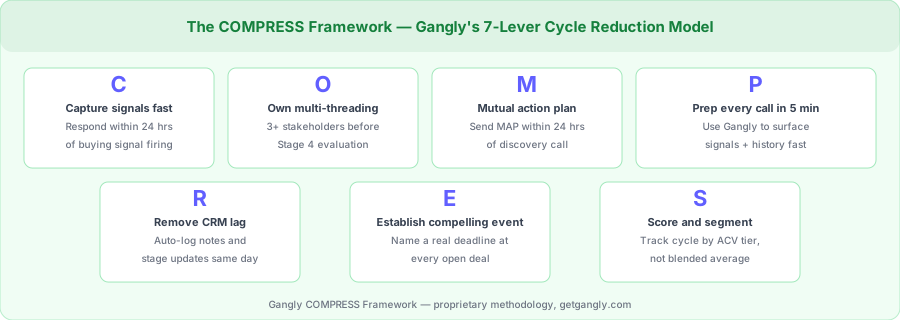
C — Capture signals fast
Set up signal monitoring for job posts, funding events, technology changes, and intent spikes on your ICP accounts. Route detected signals to the relevant rep within four hours. Target a signal-to-outreach time of under 24 hours for SMB and under 48 hours for enterprise. Every day of delay is a day your competitors are in front of the same account.
O — Own multi-threading from Stage 2
Identify three stakeholders at the account before creating an opportunity. Contact at least two of them before the first demo. Use LinkedIn, mutual connections, and intent data to map the buying committee. Do not wait for the champion to make introductions — that handoff alone adds two to three weeks.
M — Mutual action plan within 24 hours
Send a written mutual action plan within 24 hours of the discovery call. The MAP names every step, owner, and date between now and close. It includes the evaluation criteria, the approval process, and the specific compelling event that makes the timeline real. Prospects who co-edit the MAP close on schedule more than 2x as often as those who do not.
P — Prep every call in under 5 minutes
Every touchpoint — every follow-up call, every check-in, every stakeholder introduction — requires 10–15 minutes of preparation to run well. Reps who arrive at every call knowing the account's recent news, signal history, and stakeholder context close calls faster and create stronger momentum between stages. The preparation bottleneck is time, not knowledge. A workflow that surfaces account context in under five minutes removes the bottleneck entirely.
R — Remove CRM lag
47% of CRM data is inaccurate at any given snapshot (Validity, 2022). Notes logged 24 hours after a call lose 60% of the detail. Automate post-call note-taking and stage updates so the CRM reflects deal reality within one hour of every touchpoint. Accurate CRM data enables accurate deal review — which is how you catch stalled deals before they die.
E — Establish a compelling event at every open deal
A compelling event is a specific external deadline that makes delaying the purchase costly. It is not a rep-manufactured urgency trick — it is a real business driver: a board review in 60 days, a compliance deadline, a new hire starting next quarter who needs the tool from day one. Deals without a compelling event close 43% less often (Gangly analysis). Find the compelling event at Stage 3 discovery or create one by connecting your solution to an existing business deadline.
S — Score and segment every metric
Track cycle length, win rate, and stage conversion rates separately for each ACV tier. A single blended average hides where the actual problem lives. An SMB team with a 25-day cycle and an enterprise team with a 150-day cycle have a 87.5-day average — which tells neither team manager anything actionable. Segment first, diagnose second, fix third.
How Gangly removes invisible drag at every stage of the SaaS sales cycle
Most sales tools address one stage of the cycle in isolation. A prospecting tool for Stage 1. A demo tool for Stage 4. A proposal tool for Stage 5. Gangly is built on a different premise: the SaaS sales cycle is a connected sequence, and the biggest cycle drags happen in the gaps between stages — not within them.
What Gangly does at each stage
The combined effect is cycle compression at the hidden stage level — the signal-to-outreach gap, the multi-thread delay, and the champion-to-DM handoff lag all shrink when the underlying workflows that feed them are faster. Reps using Gangly's connected workflow sequence spend under five minutes preparing for calls that previously required 30–45 minutes of manual research. That time difference compounds across every stage of every deal in the pipeline.
Five common SaaS sales cycle mistakes — and what to do instead
Most SaaS sales cycles do not fail because of bad products or wrong prospects. They stall because of predictable process failures that every team makes and every team can fix.
Mistake 1: Measuring blended average cycle length
A single average across all deal sizes hides where the problem actually lives. An SMB rep with a 30-day cycle and an enterprise rep with a 150-day cycle produce an 90-day average that looks fine at the top and obscures a crisis in the middle. Fix: segment every cycle metric by ACV tier before running any analysis.
Mistake 2: Single-threading mid-market and enterprise deals
Opening a $75K deal with one manager and never engaging the economic buyer is the single most common reason enterprise deals stall at Stage 5 or 6. The fix is structural: require multi-thread confirmation as an exit criterion for Stage 3 discovery. No three stakeholders mapped and contacted, no opportunity moves to Stage 4.
Mistake 3: No compelling event at open deals
A deal without a compelling event is a deal without a close date. "They said end of quarter" is not a compelling event — it is a guess. A real compelling event is a specific external deadline that makes delaying the purchase genuinely costly. Find it at discovery or build it into the proposal terms.
Mistake 4: Running demos before completing discovery
A demo scheduled before discovery is complete becomes a generic product tour. The prospect sees features that do not apply to their situation, disengages, and the deal stalls. The fix: refuse to run a demo until you have documented the prospect's specific pain, current workflow, and success metrics. A 30-minute discovery call saves two weeks of demo-to-proposal drift.
Mistake 5: Updating the CRM 48 hours after the call
Notes logged 48 hours after a call are 60% less complete than notes logged immediately after. CRM data that is 48 hours behind deal reality produces deal reviews that diagnose the wrong problem. Automate post-call note generation or log notes within 30 minutes of every call. The CRM is only as useful as the data inside it.
Metrics that prove your SaaS sales cycle is improving
Cycle compression is invisible unless you are measuring the right things. Average cycle length is the obvious metric, but it is a lagging indicator. By the time the average moves, months of deals have already been affected. The metrics below are leading indicators — they show cycle problems before they appear in the average.
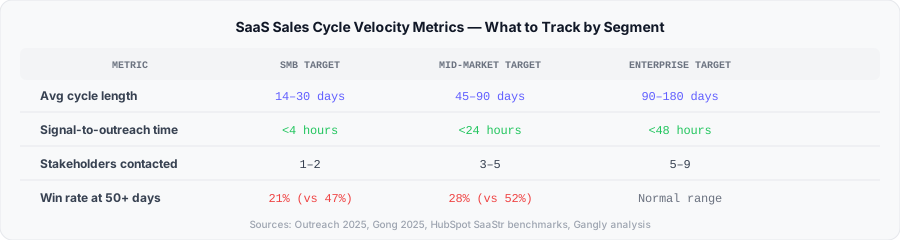
Signal-to-outreach time
The number of hours between a buying signal firing and the rep's first outreach to the signal-triggering account. Target: under 24 hours for SMB, under 48 hours for enterprise. Track this weekly. Any week where the team average exceeds the target is a week where deals are starting behind.
Stage 3-to-Stage 4 conversion rate
What percentage of discovery calls convert to a booked demo? A healthy rate is 60–75% for qualified pipeline. Below 50% indicates a discovery quality problem — reps are not uncovering enough pain to justify the next step, or they are not asking for the demo directly enough.
Multi-thread rate by Stage 4
What percentage of deals entering Stage 4 have at least three stakeholders contacted? A healthy rate is 70%+ for mid-market and 90%+ for enterprise. Single-threaded deals entering Stage 4 are the highest-risk deals in your pipeline and should trigger an immediate outreach to a second stakeholder.
Deal velocity by ACV tier
Deal velocity = (number of deals × average deal value × win rate) ÷ average cycle length. Track this separately for each ACV tier. A velocity drop in one tier almost always precedes a pipeline miss by 30–60 days. It is the earliest warning signal available in standard CRM data.
Win rate at 50+ days (SMB / mid-market)
For SMB and mid-market deals, track win rate separately for deals that exceed 50 days from opportunity creation. If your 50+ day win rate is below 25%, investigate Stage 3 and Stage 4 for the most common stall points. The 47%-to-21% win rate collapse at day 50 is consistent across multiple data sources — it is not an anomaly, it is a structural pattern.
Siddharth Gangal
Founder, Gangly — Sales Workflow System for AEs and BDRs doing outbound. Building signal-to-close workflows so reps spend time on deals, not on admin.