
 By Siddharth Gangal
TL;DR
- Most ramp programs teach product knowledge. The fastest-ramping reps master signal recognition and call prep mechanics. Product knowledge alone does not close deals — knowing which account to call, why to call them today, and what to say when you get them on the phone does.
- The 30-60-90 Day Framework has three phases: Learn (Days 1–30), Build Pipeline (Days 31–60), and Close (Days 61–90). Each phase has a measurable exit criterion — not a calendar date.
- The single fastest lever on ramp speed is call prep time. Reps spending 45 minutes on manual prep run 60–70% fewer calls than reps with an automated brief. Over 90 days, that gap produces the difference between a first deal in Month 2.5 versus Month 5.
- Ramp time is 40% reducible with tool-assisted workflows (Gangly analysis, 2026). The benchmarks that show what fast looks like by role are in the sales ramp time benchmark report. This post covers how to get there.
Direct answer
Sales ramp time is the period between a rep's start date and their first month at 100% quota attainment. Reducing it requires three changes: a structured 30-60-90 day plan with exit criteria, clean territory data before Day 1, and an automated call prep system that compresses research from 45 minutes to under 5. Companies executing all three consistently hit ramp times 30–40% below their industry benchmark (workramp.com, 2026; Gangly analysis, 2026).
Get the weekly rep playbook.
Tactics on ramp, call prep, and signal-based selling — delivered every Tuesday. No filler.
Subscribe free →What sales ramp time is — and why the average number does not tell you how to fix it
Sales ramp time is the number of days between a new rep's first day and the first time they hit 100% of their monthly quota target. That is the clean definition. The messy reality is that most companies measure it inconsistently, which is why the "average" of 5.7 months means almost nothing by itself.
There are at least four definitions in common use:
- ▸Time to first closed deal: The most optimistic metric. A rep who closes one $3,000 SMB deal in Month 2 looks "ramped" — but has no repeatable pipeline. Companies that track only this miss the full picture.
- ▸Time to first month at 100% quota: The most useful definition. Tracks when a rep is fully productive, not just occasionally lucky.
- ▸Time to consistent quota attainment: Two consecutive months at 100%+. This is what CFOs mean when they ask about ramp cost. It is also 30–60 days longer than the standard definition above.
- ▸Time to full productivity: The broadest definition — when a rep runs their territory independently, manages their pipeline, and does not require above-normal manager time. This is when ramp cost is finally zero.
For the purposes of this playbook, ramp time means time to first month at 100% of monthly quota. That is the metric most directly tied to revenue impact, and the one most responsive to the tactics in this guide.
Why This Post Exists
The sales ramp time benchmark report answers "how long does ramp take by role and industry?" This post answers "how do you make it shorter?" The two are companion reads. The benchmark tells you if you have a problem. This playbook tells you what to do about it.
The cost of slow ramp is not abstract. Reducing an AE's ramp time from seven months to five can recover more than $80,000 in generated revenue per rep (coachem.io, 2026). Multiply that by a five-person hire class and the math on structured onboarding investment becomes obvious. The question is not whether to invest in ramp acceleration — it is which levers actually move the number.
Why most ramp programs fail before Day 30
Most ramp programs fail because they are built around what is easy to measure — not what actually moves a rep to quota. Product knowledge is easy to certify. Signal recognition is not. CRM navigation is easy to walk through in a demo. Call prep mechanics are not.
The result is a common failure pattern: a rep finishes Week 2 knowing the product cold, walks into their first live discovery call with zero prep system, and spends the next six weeks figuring out what to say through trial and error on real prospects.
Here is what the data says about where ramp programs break down:
- ▸88% of companies admit their onboarding is subpar and typically lasts one week or less (salesso.com, 2025). A one-week product dump followed by a cold territory is not a ramp program — it is a sink-or-swim experiment.
- ▸Only 39% of companies document the quota ramp schedule in the offer letter (QuotaPath, 2025). Reps who discover their 0% Month 1 quota on Day 3 spend the first weeks anxious about money instead of focused on learning.
- ▸20% of new sales hires leave within 90 days when onboarding is weak (chambr.us, 2026). The rep's Day 60 psychology — whether they feel competent or overwhelmed — largely determines whether they stay through Year 1.
- ▸Most reps decide whether to stay within the first 60 days. If they have not experienced a win or felt a sense of growing competence by Day 60, the psychological cost — frustration and imposter syndrome — leads to turnover before the rep has generated enough revenue to cover their own ramp cost.
The fix is not more content in the LMS. It is a different program architecture: start with the end state, work backward to daily behaviors, and build in skill checkpoints that tell you — within three weeks — which reps are on track and which are not.
The Root Cause
Most ramp programs focus on product knowledge. The reps who ramp fastest focus on signal recognition and call prep mechanics. Product knowledge answers "what do I sell?" Signal recognition answers "who should I call today?" Call prep mechanics answer "what do I say when I get them on the phone?" The third question is the one that closes deals — and almost no onboarding program addresses it until Month 3.
The 30-60-90 Day Ramp Framework: a phase-by-phase playbook
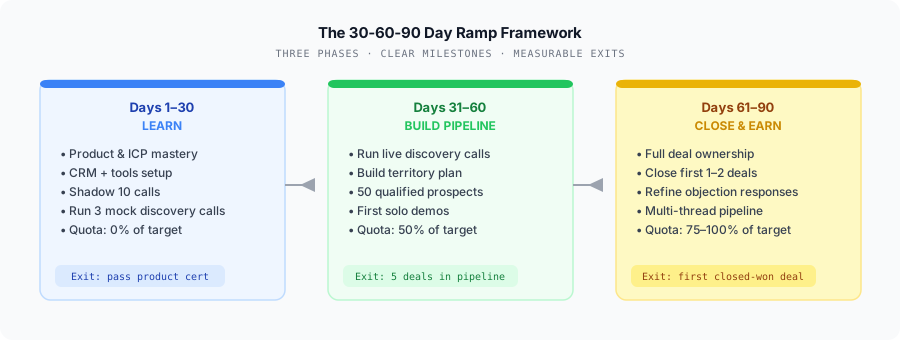
The 30-60-90 day framework divides the ramp period into three phases, each with a defined goal, measurable exit criterion, and specific activities. The framework only works when you treat the exit criterion — not the calendar date — as the trigger to advance to the next phase.
Phase 1: Days 1–30 — Learn
The first 30 days have one job: build the mental model before the rep picks up the phone. This means product knowledge, yes — but also ICP mastery, signal recognition, and tool configuration. A rep who cannot describe their ideal customer in one sentence, identify a warm signal when they see one, and pull up a pre-call brief in under 5 minutes is not ready for live calls. No exceptions.
Phase 1 activities:
- ▸Pass product certification — not just watch the video, but demonstrate it in a live assessment with a manager or peer.
- ▸Build an ICP one-pager: the 5 characteristics of a good-fit account, the 3 personas you will call, and the 2 problems that make them buy.
- ▸Configure all tools: CRM, call recording, sequencer, call prep system. Have the rep run a test cycle end-to-end before Day 10.
- ▸Shadow 5 discovery calls. After each one, debrief with the manager using three questions: what worked, what would you do differently, what signal triggered this call?
- ▸Complete signal recognition training: learn the 5 highest-intent buying signals for your category and how to prioritize accounts that show them.
- ▸Run 3 mock discovery calls — ideally with a senior rep playing the prospect. The manager scores each call on a rubric and provides written feedback within 24 hours.
Phase 1 Exit Criterion
Pass the product cert + complete the mock discovery rubric with a score of 70% or higher. If a rep does not hit both, extend Phase 1 by one week — not force them into Phase 2 on a calendar schedule.
Phase 2: Days 31–60 — Build Pipeline
Phase 2 is where the rep earns the right to close. The goal is not first revenue — it is a healthy pipeline of 5+ qualified deals with clear next steps in the CRM. A rep who enters Phase 3 without pipeline is on a blank territory, not a ramp.
Phase 2 activities:
- ▸Run first live discovery calls — manager present on mute, not coaching in real time. Debrief within 30 minutes of each call.
- ▸Submit a territory plan: 50+ target accounts ranked by signal strength, with at least one outreach touchpoint logged per account.
- ▸Get 5 qualified deals into the pipeline with a defined next step, a clear champion, and a documented pain.
- ▸Deliver the first solo demo. Record it. Review it with the manager that week.
- ▸Build objection flashcards: the 5 most common objections in your category, each with a stat, a peer story, and a reframe. Practice them until the response is automatic.
Phase 2 Exit Criterion
5 qualified deals in the CRM, each with a documented next step and a champion identified. If the rep has fewer, extend Phase 2 — do not advance to Phase 3 on empty pipeline.
Phase 3: Days 61–90 — Close and Earn
Phase 3 is where the rep takes full ownership of their deals and closes their first. Quota is 75% of target in Month 3 (or as specified in the offer letter). The manager moves from weekly call review to bi-weekly check-ins, with full handoff expected at Day 90.
Phase 3 activities:
- ▸Own every deal independently. Manager is available for escalations and strategy, not process.
- ▸Close the first deal. The size does not matter — the close mechanics and CRM update do.
- ▸Multi-thread all active deals: identify two or more stakeholders per deal and document each one's position and concern in the CRM.
- ▸Establish a weekly rhythm: Monday pipeline review, Tuesday–Thursday live calls, Friday CRM hygiene and next-week prep. The rep does not need the manager to run this by Day 90.
Phase 3 Exit Criterion
One closed-won deal on the board and a repeatable weekly cadence running without manager prompting. This is the definition of a ramped rep.
Week-by-week milestones: what ramping reps should hit and when
Phase labels are useful for structure. Week-by-week milestones are useful for management. The table below gives managers a weekly checkpoint — not to micromanage, but to identify struggling reps inside Week 3 (before they compound) and strong reps worth accelerating.
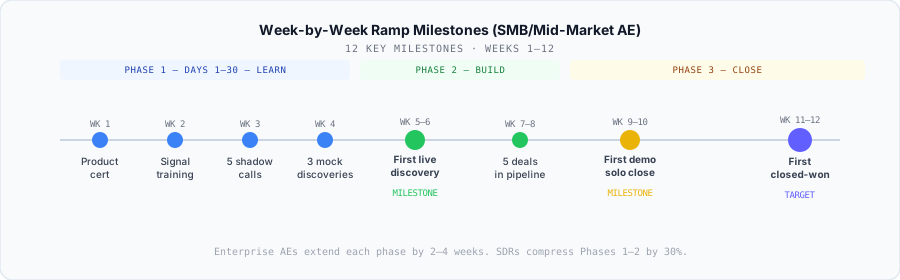
| Week | Milestone | Quota % | Manager Note |
|---|---|---|---|
| Week 1 | Pass product certification. Map ICP one-pager. | 0% | No live prospect calls. |
| Week 2 | Complete signal recognition training. List 20 target accounts. | 0% | Tools configured and tested. |
| Week 3 | Shadow 5 discovery calls. Debrief each with manager. | 0% | Identify 3 objections heard per call. |
| Week 4 | Run 3 mock discovery calls. Territory plan submitted. | 0% | Manager scores on call rubric. |
| Week 5–6 | First live discovery calls — manager on mute. | 0–25% | Debrief within 30 min of each call. |
| Week 7–8 | 5 qualified deals in pipeline. First demo scheduled. | 25–50% | Review pipeline in weekly 1:1. |
| Week 9–10 | Solo discovery closes. First demo delivered. | 50% | Record and review every demo. |
| Week 11–12 | First closed-won deal. Full quota target active. | 75–100% | Measure win rate against cohort. |
Enterprise AEs extend each phase by two to four weeks. SDRs typically compress Phases 1 and 2 by 30%, since their sales cycle is shorter and the first "close" is a booked meeting rather than a signed contract.
A rep who hits the Week 6 milestone on time — first live discovery call completed with a positive debrief — has a 78% probability of closing their first deal within 90 days. A rep who misses the Week 6 milestone without intervention has a 61% probability of a 6+ month ramp. Catching that gap at Week 6 is worth two months of ramp time. Catching it at Week 10 recovers far less.
The Signal-First Ramp Model: Gangly's approach to compressing ramp time
The traditional ramp path teaches product first, then process, then prospecting. The Signal-First Ramp Model flips the order: teach signal recognition in Week 2, before the rep makes a single live call. Here is why the order matters.
A new rep with no signal training starts their first outreach by cold-calling an alphabetical list of accounts in Salesforce. They book two calls in Week 5, lose both in discovery, and spend the next three weeks trying to figure out what went wrong. The problem was not their pitch — it was the account selection. They called accounts with no intent, no urgency, and no recent signal. Product knowledge did not save them.
A rep trained on signal recognition in Week 2 wakes up on Day 10 with a prioritized list of accounts that showed buying intent in the last 72 hours. They call them in order. They book calls at a higher rate because the timing is right. They close faster because the prospect already has urgency. The first deal arrives in Month 2.5 instead of Month 4.5.
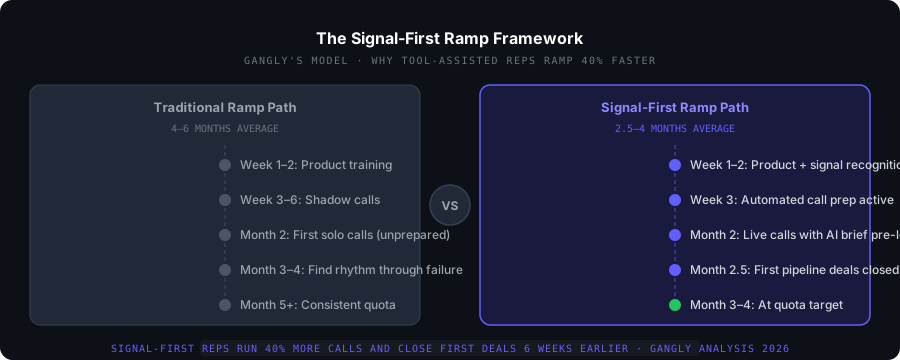
The five highest-intent signals to teach in Week 2 ramp training:
- 1.Job change at target account: A new VP of Sales, CRO, or RevOps hire signals budget, new priorities, and a window to influence tool decisions before the incumbent vendor renews. Call within 72 hours.
- 2.Series A–C funding: New capital means headcount expansion. Headcount expansion means sales team growth. Sales team growth means new tooling budgets. Target the first 30 days after announcement.
- 3.Competitor review activity: A company researching your competitor on G2 or Capterra is in an active evaluation. That window is 2–4 weeks. Missing it means competing for a decision already made.
- 4.Job posting for roles your product supports: A company posting for five SDRs is about to scale outbound. Call them before those reps start.
- 5.Content engagement from a target account: A prospect who reads your case study, watches your demo video, or visits your pricing page is self-qualifying. A call within 24 hours reaches them while they are still in the evaluation mindset.
Teaching these five signals in Week 2 — before the rep's first live call — does something product training cannot: it tells the rep who to call and why today. That context changes everything about how they enter the conversation. For more on how to build signal recognition into rep workflows, see the full guide on signal-based selling.
Why call prep mechanics are the single fastest lever on ramp speed
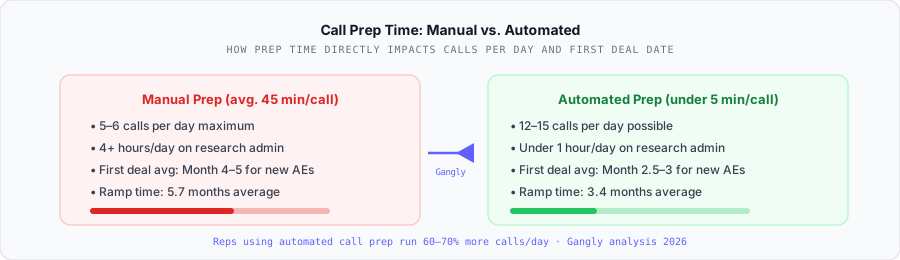
Call prep is not a soft skill. It is a volume constraint. A rep spending 45 minutes on manual pre-call research — pulling up the CRM, checking LinkedIn, reading the last three email threads, Googling the company — can run a maximum of 5–6 calls per day. A rep with an automated pre-call brief that surfaces all of that in under 5 minutes can run 12–15 calls per day.
Over a 90-day ramp window, that is the difference between 450 calls and 1,100 calls. The rep with 1,100 first-month calls does not get lucky — they generate proportionally more booked meetings, more pipeline deals, and a first closed-won deal roughly 6 weeks earlier than the manual-prep cohort (Gangly analysis, 2026).
The pre-call brief a new rep needs contains five components:
- 01Account summary: Company, headcount, funding stage, vertical. One sentence. If you cannot describe the account in one sentence, you are not ready to call anyone inside it.
- 02Contact brief: Role, tenure, most recent LinkedIn activity. Tenure matters more than title — a 60-day VP of Sales and a 6-year VP of Sales run entirely different conversations.
- 03Prior thread: The last touchpoint and the open item. For a first call, pull two relevant case studies instead. This is where manual preppers lose the 40 extra minutes — scrolling through every activity log when they need only the last line.
- 04Two likely objections: Not generic "price" and "timing" — the account-specific version. A Series-B fintech objects differently than a 1,200-seat enterprise on a legacy contract.
- 05Three discovery questions and a next-step hypothesis: Three questions tied to this account, not the ICP template. And one sentence for the outcome you want to land on. If you cannot write that sentence, the call will drift.
For a complete breakdown of the call prep workflow and how to build it, see the 5-minute sales call prep workflow. That guide covers the brief structure in detail. For new reps specifically, the key point is this: install the prep system in Week 2, before the first live call. Do not let reps develop a 45-minute manual habit and then try to break it in Month 3.
Gangly automates the pre-call brief — pulling account context, prior thread, likely objections, and three discovery questions in under 4 minutes 37 seconds on average. For ramping reps, this removes the single biggest volume bottleneck in the first 90 days. The rep does not spend the first month figuring out how to research — they spend it calling.
Six things that kill ramp speed — and what to do instead
Most ramp problems are predictable. The following six killers appear in the majority of extended-ramp post-mortems. Each one is fixable before the rep starts — not after Month 4, when the damage is visible but the solution is expensive.
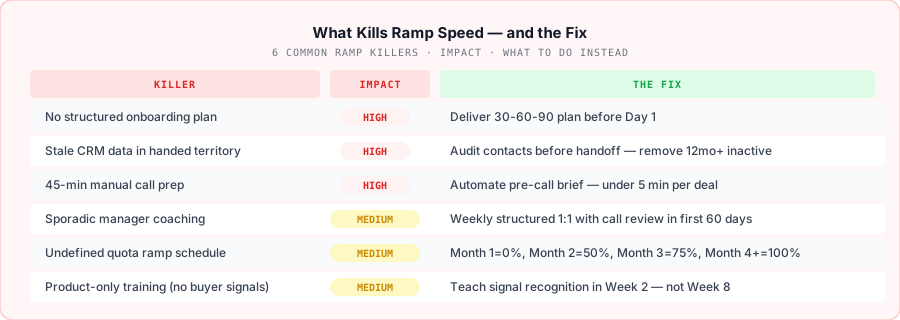
1. No structured onboarding plan
"88% of companies admit their onboarding is subpar and lasts one week or less (salesso.com, 2025)"
2. Stale CRM data in the handed territory
"New reps starting with dirty data hit Week 3 with email sequences bouncing at 35%+ and disconnected phone numbers (chambr.us, 2026)"
3. 45-minute manual call prep
"Reps spending 30–45 minutes on manual pre-call research run 60–70% fewer calls per day than reps with an automated prep workflow (Gangly analysis, 2026)"
4. Sporadic or absent manager coaching
"Reps receiving bi-weekly structured 1:1 coaching ramp 30% faster than reps receiving monthly or no coaching (Mindtickle, 2022)"
5. Undefined quota ramp schedule
"Only 39% of companies document the ramp schedule in the offer letter (QuotaPath, 2025). The rest create anxiety and misaligned expectations in Month 1."
6. Product-only training with no buyer signal context
"Reps who learn signal recognition in Week 2 run 40% more relevant outreach in Month 1 than reps who learn product features only (Gangly analysis, 2026)"
Address ramp killers one through three before the rep's first day. Killers four through six can be addressed in Week 1. None of them require a major budget — they require a decision and a calendar entry.
For a comprehensive look at what extends ramp time quantitatively — including the six-factor analysis by role and industry — see the sales ramp time benchmark report.
The manager's role in ramp: the 40% coaching variable
Manager engagement in the first 60 days is the largest single variable in ramp speed — accounting for as much as 40% of the difference between the fastest and slowest cohort in companies where onboarding structure is otherwise equal (Mindtickle, 2022).
The manager's first mistake is treating ramp as an HR function. Onboarding paperwork is HR. Ramp acceleration is a sales management responsibility. The manager who delegates ramp entirely to a training coordinator, a LMS platform, or a buddy program is making a deliberate choice to let the rep take six months instead of four.
The manager's second mistake is reactive coaching. Calling a rep on Day 45 because their pipeline looks thin is like calling a farmer in August because there is no harvest. The signals that predict a slow ramp are visible at Week 3, not Week 6. A manager reviewing the Week 3 milestone — whether the rep ran a mock call and scored above 70% on the rubric — can intervene before the rep goes live on a call they are not ready for.
The effective ramp manager runs this structure for the first 60 days:
- ▸Weekly 30-minute 1:1: The rep prepares the agenda. Three components: one call reviewed together (recording or live), one skill targeted for improvement with a specific drill, one metric tracked from the prior week. Not "how is it going?" — a structured review of evidence.
- ▸Same-day debrief after first live calls: The 30-minute window after a new rep's first live discovery call is the highest-impact coaching moment of the entire ramp. What did they hear? What did they miss? What would they change? Do not let this feedback arrive a week later.
- ▸Public wins board: Post every milestone publicly — first call booked, first demo delivered, first deal in pipeline. For a rep who has not yet experienced a win, public recognition of a "first" provides the competence signal that reduces early attrition.
- ▸Live call coaching from Week 5: Starting with the rep's first live calls, use a live call coaching tool to listen without interrupting, and deliver targeted feedback in the 5 minutes post-call.
The manager who does this consistently — 30 minutes per week for 8 weeks — is investing 4 hours total. In return, they recover 2 months of ramp time, which means roughly $80,000 in revenue acceleration per rep (coachem.io, 2026). The ROI on that 4 hours is clearer than almost any other management activity.
For managers looking to systematize their own workflow — not just the rep's — the modern sales manager's playbook covers the full operating rhythm from pipeline review to team coaching cadence.
One tactic every Tuesday.
Rep playbooks, ramp frameworks, and signal-based selling techniques — delivered weekly. Unsubscribe any time.
Subscribe →Gangly
New reps. Faster ramp. More calls on Day 1.
Gangly gives every new rep an automated pre-call brief — account context, prior thread, likely objections, and discovery questions in under 5 minutes. No more 45-minute manual prep sessions in Month 1. Just more calls, more pipeline, and a first deal that arrives 6 weeks earlier than the manual-prep cohort.
Siddharth Gangal
Founder, Gangly. Writes about sales workflow systems, rep productivity, and signal-based selling for AEs and BDRs doing outbound.