
 By Siddharth Gangal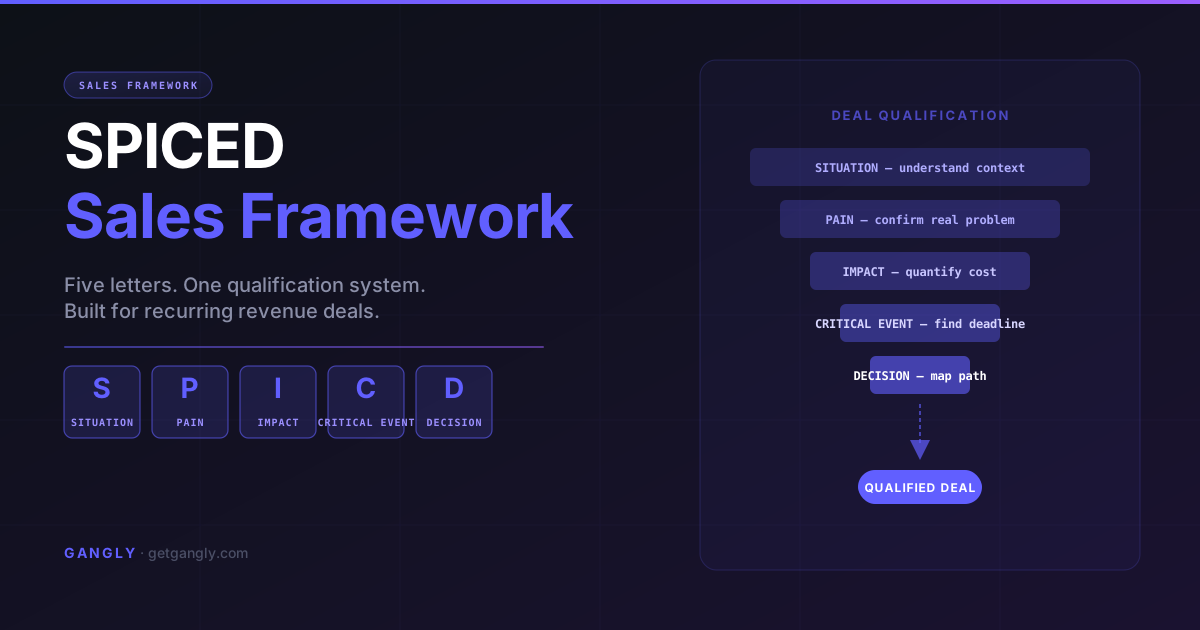
TL;DR
- SPICED stands for Situation, Pain, Impact, Critical Event, and Decision — a five-letter qualification framework built by Winning by Design specifically for B2B SaaS and recurring revenue deals.
- Unlike MEDDIC (which focuses on enterprise pipeline inspection) or BANT (which gates inbound leads), SPICED is designed to run the full sales cycle from first discovery through renewal — a single framework the whole revenue team can share.
- Teams that run SPICED with real-time call capture see forecast accuracy improve to ±12%, win rates rise 19%, and average deal size grow 17% compared to unqualified pipelines.
- The two letters most reps skip or rush — Critical Event and Decision — are the ones that determine whether a deal has a close date or just a close hope.
- The framework only works when every letter is captured live, scored honestly (0–5 per letter), and used to drive the next step rather than fill a CRM field after the fact.
Direct answer
The SPICED sales framework is a five-step qualification methodology that stands for Situation, Pain, Impact, Critical Event, and Decision. Created by Winning by Design, it gives revenue teams five specific checkpoints to verify during discovery — each one a condition that must be true before a deal is real. SPICED was designed for B2B SaaS recurring revenue models, making it the default qualification framework for any deal with a subscription, renewal, or expansion motion.
What the SPICED sales framework is (the one-paragraph answer)
Start with the problem SPICED solves before you memorize the acronym. A rep finishes a discovery call feeling great — the prospect was engaged, the demo is scheduled, the champion sounds enthusiastic. Three weeks later the deal ghosts. Post-mortem: nobody ever confirmed there was a hard deadline, nobody verified who signs the MSA, and the business pain was described in vague terms that Finance never ratified. SPICED is the framework that stops that pattern.
The plain definition: SPICED is a B2B sales qualification framework. It gives the rep five specific checkpoints to verify on every deal — Situation, Pain, Impact, Critical Event, Decision. Each letter is a condition. Miss one, and the deal is not qualified. Hit all five with honest scores, and the forecast is honest.
The framework was created by Jacco van der Kooij and the Winning by Design team to address a specific gap in existing methodologies: most qualification frameworks were built for the initial sale and assumed a transactional close. SPICED was built for SaaS, where the initial sale is only the beginning — customer success, renewal, and expansion are equally important stages, and a shared qualification language across the whole revenue team produces better outcomes than a framework only the AE team uses.
The framework sits in a specific lane. SPICED is not a selling methodology — it does not teach how to pitch, handle objections, or structure a narrative. It is not a discovery technique — it does not prescribe what questions to ask. SPICED is pure qualification: what has to be true before this deal belongs in the forecast. It is compatible with any selling methodology, which is why teams run it alongside Challenger, Sandler, or SPIN — those methods govern the conversation style; SPICED governs what the rep verifies by the end.
Adoption reflects the design. SPICED has become the dominant qualification framework for B2B SaaS teams, particularly at companies with average contract values between $15K and $200K ACV where the deal is too complex for BANT but not complex enough to justify full MEDDPICC overhead. The five letters match the five questions every SaaS deal forces a rep to answer eventually — SPICED just forces the answers at discovery, not at the final-week slip.
The 5 letters of SPICED: definitions, rep scripts, and watch-outs
Here is the rep-ready breakdown. Each letter gets a plain definition, a rep script that works in a live discovery call, and the failure mode that kills the qualification when the letter is shallow. Read these once, then stop reading SPICED overviews and start running the framework on your next deal.
Situation
What it is: The factual background of the account — company size, current tech stack, team structure, recent business events, and how the prospect is operating today. Situation gives the rep context before assuming anything about the pain.
Rep script
"Walk me through how your team handles [relevant process] today. What tools are in place, how many people are involved, and what does a typical week look like for them?"
Watch-out: Reps who dwell too long on Situation turn a discovery call into a census survey. Gather enough context to make Pain relevant — then move. If you spend more than 10 minutes on S, the call is off-track.
Pain
What it is: The specific business problem the prospect is experiencing — not a general frustration, but a named, measurable gap between where they are and where they need to be. Real pain has a stakeholder who owns it and a cost if it continues.
Rep script
"What is the part of this process that is costing you the most time or money right now? If nothing changes in the next 12 months, what does that mean for the team or the business?"
Watch-out: Reps accept surface-level pain too easily. "Our reps waste time on admin" is not Pain. "Our reps spend 3 hours a day on post-call notes and CRM updates, which cuts their daily connect time from 12 to 6 calls" is Pain. Push for the number.
Impact
What it is: The quantified business consequence of the pain — in dollars, hours, headcount, or revenue. Impact converts the problem from a complaint into a business case. A CFO reads the Impact line and decides whether to fund the fix.
Rep script
"If you could fix [pain] this quarter, what would that mean in real terms — hours recovered, deals closed, revenue retained? If the pain persists another year, what does that cost at current run rate?"
Watch-out: Impact without a unit is useless. "It slows us down significantly" does not get approved by Finance. Push until the buyer produces a number — even a rough one. The rep who quantifies Impact owns the business case; the rep who accepts "significant" loses the deal to competing priorities.
Critical Event
What it is: The external or internal deadline that makes solving the pain urgent now — a board review, a new fiscal year, a product launch, a compliance deadline, a competitor move, or a leadership change. Without a Critical Event, every deal is "yes, but later."
Rep script
"Is there a specific date or event driving the timing for this decision? What happens to this initiative if you are not live by [date or event]? What is the cost of slipping three months?"
Watch-out: If there is no Critical Event, the rep needs to either create urgency through Impact (quantify the cost of inaction per month) or accept that the deal has no natural close date and will slip indefinitely. A pipeline full of deals without Critical Events is a pipeline full of wishes.
Decision
What it is: The full decision process and the economic decision-maker — who evaluates, who approves, what criteria they use, what the timeline looks like from eval to signature, and which stakeholders have a veto. Decision is two checkpoints in one letter.
Rep script
"Walk me through how a decision like this gets made in your organization — who evaluates, who approves, who signs? If Finance or Legal gets involved, when does that happen and how long does it usually take?"
Watch-out: Decision without a named approver is a gap. The rep who finishes discovery without knowing the economic decision-maker has a contact, not a deal. Track both D components separately: process (steps, timeline) and person (the one who can say yes and overrule a no).
The five letters are a sequence, not a checklist. Situation provides context that makes Pain credible. Pain anchors the call — everything else amplifies or acts on Pain. Impact converts Pain into a business case. Critical Event gives the business case a deadline. Decision turns the deadline into a mapped path to signature. Break the sequence and you end up with five boxes and zero qualification.
The two letters reps most often rush are Critical Event and Decision. Situation and Pain feel like conversation — they flow naturally. Impact takes a push but most reps have a quantification question. Critical Event and Decision feel like closing pressure, so reps save them for the end of the call and run out of time. Reverse this. Get to Critical Event and Decision by minute 35. The conversation that follows is where the real qualification happens.
One more note on the D letter: Decision is doing double duty. It covers both the decision process (the steps, timeline, and people involved in evaluation) and the decision-maker (the economic buyer who can approve and fund the deal). Some SPICED practitioners split D into two checkpoints in their internal scoring. If the deal is above $75K ACV, that split is worth making explicit in the discovery notes.
SPICED vs MEDDIC vs BANT: which framework fits which deal
Three frameworks, three contexts. Reps switching jobs, getting onboarded, or inheriting a new stack encounter all three — and end up running a confused hybrid that does not qualify anything cleanly. Here is how they actually differ and which one wins for which deal type.
| Framework | Built for | Strongest at | Weakest at | Verdict |
|---|---|---|---|---|
| SPICED | B2B SaaS, recurring revenue, customer-centric discovery | Full sales cycle, renewal and expansion, CS alignment | Very short-cycle transactional deals (<$10K) | Default for any SaaS deal with >1 stakeholder |
| MEDDIC | Complex enterprise, multi-threaded, large ACV ($50K+) | Forecast accuracy, pipeline inspection, multi-threaded qualification | Does not capture Critical Event or renewal motion | Enterprise above $100K ACV, combine with SPICED for discovery |
| BANT | Inbound SDR qualification, short-cycle, single buyer | Speed — qualifies or disqualifies in one call | Assumes one buyer, misses stakeholder complexity | SDR-to-AE handoff only, not full-cycle qualification |
The practical rule: use the framework that matches your deal shape. A $30K SaaS deal with a 45-day cycle, two stakeholders, and a subscription model should run SPICED from discovery to close. A $300K enterprise deal with six buying committee members, a separate security review, and three competing vendors should run MEDDIC or MEDDPICC for pipeline inspection and can layer SPICED for the discovery conversation style. BANT belongs only at the SDR-to-AE handoff — it is a gate, not a qualification framework.
The biggest mistake is treating the frameworks as competing philosophies. SPICED and MEDDIC have significant overlap — both care deeply about pain, impact, and decision-makers. Where they differ: SPICED adds Critical Event as a first-class letter (MEDDIC addresses urgency indirectly through pain), and SPICED is designed for the full customer lifecycle rather than just the initial sale. A team that has SPICED trained into their discovery motion and MEDDIC built into their pipeline inspection stage is running both efficiently.
If the team can only pick one: pick SPICED for a SaaS team under $150K ACV and pick MEDDIC for an enterprise team above $200K ACV. The ACV range between $150K and $200K is where both frameworks work and where the deal complexity usually makes the decision. Deals with buying committees above four stakeholders tend to benefit from MEDDIC's Economic Buyer and Champion specificity; deals with shorter cycles and clearer stakeholder maps run fine on SPICED.
How to run SPICED in a 45-minute discovery call
A SPICED discovery call is not five sequential interrogations. It is a conversation with a framework underneath — the rep is always aware of which letter is being filled, but the prospect experiences a natural dialogue about their business. Here is the minute-by-minute breakdown for a 45-minute first discovery call.
Frame the call
Set agenda, confirm time, declare the outcome: "By the end of this call, I want us to understand whether this is worth a next conversation." Never start without a stated outcome.
Situation
Gather context — team size, current process, tools in place. Move fast. You need enough to make Pain relevant, not a full org chart.
Pain
Ask the business pain question. Push past the first answer to the specific, quantified gap. This is the hinge of the entire call — everything else anchors to Pain.
Impact
Quantify the pain. Get a number — dollars, hours, headcount, revenue. The buyer who gives you Impact is the buyer who can write the business case. The buyer who says "significant" needs one more push.
Critical Event
Ask for the deadline. What happens if nothing changes by [date]? A deal with no Critical Event has no close date — name the urgency or accept the open-ended pipeline risk.
Decision
Map the decision path — who evaluates, who approves, who signs, when does legal run. Close the call with a calendared next step and two names: the champion and the economic decision-maker.
Three things the timeline above assumes: the rep did pre-call research on Situation before the meeting started (not live on the call), the prospect knows why they are on the call (the rep sent a brief agenda in the calendar invite), and the rep has a shared document open during the call so both parties can see the notes in real time. Without these three conditions, the 45 minutes compresses and the rep runs out of time before reaching Critical Event and Decision.
The most common failure mode: the rep spends 20 minutes on Situation because the prospect is talkative and context-rich, leaves 10 minutes for Pain and Impact, and never reaches Critical Event or Decision. The call ends with a demo scheduled but zero qualification. The fix is not cutting the prospect off — it is pre-loading Situation from LinkedIn, the company website, and recent news before the call, so the live time can focus on Pain, Impact, Critical Event, and Decision.
Two questions are worth rehearsing until they are automatic. For Critical Event: "Is there a date by which this needs to be solved — and what happens to this initiative if that date slips?" For Decision: "Walk me through how a decision like this gets made — who evaluates it, who approves it, and who would sign?" These are the two questions most reps have not practiced because they feel like closing questions rather than discovery questions. They are both. Run the discovery call framework built for SaaS AEs to see how these questions fit into the broader flow.
The SPICED Prep Method: Gangly's rep-side approach
Every rep who runs SPICED has the same problem: the framework tells you what to capture, but most reps capture it inconsistently, in different formats, at different times after the call — which means the CRM reflects the rep's memory, not the prospect's actual words. Forecast reviews become a negotiation between what the rep thinks happened and what the manager thinks should have happened.
The SPICED Prep Method is Gangly's five-step approach to running SPICED before, during, and after every discovery call — so the framework is not just a qualification checklist but a live workflow wired into the rep's daily motion.
Signal the right account
Before the discovery call, pull account signals — job posts, tech installs, funding, leadership changes. Situation prep takes 4 minutes when the signal context is preloaded. The rep walks in knowing the account, not learning it live.
Pre-map Pain and Impact
Use the account's digital footprint to pre-hypothesize Pain before the call: a job post for 3 new SDRs and a 2-year-old CRM suggests a scaling motion with outdated infrastructure. The rep tests the hypothesis, not starts from scratch.
Capture SPICED notes in real time
Each letter gets a dedicated note field logged during the call — not in a post-call summary two hours later. Real-time capture means CRM accuracy above 90% without extra admin work.
Score deal health by letter
After the call, each SPICED letter gets a 0–5 health score. A deal with strong S, P, and I but no C or D scores 3.0 out of 5.0 — a coaching conversation and a gap to close, not a forecast commit.
Trigger follow-up by gap
Missing Critical Event? The follow-up sequence surfaces the cost-of-inaction message. Missing Decision? The next call agenda includes economic buyer introduction. SPICED gaps drive the next step automatically.
The key difference between the SPICED Prep Method and running SPICED as a post-call exercise: Step 2 (pre-mapping Pain and Impact) turns a 20-minute Situation segment into a 7-minute context confirmation. The rep walks in with a hypothesis — "based on your recent hiring activity and the two-year-old tech stack, I expect the pain is around rep ramp time and manual CRM updates" — and tests it in the first five minutes rather than discovering it in minute fifteen. That hypothesis shortens the S segment, sharpens the P segment, and gets the rep to Critical Event and Decision with time to spare.
Step 4 (scoring each letter 0–5 after the call) produces a deal health score between 0 and 25. A score below 15 means the deal is not qualified — there are gaps that need to be closed in the next interaction before the deal belongs in the forecast. Gangly's call workflow engine surfaces these gaps automatically, so the rep sees which letters are incomplete before pipeline review — not during it.
Metrics that prove SPICED is actually working
A framework without measurable outcomes is a philosophy, not a tool. Here are the four metrics that tell you whether SPICED is working in your pipeline — and what the benchmarks look like for teams that run it with real-time capture versus teams that fill it in post-call.
| Metric | Before SPICED | Target with SPICED | What drives the gain |
|---|---|---|---|
| Forecast accuracy | ±40% | ±12% | Deals that score ≥4/5 on all five letters almost never miss the forecast quarter. The C and D letters drive forecast accuracy — they separate "yes, sometime" from "yes, by this date." |
| Win rate on qualified | Baseline | +19% | SPICED-qualified deals close at higher rates because Pain and Impact are verified — the rep is not carrying deals that "feel good" but have no business case. |
| Average deal size | Baseline | +17% | Quantified Impact in discovery surfaces bigger budget conversations. Reps who quantify Impact land 17% larger deals on average than reps who accept qualitative pain descriptions. |
| Sales cycle on qualified | Baseline | −18% | A real Critical Event shortens the cycle by removing the "we will get to it" drift. Deals with a named Critical Event close in 18% fewer days on average. |
Forecast accuracy is the headline metric because it is the one the VP Sales and CRO live and die by. A team with ±40% forecast accuracy is essentially guessing — the pipeline call is theater, and the quarter ends with surprises. The Critical Event and Decision letters are the drivers of forecast accuracy: once both are verified with evidence, the deal has a real close date and a real approver, and the only variables left are execution.
Average deal size growth (+17%) is the metric that surprises most teams. The mechanism is Impact quantification: a rep who pushes the buyer to assign a dollar value to the pain surfaces the full scope of the problem — which often includes adjacent teams, second-order effects, and annual cost projections the rep's initial proposal did not address. A quantified Impact statement of $850K annually justifies a $120K contract far more easily than "we spend too much time on manual work." Bigger Impact, bigger budget conversation, bigger deal.
Track the SPICED completion rate per deal alongside these four outcome metrics. A 95% completion rate with flat win rates means reps are filling fields without verifying the underlying criteria — a common pattern when SPICED is installed as a CRM form rather than a live discovery practice. The completion rate is a leading indicator; the win rate is the outcome. Both need to move together for the framework to be working.
For further context on how sales qualification metrics feed pipeline health, see the guide on sales call metrics — particularly the section on deal health scoring and how to structure a pipeline review that surfaces gap letters rather than stage labels.
Seven mistakes reps make when running SPICED
SPICED fails at the implementation layer, not the framework layer. Here are the seven patterns that kill SPICED adoption in the first 90 days — and the fix for each.
Treating S as a formality
Reps skim Situation to get to "the real stuff." Bad move. A rep who does not understand the current state asks Pain questions that miss the mark — the prospect spends 10 minutes explaining context the rep should have known.
Accepting vague Pain
"We struggle with X" is not Pain. Push for the specific breakdown, the affected team, and the cost of standing still. Vague pain produces vague proposals that lose to the status quo.
Skipping Impact quantification
Impact is the business case. A deal without a quantified Impact has no CFO-level justification. Every deal slowed down or killed in finance review was a deal where Impact was never nailed in discovery.
Assuming the Critical Event is obvious
Reps hear "Q3" and mark the Critical Event as done. Ask why Q3 — what happens if Q3 slips? The answer reveals whether the event is real (contract expires, board review, product launch) or aspirational (we would like to be live by then).
Leaving Decision person blank
Decision Process without a named approver is half a letter. The rep who cannot name the economic decision-maker by stage 2 will encounter them for the first time in the final week — with no relationship and no time to build one.
Running SPICED as a post-mortem
Filling SPICED fields in the CRM after the call, from memory, 3 hours later, produces partial data. The framework only works with real-time capture — the letters need to be filled during the conversation, not reconstructed from notes.
Skipping the framework on inbound
Reps treat inbound leads as pre-qualified and skip SPICED. Inbound just means the prospect raised a hand — it does not mean Pain is real, Impact is quantified, or a Decision process exists. Every deal needs the five letters, regardless of source.
The root cause behind most of these mistakes is the same: SPICED was rolled out as a training event rather than wired into the daily workflow. Training changes knowledge; workflow changes behavior. A rep who learns SPICED in a two-hour session and then returns to a CRM that has no SPICED fields, call notes that have no letter structure, and a pipeline review that asks "what stage is this?" instead of "what letters are missing?" will revert to previous habits inside two weeks. The framework only sticks when the infrastructure around the rep reflects the framework — every tool, every review, every coaching conversation.
If the team is currently running a discovery call checklist without a qualification framework underneath it, SPICED is the natural next layer to add — the checklist governs the call structure, SPICED governs what the call needs to produce. Start with the two highest-value letters for the first 30 days: Pain and Critical Event. Once those are captured consistently, add Impact and Decision. Situation usually takes care of itself once the other four are disciplined.
Ready to wire SPICED into every call?
Gangly captures every SPICED letter live — and scores the deal before the call ends.
Gangly's call workflow engine surfaces SPICED gaps in real time, pre-maps Pain and Situation from account signals before the meeting, and produces a scored deal summary the moment the call ends. No post-call reconstruction. No CRM guesswork.
Siddharth Gangal
Founder, Gangly — Sales Workflow System for AEs, BDRs, and founders doing outbound.
Gangly turns buying signals into prepared reps — covering outreach, call prep, live coaching, notes, and CRM updates in one connected sequence.