
 By Siddharth Gangal
TL;DR
- What AI call analysis is: technology that transcribes every recorded sales call and extracts six categories of signal — talk ratio, sentiment shifts, objections, keywords, competitor mentions, and question frequency — automatically, at scale.
- The benchmark that matters most: top performers maintain a 40 : 60 rep-to-prospect talk ratio. Average reps talk 63–68 percent of the call and miss the information that lives in the other side of the conversation.
- The gap most tools miss: standard AI call analysis is backward-looking. It tells you what happened. The reps who improve fastest use the data forward — patterns from past calls feed next-call prep, opening questions, and pre-loaded objection responses.
- The Gangly difference: Gangly runs a Pattern Loop — signals from every call feed the prep brief for the next call with the same account, so the rep walks in already calibrated to that buyer's behavior and objection patterns.
What is AI call analysis?
AI call analysis is the automated processing of recorded sales calls to extract structured performance signals — talk ratio, sentiment, objections, keyword patterns, competitor mentions, and question frequency — without manual review. The AI transcribes the recording, classifies the conversation by topic, scores behavioral metrics, and surfaces insights that would otherwise require a manager to sit through every call. On a ten-call week, a rep generates roughly five to six hours of conversation data. No manager reviews all of it. AI call analysis reviews every second of it.
The category sits inside the broader discipline of conversation intelligence — the systematic analysis of sales conversations to improve rep performance, deal health, and forecasting accuracy. AI call analysis is the detection layer: the engine that reads what was said, how it was said, and who was talking at which point.
The market for this technology grew rapidly because the alternative is unacceptable. Managers in B2B sales teams review 2–5 percent of calls manually. The remaining 95–98 percent yield zero coaching signal. A rep developing a bad habit — monopolizing talk time, skipping discovery questions, folding on pricing — can run that pattern for 60 days before a manager catches it. AI call analysis catches it on call one.
Tools in this space include Gong (the category leader, trained on billions of sales interactions), Chorus (now part of ZoomInfo), Clari Copilot, tl;dv, Fireflies.ai, and Gangly. Each uses a similar detection stack: automatic speech recognition for transcription, natural language processing for topic and sentiment classification, and rule-based or ML-based scoring for behavioral metrics. The differences lie in what happens after the analysis — how the insights reach the rep and whether they change what happens on the next call.
AI call analysis — the automated extraction of behavioral and conversational signals (talk ratio, sentiment, objections, keywords, competitor mentions) from recorded sales calls using speech recognition and NLP. Example: a 34-minute discovery call generates a transcript, a talk ratio score of 67% rep / 33% prospect, three flagged objections, one competitor mention, and a sentiment dip at minute 21 when pricing was introduced — all available within three minutes of the call ending.
Six signals AI detects on every call
Every AI call analysis platform detects the same core set of signals. The six categories below are what current-generation systems surface reliably — not hypothetical capabilities, but metrics that appear in the output of every major tool in 2026.
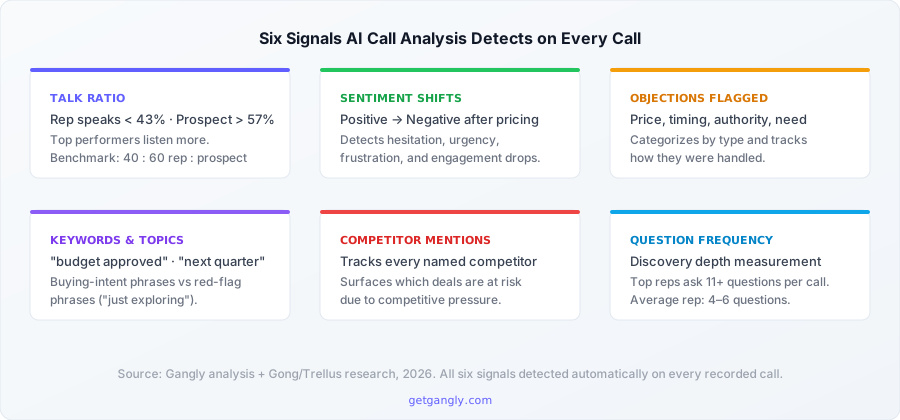
1. Talk ratio
Talk ratio measures the percentage of call time each speaker occupies. The AI timestamps every speaker turn and calculates the split. Output: "Rep: 67% / Prospect: 33%." This single metric is the fastest predictor of call quality available. The 40 : 60 benchmark — rep speaking 40 percent, prospect speaking 60 percent — correlates with the highest win rates across Gong's research on millions of calls. It is not a participation trophy metric. It is an information metric. When the prospect is speaking 60 percent, they are revealing budget, timeline, internal politics, and competing priorities. A rep speaking 70 percent is missing all of that signal.
2. Sentiment shifts
Sentiment analysis classifies the emotional tone of the conversation — positive, neutral, or negative — and tracks how it changes over time. More useful than the overall sentiment score is the shift analysis: a conversation that runs positive for 20 minutes and then drops sharply when pricing is introduced tells the rep something specific. The prospect had budget objections they did not verbalize. The AI flags the dip with a timestamp: "Sentiment shift detected at 21:44 — pricing introduction." That is a coaching moment a manager would never find reviewing notes.
3. Objections flagged and categorized
AI call analysis identifies and categorizes objections by type: price objections ("that is more than we were expecting"), timing objections ("let us revisit this next quarter"), authority objections ("I need to loop in my director"), and need objections ("we already have something for this"). Beyond surfacing them, advanced platforms score how the rep handled each objection — whether they acknowledged it, reframed the value, or gave in immediately. The objection handling guide covers the response frameworks that score highest in call analysis systems.
4. Keywords and topic detection
Topic detection identifies which subjects came up during the call and when. Smart tracker keywords flag buying-intent phrases ("budget approved," "we are moving forward," "next quarter implementation") and red-flag phrases ("we are just exploring," "not a priority right now," "we need to pause"). Managers can build custom keyword libraries for their product, their competitors, and their deal qualification criteria. When a rep on 40 calls per month stops hitting "compelling event" in transcripts, the AI surfaces the gap before the pipeline shows it.
5. Competitor mentions
Every competitor name mentioned on a recorded call is logged, timestamped, and associated with a deal. This produces a real-time competitive intelligence feed: which competitors are appearing in active deals, at what stage, and how often they are coming up. A sales leader watching competitor mentions spike in late-stage deals has a specific intervention to make. A rep who does not know a competitor was just mentioned on a call cannot prepare a response for the follow-up. AI call analysis surfaces the mention before the deal goes cold.
6. Question frequency and discovery depth
The number of discovery questions a rep asks per call is a reliable predictor of deal quality. Top performers ask 11 or more questions per discovery call — not because they work from a script, but because genuine curiosity about the buyer's situation drives the conversation deeper. Average reps ask 4–6 questions and spend the rest of the time presenting. AI call analysis counts the questions, classifies them by type (open vs closed), and shows the trend across a rep's calls. A rep whose question count drops from 10 to 4 over three weeks is worth a coaching conversation.
Talk ratio: the single most actionable metric
Talk ratio gets the most attention among the six signals for good reason: it is the fastest to measure, the easiest to act on, and the most consistently predictive of outcomes. The benchmark is clear. The rep target is 40 percent or below. The coaching action is direct. But the numbers behind the benchmark are worth understanding before the first coaching conversation.
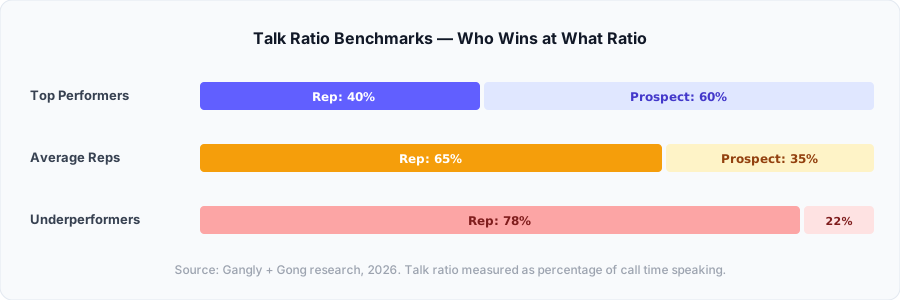
Top performers speak 38–43 percent of every discovery call. Average reps speak 63–68 percent. Underperformers speak 75–80 percent. The difference is not personality — it is discipline. The habit of asking one more question instead of moving to the next slide.
The 40 : 60 benchmark holds across call types — discovery, demo, negotiation — but the target shifts by stage. On a cold outbound call, 50 : 50 is acceptable because the rep needs to earn the right to a longer conversation. On a late-stage negotiation call, the target tips further toward the prospect: 30 : 70 means the rep is listening to every signal before making a concession. The AI call analysis system should be configured with stage-appropriate benchmarks, not a single number applied to every call type.
The coaching conversation that follows a talk ratio flag matters as much as the flag itself. "You talked 68 percent of that call" is not coaching. "You talked 68 percent, and the prospect raised their budget concern at 14:22 — here is the question you could ask next time to get that concern earlier" is coaching. The AI surfaces the data. The manager makes it actionable. See the AI sales coaching tools guide for the frameworks that turn call analysis data into rep behavior change.
Monologue length: the metric inside the metric
Inside the talk ratio signal is a more specific metric: monologue length. A rep with a 40 percent talk ratio who takes one 14-minute uninterrupted monologue to deliver a demo is not actually listening. They are front-loading. AI call analysis platforms flag monologues above four minutes as a coaching risk — because any monologue that long has almost certainly lost the prospect's attention. The practical rule: two to three minutes maximum before asking a question. No exceptions on discovery calls.
Sentiment, objections, and keyword detection
Talk ratio is the most visible metric in AI call analysis, but the three signals that reveal deal health are sentiment shifts, objection patterns, and keyword density. These are less obvious to measure and harder to interpret — which is exactly why most reps ignore them and why the ones who pay attention have a structural advantage.
Sentiment: the leading indicator before deals go silent
Sentiment analysis on sales calls runs two levels of detection. The first is overall call sentiment — a positive, neutral, or negative composite score. The second, and far more useful, is topic-level sentiment: how the prospect's tone changed when specific subjects came up. A prospect who responds positively to use-case discussion but negatively to pricing is a different deal than one who is neutral throughout. The dip reveals the sticking point.
The most predictive sentiment pattern is the post-pricing drop. Across deal analysis at Gong, a sudden negative sentiment shift after pricing introduction correlates strongly with deals that go dark within two weeks. The rep who sees that flag in the call analysis can address it on the follow-up call before the prospect stops responding. The rep who does not see it sends a generic check-in and wonders why no one replies. For the follow-up approach when buyers go silent, the buyers go dark after pricing guide has the specific scripts.
Objection analysis: from frequency to pattern
A single call's objection log tells a rep what to prepare for the next conversation. An aggregate of 50 calls' objection logs tells the manager something more important: which objections the team handles well, which they give in on prematurely, and which they do not address at all.
| Objection Type | What AI Flags | Rep Action | Coaching Focus |
|---|---|---|---|
| Price | "More than expected" · "Budget is tight" | Reframe ROI before the next call | Did rep ask about budget before pricing? |
| Timing | "Next quarter" · "Not right now" | Find compelling event to accelerate | Was a compelling event established? |
| Authority | "Need to loop in my director" | Request multi-stakeholder meeting | Did rep identify decision-maker early? |
| Need | "We have something for this already" | Surface differentiation, run gap analysis | Did rep discover current-state pain? |
| Competitor | "We are also looking at [competitor]" | Deploy battle card before next call | Did rep acknowledge and reframe? |
Keyword density: reading the buy or no-buy signals
Keyword detection works by tracking phrase frequency across a rep's calls and flagging anomalies. A rep who has "budget approved" appear in six of ten calls this week is in strong territory. A rep who has "just exploring" appear in eight of ten calls has a targeting problem, not a closing problem. The keyword data is most powerful at the manager level — aggregated across ten or twenty reps, it reveals where the team's messaging is resonating and where it is landing flat.
Backward-looking analysis vs forward prep: the gap most tools miss
The structural limitation of most AI call analysis tools is that they are backward-looking. They describe what happened. They do not change what happens next. A rep reviews a call analysis dashboard after the call ends, sees the talk ratio was off, notes the sentiment dip at pricing, and then opens the next call prep starting from zero.
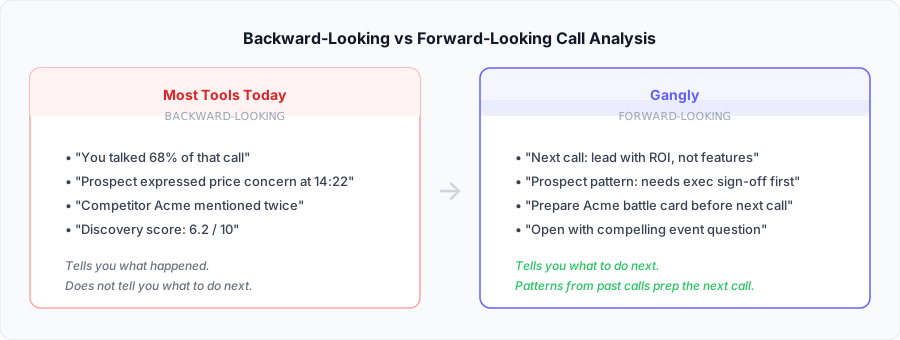
This is not a criticism of the tools. Gong, Chorus, and Clari Copilot are excellent at what they do: surfacing patterns from recorded calls and giving managers something to coach from. The gap is what happens between the insight and the next call. Most teams have no system for converting call analysis output into pre-call prep. The insight sits in the platform. The rep runs the next call with no awareness of what the last call revealed about that specific buyer.
Call analysis is backward-looking by default. It tells the rep what happened on the last call. The reps who close at the highest rates use the data forward: the patterns from calls 1 through 5 with an account change how call 6 opens, how objections are framed, and which questions lead the discovery. Most tools show you the rearview mirror. The highest-performing reps build the windshield from it.
The practical consequence: a rep who reviewed ten calls in Gong this quarter probably improved their talk ratio. A rep who had the patterns from those ten calls automatically surfaced in their pre-call brief for the next interaction improved their talk ratio, their opening question, their objection response, and their competitive positioning — all at once, without spending extra time on review. The difference is not discipline. It is system design.
The related capability — what happens during the call, not just after — is covered in the live call coaching guide. AI prompts on the rep's screen during a live call represent a separate but complementary system: analysis of past calls feeds pre-call prep, and real-time AI coaching handles in-call guidance. Both depend on the same underlying call analysis engine.
The Gangly Pattern Loop: how past calls feed next-call prep
Gangly addresses the backward-looking limitation through a four-step Pattern Loop — a system that feeds the signals from every recorded call forward into the next interaction with the same account. The loop does not require the rep to review dashboards, attend coaching sessions, or remember what happened three calls ago. The system surfaces it automatically.
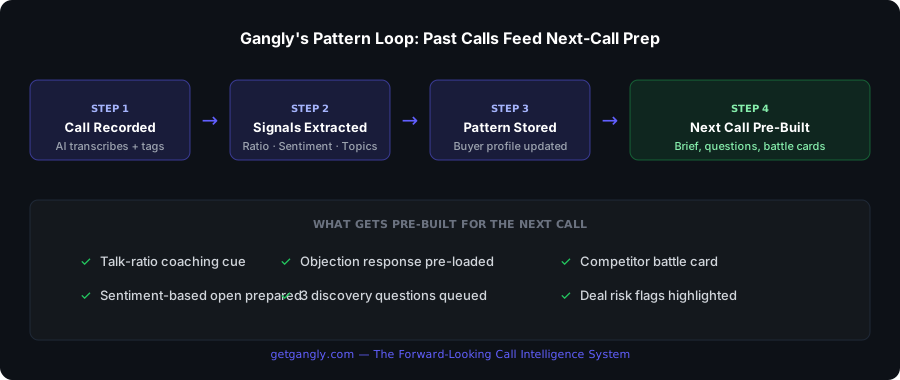
Here is how each step works in practice:
- 1
Call recorded and transcribed
Every recorded call is transcribed with speaker separation. The transcript is available within three minutes of call end. Talk ratio, sentiment scores, objection flags, and keyword detections are generated automatically. The rep does not need to initiate anything.
- 2
Signals extracted to account-level profile
The six signals from the call are written to the account's conversation history in Gangly. Each call adds a layer: this account's buyer has shown a consistent pricing sensitivity pattern, asks about implementation timeline on every call, and mentioned a competitor twice in the last two calls. These patterns are stored, not discarded.
- 3
Pattern synthesized before next call
When the next meeting with that account is scheduled, Gangly generates a prep brief from the stored pattern data. Not a generic brief — a brief specific to this buyer's conversation history. The rep sees: "This prospect drops sentiment at pricing. Open with ROI anchoring. They mentioned [Competitor] twice — deploy battle card. Their typical first objection is timing — prepare compelling event."
- 4
Rep walks in prepared — not just informed
The difference between reading a Gong dashboard and having a Gangly prep brief is the difference between information and preparation. Information requires the rep to synthesize, apply, and remember. Preparation delivers the synthesis already done, in the format the rep needs to open the call correctly. See the full sales call prep workflow for how this connects to the broader pre-call sequence.
The loop closes when post-call data from the AI analysis — notes, CRM updates, next-step task — flows back into the account record without manual entry. The rep reviews and approves in under 90 seconds. The record is complete before the next call begins. No end-of-day data-entry block. The related workflow — what happens after the call ends — is covered in post-call note automation.
How reps turn AI call analysis into rep behavior change
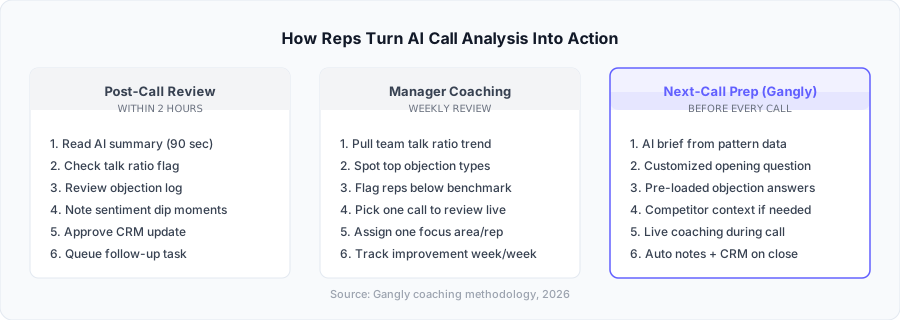
AI call analysis data only changes outcomes when it reaches rep behavior. A dashboard that managers review but never discuss with reps produces zero quota improvement. The teams that see 23–35 percent quota attainment improvement within six months (Cirrus Insight, 2026) follow a specific pattern: the insights flow to reps in a format they can use on the next call, not in a format they need to interpret.
The 90-second post-call rep review
Every rep should spend 90 seconds on AI call analysis data after every call — not 20 minutes, 90 seconds. The goal is not a comprehensive review. It is four specific actions:
- 1.Read the AI summary and correct any transcription errors or misclassified sentiment.
- 2.Check talk ratio. If it was above 50 percent, note what drove it — was it the demo segment, pricing discussion, or the entire call?
- 3.Scan the objection log. Note which objections surfaced and which response approach was used.
- 4.Approve the CRM update and the follow-up task the AI staged. Click once. The record is done.
Four actions. 90 seconds. The insight from this call is now in the system and will feed the next-call prep automatically. There is no separate "learning from the call" task. The system converts the review into future prep without additional rep effort.
Manager coaching: from aggregate to individual
The manager's role in AI call analysis is not to review every call — that is what the AI does. The manager's role is to interpret aggregate patterns and connect them to specific rep behavior. The weekly coaching workflow has two inputs: the team's talk ratio trend and the week's top objection types.
If talk ratio is climbing across the team, the issue is likely pitch-heavy demos. The fix is demo structure, not individual rep coaching. If one rep's talk ratio is climbing while the team's holds steady, the issue is that rep's specific habit — usually nerves, product excitement, or over-explanation. That is a one-on-one coaching conversation with a specific call timestamp: "At 14:30, you took an 11-minute run through the feature list. Here is what the prospect did during that segment — they stopped asking questions entirely."
Team-level patterns: the signal your CRM cannot show
AI call analysis surfaces patterns that no CRM field captures. A CRM shows deals won and lost. Call analysis shows why. The team that reviews its top five lost deals from last quarter through a call analysis lens — looking for common objection patterns, sentiment dips at the same topic, competitor mentions clustering around the same stage — is building a playbook. The team that reviews lost deals through CRM data alone is counting outcomes without understanding causes.
How to implement AI call analysis in four weeks
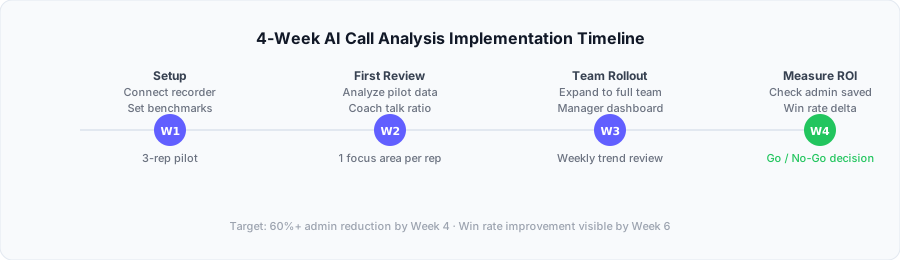
A four-week implementation plan for AI call analysis does not require a long evaluation, a consultant, or a multi-month rollout. The three-rep pilot model gets useful data in seven days and a full-team deployment complete by week three.
Week 1: Connect and baseline
Connect the call recording tool to the calendar and CRM. Start with three reps — one top performer, one middle performer, one newer rep. Set the baseline metrics before anything changes: current talk ratio, weekly call count, and self-reported admin time per call. These numbers are the control group. Every improvement will be measured against them.
Week 2: First analysis review
After seven days of pilot calls, pull the aggregate data. Look for three patterns: which rep had the most balanced talk ratio, which call produced the clearest buying signals, and which objection type appeared most frequently. Run one 30-minute coaching session with the pilot reps using specific call timestamps — not general feedback. "At 9:44, the prospect asked about implementation timeline and you moved past it" is more actionable than "ask more discovery questions."
Week 3: Full-team rollout
Expand to the full team. Run a 20-minute onboarding session that covers one thing: what the 90-second post-call review looks like. Do not overwhelm reps with features. The 90-second review habit is the only behavior change required in week three. Everything else follows from that habit. Teams that try to launch five new workflows simultaneously see zero adoption. One behavior, embedded first.
Week 4: Measure and decide
Measure four metrics at the four-week mark: talk ratio trend (is it moving toward 40 : 60?), admin time per call (should be down 8–12 minutes), objection handling score (are reps responding or folding?), and manager coaching time (should be down because the AI pre-surfaces the coaching material). If three of four are moving in the right direction, scale. If fewer than two are moving, the tool configuration or the coaching loop needs adjustment — not more time or a different tool.
Five mistakes that waste every insight AI surfaces
Every team that buys AI call analysis and sees zero improvement makes the same set of mistakes. None of them are about the technology. All of them are about how the insights connect — or fail to connect — to rep behavior.
Mistake 1: Leaving insights in the platform
The most common failure mode: the platform produces insights, the manager reviews them occasionally, and the rep never sees the data in a format they can act on before the next call. The insight existed. It had zero impact. The fix is a system for converting call analysis output into pre-call prep — either manually (a manager sends a rep a note with three timestamps before the follow-up call) or automatically (a tool like Gangly surfaces the patterns in the prep brief). Insights left in dashboards do not change outcomes.
Mistake 2: Coaching on talk ratio without context
"Your talk ratio is 67 percent" is not a coaching conversation. It is a data point. The rep hears it, agrees it sounds bad, and has no idea what to change. The coaching conversation needs the timestamp: at which point in the call did the ratio climb, what was being discussed, and what question could have shifted the balance. Without the context, the rep tries to talk less and ends up creating awkward silences instead of asking better questions. Silence is not the goal. Questions are the goal.
Mistake 3: Using aggregate data to manage individual reps
A team talk ratio of 50 : 50 can hide one rep at 40 : 60 and one rep at 75 : 25. Aggregate data is useful for trend detection. Individual rep data is the coaching input. Always segment the analysis before running the coaching conversation. The rep whose ratio is perfect does not need the same session as the rep who is monologuing for 14 minutes at a time.
Mistake 4: Treating AI sentiment as ground truth
Sentiment analysis accuracy on sales calls runs 74–80 percent. One in five classifications is wrong. A rep who reads "negative sentiment at 21:44" and assumes the deal is in trouble without listening to the 30-second clip at that timestamp is making a decision on flawed data. The protocol: when sentiment flags a shift, listen to the clip before drawing a conclusion. The AI surfaces the moment. The rep assesses the reality.
Mistake 5: Buying analysis without buying the workflow
AI call analysis that is not connected to pre-call prep, post-call notes, and CRM updates is a single-point tool in a workflow that needs a full sequence. The rep who has a call analysis platform but still manually writes notes, manually prepares for calls, and manually updates the CRM has improved visibility but not velocity. The tools that move quota attainment are the ones where the analysis output feeds directly into what the rep does next — prep, notes, CRM — without a manual step in between. The AI call recording analysis guide covers the full workflow of how recording, analysis, and CRM updates connect as a single sequence.