
 By Siddharth Gangal
TL;DR
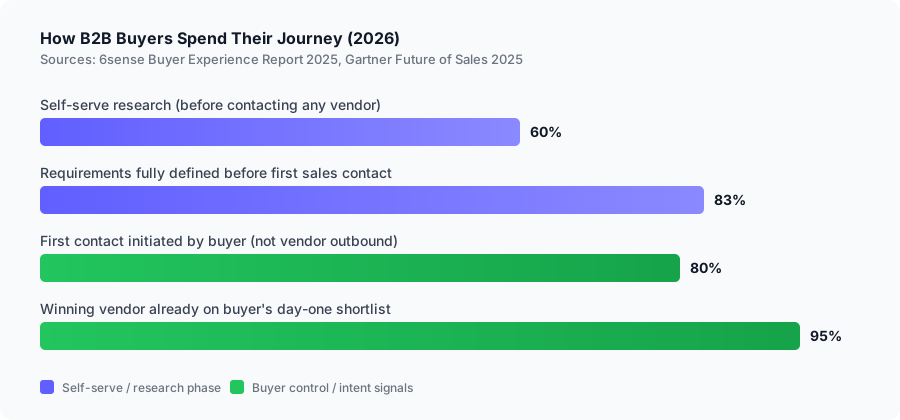
- 83% of B2B buyers define their requirements before speaking to a sales rep (6sense, 2025). The buying journey is 60% complete before a vendor is contacted. The rep who waits for inbound is working on leads that are already decided.
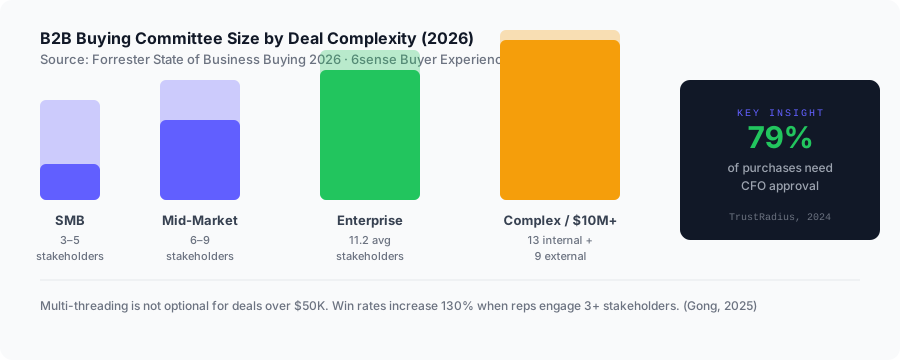
- The average buying committee now includes 11.2 stakeholders for deals over $50K (Forrester/6sense, 2026). 79% of B2B purchases require CFO approval. Single-threaded deals lose to multi-threaded ones at twice the rate.
- 95% of winning vendors were on the buyer's day-one shortlist (6sense, 2025). The deal is won or lost before the first discovery call. Visibility during the research phase — through peer reviews, AI citations, and signal-based outreach — determines which list you are on.
- Vendors take an average of 47 hours to respond to inbound leads (Setter AI, 2026). Buyers expect 10 minutes. 75% choose whoever responds first. Speed to action on buying signals is now a binary win/lose variable.
- 94% of B2B buyers now use LLMs in their purchasing process (6sense, 2025). 51% start research in an AI chatbot, not Google. Being cited by AI search has become a lead generation channel that most vendors have not built for yet.
Direct answer
B2B buyer behavior statistics in 2026 show that 83% of buyers define requirements before contacting sales, the average buying committee has 11.2 stakeholders, 95% of winning vendors appear on buyers' day-one shortlists, and the average vendor response time is 47 hours against a 10-minute buyer expectation. Buyers use 10.2 channels per purchase journey, 94% use LLMs in their research, and 73% trust peer recommendations over vendor-owned content. The data points to one shift: buyers control more of the journey than ever, and reps who intercept signals early win at 2x the rate of those who wait for inbound.
In this article
- 01What B2B buyer behavior data tells us at a glance
- 02Self-serve research statistics: buyers move 60% of the way before contacting sales
- 03Buying committee statistics: 11+ stakeholders, 79% need CFO approval
- 04Digital channel statistics: 80% of B2B interactions now happen online
- 05Trust and content statistics: peer reviews beat vendor websites 3-to-1
- 06AI-driven research statistics: 94% of buyers use LLMs in purchase decisions
- 07Response time statistics: buyers expect 10 minutes, vendors deliver 47 hours
- 08The Signal-Velocity Framework: Gangly's model for selling to the modern buyer
- 09What changed buyer behavior means for how you sell in 2026
- 10Frequently asked questions
What B2B buyer behavior data tells us at a glance
Three numbers frame everything else on this page. First: 83%. That is the share of B2B buyers who fully define their requirements before they speak to a sales rep. The modern buyer does not need a rep to understand the category. They need a rep to confirm the shortlist they already built.
Second: 11.2. That is the average buying committee size for deals over $50K. Not 3 people on a discovery call. Eleven people, often spread across finance, IT, legal, operations, and the end user. The rep who maps only the champion is selling to one vote in eleven.
Third: 47 hours vs. 10 minutes. Buyers expect a response within ten minutes of reaching out. The average vendor takes 47 hours. 75% of buyers choose whoever responds first. The company that closes that gap — through signal detection and automated workflows — wins a disproportionate share of deals that never required a superior product.
2026 B2B Buyer Behavior Snapshot
83%
Define needs before calling
11.2
Avg. committee size
95%
Winners on day-one list
47 hrs
Avg. vendor response
Each section below covers one category of buyer behavior data. Every table includes a "what this means for reps" insight box that translates the numbers into a specific action. Read the full dataset or jump to the category your team is measuring right now. For broader B2B sales performance data, see the full sales statistics 2026 reference.
Self-serve research statistics: buyers move 60% of the way before contacting sales
The self-serve research phase is not a trend. It is the new default state of B2B buying. Sixty percent of the buying journey is completed independently before a vendor is contacted. By the time a buyer fills out a demo form or sends a cold reply, they have already reviewed competitor pages, read peer reviews, consulted their network, and in many cases, decided on a preferred vendor.
The most telling number is 95%. That is the share of winning vendors who were already on the buyer's day-one shortlist — before sales contact was initiated. The implication is direct: if your company is not in the consideration set before the formal evaluation starts, you are competing for a slot that is nearly impossible to win. The average buyer goes on to choose the vendor ranked first on their shortlist 80% of the time.
Proactive sellers — those who identify buying intent signals and reach out before the formal RFP process — win deals at a 33–41% rate. Reactive sellers responding to buyer-initiated contact win at 18–25%. That 15-point gap compounds across every rep on the team, every quarter (Emblaze, 2025).
| # | Stat | What it measures | Source |
|---|---|---|---|
| 01 | 60% | Of the B2B buying journey completed independently before buyers contact a vendor | 6sense Buyer Experience Report, 2025 |
| 02 | 83% | Of B2B buyers fully define their requirements before speaking with a sales rep | 6sense Buyer Experience Report, 2025 |
| 03 | 80% | Of first contacts are buyer-initiated — vendors do not start most conversations | 6sense Buyer Experience Report, 2025 |
| 04 | 95% | Of winning vendors were already on the buyer's day-one shortlist before outreach | 6sense Buyer Experience Report, 2025 |
| 05 | 80% | Of the time, vendor ranked first on the shortlist wins the deal | 6sense Buyer Experience Report, 2025 |
| 06 | 41% | Of buyers start the journey with a single preferred vendor already in mind | Forrester State of Business Buying, 2024 |
| 07 | 92% | Of B2B buyers begin their journey with at least one vendor already in mind | Forrester State of Business Buying, 2024 |
| 08 | 81% | Of buyers have already chosen a vendor before initiating first contact with sales | 6sense Buyer Experience Report, 2024 |
| 09 | 10.1 mo | Average B2B buying cycle length in 2025, down from 11.3 months in 2024 | 6sense Buyer Experience Report, 2025 |
| 10 | 16 | Average interactions per buyer with the winning vendor across the full cycle | 6sense Buyer Experience Report, 2025 |
What this means for reps
The self-serve data rewrites the outbound model. Volume-based cold outreach targeting buyers who have shown no signal reaches prospects at the wrong point in their journey. The buyers who convert fastest are those who have already started researching — pricing page visits, job postings that indicate new budget, executive hires that signal strategic change. Detecting those signals and acting within 72 hours gives reps access to buyers before the shortlist closes. For a full breakdown of what those signals look like, see the guide to intent signals in sales.
Buying committee statistics: 11+ stakeholders, 79% need CFO approval
The buying committee has grown every year since 2016. Deals that once involved three or four decision-makers now involve eleven or more. Forrester's 2026 State of Business Buying report puts the figure for complex purchases at 13 internal participants plus 9 external influencers — a total of 22 people who touch the decision before a contract is signed. For deals in the $50K–$500K range, the median is 11.2 internal stakeholders.
The CFO gate is one of the most underestimated obstacles in modern B2B selling. 79% of B2B purchases require CFO or finance approval. That means the champion — the person who ran the evaluation — is not the final decision-maker in four out of five deals. A rep who builds only on the champion is building on a foundation that a CFO objection can collapse in 48 hours.
The generational shift is real and measurable. Buyers under 40 involve an average of 6.8 stakeholders in their purchasing process. Buyers over 40 involve 3.5. As Millennials and Gen Z now represent 71% of B2B decision-makers (up from 64% in 2022), buying committees will continue to grow. The rep who maps the full committee wins at a rate 130% higher than the rep who single-threads for deals over $50K (Gong, 2025). For the full playbook on navigating buying committees, see the guide to B2B sales buying committees.
| # | Stat | What it measures | Source |
|---|---|---|---|
| 01 | 11.2 | Average stakeholders in a B2B buying committee for deals of $50K or more | Forrester / 6sense, 2026 |
| 02 | 13 + 9 | Internal (13) and external (9) participants in complex B2B purchases per Forrester | Forrester State of Business Buying, 2026 |
| 03 | 79% | Of B2B purchases require CFO or finance approval before a decision can proceed | TrustRadius B2B Buying Disconnect, 2024 |
| 04 | 52% | Of buying groups include at least one VP-level or above decision-maker | TrustRadius B2B Buying Disconnect, 2024 |
| 05 | 72% | Of purchases in 2025 involved high-complexity buying groups of 10+ people | Demandbase, 2025 |
| 06 | 130% | Win rate increase for multi-threaded deals over $50K ACV vs. single-contact deals | Gong, 2025 |
| 07 | 6.8 | Average stakeholders involved by buyers under 40, vs. 3.5 for those over 40 | Sopro State of Prospecting, 2025 |
| 08 | 86% | Of B2B purchases stall at some point during the buying process | Forrester State of Business Buying, 2024 |
| 09 | 81% | Of buyers are dissatisfied with the provider they ultimately chose | Forrester State of Business Buying, 2024 |
| 10 | 54% | Of buying groups actively evolving their decision models and evaluation criteria | Demandbase, 2025 |
What this means for reps
The committee data has one direct instruction: map the room before you close the champion. This means identifying economic buyers, legal or IT stakeholders, and finance contacts early — not when a deal stalls at verbal agreement. The rep who presents to the champion without a plan for the CFO gate loses deals they thought were closed. Multi-threading is not a nice-to-have strategy on enterprise deals. It is the only strategy that holds up to the 11-stakeholder reality. Signal-based selling surfaces those stakeholders by monitoring who from an account is engaging with content, visiting pricing pages, or attending webinars before the formal eval begins.
Gangly Weekly
B2B sales data. No filler. Delivered every Tuesday.
Stat-heavy updates on what is actually working in outbound, buying behavior, and AI sales tools — for AEs and BDRs who track the numbers.
Digital channel statistics: 80% of B2B interactions now happen online
Eight years ago, the average B2B buyer used five channels in a purchase journey. In 2024, that number reached 10.2 (McKinsey B2B Pulse Survey, 2024). That is a doubling of channel complexity in under a decade. Each additional channel is another place where a vendor can be present — or absent.
The 80% figure from Gartner — 80% of B2B sales interactions now occur in digital channels — is the single most consequential number for field sales teams. In-person meetings are not gone. But they are no longer the primary relationship-building mechanism. The rep who can build trust, communicate value, and advance deals through digital channels holds an advantage that grows every quarter. Buyers who experience friction in digital interactions do not call to complain. 54% switch suppliers.
The transaction size data from McKinsey and Forrester challenges the assumption that large purchases require human-mediated process. 39% of B2B buyers are willing to transact over $500K through a purely self-serve digital channel. More than half of transactions over $1M now go through self-serve or remote channels. This is not SMB behavior. These are enterprise-scale deals closing without a sales-led process.
Omnichannel execution pays. B2B organizations that execute across multiple digital channels hold up to 70% higher market share than single-channel competitors (McKinsey, 2024). The mechanism is not advertising spend — it is presence at every stage of the self-serve journey across the channels buyers actually use. 90% of B2B buyers turn to online channels first when sourcing new suppliers.
| # | Stat | What it measures | Source |
|---|---|---|---|
| 01 | 80% | Of B2B sales interactions between suppliers and buyers now occur in digital channels | Gartner Future of Sales, 2025 |
| 02 | 10.2 | Average channels a B2B buyer uses in a single purchase journey, up from 5 in 2016 | McKinsey B2B Pulse Survey, 2024 |
| 03 | 90% | Of B2B buyers turn to online channels first when sourcing new suppliers | Sopro State of Prospecting, 2025 |
| 04 | 54% | Of B2B buyers would switch suppliers after a poor omnichannel experience | McKinsey B2B Pulse Survey, 2024 |
| 05 | 39% | Of B2B buyers willing to spend over $500K through a purely self-serve digital process | McKinsey B2B Pulse Survey, 2024 |
| 06 | 50%+ | Of large B2B transactions over $1M now completed via digital self-serve channels | Forrester B2B Predictions, 2025 |
| 07 | 34% | Of B2B revenue now generated through self-serve and remote digital channels | McKinsey B2B Pulse Survey, 2024 |
| 08 | 70% | Higher market share advantage for B2B omnichannel leaders vs. single-channel sellers | McKinsey B2B Pulse Survey, 2024 |
| 09 | 67% | Of B2B buyers prefer engaging vendors via digital channels for initial outreach | Gartner Future of Sales, 2025 |
| 10 | Two-thirds | Of B2B buyers prefer engaging sales only in the later stages — up 17 percentage points YoY | G2 Buyer Behavior Report, 2025 |
What this means for reps
Multi-channel does not mean spray-and-pray across every platform. It means being detectable at the exact channel a buyer is using when they are in-market. Email, LinkedIn, direct dial, and content are not competing channels — they are phases in a buyer's trust-building sequence. The rep who is visible across all four at the right time closes; the one who picks one channel and waits misses the window. For the channel-by-channel performance numbers, see cold email vs LinkedIn outreach benchmarks.
Trust and content statistics: peer reviews beat vendor websites 3-to-1
The trust gap between peer communities and vendor-owned content has never been wider — and the data from 2024–2026 shows it still widening. Only 9% of B2B buyers consider vendor websites a reliable source of purchasing information. 73% rank word-of-mouth and peer recommendations as their most trusted source. That is an 8-to-1 trust differential in favor of voices the vendor cannot control.
The analyst report, once the primary trust anchor for enterprise technology purchases, is in freefall. Just 16% of buyers now consult analyst reports — a seven-year low, down from 32% in 2017 (TrustRadius, 2024). The buyers who filled that gap did not turn to vendor case studies. They turned to G2, Capterra, Reddit, and direct conversations with current users. 56% of buyers consult existing product users before purchasing. For enterprise deals, that number rises to 71%.
The 74% figure from McKinsey captures the trust dynamic at the rep level: 74% of buyers want vendors to demonstrate understanding of their specific problem digitally — before a live conversation happens. The rep who sends a generic deck and asks for 30 minutes is asking for trust they have not yet earned. The rep who sends a relevant insight tied to a specific business problem the buyer is facing earns the calendar invite. The buying signals that inform that personalization come from the digital behavior buyers leave behind during self-serve research.
The network effect is concentrated at the CFO gate. 79% of purchases require CFO approval. CFOs do not read marketing brochures — they read board presentations built by champions and they take calls with peers. The 58% of marketing executives who rely on their professional network when building shortlists (Wynter, 2024) reflects a buying behavior that peer-driven go-to-market strategies are built to serve. A single strong customer reference in the right industry can close more deals than a year of content marketing.
| # | Stat | What it measures | Source |
|---|---|---|---|
| 01 | 73% | Of B2B buyers rank word-of-mouth and peer recommendations as their most trusted source | Wynter, 2024 |
| 02 | 56% | Of buyers consult existing product users before purchasing, rising to 71% for enterprise | TrustRadius, 2024 |
| 03 | 31% | Of buyers list public review sites (G2, Capterra) as their most consulted source | G2 Buyer Behavior Report, 2024 |
| 04 | 9% | Of buyers consider vendor websites a reliable source of purchasing information | G2 Buyer Behavior Report, 2024 |
| 05 | 58% | Of B2B marketing executives rely on their professional network when building shortlists | Wynter, 2024 |
| 06 | 71% | Of decision-makers trust thought leadership content over traditional marketing materials | Edelman–LinkedIn B2B Study, 2025 |
| 07 | 74% | Of buyers want vendors to demonstrate understanding of their problem digitally | McKinsey B2B Decision-Maker Pulse, 2024 |
| 08 | 75% | Of B2B buyers say they would switch suppliers for a better overall purchase experience | FedEx B2B Business Trends Report, 2026 |
| 09 | 72% | Of buying teams hire external consultants or analysts to influence decisions | 6sense Buyer Experience Report, 2024 |
| 10 | 16% | Of buyers consult analyst reports — a 7-year low, down from 32% in 2017 | TrustRadius B2B Buying Disconnect, 2024 |
What this means for reps
Vendor-controlled content is no longer sufficient for building the trust that earns a shortlist position. Customer references, review site presence, and peer network visibility all outperform content marketing when the buyer is in research mode. The most effective rep-level play: send prospects to a relevant customer story — ideally involving a company in the same industry and at the same scale — before the discovery call. That single action collapses the credibility gap faster than any pitch deck. Connecting with prospects on LinkedIn with a relevant insight tied to a buying signal they triggered is the digital equivalent of a warm peer introduction.
AI-driven research statistics: 94% of buyers use LLMs in purchase decisions
Ninety-four percent of B2B buyers now use large language models as part of their purchasing process (6sense, 2025). That number crossed 50% for the first time in late 2024 and has not stopped climbing. The buyer who used to start on Google now starts in ChatGPT, Perplexity, or Gemini. The initial vendor shortlist is increasingly shaped by which companies appear in AI-generated research summaries, not which ones rank on page one of a traditional SERP.
The citation data from TrustRadius is the most important number for content teams and sales organizations alike: 90% of buyers who saw an AI Overview citation clicked through to the cited source. AI search is not just a discovery layer — it is a traffic driver to the original content. The companies cited by AI systems receive qualified inbound interest from buyers who are already in research mode. Vendors who do not appear in AI-generated responses are invisible to the majority of buyers before the shortlist is built.
The trust picture for AI is nuanced. 80% of buyers trust AI tools at least sometimes — but 20% say AI made them less confident due to inaccurate or unreliable information (Forrester, 2026). That 20% represents buyers who now look for human verification of AI-generated claims. Vendors who provide structured, citable, named-source data are positioned to serve both the 80% who trust AI outputs and the 20% who verify them.
AI also changes the questions buyers bring to a first conversation. 62% of buyers needed the vendor to clarify AI capabilities of a product before proceeding (6sense, 2025). The rep who cannot speak fluently to how AI features actually work — not marketing language, but specific workflows and time savings — loses credibility at a moment when 89% of buyers ultimately purchase solutions that include AI features. For the full AI adoption picture, see the state of AI in B2B sales 2026.
| # | Stat | What it measures | Source |
|---|---|---|---|
| 01 | 94% | Of B2B buyers now use large language models (LLMs) as part of their purchasing process | 6sense Buyer Experience Report, 2025 |
| 02 | 51% | Of buyers start their vendor research in an AI chatbot, not a search engine | Forrester State of Business Buying, 2026 |
| 03 | 80% | Of buyers trust AI research tools at least sometimes, up 19 percentage points year-over-year | TrustRadius Buyer Research, 2025 |
| 04 | 72% | Of B2B buyers encountered Google AI Overviews during their purchasing research phase | TrustRadius Buyer Research, 2025 |
| 05 | 90% | Of buyers who saw an AI Overview citation clicked through to the cited source | TrustRadius Buyer Research, 2025 |
| 06 | 17.1% | Share of buyers who named AI chatbots as the top source influencing their vendor shortlist | G2 Buyer Behavior Report, 2025 |
| 07 | 20% | Of buyers felt less confident in their decision after using AI due to inaccurate results | Forrester State of Business Buying, 2026 |
| 08 | 62% | Of buyers needed the vendor to clarify AI capabilities of a product before deciding | 6sense Buyer Experience Report, 2025 |
| 09 | 89% | Of B2B buyers ultimately purchase solutions that include AI-powered features | 6sense Buyer Experience Report, 2025 |
| 10 | 29% | Of buyers now start research via LLMs more often than via Google | G2 Buyer Behavior Report, 2025 |
What this means for reps
AI-driven research changes two things for reps. First, the pre-call brief now needs to include what AI systems say about your company — because that is what the buyer read before your call. Second, the first-call product demo needs a specific answer to "how does AI actually work in your product?" — not a slide, but a workflow walkthrough with real time savings. The buyers who ask that question represent 62% of your pipeline. The reps who answer it clearly advance to next steps. The ones who deflect with "great question, let me connect you with our product team" lose the momentum built in the self-serve phase.
Response time statistics: buyers expect 10 minutes, vendors deliver 47 hours
The response time gap is one of the most valuable opportunities in B2B sales — and one of the most neglected. Buyers expect a response within 10 minutes of reaching out. The average B2B SaaS vendor responds in 47 hours. That is a 282x gap between expectation and reality, measured across 939 companies (Setter AI, 2026).
The compounding cost of slowness is severe. Harvard Business Review analysis of 100,000 call attempts found that extending response time from 5 to 10 minutes drops lead qualification odds by 400%. Not 4%. Four hundred percent. The buyer who reached out at 2 p.m. on Tuesday has emailed three competitors by 2:15 p.m. By the time a rep responds at 10 a.m. the following Thursday, the buyer has a preferred vendor who responded in nine minutes.
The 75% figure compounds everything above. Three-quarters of B2B buyers choose the first vendor to respond — regardless of price, features, or brand recognition. Speed to response is not a service quality metric. It is a sales strategy. The company that systematizes response velocity — through buying signal detection, automated triage, and rep notification — wins a structural advantage that no product feature can replicate after the fact.
The same principle applies to outbound timing. Buying signals — pricing page visits, job postings, funding announcements — have a decay rate. The rep who acts on a signal within 24 hours is reaching a buyer at peak consideration. The rep who acts on the same signal seven days later finds a buyer who has either moved on or already shortlisted competitors. Speed is the variable that converts data into revenue.
| # | Stat | What it measures | Source |
|---|---|---|---|
| 01 | 47 hrs | Average B2B SaaS vendor response time to a new inbound lead across 939 companies | Setter AI B2B Lead Response Benchmark, 2026 |
| 02 | 10 min | Maximum response time most B2B buyers say they expect after reaching out to a vendor | Harvard Business Review / Setter AI, 2026 |
| 03 | 400% | Drop in lead qualification odds when response time extends from 5 to 10 minutes | Harvard Business Review, Lead Response Study |
| 04 | 75% | Of B2B buyers choose the first vendor to respond — regardless of price or features | Kixie Speed-to-Lead Research, 2025 |
| 05 | 8–9 | Prior purchase journeys the average B2B buyer has completed for the same solution type | 6sense Buyer Experience Report, 2025 |
| 06 | 57% | Of global B2B buyers expect ROI within 3 months of completing a purchase | G2 Buyer Behavior Report, 2025 |
| 07 | 11% | Of buyers expect ROI immediately upon deployment or go-live of a purchased solution | G2 Buyer Behavior Report, 2025 |
| 08 | 43% | Reduction in purchase likelihood when buyers experience high friction with a vendor | SBI Growth Advisory, 2024 |
What this means for reps
Response velocity requires a system, not effort. A rep manually monitoring inbound forms will never reliably respond in under 10 minutes across every working hour. The floor-level fix: route inbound leads to a rep's phone with a pre-loaded context brief, so the rep picks up a number and immediately knows who is calling and why. The ceiling: automated signal detection that notifies reps when a target account triggers a buying signal, with a one-click outreach draft. Both require workflow infrastructure that removes the 46-hour delay that kills 75% of potential deals before a conversation starts.
The Signal-Velocity Framework: Gangly's model for selling to the modern buyer
The six stat categories above — self-serve research, buying committees, digital channels, trust signals, AI research, and response time — are not independent problems. They are six dimensions of one shift: buyers have moved the power seat from the vendor to themselves, and the sales motions built for the 2018 buyer are structurally misaligned with the 2026 buyer.
The Signal-Velocity Framework is Gangly's model for closing the gap between how buyers behave and how reps operate. It has three components:
The Signal-Velocity Framework
1. Signal Detection — Before the Shortlist Closes
95% of winning vendors appear before the buyer initiates formal contact. Signal detection means monitoring accounts for events that indicate a buying window has opened — funding announcements, executive hires, job postings that signal new budget, pricing page visits, competitor review activity. Each signal is a real-time indicator that a buyer is in-market right now, not just "interested in the category." The rep who acts on signals reaches buyers 30–60 days before competitors who wait for inbound.
2. Committee Mapping — Before the Champion Is Isolated
The 11-stakeholder reality means the champion is never the decision. The framework maps all identifiable decision-makers — economic buyer, technical evaluator, legal/security, finance — as early as the first conversation. Multi-threading from day one, rather than as a rescue maneuver when deals stall, gives reps access to the full buying group before objections from invisible stakeholders derail a verbal agreement. Win rates increase 130% on deals over $50K when three or more contacts are engaged (Gong, 2025).
3. Velocity Execution — Within the Signal Window
Signals decay. A pricing page visit on Monday is a strong buying indicator. The same visit, acted on the following Thursday, reaches a buyer who has moved through most of their shortlist decision. The framework defines the signal window — typically 24–72 hours for first-party signals, 72–120 hours for third-party signals — and automates the first-touch outreach so the rep reaches the buyer while the signal is still warm. 75% of buyers choose whoever responds first. The framework is built to make that first contact happen within the window, consistently, without rep-level manual monitoring.
Gangly connects all three components into one workflow: signal detection surfaces buying-window accounts, the committee map identifies the right contacts to engage, and automated outreach drafts go out within the signal window with the right context for each stakeholder type. The result is a rep who is always first in front of buyers who are actively evaluating — and who arrives with the right message for each committee member. For the full methodology, see the signal-based selling guide or the detailed signal-based selling playbook.
What changed buyer behavior means for how you sell in 2026
The buyer behavior data above has direct implications for outbound strategy, sales process, and rep training. Six changes stand out as the most impactful shifts in how high-performing sales teams are adapting.
1. Move outbound earlier in the buyer's self-serve journey
Buyers complete 60% of their journey before contacting a vendor. The shortlist is largely decided before any discovery call. Reps who run pure inbound or respond only to form fills are competing for attention after most decisions are made. The practical shift: use signal-based triggers — funding events, job posts, tech stack changes — to identify when an account has entered a buying window and reach out before formal evaluations begin. Proactive sellers win at 33–41% versus 18–25% for reactive ones (Emblaze, 2025).
2. Build committee maps on day one, not week six
With 11+ stakeholders, discovering the buying committee after the champion goes silent is too late. The rep who asks about the evaluation process, the key decision-makers, and the CFO gate in the first discovery call gathers information that changes the entire deal strategy. Multi-threading is not a late-stage intervention — it is a first-call discipline for deals over $25K. For the full committee management playbook, see how to navigate B2B buying committees.
3. Earn the shortlist through content that AI systems cite
94% of buyers use LLMs in their purchasing process. 51% start there. Being cited by AI Overviews, Perplexity, and ChatGPT is now a B2B pipeline strategy, not just a marketing effort. The companies that publish named-source data, proprietary frameworks, and structured research get cited. The ones that publish generic "best practices" content do not. The 90% click-through rate from AI citations means that each citation is a warm inbound visit from a buyer in research mode.
4. Treat peer reviews as a sales asset, not a marketing afterthought
73% of buyers trust peer recommendations above all other sources. Only 9% trust vendor websites. The most underspent B2B sales asset is a systematic customer reference program — where each closed customer is asked, within 30 days of go-live, for a G2 review, a case study participation, and willingness to serve as a reference call. That pipeline of peer voices does more for the day-one shortlist than any amount of paid advertising.
5. Build the response infrastructure before the lead arrives
75% of buyers choose whoever responds first. 47-hour response times are disqualifying regardless of product quality. The fix is not asking reps to work faster — it is building systems that notify the right rep within minutes of a signal, with the context they need to respond intelligently. Automated lead routing, mobile alerts on inbound form fills, and pre-drafted first-touch messages that a rep can send with one review are the infrastructure components. The 10-minute window is not a stretch goal. It is a binary pass/fail that most vendors currently fail.
6. Personalize for the problem, not just the company
74% of buyers want vendors to demonstrate understanding of their specific problem digitally before a live conversation. The rep who shows up to a first call with a Salesforce slide and a generic intro email has already lost 74% of the room. The rep who references the specific initiative the buyer is running — surfaced by a job posting, a LinkedIn post, or a product review they left — enters the call as a peer who did their homework. Signal-based personalization is the only personalization method that scales to 50+ accounts per rep without consuming research hours that the average rep does not have. For the workflow that makes this possible, see AI sales workflow: connecting signal to close.
Gangly — Sales Workflow System
Sell to the buyer that the 2026 data describes
Signal detection, committee mapping, and velocity execution — built into one connected workflow. Gangly turns buying signals into prepared reps before the shortlist closes.
Siddharth Gangal
Founder, Gangly · Building sales workflow infrastructure for AEs, BDRs, and founders doing outbound.