
 By Siddharth Gangal
TL;DR
- What cognitive bias is in sales: A systematic mental shortcut that causes both buyers and reps to make decisions based on incomplete or distorted information. Most articles cover only buyer biases — the six biases that stall purchase decisions. This guide covers both sides: the six buyer biases and the six rep biases that inflate pipelines, misqualify deals, and produce lost quarters.
- Why it matters: The same rep who understands loss aversion in a buyer is likely operating under happy ears or champion bias on the same deal. Understanding both sides simultaneously is what separates consistent quota attainment from sporadic performance.
- The dual problem: Buyer biases block the decision. Rep biases block accurate reading of the deal. When both are active in the same sales cycle, the deal looks strong until it disappears. Most post-mortems miss this combination.
- The Signal Antidote Framework: Pre-call research based on observable signal data — not gut feeling — is the primary structural counter to rep-side bias. External data beats internal gut feelings. This is why Gangly surfaces a signal brief before every call: it replaces the rep's biased recall with objective account context.
- First step: Take your top three open deals and apply the rep bias checklist from this guide. Identify which biases are present in each. What you find will be uncomfortable. Act on it anyway.
What is cognitive bias in sales?
Cognitive bias in sales is a systematic mental shortcut that causes buyers and reps to process deal information inaccurately — leading to decisions that feel rational but deviate from the logical optimum. Buyers use cognitive shortcuts to manage the complexity of purchase decisions; reps use them to process the ambiguity of deal qualification. Both sides are operating under bias simultaneously, in every sales cycle, on every call.
The term originates with psychologists Daniel Kahneman and Amos Tversky, whose 1979 Prospect Theory demonstrated that human decision-making systematically deviates from rational economic models. Their research won a Nobel Prize in 2002 and laid the foundation for behavioral economics — the field that explains why people do not behave the way classical economic models predicted they would.
In sales, the practical implication is this: the buyer in your deal is not a rational economic actor weighing features, pricing, and ROI on a clean spreadsheet. They are a human being whose evaluation is shaped by the first price they heard, what their peers are doing, what they stand to lose, and which information confirms their pre-existing view of the category. Every one of those influences is a cognitive bias.
Most articles on cognitive bias in sales stop there — at buyer psychology. This guide does not. The rep across the table from that buyer is also operating under cognitive bias. They hear what they want to hear on calls (happy ears). They stay committed to deals that stopped progressing 45 days ago (sunk cost fallacy). They over-rely on one enthusiastic champion (champion bias) and overestimate close probability every single quarter (overconfidence bias).
Understanding both sides simultaneously — buyer biases that block decisions and rep biases that distort pipeline judgment — is what makes the difference between a rep who can diagnose deal failures and one who keeps repeating them. The 12 biases in this guide are organized into those two categories. The consultative selling framework addresses many of these at the process level — but process alone does not eliminate bias. Awareness of the specific biases at work in each deal is required.
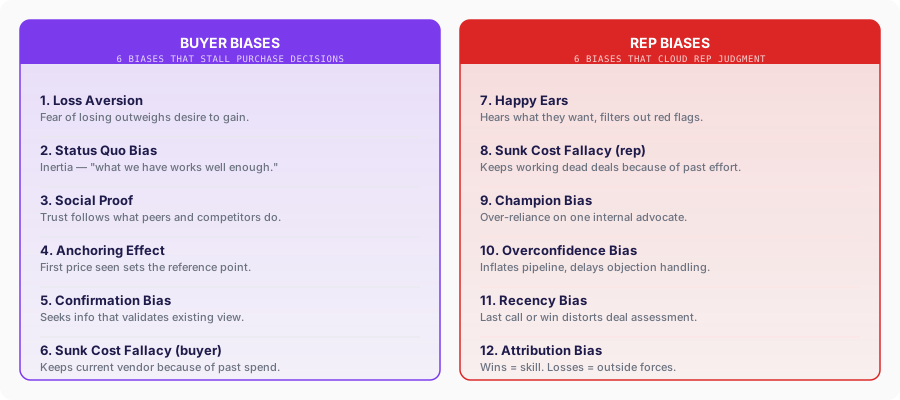
One practical note before the breakdowns: cognitive biases are not signs of poor intelligence or lack of skill. They are the output of a brain that evolved to make fast decisions with incomplete information. In sales — where information is perpetually incomplete and decisions are perpetually time-pressured — they are structural. The goal is not to eliminate them. The goal is to recognize when they are active and apply a structural counter-move before they distort the decision.
Buyer biases that stall deals — and how to counter each
Buyer biases operate below the surface of every sales conversation. The buyer is not aware of them. They do not appear in any procurement process document. They do not show up in the stated objection. Understanding them requires reading what is driving the objection, not the objection itself.
Each breakdown below follows the same structure: the definition, how the bias shows up in a real sales situation, and the specific counter-move that addresses the underlying psychology rather than the surface behavior.
BUYER BIAS
Loss Aversion
Definition
The tendency to feel losses approximately twice as intensely as equivalent gains. Daniel Kahneman and Amos Tversky established this in their 1979 Prospect Theory research — a foundational finding in behavioral economics.
How it shows up in sales
A buyer who has evaluated your tool against their current state will almost always anchor on what they stand to lose — time invested in the existing system, familiarity, team muscle memory — rather than what they stand to gain. "What if the migration breaks something?" outweighs "we would save 40 hours per month" on the emotional math even when the logical math is clear.
The counter-move
Reframe the conversation from gain to loss prevention. Do not say "you will gain X." Say "here is what staying on the current system continues to cost you." Quantify the cost of inaction — in dollars, hours, headcount — in the buyer's own numbers. Loss aversion works for you once the status quo becomes the perceived risk.
Research note: Prospect Theory (Kahneman & Tversky, 1979) established that losses feel roughly 2× as painful as equivalent gains — which means buyers weigh the risk of switching at 2× the weight of the benefit.
BUYER BIAS
Status Quo Bias
Definition
The preference for the current state of affairs, even when a change would produce a better outcome. Related to loss aversion but distinct — status quo bias is specifically about inertia and the cognitive energy required to justify a change decision.
How it shows up in sales
This is why "no decision" is your most common competitor. A buyer who evaluates your product against their current setup is not deciding between you and a competitor — they are deciding between change and no change. Change requires justification. No change requires nothing. The default wins when urgency is absent.
The counter-move
Build a specific cost-of-staying picture before any product conversation. Quantify the exact cost of the current process: hours lost per week, errors per month, deals missed per quarter. Then ask the buyer to confirm the number. When the buyer themselves confirms the cost of staying is $3M in missed pipeline, "do nothing" no longer feels like the safe option.
Research note: Research from CEB (now Gartner) found that "no decision" accounts for approximately 40–60% of B2B losses — more than any single competitor. Status quo bias is the primary driver.
BUYER BIAS
Social Proof
Definition
The tendency to treat the behavior of others as a signal of the correct behavior, especially under uncertainty. In sales, this manifests as buyers waiting to see what competitors, peers, or respected companies in their space are doing before committing.
How it shows up in sales
A VP of Sales evaluating a new workflow tool will search for who else uses it. "Who else at our stage has deployed this?" is not a stall — it is the social proof bias at work. If your answer is weak, the buyer's uncertainty rises. If your answer names their exact peer set, it resolves instantly.
The counter-move
Build your case study library by segment, stage, and use case — not by revenue or logo size. A Series B SaaS VP of Sales cares that a company at their stage with their motion uses the product, not that a Fortune 500 company does. Specificity of peer match drives credibility. One tight peer reference beats three irrelevant logos every time.
Research note: Social proof influences 63% of B2B purchase decisions, with peer reviews rated as the most trusted content type (Demand Gen Report, 2025).
BUYER BIAS
Anchoring Effect
Definition
The cognitive bias where the first piece of information received on a subject — the anchor — disproportionately influences all subsequent judgments. In pricing, the first number seen becomes the reference point for everything that follows.
How it shows up in sales
If a buyer discovers your competitor's pricing before yours, that price becomes the anchor. Everything you present gets evaluated against that anchor. If a buyer hears the monthly plan before the annual plan, the annual plan feels expensive even when the annual is better value per month. The anchor is set before you present — unless you control it.
The counter-move
Lead with your premium or enterprise price first, then show the plan that fits the buyer. The contrast makes the actual price feel reasonable relative to the anchor you set. When presenting multiple tiers, always present high-to-low — the IKEA pricing sequence. Never let the buyer anchor on a competitor's price before you present yours.
Research note: In a Stanford pricing study, participants shown a high price first consistently rated the same product as more valuable than participants shown a low price first — even when the product was identical.
BUYER BIAS
Confirmation Bias (buyer)
Definition
The tendency to search for, interpret, and recall information in a way that confirms pre-existing beliefs. Buyers who believe your product is overpriced, or that category solutions do not work, will selectively process all evidence through that filter.
How it shows up in sales
A buyer who read a negative review of your category last week will evaluate your demo through that lens. Every demo moment that could support the negative view will be noticed. Every moment that contradicts it will be discounted. You cannot win by presenting evidence that contradicts a confirmation bias directly — the bias is specifically designed to reject contradicting evidence.
The counter-move
Acknowledge the existing belief first. Confirming what the buyer believes disarms the bias. Then introduce a contrast: "Most teams who came to us with that concern found that the specific issue was X, which we solved by Y." Evidence introduced after agreement with the buyer's frame lands differently than evidence that opens with contradiction.
Research note: A 2020 review in the Journal of Behavioral Decision Making found that confirmation bias was the single most documented cognitive bias in human decision-making — appearing in over 5,000 published studies.
BUYER BIAS
Sunk Cost Fallacy (buyer)
Definition
The tendency to continue investing in something because of past investment, rather than based on future expected value. Buyers often stay with underperforming vendors because they have already invested 18 months and $200,000 — switching feels like admitting the original decision was wrong.
How it shows up in sales
This works against you when you are the new entrant trying to replace an incumbent. "We have already invested so much in this system" is the sunk cost fallacy protecting your competitor. It is not rational — past investment does not change future expected value — but it is real, and ignoring it in your pitch will lose the deal.
The counter-move
Separate past investment from future value explicitly. "That investment made complete sense based on what was available at the time. The question now is: what is the right decision for the next 24 months given where your team needs to be?" Reframe the decision as forward-looking, not a reversal of the past. Give the buyer permission to make the best decision for the future without invalidating the past.
Research note: Arkes and Blumer (1985) demonstrated that sunk cost fallacy leads individuals to continue investments they rationally should abandon — a finding replicated across purchasing decisions, project management, and vendor selection.
Rep biases that distort pipeline judgment — and how to counter each
Rep-side bias is the missing half of every cognitive bias article written for salespeople. Most content on this topic is written to help reps exploit buyer psychology — which is useful, but incomplete. The same rep who understands loss aversion in a buyer is almost certainly under the influence of happy ears, sunk cost thinking, or champion bias on the same deal. Self-awareness of rep-side bias is the more valuable skill.
The biases below are drawn from research in behavioral psychology, sales call analysis, and pipeline review patterns. They are not personality flaws — they are the predictable output of a brain under the specific pressures of quota, pipeline expectations, and deal ambiguity. Every experienced rep will recognize them. The question is whether recognition happens before or after the deal closes wrong.
For a deeper look at how these biases manifest in discovery conversations specifically, read the discovery call framework guide — which covers how structured questioning reduces the surface area for happy ears and confirmation bias in real-time.
REP BIAS
Happy Ears
Definition
The selective processing of positive signals from a prospect while filtering out or minimizing red flags. A rep with happy ears hears "this is really interesting" and processes it as a buying signal, while unconsciously suppressing the "but we are not ready to budget for this until H2" that followed.
How it shows up in sales
Happy ears produce bloated pipelines of deals that look qualified on paper but will not close on the timeline the rep projected. The rep recalls the enthusiasm from the first call, not the qualification gaps that appeared in calls two and three. Pipeline reviews filled with "they loved the demo" and "they are really excited" are happy ears in action.
The counter-move
Review call recordings or transcripts 24 hours after the fact, when emotional engagement has faded. Apply a written qualification standard: compelling event confirmed, budget range confirmed, decision process mapped, second stakeholder identified. If any of the four are missing, the deal is not qualified — regardless of the buyer's tone in the call.
Gangly note
Gangly's post-call notes capture the full conversation, not the rep's filtered recall. A rep reviewing a Gangly summary sees what was actually said — including the objection they unconsciously minimized.
REP BIAS
Sunk Cost Fallacy (rep)
Definition
The rep equivalent: continuing to invest time, energy, and emotional capital in deals that no longer show forward progress, because walking away feels like wasting the previous ten calls.
How it shows up in sales
A deal that has not moved in 45 days, where the last three calls produced "we need to loop in one more person" and "we are still evaluating internally," is almost certainly dead. But a rep who has invested eight calls and three proposals into it cannot disqualify it. The ten hours of previous work feel like they justify the next hour — even when every piece of evidence says otherwise.
The counter-move
Apply a 21-day forward progress rule: if a deal has produced no new stakeholder introduction, no defined next step, and no movement toward a decision in 21 days, it goes to a "recycled" stage and the rep stops active pursuit. Past time investment has no bearing on whether the deal should receive future time investment. None.
Gangly note
Signal-based data makes this easier. When Gangly surfaces that an account has had zero buying signal activity in 30 days, the absence of signal is itself a qualification data point.
REP BIAS
Champion Bias
Definition
Over-reliance on one enthusiastic internal advocate to drive a deal forward, with insufficient attention to the broader buying committee. Champion bias makes the rep treat one person's buy-in as a proxy for organizational buy-in.
How it shows up in sales
The champion calls back immediately. They forward every email. They say "I am pushing this hard internally." The rep reads all of this as a strong deal signal. Then the champion leaves the company, gets overruled by finance, or turns out to have zero budget authority — and the deal vanishes in 72 hours. Single-threaded deals with a highly engaged champion are the most dangerous deals in a pipeline: they feel strong right up until they disappear entirely.
The counter-move
Map a minimum of two stakeholders before advancing a deal past the discovery stage. The second stakeholder does not have to be as engaged as the champion — they need to be identified, reached, and give some signal of awareness. A deal that depends on one person is not qualified.
Gangly note
Gangly flags single-contact deals in the pipeline view. A rep with a deal where all CRM touchpoints reference a single contact gets a stakeholder gap alert before the deal advances.
REP BIAS
Overconfidence Bias
Definition
The systematic overestimation of one's own ability to predict outcomes, close deals, and assess deal health. In sales, overconfidence produces inflated commit forecasts, premature deal advancement, and delayed response to objections.
How it shows up in sales
Study after study on sales forecasting finds that reps consistently overestimate close probability. A rep calling a deal "75% likely to close this quarter" based on a good demo and positive vibes is almost certainly applying overconfidence, not evidence-based assessment. The disconnect between pipeline probability and actual close rates at most B2B sales teams is a direct measurement of collective overconfidence bias.
The counter-move
Score every deal on a 5-point evidence rubric before assigning probability: (1) compelling event confirmed, (2) budget confirmed, (3) decision process and timeline mapped, (4) second stakeholder engaged, (5) legal and procurement risk assessed. A deal with 3 of 5 evidence points is not a 75% deal. It is a 60% deal at best, and honest scoring will show the gap.
Gangly note
When Gangly's call analysis flags that a "discovery" call had minimal pain confirmation and no next step agreed on tape, that is overconfidence bias prevention — the rep's assessment is checked against what actually happened in the room.
REP BIAS
Recency Bias
Definition
The tendency to give disproportionate weight to recent events when forming judgments. A rep who just closed a large deal will subconsciously apply the patterns of that win to current deals. A rep who just lost three in a row will over-index on the patterns of those losses.
How it shows up in sales
Recency bias shows up in forecast conversations. The rep who closed a $200K deal last week is optimistic about the pipeline. The same rep after a bad month sees every deal as at risk. Neither assessment is accurate — both are driven by the weight of the most recent outcome. Pipeline health does not correlate with the last deal outcome. But to the human brain, it feels like it does.
The counter-move
Review pipeline against rolling 90-day close rate, not against the last three weeks. Build a written record of the qualifying criteria that separated closed-won from closed-lost in the trailing quarter. Apply that record to current deals, not the emotional residue of the last outcome.
Gangly note
A consistent pre-call prep process counteracts recency bias. When every call starts with the same structured signal review — regardless of whether the last deal closed or not — the rep's baseline is objective data, not last week's emotional weather.
REP BIAS
Attribution Bias
Definition
The self-serving cognitive error of attributing wins to personal skill and losses to external factors. "I closed that because I ran a great discovery" versus "that fell apart because of the macro environment" — when both outcomes may have had the same underlying drivers.
How it shows up in sales
Attribution bias is the most dangerous bias for sales rep development because it specifically prevents learning from losses. A rep who attributes every lost deal to budget constraints, timing, or champion turnover will never examine whether their qualification process, product framing, or objection handling contributed. Growth requires accurate attribution of both wins and losses.
The counter-move
Conduct a written post-mortem on every closed-lost deal that answers three questions: (1) what qualification gap was present in the last 30 days of the deal that should have predicted this outcome? (2) what would the rep do differently in the discovery phase? (3) what bias — happy ears, champion over-reliance, or overconfidence — was present? Honest post-mortems are the primary antidote to attribution bias.
Gangly note
Gangly's post-call transcripts provide an objective record of what happened in every deal conversation — allowing attribution analysis based on what was said, not what the rep remembers.
The Signal Antidote Framework — why data beats gut feeling on rep bias
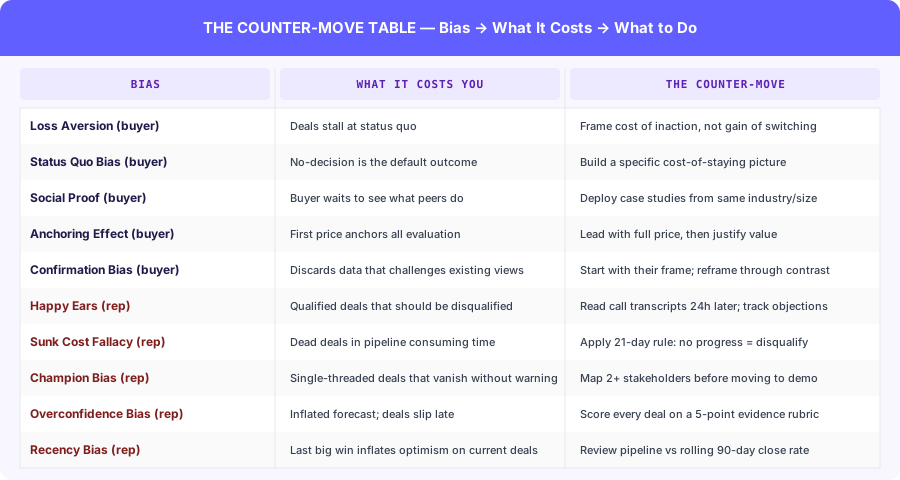
Every counter-move in the rep bias section shares a common structural principle: replace subjective recall with objective data. Happy ears is countered by reviewing call transcripts, not trusting in-call memory. Sunk cost fallacy is countered by applying a forward-progress rule based on activity data. Champion bias is countered by mapping the CRM contact record, not by intuition about how engaged the deal feels. Overconfidence is countered by scoring deals on evidence criteria, not gut probability estimates.
The pattern is clear: the antidote to rep-side cognitive bias is external, observable data — not self-correction through willpower. Willpower-based bias correction does not work at scale. A rep running 4 calls a day, managing 30 open opportunities, and operating under quota pressure cannot apply conscious cognitive monitoring to every deal decision. The structure has to do the work.
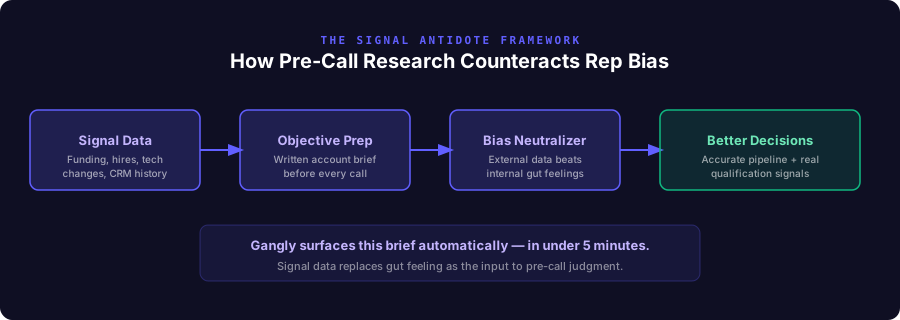
This is the principle behind the Signal Antidote Framework: build the pre-call and post-call workflow around observable signal data, so that objective input — not biased recall — is the foundation of every qualification decision.
Step 1 — Pre-call signal brief
Before every call, the rep reviews an objective account brief: buying signals (funding events, hiring bursts, tech changes), recent CRM touchpoints, known stakeholder map, and any open objections from prior calls. This brief is built from observable data, not from the rep's memory of how the last call felt.
The purpose is to enter every call with an evidence-based hypothesis of deal state, rather than an emotionally-colored one. A rep who reviewed the account brief and saw that the last three touchpoints produced no stakeholder introduction and no confirmed next step enters the call with an accurate, skeptical assessment. A rep who only trusts their recall enters with the optimistic distortion that recency bias and happy ears provide.
For the full workflow behind pre-call preparation and how it connects to qualification, the sales call prep workflow covers the complete 5-step process. The signal-based selling guide covers the underlying methodology for using observable signals as the input to deal qualification.
Step 2 — Post-call transcript review
After every call, the rep reviews a written summary or transcript of what was actually said — not what they remember. This is the primary structural counter to happy ears. What was said about timeline? What objections were raised? Did the buyer confirm a specific compelling event, or did they express general interest? These are not the same thing, and in-call memory reliably conflates them.
A rep who reviews call summaries 24 hours after the fact — when the emotional engagement of the call has faded — will catch happy ears before it produces a false positive in the pipeline. They will also catch attribution bias in action: "I lost that deal because the champion left" looks different when the transcript shows the qualifying conversation never actually happened.
Gangly surfaces structured call summaries automatically after every call — including flagged objections, uncovered qualifying criteria, and suggested next steps. A rep using Gangly has objective post-call input for every deal without building the habit of manual review. The structure does the debiasing work.
Step 3 — Evidence-based deal scoring
Replace probability estimates with a 5-point evidence rubric on every deal: (1) compelling event confirmed in the buyer's own words, (2) budget range confirmed, (3) decision process and timeline mapped, (4) second stakeholder engaged, (5) legal or procurement risk assessed. Score each criterion 0 or 1. Total score out of 5.
A deal with a score of 3/5 is not a 75% deal. It is a 3/5 deal. The evidence score tells you what you actually know. The probability percentage tells you what you hope. Build the pipeline and the forecast on evidence scores, and overconfidence bias loses its structural foothold.
For context on how win rate connects to pipeline qualification quality, read why win rates fall below 20% — many of the root causes identified there trace directly back to undetected rep-side cognitive bias in the qualification stage.
The bias recognition checklist — audit your top 5 deals right now
Take your five largest open deals. For each one, answer the questions below honestly. The answers will surface which biases are currently active in your pipeline. This is the most practical application of the frameworks above.
BUYER BIAS AUDIT — Apply to each deal
Loss Aversion: Have you quantified the cost of inaction for this buyer, in their own numbers? If not, the buyer is evaluating "switch" vs "stay" without a loss frame, and the default will win.
Status Quo Bias: Has the buyer articulated a specific cost of maintaining the current state? Generic interest is not sufficient. "This is interesting" is status quo bias operating unchallenged.
Social Proof: Have you provided a peer reference that matches this buyer's segment, stage, and use case specifically? A logo from a different industry does not resolve social proof bias.
Anchoring: What was the first price this buyer saw in your product category? If it was a competitor's price or a low-tier entry plan, everything you present is being evaluated against that anchor.
Sunk Cost (buyer): Has the buyer mentioned time, money, or training invested in the current system? If so, switching cost framing has not been addressed, and the incumbent has a structural advantage.
REP BIAS AUDIT — Apply to yourself on each deal
Happy Ears: When did you last read this deal's call transcript rather than relying on your memory of the call? What objections do you recall? Are they the same ones that appear in the transcript?
Sunk Cost (rep): How many calls have you invested in this deal without confirmed forward progress? If the answer is more than three with no compelling event confirmed, you are likely holding a sunk cost deal.
Champion Bias: How many contacts from this account appear in your CRM? If the answer is one, you are single-threaded. If that contact leaves or is overruled, the deal is gone.
Overconfidence: What is your evidence score for this deal (out of 5: compelling event, budget, decision process, second stakeholder, risk assessment)? If you are calling it 80% likely to close and the evidence score is 2/5, overconfidence bias is active.
Recency Bias: Has a recent win or loss influenced your assessment of this deal? If your last deal closed well, are you applying its pattern here? If your last deal collapsed, are you seeing more risk here than the evidence warrants?
A rep who completes this audit across their top five deals will typically find two to three biases active per deal. That is normal — not a sign of poor performance. The goal is not a zero-bias pipeline. The goal is a pipeline where the biases have been identified and the structural counter-moves have been applied. A deal where loss aversion has been addressed with a specific cost-of-inaction calculation is a fundamentally different deal than one where it has not.
Common mistakes reps make when working with cognitive bias
Understanding cognitive bias is not the same as applying it well. These are the six patterns that appear most frequently in post-mortems on deals where bias played a central role.
- 1
Applying buyer bias knowledge to exploitation rather than understanding
Reading about loss aversion and then engineering artificial scarcity or fake urgency to trigger it is exploitation, not sales. Buyers recognize manufactured urgency, and it destroys the trust that complex B2B deals require. The correct application is to surface real loss — the actual cost of the current situation — not to fabricate a threat. Understanding loss aversion makes you better at framing real consequences; it is not a manipulation toolkit.
- 2
Treating bias knowledge as a one-time read rather than a per-deal diagnostic
Reading about cognitive bias in the abstract is not useful. Applying the checklist to your specific five open deals this week is. The value is in the active diagnosis, not the general knowledge. A rep who reads this guide and never runs the bias audit on their pipeline has extracted zero practical value from it. The bias audit takes 15 minutes per deal. Do it.
- 3
Addressing buyer bias while ignoring their own rep bias on the same deal
This is the most common pattern. A rep learns about loss aversion and social proof and applies those techniques to the buyer conversation. Meanwhile, happy ears has prevented them from accurately hearing the qualification gaps in that same conversation, and champion bias has left them single-threaded on a deal that requires three stakeholders. Both sides of the bias equation need to be addressed for the deal to be managed accurately. Most deal slippage traces to rep-side bias, not buyer psychology — because the rep's bias is invisible to them while the buyer's is the focus of attention.
- 4
Attempting willpower-based self-correction without structural support
A rep who decides to "be more objective" about pipeline does not neutralize overconfidence bias. A rep who decides to "listen more carefully" does not neutralize happy ears. Bias operates at a level below conscious effort — the brain filters information before it reaches conscious processing. The counter-moves in this guide are structural precisely because willpower-based approaches do not work at scale. Recording reviews, evidence rubrics, and pre-call briefs are structural. "Try harder" is not.
- 5
Confusing emotional tone with deal health
Buyer enthusiasm is not a qualification signal. A buyer who says "this is amazing, we definitely need this" and "we have no budget allocated and no decision timeline" is not a qualified deal regardless of the emotional temperature of the conversation. Tone predicts engagement, not close. Happy ears specifically attaches deal probability to emotional tone rather than to qualification criteria. Separate the two consciously. Apply SPIN Selling implication questioning or MEDDIC qualification criteria to every deal, regardless of how positive the call felt. See the SPIN Selling guide for the specific questioning structure that surface confirmed pain rather than expressed interest.
- 6
Skipping post-mortem analysis on losses
Attribution bias is the cognitive bias that specifically prevents learning from losses. A rep who does not conduct written post-mortems on closed-lost deals will attribute every loss to external factors, never identify the qualification or bias patterns that contributed, and repeat the same errors next quarter. Post-mortems are the primary structural intervention for attribution bias. They take 20 minutes per deal. They produce more learning per hour than any other activity in the sales improvement stack.