
 By Siddharth Gangal
TL;DR
- What it is: Consultative selling is a sales methodology where the rep acts as a trusted advisor — diagnosing the buyer's problem before prescribing a solution. It is the approach that produces the highest win rates and average contract values on complex B2B deals above $10,000 ACV.
- Why reps fail at it: Consultative selling requires more pre-call prep than any other methodology. Most reps skip Phase 1 (signal-based research) entirely, arrive at discovery blind, and ask generic questions that immediately signal "vendor," not "advisor." The advisor posture is impossible without the context that prep provides.
- The 5-phase framework: Signal-Based Research → Needs Discovery → Problem Framing → Solution Alignment → Commitment and Close. Each phase builds on the previous. Skipping Phase 1 compromises every subsequent phase.
- How it relates to SPIN and Challenger: Consultative selling is the outer posture. SPIN provides the questioning architecture for Phases 2 and 3. The Challenger Sale provides the reframe and control structure for Phases 3 and 4. The three work together; they are not competing alternatives.
- First step: Pull up your next five scheduled calls. How much do you know about each account before opening the calendar invite? If the answer is "not much," Phase 1 is the place to start.
What is consultative selling?
Consultative selling is a sales methodology where the rep acts as a trusted advisor rather than a product vendor. The core principle: diagnose before you prescribe. Instead of leading with features and benefits, a consultative rep invests in understanding the buyer's specific situation, surface-level problems, and deeper consequences of those problems before presenting any solution. The methodology is best suited to complex B2B deals above $10,000 ACV where the buyer has not fully defined the scope of their problem and multiple stakeholders are involved in the decision.
The term "consultative selling" was coined in 1970 by Mack Hanan in his book of the same name. The premise was straightforward: salespeople who behave like consultants — arriving with knowledge of the client's business, asking diagnostic questions, and recommending solutions tailored to specific problems — produce better outcomes for buyers and higher win rates for sellers. That premise has proven durable over five decades, and the core mechanism has not changed.
What has changed is the execution context. In 1970, a consultative rep earned the advisor label by knowing more about the client's industry than the client expected. In 2026, that baseline is table stakes — buyers research vendors before the first call, and they arrive with specific questions, not open-ended curiosity. The modern consultative rep earns the advisor label differently: by arriving with signal-based context about the account's current state — funding events, hiring velocity, tech changes, recent touchpoints — that the buyer did not expect them to have.
Research from RAIN Group's analysis of 731 major B2B purchases found that sales winners outperform second-place finishers by 2.5x on one specific dimension: demonstrating that they understand the buyer's world. Not understanding the product. Not presenting a compelling vision. Understanding the buyer's specific context. That is the measurement that separates advisors from vendors in 2026 — and it begins with prep, not presence.
Consultative selling is not a single framework or script. It is a posture and a process. The posture is: this conversation is about the buyer's problem, not your product. The process is the 5-phase framework this guide covers in full. Within that framework, structured methodologies like SPIN Selling, the Challenger Sale, and the Sandler Selling System provide the specific question sequences and conversation architectures that make each phase rigorous.
Consultative vs transactional selling — the honest comparison
The distinction between consultative and transactional selling is real and consequential, but it is not a judgment about which is "better." They serve different deal types. The problem is when reps apply transactional behaviors to consultative deals — or consultative overhead to deals where it is not justified.
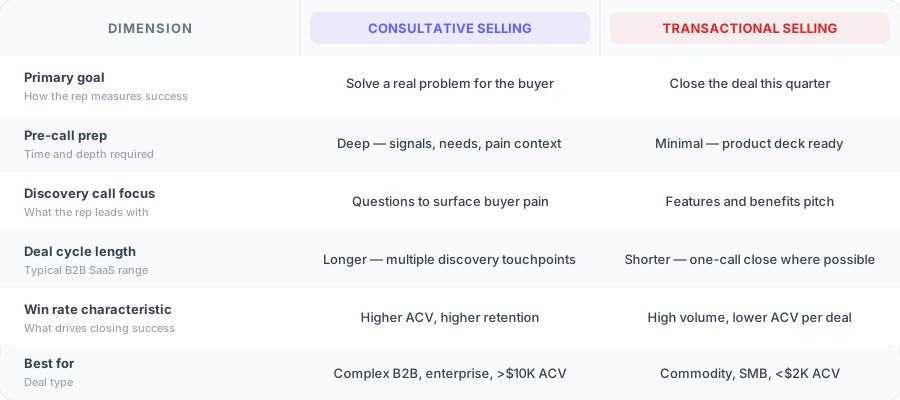
The clearest signal for which approach to use: ACV and stakeholder count. Consultative selling pays off when the annual contract value exceeds $10,000 and the buying decision involves more than one stakeholder. Below that threshold, the discovery overhead is not justified — buyers want a direct answer to a specific question, not a structured conversation about their problems.
Consultative Selling — Use When
- ▶ACV > $10,000 annually
- ▶Multiple stakeholders in the decision
- ▶Buyer has not fully defined their problem
- ▶Deal cycle > 3 weeks
- ▶Retention and expansion are revenue goals
Transactional Selling — Use When
- ▶ACV < $2,000 annually
- ▶Single decision-maker or self-service
- ▶Buyer has a defined need, just comparing options
- ▶Same-day or same-week decision
- ▶Volume is the primary business model driver
One more important note: consultative selling is not an either/or choice across your entire book of business. A rep working a mix of SMB and enterprise deals may apply transactional behaviors to sub-$5K SMB renewals and full consultative process to enterprise expansions and new logos above $20K. The methodology follows the deal, not the rep's default mode.
The 5-phase consultative selling framework
Consultative selling is not one long discovery call. It is a structured process with five discrete phases, each with a clear purpose, specific behaviors, and a clear completion criterion before the next phase begins. The phases below represent how the most effective consultative reps in B2B SaaS structure their deal process in 2026.
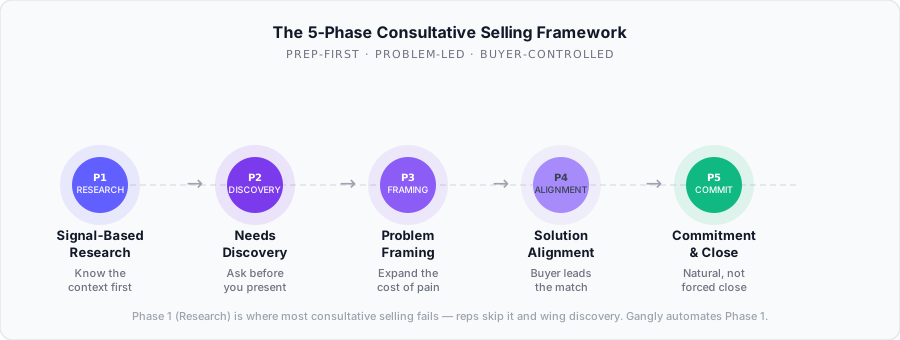
PHASE 1
Signal-Based Research
Before the first question leaves your mouth, you need to know the account's current state — not from a form they filled in, but from observable signals: recent funding, executive hires, tech changes, posted roles. This is the phase most reps skip. Skipping it forces you to ask questions you should already know the answers to, which signals to the buyer that you are a vendor, not an advisor.
How to execute this phase
- ▶Check for funding events in the last 30 days (Crunchbase, LinkedIn)
- ▶Note hiring bursts — 5+ sales or ops roles posted simultaneously
- ▶Identify tech changes — new CRM, SEP, or data tool onboarded
- ▶Review last 3 CRM touchpoints for unresolved issues or objections
- ▶Map the primary stakeholder: title, tenure, stated priorities on LinkedIn
Gangly note
Gangly surfaces this prep stack automatically. A rep can review the full signal context for an account in under 5 minutes — buying signals, account history, stakeholder map, and a suggested opening question — before the call begins.
PHASE 2
Needs Discovery
Discovery in consultative selling is not a checklist. It is a genuine investigation. The goal is to surface the specific friction the buyer is living with — including the friction they have normalized and stopped noticing. The advisor posture means you arrive with a hypothesis of pain (built in Phase 1), and you use questions to confirm or invalidate that hypothesis. You do not arrive blank and hope the buyer fills in the gaps.
How to execute this phase
- ▶Open with a signal-referenced question: "I noticed you posted 8 AE roles this month — is that a GTM push or something specific?"
- ▶Probe the answer: follow the thread that has the most energy, not your next scripted question
- ▶Confirm pain before moving on: "Is that showing up as a real friction point for your team right now?"
- ▶Ask for specifics: "What does that look like in practice on a typical week?"
- ▶Resist the urge to suggest solutions — discovery is not complete until the buyer articulates the problem in their own words
Gangly note
When reps enter discovery with the signal context pre-loaded, they ask 60% fewer Situation questions and arrive at confirmed pain an average of 9 minutes faster than cold-entry discovery calls.
PHASE 3
Problem Framing
Confirming pain is not the same as building urgency. Problem framing is the phase where the advisor expands the consequences of the problem beyond the surface symptom. A rep who hears "our reps take too long to prep for calls" and immediately pivots to the product has missed this phase. The advisor asks: what does that prep time cost in selling hours per week? What does it mean for ramp time on new hires? What does it imply for the Q4 target the board just set?
How to execute this phase
- ▶Ask consequence questions: "If that process continues as-is for another two quarters, what does that do to [outcome they care about]?"
- ▶Quantify when possible: "If each rep loses 45 minutes per call to prep, and you have 8 reps running 3 calls per day..."
- ▶Connect to a strategic moment: "You mentioned the board set an $8M ARR target for Q4 — does this bottleneck sit on the critical path to that number?"
- ▶Let the buyer do the math: buyers who calculate the cost themselves commit to solving it at a higher rate than buyers who are told the number by a rep
- ▶Do not frame a problem the buyer has not confirmed — that reads as a pitch, not consulting
Gangly note
This is the phase where SPIN Selling's Implication questions are most relevant. Consultative selling is the posture; SPIN provides the questioning architecture for Phase 3.
PHASE 4
Solution Alignment
This is where most guides say "present your solution." That framing is wrong. Solution alignment is not a presentation — it is a collaborative process where the buyer describes what the right solution looks like and you confirm whether your product matches that description. The distinction matters: a presentation is rep-led. Alignment is buyer-led. When the buyer says "we need something that does X, Y, and Z," and you say "here is where we match and here is where we are still developing," you are operating as an advisor, not a vendor.
How to execute this phase
- ▶Ask the buyer to describe their ideal outcome: "If you could design the ideal solution to what we just discussed, what would it look like?"
- ▶Map their description to your product — point by point, not in a deck presentation
- ▶Be honest about gaps: "We do X and Y today. Z is on our roadmap for Q3 — here is the honest state of it."
- ▶Do not over-claim: a consultative reputation is built on being the rep who tells buyers the truth, even when the truth reduces deal size
- ▶Confirm match before advancing: "Does this address the core of what you described?" — not "Does this sound good?"
Gangly note
This is also where the Challenger Sale's Tailor and Take Control components are most applicable. After alignment, a consultative rep with Challenger skills drives the decision timeline rather than leaving it open-ended.
PHASE 5
Commitment and Close
In consultative selling, the close is not a technique — it is the natural conclusion of a process the buyer has been leading. When discovery, framing, and alignment have all gone correctly, the buyer has already articulated why they need this, what it would cost them not to act, and how your product matches their description of a solution. At that point, the close is a logistics question, not a persuasion question. "What does your internal process look like from here?" replaces "Are you ready to move forward?"
How to execute this phase
- ▶Recap the buyer's own words: "You described the problem as X, said it costs you Y, and confirmed that our product covers Z — does that summary match what you are thinking?"
- ▶Ask about the decision process, not about the decision: "What does the approval process look like from here?"
- ▶Identify timing naturally: "You mentioned Q4 is the target — what does that mean for when this needs to be in place?"
- ▶Agree on mutual next steps with specific dates and owners — not vague "let us reconnect"
- ▶Confirm champion: "Who else needs to be comfortable with this before you can move it forward?"
Gangly note
Gangly's post-call workflow captures the buyer's own language from the call — the exact phrases they used to describe their pain and the ideal outcome — and surfaces them in the follow-up draft so the rep's next message reflects the buyer's words, not generic sales copy.
Why prep is the foundation — and where most reps fail
The most important insight in consultative selling is not a question technique or a closing framework. It is this: the quality of your discovery is determined before the call begins.
A rep who arrives at a discovery call without signal context is forced to ask questions that establish baseline information — company size, current process, team structure. These are Situation questions in SPIN terminology. They are necessary when you have no context, but they are credibility-destroying when the information was publicly available and the rep simply did not look it up. Every Situation question you ask about something you could have known signals to the buyer: "This rep did not prepare. This is a vendor call, not an advisor call."
The rep who arrives with context — "I saw you closed a Series B three weeks ago and posted eight AE roles — I wanted to ask you about the ramp problem that typically follows that kind of hiring burst" — signals something completely different. That rep already knows the account's current state. The first question is not an information-gathering question; it is a diagnostic question. The buyer experiences an entirely different quality of conversation from sentence one.
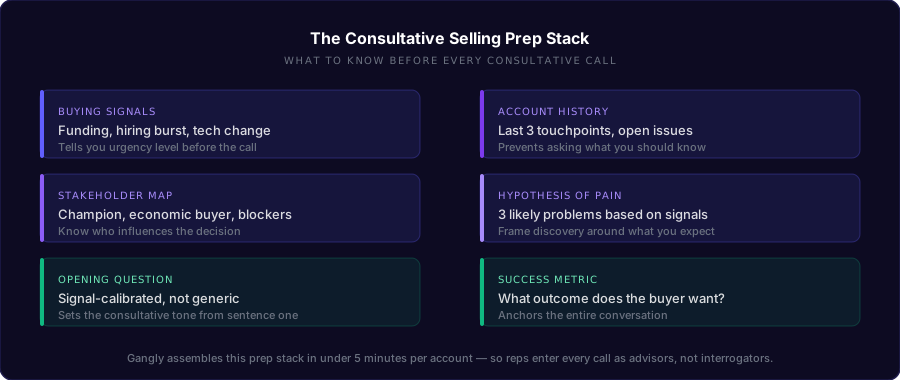
The reason most reps skip prep is not laziness — it is time. Thorough pre-call research that covers signals, account history, stakeholder mapping, and opening question calibration takes 45–60 minutes per account when done manually. A rep running four calls per day cannot spend 3–4 hours on prep alone. The math does not work.
This is where the technology gap between consultative sellers who perform and those who do not has widened most sharply in 2025–2026. Signal-based prep tools that aggregate buying signals, account history, and stakeholder context into a pre-call brief — in under 5 minutes — have eliminated the time objection to Phase 1. A rep using Gangly's call prep engine spends 4–6 minutes reviewing the prep brief before a consultative call, rather than 45 minutes building it manually. That is the difference between prep as a theoretical best practice and prep as an actual daily behavior. For a full framework on call preparation, read the sales call prep workflow guide.
The prep stack for a consultative call has five components:
Buying signals
Funding events, hiring bursts, tech changes, executive hires. These tell you the urgency context before the call begins.
Account history
Last three touchpoints, any unresolved objections, prior product interests. Prevents asking what you should already know.
Stakeholder map
Champion, economic buyer, likely blockers. Know who influences the decision before you begin building the case.
Hypothesis of pain
Three likely problems based on the signals. Frames discovery around what you expect, so questions feel informed rather than exploratory.
Signal-calibrated opening question
A specific question that references the account's current signal context. Sets the advisor tone from the first sentence.
A worked consultative sales conversation
Abstract principles are easy to state and difficult to execute. The following is a worked example of what consultative selling looks like in practice — including the prep that makes the conversation possible, the discovery that builds genuine urgency, and the close that feels natural rather than pushed.
Context: an AE at a sales workflow tool vendor is calling the new VP of Sales at a Series B SaaS company. The company posted 12 new sales roles in 3 weeks, and the VP started 18 days ago.
Consultative Sales Conversation — Annotated by Phase
Phase 1 — Pre-Call Prep (5 minutes, before the call)
Rep reviewed: Series B closed 21 days ago ($12M). VP started 18 days ago (new leader signal). 12 AE roles posted (hiring burst). No prior CRM history with this account. Hypothesis of pain: rep ramp speed will be the first pressure point. Opening question: reference the hiring burst and the new role.
Rep:
"I noticed you started about three weeks ago and you have already posted 12 new AE roles — that is a fast start. Is the push coming from the Series B targets, or is there a specific gap the board identified?"
VP Sales:
"Both. We need to get to $15M ARR by Q3, and the current team of 6 AEs cannot do it alone. We are tripling the team and expecting them productive within 60 days."
Rep:
"Sixty days — that is aggressive for an AE ramp. What does 'productive' actually look like in your context — is that first closed deal, or full quota attainment?"
VP Sales:
"First closed deal by day 60. Full quota by month four. Right now, with my last team, it was taking 5–6 months just to close the first deal."
Note: Two discovery questions. The rep referenced signal data (new role, hiring burst) to open without generic Situation questions. Pain confirmed: ramp timeline is the problem.
Rep:
"If 12 new AEs ramp in 5–6 months instead of your 60-day target — what does that mean for the $15M ARR goal? Is that number built on them being fully productive by Q3, or do you have buffer?"
VP Sales:
"No buffer. The model assumes they are at full quota by month four. If it slips to six months, we miss Q3 by a significant amount."
Rep:
"And the gap between 4-month ramp and 6-month ramp — for 12 reps, at your current ACV, what does that translate to in missed pipeline?"
VP Sales:
"[Pause.] At $45K ACV and 8 deals per quarter per rep at full quota... a two-month slip per rep, across 12 reps... that is probably $3–4M in pipeline that does not exist in Q3."
Note: The rep did not state the number — the VP calculated it. Buyer-generated urgency. The problem is now $3–4M in missed Q3 pipeline, not "slow ramp times."
Rep:
"If you could design the ideal solution to compress that ramp — what would it do? What is the one variable in the first 60 days that, if you could fix it, moves the needle on that $3–4M?"
VP Sales:
"Honestly? Call preparation and execution consistency. Our best AEs already know how to prep for a call well — they show up knowing the account, they ask the right questions. The new hires wing it. If every rep could execute like the top two or three, the ramp problem mostly solves itself."
Rep:
"That is exactly the category we work in. Can I show you specifically how we handle the prep and live guidance side — and be honest where we do and do not solve the consistency problem you just described?"
Note: The solution request came from the buyer. The rep offered a demo framed around the buyer's exact language — not a generic pitch.
Rep (after 20-minute demo):
"You described the core problem as call prep and execution consistency — and we confirmed we cover prep, live coaching, and post-call capture. What does your internal process look like for evaluating something like this, given your Q3 timeline?"
VP Sales:
"I want to loop in my CFO on the commercial side. But I am moving fast — if you can send me a pilot structure, I can have an answer within the week."
Note: The rep asked about the decision process, not "are you ready to buy?" The buyer self-identified the next step and the timeline. No pressure close needed.
Read that conversation against what would have happened without Phase 1 prep. Without signal data, the rep opens with "what are your biggest challenges?" and spends 10 minutes on generic context-gathering before reaching the first real question. The buyer has heard that conversation a hundred times. They categorize the rep as a vendor and give polished, low-information answers. The deal moves slowly, if at all.
With signal data, the rep's first question referenced a specific, observable fact about the account's current state. The buyer recognized that the rep had done homework — and responded with candor, not a polished deflection. That quality of candor is what consultative selling produces, and it begins in Phase 1, not in Phase 2.
Consultative selling vs SPIN Selling vs the Challenger Sale
Three of the most-cited B2B sales methodologies — consultative selling, SPIN Selling, and the Challenger Sale — are often positioned as competing alternatives. They are not. Each solves a different problem in the same deal, and experienced enterprise AEs deploy all three within a single sales cycle.
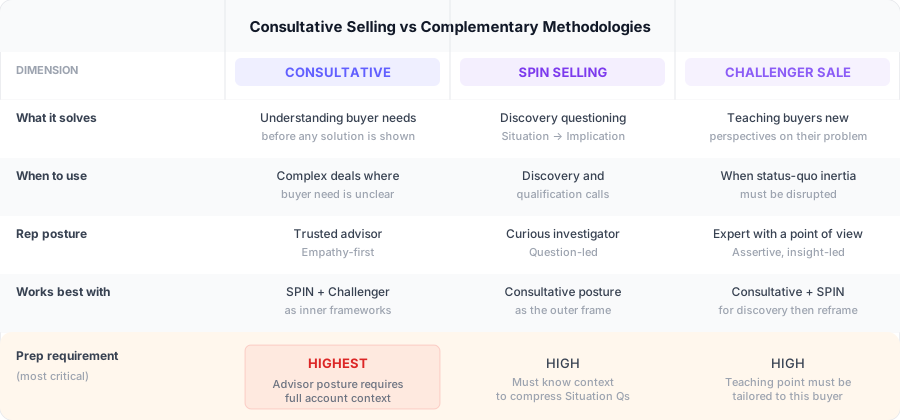
Consultative selling: the posture layer
Consultative selling defines how the rep shows up throughout the entire deal cycle — as an advisor whose primary goal is to understand and solve the buyer's problem, not to close a transaction. It governs the prep investment, the questions asked, the honesty with which gaps are acknowledged, and the patience with which the rep waits for the buyer to articulate value before presenting a solution.
SPIN and Challenger provide the technique layer that executes within the consultative posture. Without the consultative posture, SPIN questions become a scripted interrogation and Challenger reframes become confrontational rather than instructive. The posture is what makes the techniques land as they are designed to.
SPIN Selling: the discovery architecture
SPIN Selling, developed by Neil Rackham after a 12-year study of 35,000 sales calls, provides the question-type framework for Phases 2 and 3 of the consultative process. Situation questions establish context. Problem questions surface specific pain. Implication questions expand the consequence of that pain — the most critical phase, and the one most often skipped. Need-Payoff questions invite the buyer to articulate the value of a solution in their own words, setting up Phase 4.
The integration is direct: SPIN's Implication questions are Phase 3 (Problem Framing) of the consultative framework. SPIN's Need-Payoff questions bridge Phase 3 and Phase 4 (Solution Alignment). A rep operating within the consultative posture and using SPIN-structured questions in discovery executes Phases 2 and 3 more rigorously than a rep using either approach alone.
The Challenger Sale: the insight and control layer
The Challenger Sale contributes at Phase 3 and Phase 4. The Challenger's "Teach" component — bringing a counterintuitive insight about the buyer's problem — is a powerful way to deepen Phase 3 problem framing when the buyer has normalized the pain and stopped seeing its full cost. The Challenger's "Tailor" and "Take Control" components are most relevant in Phase 4 (Solution Alignment) and Phase 5 (Commitment), where the rep drives the decision process rather than leaving it open-ended.
A practical integration: use SPIN's Implication questioning to build buyer-generated urgency in Phase 3. Then, if urgency is confirmed but the buyer appears to have normalized the status quo, deploy a Challenger teaching point that reframes the problem in a way that points to your specific capability. The sequence becomes: SPIN questions surface the pain → Challenger insight reframes its source → consultative alignment follows.
For context on where the Sandler approach fits this picture, the Sandler Selling System guide covers how Sandler's Pain Funnel and Upfront Contract mechanics work within the discovery phase. Sandler's approach to qualification — ensuring the rep and buyer mutually agree on whether to proceed — aligns closely with the completion criterion for Phase 2 of the consultative framework.
For the discovery call structure that ties these approaches together, the discovery call framework provides a complete call-by-call structure for executing Phases 2 and 3 of consultative selling.
Six consultative selling mistakes that kill deals
Consultative selling failure patterns are consistent across industries and company sizes. The same six mistakes appear in post-mortems on stalled deals, in manager coaching reviews, and in rep self-assessments of calls that went wrong. Understanding them before they happen is the fastest path to avoiding them.
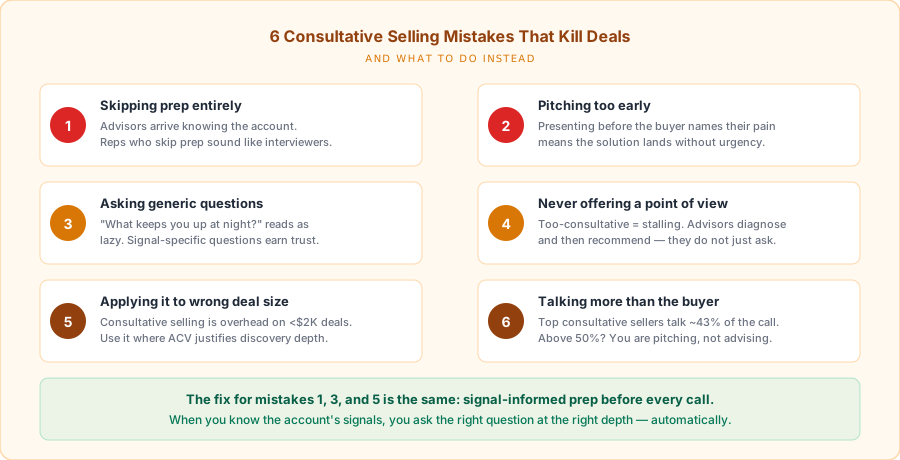
- 1
Skipping Phase 1 (prep) entirely
Consultative selling requires more prep than any other methodology. An advisor who arrives without context about the account's current signals, recent history, and stakeholder landscape cannot ask the informed questions that earn the advisor label. Instead, they ask generic questions that any vendor would ask — "What are your biggest challenges right now?" — and the buyer immediately categorizes them as a vendor, not an advisor. The fix is simple but non-negotiable: ten minutes of signal-based research before every consultative call. Not sixty minutes. Ten. But those ten minutes must happen.
- 2
Pitching before discovery is complete
The most common consultative selling failure is a rep who hears the first hint of pain — "yeah, our ramp times are too long" — and immediately pivots to the product. Discovery is not complete until the buyer has articulated the specific problem, the consequence of that problem, and the rough shape of the outcome they want. Pitching at the first sign of pain produces a demonstration that the buyer sits through politely before saying "interesting — let us revisit next quarter." The product never landed because the urgency was never built.
- 3
Asking generic questions instead of signal-specific ones
"What keeps you up at night?" is the lowest-credibility question in consultative selling. It signals that you did not prepare. Signal-specific questions — questions that reference observable facts about the account's current state — earn a completely different quality of answer. "I noticed you just closed a Series B and your team posted 8 AE roles in three weeks — is the rep ramp problem already showing up as a concern, or is that further out?" That question is only possible with Phase 1 prep. Generic questions are what happen when Phase 1 is skipped.
- 4
Never offering a point of view
Some reps over-correct on consultative selling and become question machines who never commit to a recommendation. This is as damaging as pitching too early. Buyers who are in an exploratory conversation with a rep eventually want the rep to say: "Based on what you just told me, here is what I would do." A rep who responds to every question with another question is not demonstrating expertise — they are demonstrating the absence of one. Consultative selling includes a moment where the advisor says: "In my experience with teams at your stage, the pattern I see most often is X. Does that match what you are describing?"
- 5
Applying consultative selling to the wrong deal size
A buyer purchasing a $1,800/year tool does not want a consultative discovery process — they want a direct answer to a specific question. The overhead of consultative selling (multiple discovery sessions, deep prep, multi-stakeholder alignment) is only justified when the ACV warrants it. As a rule of thumb: consultative selling pays off on deals where the annual contract value exceeds $10,000 and the buying decision involves more than one stakeholder. Below that threshold, the process slows the deal without adding proportional value.
- 6
Talking more than 50% of the call
Research on top-performing consultative sellers shows they talk approximately 43% of call time and listen 57%. When a rep exceeds 50% talk time on a consultative call, they have shifted from discovery mode into presentation mode — and the buyer stops being an active participant in their own problem-solving process. The fix is not silence — it is better questions. A specific, well-framed question creates 45 seconds to 2 minutes of buyer talk time. Generic questions get short answers. Good questions open up the conversation.
Notice the pattern: mistakes 1, 3, and 5 all trace back to the same root cause — insufficient Phase 1 prep. When a rep has real signal context before a call, they do not ask generic questions (mistake 3) because they already have signal-specific questions ready. They do not apply consultative overhead to the wrong deal type (mistake 5) because they know the account well enough to calibrate the depth appropriately. They do not show up blank (mistake 1) because the prep happened before the calendar invite opened.
Mistakes 2 and 4 are harder to fix through prep alone — they require a genuine comfort with the consultative posture and the patience to stay in discovery mode when the product-pitch instinct kicks in. This is where live call coaching makes the biggest difference. When a rep gets a strong answer to a discovery question and the reflex is to pivot to features, a real-time coaching prompt — "stay in Phase 3 — what does that cost them?" — redirects the conversation before the mistake lands.