
 By Siddharth Gangal
TL;DR
- What it is: The Sandler Selling System is a psychology-based B2B sales methodology developed by David Sandler in 1967. Its core premise: the rep qualifies the prospect as rigorously as the prospect evaluates the vendor. Equal power. No chasing. The methodology is structured as 7 sequential steps called the Sandler Submarine — each one a qualification gate before the next opens.
- The core tools: The Upfront Contract (a mutual agreement at the start of every call that eliminates ghosting), the Pain Funnel (a 3-level questioning sequence that surfaces business and personal pain before surface symptoms), and the Dummy Curve (a technique that gets prospects talking by playing less knowledgeable).
- When it wins: Against evasive prospects who give polished non-answers, in high-ACV deals where months of rep time are at stake, and in any context where reps routinely present to people who cannot or will not buy. Sandler reduces wasted presentation time by 40–60% on average for teams that implement it rigorously.
- Compared to other methodologies: Sandler is the only major methodology built specifically for prospects who deflect, delay, and deceive. Challenger assumes the buyer is status-quo but honest. SPIN assumes the buyer needs help surfacing their own pain. Sandler assumes the buyer may not tell you the truth — and builds a system to surface it anyway.
- First step: Write your Upfront Contract script for your next call. State the purpose, time, agenda, mutual permission to say no, and the outcome. Use it verbatim. The post-call ghosting rate drops immediately.
What is the Sandler Selling System?
The Sandler Selling System is a psychology-based B2B sales methodology developed by David Sandler in 1967 and formalized through Sandler Training into a globally deployed framework. It structures the sales process as 7 sequential steps — the "Sandler Submarine" — each of which qualifies the prospect before the next opens. The core principle is mutual qualification: the rep decides whether the prospect deserves the next step as often as the prospect decides whether the rep deserves it. Key tools include the Upfront Contract (eliminating ghosting by setting explicit mutual agreements), the Pain Funnel (surfacing pain at three levels: surface, business impact, and personal consequences), and the Dummy Curve (getting prospects to reveal deeper information by appearing less knowledgeable than you are).
David Sandler developed the system as a direct reaction to the "always be closing" culture that dominated sales training in the 1960s. The prevailing model put all the pressure on the rep — chase the deal, overcome every objection, never let the prospect walk away. Sandler observed that this model produced two outcomes: burned-out reps and defensive prospects. The rep spent more time on qualification theater than actual qualification. The prospect learned to string the rep along because the rep had no exit condition.
Sandler's insight was structural rather than tactical. He did not prescribe a better objection-handling script. He redesigned the power dynamic. In Sandler selling, the rep enters every conversation with the explicit position: "I am here to find out whether this is a fit for both of us. If it is not, I will tell you. You should tell me too." This posture changes what prospects say — because prospects who believe the rep will walk away if there is no fit have no incentive to inflate interest or hide blockers.
The psychological foundation matters because it explains why Sandler techniques work where others fail. The Upfront Contract removes the evasion incentive: the prospect already agreed to give a clear answer. The Pain Funnel surfaces information prospects would never volunteer in a traditional discovery call. The Dummy Curve lowers the prospect's defensive posture by removing the status threat. Every Sandler tool operates on the same underlying mechanism: reduce the pressure that causes prospects to withhold, deflect, and deceive.
In 2026, Sandler's relevance has increased rather than decreased. The average B2B enterprise deal involves 6 to 10 stakeholders (Gartner, 2025). Buying processes have extended by an average of 22% since 2022. The cost of wasting months on a deal that was never going to close has grown substantially. Sandler's qualification rigor directly addresses the highest-cost problem in modern B2B sales: investing deeply in deals that die quietly. The methodology does not guarantee every deal closes — it guarantees that you will know sooner whether it will not.
Sandler integrates cleanly with other methodologies. The MEDDIC sales methodology provides the qualification scoring framework; Sandler provides the behavioral tools to surface the MEDDIC elements. The Challenger Sale provides the teaching posture for status-quo buyers; Sandler provides the qualification gate that confirms a deal is worth teaching. Most enterprise AEs who run Sandler in practice layer it with SPIN and Challenger rather than replacing them.
The 7-step Sandler Submarine
The "Submarine" metaphor is deliberate. A submarine is built of watertight compartments. If one compartment floods, the doors seal — the rest of the boat survives. In Sandler selling, each step is a compartment: watertight, sealed before the next opens. A rep who skips from Bonding straight to Fulfillment has opened a flooded compartment directly into the presentation. The deal sinks.
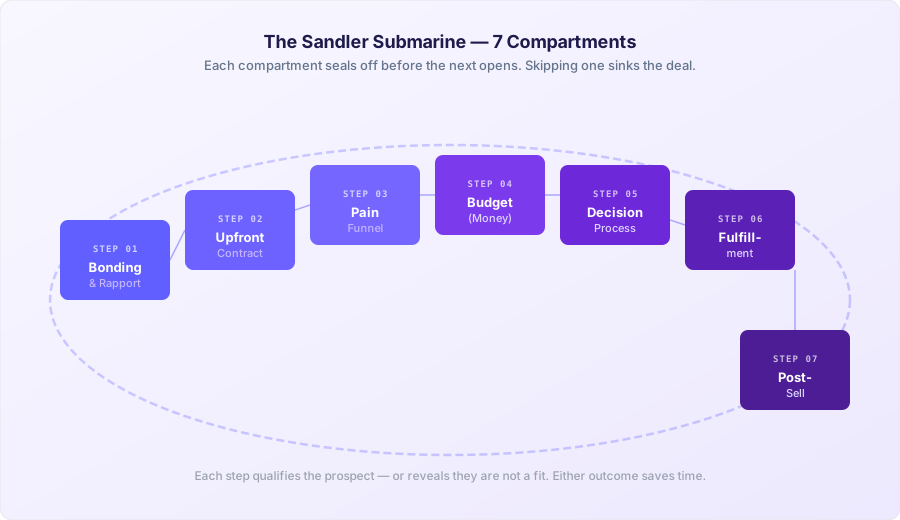
Bonding and Rapport
Build genuine credibility before the agenda starts. Sandler's bonding phase is not small talk — it is a deliberate effort to establish psychological safety. The prospect needs to feel that this is a conversation between peers, not a sales transaction. Ask about their business, not your product. Listen for signals about priorities, pressures, and personality.
Key move
Mirror tone. Match pace. Confirm you have the right amount of time before proceeding.
Upfront Contract
Set explicit expectations for the conversation before any content begins. State the purpose, time, agenda, mutual permission to say no, and what a successful outcome looks like for both sides. This single step prevents post-call ghosting more reliably than any follow-up sequence.
Key move
Say it out loud: "By the end of this call, we should both know if it makes sense to go further — or not."
Pain
Uncover pain at three levels: surface symptoms (what they observe), business impact (what it costs), and personal/emotional consequences (what it means for the person in the room). Most reps stop at Level 1. Sandler requires going to Level 3 before moving forward.
Key move
Ask: "What has that cost you personally?" before moving to budget.
Budget
Qualify investment capacity without naming a price first. Sandler calls this "money" — not just budget, but the willingness to invest to solve the problem. Ask whether the pain is worth solving financially. Get a range before revealing your pricing. If there is no investment capacity, disengage cleanly now rather than at proposal.
Key move
Ask: "What have you budgeted to solve this — or is that conversation still ahead of you?"
Decision
Map the full decision process before the presentation. Who signs? Who blocks? What does the evaluation process look like? What has killed similar decisions in the past? Sandler reps never present without a clear picture of the decision path — because presenting to someone who cannot say yes is a waste of both parties' time.
Key move
Ask: "If everything lines up perfectly on our end, walk me through how a decision like this typically gets made here."
Fulfillment
Only at this stage does the rep present the solution — and only the parts that directly address the pain uncovered in Step 3. Not a full demo. Not a feature tour. A targeted narrative: here is what you told me was hurting you, here is exactly how we address that, here is what changes for the person in this room. Nothing else.
Key move
Reference every pain point from Step 3 explicitly before naming any feature.
Post-Sell
After the prospect says yes, Sandler reps immediately address buyer's remorse before it materializes. Confirm the decision, restate the value, set implementation expectations, and introduce the champion who will drive internal adoption. This step prevents the "we need to reconsider" call that arrives 72 hours after a verbal close.
Key move
Say: "Before we end — is there anything that could get in the way of this moving forward on your end?"
The Submarine structure also reveals a counterintuitive truth about Sandler: the best outcome at any step is not always "yes." A prospect who clearly does not have budget after Step 4 deserves a clean disengagement, not a presentation. A prospect who cannot explain the decision process in Step 5 is telling you the deal is not real — advancing to Step 6 wastes both parties' time. Sandler reps treat "no" at Step 3 as a better outcome than "no" at contract review. The time saved is the ROI.
This is the structural difference between Sandler and most other methodologies. SPIN selling and Challenger selling optimize for advancing the deal. Sandler optimizes for qualifying the deal — advancing it only when the qualification confirms it is real. The distinction matters at the rep level because a Sandler-trained rep with 40 active deals has 40 real deals. A non-Sandler rep with 40 active deals may have 15 real deals and 25 wishful pipeline entries. The discovery call framework helps identify which questions to ask at each Sandler stage to surface qualification signals early.
The Upfront Contract — Sandler's unfair advantage
The Upfront Contract is the single most misunderstood and most underused Sandler tool. Most reps who read about Sandler understand the Pain Funnel. Far fewer actually use the Upfront Contract consistently. That is a mistake — because the Upfront Contract is what makes every other Sandler step work.
The mechanism is simple: at the start of every interaction — first call, discovery, demo, follow-up — the rep explicitly states five things and gets verbal confirmation of each.
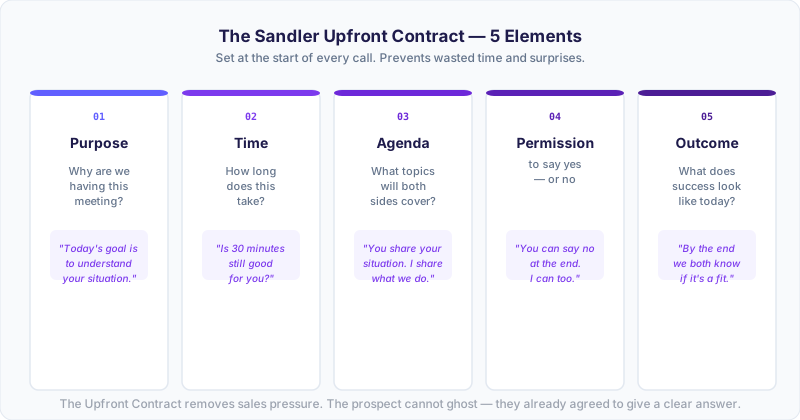
The element most reps skip is the Permission to Say No. It sounds counterintuitive to give prospects explicit permission to end the conversation. In practice, it does the opposite of what reps fear. Prospects who believe they can say no at any time relax. They stop hedging. They give real answers instead of answers designed to delay the rep without fully closing the door.
A worked example. A rep selling a revenue intelligence platform opens a discovery call this way: "We have 30 minutes confirmed. My goal today is to understand your current situation — specifically around how your reps use call data for coaching. If after 30 minutes I think we can genuinely help you, I will say so and we can discuss next steps. If I do not think we are the right fit, I will tell you that too. Same for you — if at any point you realize this is not a priority, just tell me and we can use the remaining time better. Does that work?"
Notice what this does. It states the time (30 minutes), the purpose (understand current situation around call coaching), the agenda (both sides share), mutual permission to say no, and the outcome (clear yes or no on fit). The prospect who says "yes, that works" has made a micro-commitment to honesty. Post-call ghosting requires breaking that commitment — which most prospects are less willing to do than reps assume.
Teams that deploy Upfront Contracts consistently report 30–45% reductions in post-discovery ghosting within the first 90 days. The mechanism is not manipulation — it is expectation alignment. The prospect and the rep are now in a conversation defined by mutual respect rather than mutual performance. That shift in dynamic is what Sandler's entire methodology rests on.
Upfront Contract mistakes to avoid
- ✗Skipping it on follow-up calls. The Upfront Contract is not just for first calls. Every call where something is at stake gets an Upfront Contract — the stakes change but the structure does not.
- ✗Making it a monologue. The Upfront Contract requires verbal confirmation from the prospect at each element — not just a statement from the rep. Ask, do not announce.
- ✗Forgetting to include both agendas. The contract covers what the rep wants from the call AND what the prospect wants. Missing the prospect's agenda produces a conversation the rep controls but the prospect does not invest in.
- ✓The correct habit: Write the Upfront Contract for every call in your call prep. Three sentences. State it, get confirmation, proceed.
The Pain Funnel — digging to Level 3
Step 3 of the Sandler Submarine is Pain. The Pain Funnel is the tool that makes Step 3 work. It is a structured questioning sequence that moves from observable symptoms to business impact to personal and emotional consequences. The 3-level structure reflects a psychological reality: people make buying decisions at Level 3, but they describe their problems at Level 1.
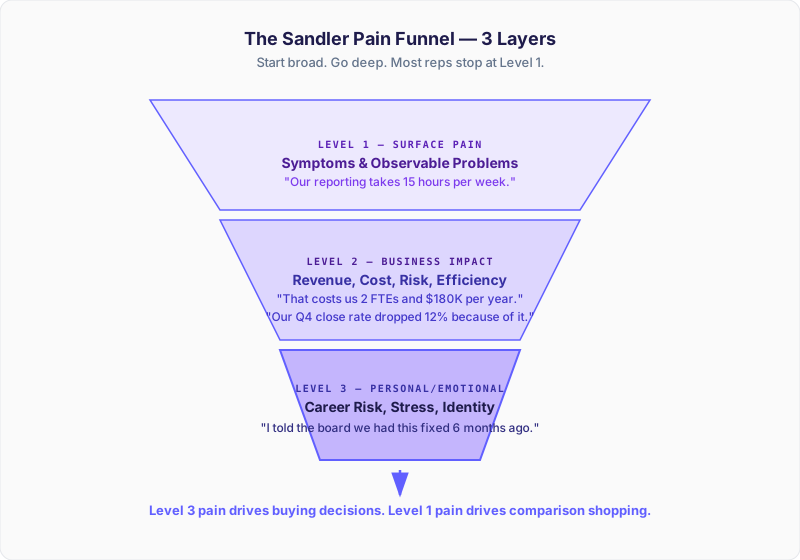
The Pain Funnel works because it follows the natural psychology of problem disclosure. Prospects start with surface symptoms because those are safe to share — they do not expose vulnerability. Business impact requires some trust before sharing. Personal and emotional consequences require significant trust — because admitting that a problem affects your own career or reputation means admitting fallibility to someone who is trying to sell you something.
The rep's job in the Pain Funnel is to build enough trust at each level before probing deeper. Jumping from Level 1 to Level 3 without establishing Level 2 feels presumptuous. The prospect who just confirmed the symptom ("yes, our reporting does take 15 hours per week") is not yet ready to say "I told the board we had this fixed six months ago." The path from Level 1 to Level 3 runs through Level 2 — the business impact — which provides the logical bridge to personal stakes.
Pain Funnel question structure
The Pain Funnel uses a specific question progression. Start broad and factual. Narrow to impact. Arrive at consequence.
Level 1 — Surface Questions
- → "Tell me more about that."
- → "How long has this been the situation?"
- → "How often does this happen?"
- → "Can you give me a specific example?"
Level 2 — Business Impact Questions
- → "What does that cost you in time or money per month?"
- → "How does that affect your team's output?"
- → "What opportunities are you missing because of it?"
- → "What happens at quarter-end if this is not fixed?"
Level 3 — Personal / Emotional Questions (deploy carefully)
- → "How does this affect you personally?"
- → "Have you made commitments to leadership around this?"
- → "What happens to your team — and to you — if this is not resolved in the next six months?"
- → "How long is this problem acceptable to leadership before it becomes someone's performance problem?"
Level 3 questions require trust established at Levels 1 and 2. A rep who jumps to "what happens to you personally if this is not resolved?" in the first five minutes is performing psychological manipulation, not discovery. The progression is not a script — it is a framework for following the prospect's willingness to go deeper. Some prospects reach Level 3 in 8 minutes. Some take two full calls. The rep's job is to recognize the signal, not to force the sequence.
The Pain Funnel also produces a diagnostic test for deal quality. A prospect who reaches Level 3 — who names the personal consequences of the problem — has a real pain point. A prospect who stays at Level 1 despite gentle probing toward Level 2 either does not have a serious enough problem to justify a buying decision, or has not yet trusted the rep enough to share it. The first scenario is a disqualification signal. The second is a signal to return to the Upfront Contract and re-establish the mutual permission dynamic.
The Dummy Curve and Reversing
The Pain Funnel gives you the question structure. The Dummy Curve and Reversing give you the behavioral mechanics to make prospects answer honestly. They are two of Sandler's most effective tools — and the two that most resemble psychological judo.
The Dummy Curve
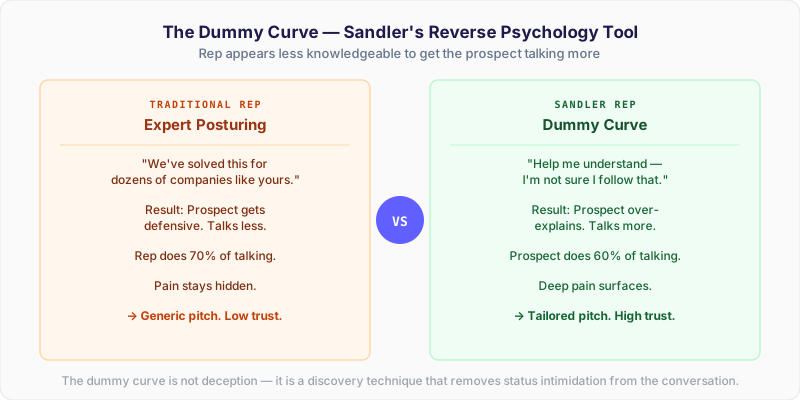
The Dummy Curve is a deliberate under-representation of the rep's knowledge to get the prospect talking more. When the prospect says something the rep already understands completely, the Sandler rep responds as if slightly confused: "Help me understand that a bit better — I am not sure I am following."
The effect is reliable and well-documented. Prospects who believe the rep understands them completely stop elaborating — the rep is already in the picture, so what is there to add? Prospects who believe the rep needs more explanation over-explain. In that over-explanation, they reveal second and third layers of detail they would never have shared in response to a direct question. The rep, appearing less knowledgeable, actually learns more.
The Dummy Curve is not deception in the harmful sense — it is a social mechanism for removing the status intimidation that makes prospects defensive. A prospect talking to someone they perceive as an expert has two modes: perform competence (hide problems), or defer to the expert's framing (lose ownership of their own problem). The Dummy Curve eliminates both failure modes by placing the rep in a learning posture rather than an expert posture.
Use the Dummy Curve during the Pain Funnel when the prospect gives a surface answer that you suspect has a deeper story. Instead of probing directly ("what does that cost you?"), respond with apparent confusion: "That is interesting — I want to make sure I understand. When you say the reporting takes 15 hours per week, what is actually happening during those 15 hours? Walk me through it." The prospect who explains their own problem in detail is also diagnosing their own pain — which is far more convincing to a buying committee than a rep's description of the pain.
Reversing
Reversing is the technique of answering a question with a question — specifically, turning the prospect's question back to them to surface the concern or intent behind it before responding.
The trigger: the prospect asks a direct question that would, if answered directly, move the conversation where the rep does not yet have enough information to go. Common examples: "How much does it cost?" (asked before pain is established), "Can it integrate with our CRM?" (asked before the rep knows which CRM or whether integration is actually the pain), "How long does implementation take?" (asked before the rep knows what the prospect's timeline pressure actually is).
The Reversing response: "That is a good question — can I ask what is making that important to you right now?" or "Before I answer that, help me understand the context — what is driving that question?"
Reversing serves two purposes. First, it prevents the rep from answering in a direction that does not address the prospect's actual concern. A prospect asking "how much does it cost?" before pain is established may be testing whether this is in budget range — or may be looking for a reason to disqualify. Answering directly answers the surface question but not the underlying one. Reversing surfaces the underlying one. Second, Reversing extends the discovery phase without appearing to avoid the question. The rep who says "I will get to that — but first, help me understand what prompted that question" is practicing legitimate discovery, not deflection.
Sandler vs Challenger vs SPIN — when each methodology wins
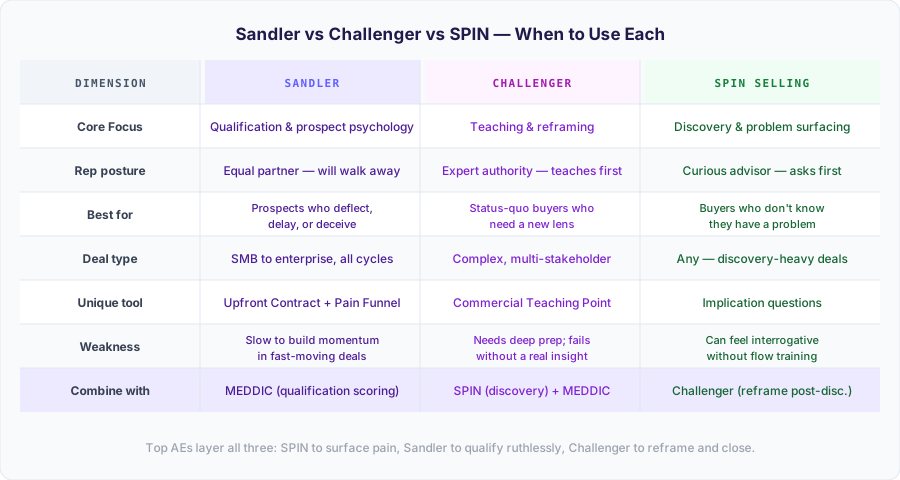
The three most widely deployed B2B sales methodologies in 2026 are Sandler, Challenger, and SPIN. Each was built for a different sales problem. Choosing the right one — or the right combination — depends on understanding what problem each solves.
Sandler — for prospects who deflect
Sandler is the only major methodology built specifically for prospects who do not tell the truth. Not dishonest in a malicious sense — but evasive in the way that every professional is trained to be when interacting with salespeople. Polished non-answers. Inflated interest to avoid an awkward "no." Vague timelines that never arrive. Sandler's tools — particularly the Upfront Contract and the Dummy Curve — are specifically designed to surface real information from prospects who have learned to give safe, generic answers to sales reps.
Sandler also wins in high-ACV deals where the cost of a bad forecast is significant. A rep who carries $2M in annual quota cannot afford six months of effort on deals that were never real. Sandler's qualification rigor forces that truth to the surface at Step 4 (Budget) and Step 5 (Decision) — not at the proposal stage where it causes maximum damage.
Challenger — for status-quo buyers
The Challenger Sale methodology solves a different problem: the buyer who is content with their current approach and does not recognize the cost of inaction. Challenger reps teach new perspectives, quantify what the current approach costs, and take confident control of the conversation to drive it toward a decision. The Challenger rep assumes the buyer is honest but stuck in a wrong mental model.
Challenger underperforms Sandler when the buyer is not stuck in a mental model — when they are actively evasive. Challenging a buyer who is giving polished non-answers produces more polished non-answers. The insight does not land because the buyer has not yet been brought to the psychological state where they will receive it honestly.
SPIN — for buyers who need help naming the problem
SPIN Selling is a discovery framework built around four question types: Situation, Problem, Implication, and Need-Payoff. It excels when the buyer knows something is wrong but has not articulated it clearly — not because they are hiding it but because they have not organized their own thinking about it. SPIN questions help buyers self-diagnose, which makes the problem feel more real and the urgency more genuine.
SPIN and Sandler are highly complementary. SPIN's Situation and Problem questions map directly onto Sandler's Pain Funnel Level 1. SPIN's Implication questions are Pain Funnel Level 2. Sandler's Level 3 personal consequence questions go where SPIN's Need-Payoff questions do not — into personal career and emotional stakes. A rep who uses SPIN to surface the problem structure and Sandler's Level 3 questions to confirm the personal stakes has covered the full discovery spectrum.
The layered approach that top AEs use
In practice, the most effective enterprise AEs in 2026 do not choose one methodology. They layer three. SPIN surfaces what the problem is. Sandler qualifies whether the problem is real and whether this prospect will buy. Challenger reframes the problem in a way that creates urgency and positions the rep's product as the logical solution. The three methodologies answer three different questions: What is the problem? Is this deal real? Why should they act now?
Signal-based Sandler — when to deploy each step
Sandler answers how to qualify a prospect. Signal data answers which prospects deserve the qualification effort — and which Sandler step to lead with based on what the signal reveals about the account's current state.
Gangly Framework
The Signal-to-Sandler Entry Framework
Gangly's analysis of outbound sequences run on signal-triggered accounts in 2025–2026 identified that different signal types correlate with different optimal Sandler entry points. Reps who matched their Sandler entry step to the signal type — rather than starting every call at Step 1 — showed 2.3× higher first-call-to-discovery conversion and 1.7× higher pain-confirmation rate at Step 3.
The four signal-to-Sandler mappings:
- Funding event (15–21 day window). New capital means growth pressure. The prospect's Level 2 pain is almost certainly "we need to hit the board's growth targets." Lead with: "Congratulations on the round — most teams at your stage tell us the first challenge they hit is [specific problem you solve] when they start scaling the team. Is that showing up for you yet?" This positions the Pain Funnel at Level 2 immediately, because the signal context makes Level 2 the obvious entry point.
- Hiring burst (7–14 day window). Five or more open roles in a relevant function signals scaling chaos. The Level 2 pain is onboarding and efficiency. Lead with the budget conversation earlier than normal — hiring budgets are already allocated for the new roles, and the rep can position their solution as an adjacent investment rather than a new line item.
- Technology change (21–30 day window). A new CRM, SEP, or data platform creates workflow gaps. The Level 2 pain is integration disruption and productivity loss. Sandler's Upfront Contract here should explicitly name this as the agenda: "I noticed you recently adopted [tool]. In my experience, most teams run into [specific gap] within the first 90 days. I want to understand if that is showing up for you — and if it is, whether we can help."
- Leadership hire in ICP role (7–21 day window). A new VP of Sales, CRO, or Head of RevOps is evaluating the current tool stack in their first 90 days. This is the highest Level 3 pain scenario — the new leader has personal career stakes in making the right calls before committing to the status quo. Lead with: "You are in your evaluation window right now. The reps I talk to in your position typically have a 60–90 day window to change things before the organization locks in. What are you finding in the current setup?"
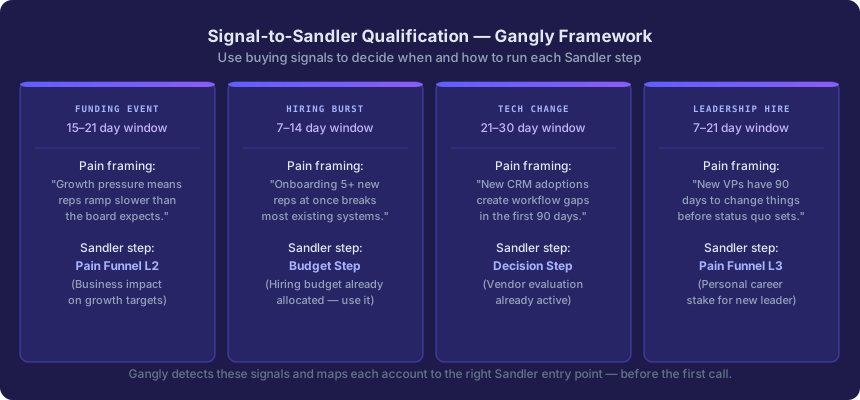
The practical implication: Sandler without signal data produces uniform qualification effort across an uneven prospect pool. Some accounts are highly ready to engage — they have a signal that makes the timing obvious. Others are cold accounts where the Sandler qualification rigor will surface a "not right now" within two steps. Signal data lets reps allocate the full Sandler qualification effort where it will produce the highest return.
Gangly's call prep engine surfaces the relevant signal for each account before the first call, maps it to the appropriate Sandler entry point, and generates the Upfront Contract language and first-level Pain Funnel questions tailored to that signal context. The rep reviews, edits to their voice, and walks in with a ready Sandler setup rather than a generic opener. The prep time for a signal-informed Sandler call is under 7 minutes — versus 25–35 minutes for manual research to the equivalent quality. That compression is what makes systematic Sandler execution feasible across a full territory, not just in the top 20 accounts a rep happens to know well.
For the full signal detection and action workflow, see the signal-based selling guide for B2B reps.
When Sandler works — and when it backfires
Understanding Sandler's fit conditions is as important as understanding the methodology itself. Deploying Sandler in the wrong context produces worse results than not using it at all.
Where Sandler outperforms
High-ACV, long-cycle enterprise deals
Where qualification failure is expensive — 6+ months of effort on a deal that was never real is a career-level mistake. Sandler's qualification rigor surfaces "not real" at Step 4 rather than Step 7.
Evasive or polished prospects
VP-level buyers who are trained to give professional non-answers. The Upfront Contract and Dummy Curve cut through professional evasion without confrontation.
Teams with high no-decision rates
Where prospects advance through the funnel and then disappear without deciding. Sandler's mutual commitment structure — particularly the Upfront Contract — reduces no-decision outcomes by making "no" an acceptable and expected outcome at each step rather than a failure to be avoided.
Complex B2B with multi-level stakeholders
Sandler's Decision step (Step 5) explicitly maps who buys, who blocks, and who influences. In deals with 5+ stakeholders, skipping this step produces surprises that kill deals at the proposal stage. Sandler surfaces the full decision map before the rep invests in a presentation.
Where Sandler backfires
Transactional deals with fast decision cycles
A prospect who wants to buy in 2 days does not want a 7-step qualification process. Sandler's rigor reads as friction in fast-moving deals where the buyer already knows what they want. Use consultative selling instead.
Warm inbound leads with high intent
A prospect who booked a demo after signing up for a trial and reading three case studies does not need to be told they can say no. They are ready to advance. Full Sandler qualification in this context slows deals that should close fast.
Reps without genuine Upfront Contract discipline
Sandler delivers its value through consistent execution, not occasional use. A rep who uses the Upfront Contract on 3 of their 20 calls per week is not running Sandler — they are running a partially qualified pipeline. The qualification benefit only materializes when the behavior is consistent.
Common Sandler mistakes to avoid
Sandler is widely deployed and widely misapplied. The failure modes are consistent across organizations that adopt the methodology without completing the behavioral change the methodology requires.
Stopping the Pain Funnel at Level 1
Fix: The most common Sandler mistake. The rep asks "tell me more about that" once, gets a surface answer, and moves on. Level 1 answers produce Level 1 presentations — generic solutions to symptoms rather than targeted solutions to real pain. The fix: do not advance from Step 3 until you have a Level 3 answer. If the prospect will not go to Level 3, either the pain is not serious enough to drive a decision, or the trust built in Step 1 was insufficient. Both are disqualification signals.
Forgetting the Upfront Contract on follow-up calls
Fix: The Upfront Contract is a mandatory step for every call with substantive stakes — not just the first one. A rep who uses it on the first discovery call and then drops it on the follow-up loses the mutual commitment dynamic precisely when it matters most. Before every call where the rep will ask the prospect for a decision, re-establish the Upfront Contract. It takes 60 seconds and prevents the "I need more time to think" non-answer at the end.
Skipping the Budget step to avoid awkwardness
Fix: Budget conversations are uncomfortable. Most reps delay them or soften them into non-questions. Sandler makes budget a mandatory qualification step before the presentation — specifically to prevent presenting to prospects without investment capacity. The question is not "do you have budget?" (which produces a meaningless yes/no). It is "what have you budgeted to address this — or is that conversation still ahead of you?" The second phrasing surfaces both the number and the stage of the buying process.
Using Sandler's permission structure as a close technique
Fix: The Upfront Contract's "you can say no" element is not a manipulation technique — it is a genuine offer. Reps who deploy it purely as a tactic to make prospects feel safe while actually hoping they never say no will find the methodology stops working. Prospects recognize the mismatch between the stated posture and the actual pressure. Genuine willingness to disengage when qualification fails is not just ethics — it is what makes Sandler's dynamic sustainable and effective over time.
Presenting the full product before completing Step 5
Fix: Sandler's Fulfillment step is narrow by design — present only what addresses the confirmed pain. Reps trained in feature-dense demos revert to full presentations that override the targeted narrative Sandler requires. The prospect who just confirmed Level 3 pain does not need a 45-minute product tour. They need a 12-minute narrative that connects their specific pain to the specific capability that addresses it. Everything else creates noise that dilutes the buying signal.
Skipping Post-Sell because the deal is "done"
Fix: Buyer's remorse is real and predictable. The verbal yes that arrives at the end of Step 6 is not a closed deal — it is a temporarily high-commitment state that will cool within 48–72 hours. Sandler's Post-Sell step addresses this by confirming the decision, reframing the value, setting implementation expectations, and explicitly asking: "Is there anything that could get in the way of this moving forward?" Ask this question while the answer is still constructive rather than after the reversing call arrives.
A structural observation covers most of these mistakes: Sandler requires genuine behavioral change, not just technique adoption. A rep who memorizes the 7 steps but still chases deals, skips budget conversations, and presents the full product on every call is not running Sandler — they are running a traditional sales process with Sandler vocabulary. The discipline to disengage from a bad deal at Step 4, to run the Upfront Contract on every call without exception, to stop the presentation at exactly the pain points confirmed — this is the behavior change Sandler requires. The techniques are easy. The discipline is hard.
For how Sandler integrates with MEDDIC qualification scoring — particularly how Sandler's Pain, Budget, and Decision steps map onto the M, E, D, D, and I of MEDDIC — read the full MEDDIC sales methodology guide.