
 By Siddharth Gangal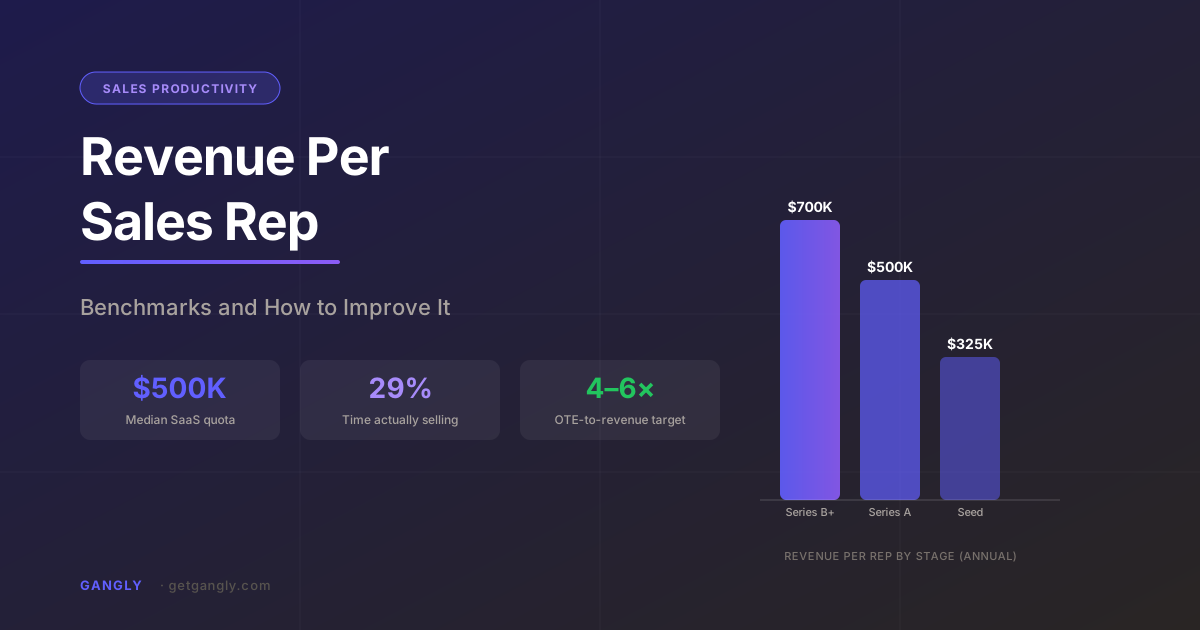
TL;DR
- Revenue per sales rep = Total closed revenue ÷ quota-carrying reps. The B2B SaaS median is $500,000–$700,000 per year at scale (Optifai, 2026). Seed-stage teams benchmark at $250,000–$400,000.
- The metric has declined across B2B sales since 2019. The primary cause is not rep skill — it is admin burden. Reps spend only 29% of the workweek actively selling (Salesforce, 2024).
- A rep should generate 4–6× their total compensation in annual revenue. Below 3× the investment stops being profitable. Above 6× the quota may be set too low.
- The fastest lever: recovering 2 hours of selling time per day per rep is equivalent to a 30–40% increase in revenue capacity — with no additional headcount cost.
- Five workflow changes raise revenue per rep: reduce admin time, use signal-based prospecting, enforce 3× pipeline coverage, invest in call preparation, and calibrate quota to actual cycle length.
Direct Answer
Revenue per sales rep is the average closed revenue generated by each quota-carrying rep in a defined period. Calculate it by dividing total closed revenue by the number of fully ramped reps. The 2026 median for B2B SaaS is $500,000–$700,000 annually, with Seed-stage teams at $250,000–$400,000 and Series C+ teams targeting $800,000–$1,200,000+. A healthy revenue-to-compensation ratio is 4:1 to 6:1. The metric has declined since 2019 as admin burden grew to consume 71% of the average rep's workweek.
Get the Gangly sales benchmark digest
Revenue per rep data, quota benchmarks, and workflow studies — delivered monthly. No pitch.
Subscribe free →What Is Revenue Per Sales Rep?
Revenue per sales rep is a productivity metric that measures the average closed revenue generated by each quota-carrying rep during a specific time period. It answers one question: how much is each sales seat producing for the business?
The metric operates at two levels. At the team level, it reveals whether the sales organization is delivering expected return on headcount investment. At the individual level, it identifies which reps generate above or below the team average and surfaces patterns in those gaps — whether the cause is pipeline, skill, territory, or time allocation.
Revenue per rep is closely related to — but distinct from — quota attainment rate. Attainment tells you what percentage of assigned quota a rep achieved. Revenue per rep tells you the absolute dollar output. A team where every rep attains 80% of a $500,000 quota generates $400,000 per rep. A team where every rep attains 80% of a $1,000,000 quota generates $800,000 per rep. The attainment percentage is identical. The revenue output is double.
CROs and RevOps leaders use revenue per rep for three decisions: headcount planning (how many reps needed to hit the revenue target), quota calibration (is the revenue target per rep realistic given current benchmarks?), and productivity diagnosis (why is revenue per rep trending down?). All three require a reliable baseline number — which is why the formula matters.
The "fully ramped" qualifier matters. Including new hires in months 1–3 of ramp artificially deflates the metric and produces a misleading benchmark. A team of 10 reps where 3 are in ramp-up generates 7 reps' worth of revenue. Dividing by 10 understates the productivity of the 7 fully ramped reps and overstates the headcount investment picture.
Revenue Per Rep vs. Revenue Per Employee
Revenue per employee is a broader organizational efficiency metric that includes all headcount — engineering, support, marketing, finance. Revenue per sales rep is narrower and more actionable for sales leaders. SaaS Capital (2025) benchmarks private SaaS companies at $170,000–$250,000 revenue per employee across all functions. Revenue per sales rep in those same companies runs 3–5× higher because reps are the revenue-generating function, not a support function.
When revenue per rep and revenue per employee diverge significantly — that is, when reps are producing at target but overall revenue per employee is low — the problem is organizational overhead, not sales productivity. Diagnosing which metric is off points directly to where the intervention belongs.
2026 Revenue Per Sales Rep Benchmarks: By ARR Stage, Industry, and Role
Revenue per rep does not have a single correct number. It moves with ARR stage, ACV, industry, and deal complexity. Comparing a Seed-stage team's output to a Series C benchmark produces the wrong conclusions. Use the table below to find the relevant reference point for your team.
Revenue Per Rep by Industry
Industry context matters as much as ARR stage. A professional services firm selling $500,000 contracts expects higher revenue per rep than a SaaS company selling $12,000 ACV subscriptions. The comparison should always be within industry and ACV range.
| Industry | Avg Revenue Per Rep | Typical ACV Range | Notes |
|---|---|---|---|
| B2B SaaS (SMB focus) | $300K–$500K | $5K–$20K ACV | High volume, short cycle |
| B2B SaaS (Mid-Market) | $500K–$800K | $20K–$100K ACV | Balanced volume and complexity |
| Enterprise SaaS | $1M–$2M+ | $100K–$500K+ ACV | Low volume, long cycle (9–18 months) |
| Professional Services | $600K–$1.2M | $50K–$500K+ projects | Relationship-driven, higher attainment rates |
| Manufacturing / Industrial | $800K–$2M | $25K–$2M+ orders | Territory-based, longer relationships |
| FinTech / Finserv | $700K–$1.5M | $30K–$300K ACV | Compliance-heavy, longer cycles |
The Revenue-to-Compensation Ratio: Your Profitability Threshold
The most useful way to evaluate revenue per rep is not against an industry benchmark alone — it is against the rep's total compensation cost. The revenue-to-compensation ratio tells you whether each sales seat is generating enough return to justify the investment.
REVENUE-TO-COMPENSATION RATIO — WHAT EACH THRESHOLD MEANS
Rep cost exceeds gross profit contribution. Immediate quota or cost intervention required.
Revenue barely covers compensation after overhead. Minimum viable threshold. Not sustainable at scale.
Industry standard for most SaaS models. Generates meaningful gross profit while supporting comp at OTE.
High productivity. Rep is generating significant returns. Check that quota is not set too low.
Top quartile output. May indicate quota underestimation — or a genuinely exceptional rep or territory.
Source: SalesForce Search, 2025 · Alexander Group compensation benchmarks · Gangly analysis
Industry standards put the compensation portion of sales costs at 7.9% of total revenue (Alexander Group). On a $500,000 revenue-per-rep basis, that implies a $39,500 compensation budget — which does not work for most SaaS AE structures. The 7.9% figure applies to the full sales cost as a percentage of total company revenue, not to individual rep compensation math. For rep-level planning, the 4:1 to 6:1 OTE-to-revenue ratio is the correct framework.
For a detailed breakdown of how SaaS companies structure comp alongside revenue targets, the SaaS sales compensation guide covers OTE-to-quota ratios across ARR stages.
Why Revenue Per Sales Rep Has Declined Since 2019
The decline in revenue per rep is not a talent problem. It is a structural problem. Three data points frame the scope: in 2019, the average B2B sales rep attained quota above 60%. By 2025, 78% of sellers missed quota (Salesforce, 2025). Only 29% of the average rep's workweek goes to actual selling (Salesforce, 2024), down from a peak that was already too low. These numbers compound: less selling time, harder buying environment, same or higher quota targets.
THE AVERAGE REP'S WORKWEEK — HOW 40 HOURS ARE ACTUALLY SPENT
Source: Salesforce 2024 State of Sales (N=5,500 professionals, 27 countries) · Gangly Q1 2026 cohort data
The Admin Burden Is the Biggest Lever
Salesforce's 2024 State of Sales found that 68% of reps cite note-taking and data entry as their most time-consuming tasks. 43% of reps report that administrative work occupies between 10 and 20 hours each week. Top-performing reps spend 34% of their time selling versus 23% for bottom performers. The 11-percentage-point difference in sell time directly explains a significant portion of the performance gap.
Despite investment in sales technology, Salesforce found only a two-percentage-point improvement in selling time between 2022 and 2024. The tools exist. The problem is that most sales tech adds workflow steps rather than removing them. A rep using five disconnected tools — CRM, email sequencer, call recorder, note-taker, and signal platform — spends more time managing the stack than the stack saves.
The admin time reduction playbook covers the specific interventions that actually recover selling hours versus those that only add new UI surfaces.
Quota Inflation Without Revenue Growth
Between 2019 and 2022, SaaS companies grew revenue at 30–50% annually. Quota targets were set on that trajectory. When growth rates normalized to 10–20%, quotas stayed inflated. CaptivateIQ's State of Sales 2026 found that 71% of salespeople started 2026 without a confirmed quota in place, and 90% faced major obstacles reaching targets.
A rep whose quota is set 50% above what market conditions support will generate lower revenue per rep on paper — not because they are underperforming, but because the denominator (quota) was wrong. Revenue per rep as a raw number captures the output. Revenue per rep relative to quota captures the efficiency. Both metrics need context.
Longer Cycles, Larger Committees
The average B2B buying committee now includes 6.3 to 13 stakeholders depending on deal size (Prospeo, 2026). More stakeholders extend sales cycles and require more rep time per deal. The average enterprise B2B sales cycle runs 10.1 months (Outreach, 2025). A rep closing 6–8 deals per year at a 9-month average cycle length has zero capacity for additional pipeline if admin and prep time stay constant.
Longer cycles also mean quota math fails. A rep carrying a $900,000 annual quota built around 4-month cycles cannot hit that number when actual cycles run 10 months. Revenue per rep reflects the output — not the flawed quota assumption behind the number.
How to Improve Revenue Per Sales Rep: 5 Workflow Changes
Improving revenue per rep requires interventions at two levels: organizational (quota calibration, pipeline standards) and rep-level (daily workflow changes that recover sell time and improve deal quality). Both are required. Most improvement programs address only one and wonder why the number does not move.
Change 1: Recover Selling Time by Cutting Admin
The fastest lever on revenue per rep is not hiring more reps or raising quotas. It is returning selling hours to the reps you already have. Recovering 2 hours of selling time per day per rep — from the current 2-hour average to 4 hours — is the equivalent of doubling selling capacity with no additional headcount cost.
The highest-ROI admin interventions: automated post-call note generation eliminates 30–45 minutes per call of manual CRM entry. Automated call brief preparation cuts pre-call research from 45 minutes to under 5. Signal-based account prioritization eliminates hours of manual list-building. Each intervention is discrete, measurable, and reversible.
Gangly's Q1 2026 cohort data shows reps using the connected workflow — signal detection, outreach drafting, call prep, live coaching, notes, and CRM updates in one sequence — spend an average of 4.2 hours per day on active selling activity, compared to the 2.3-hour industry average. That 1.9-hour daily recovery is worth approximately $200,000–$300,000 in additional annual revenue capacity per rep at mid-market ACV levels.
For reps focused on call preparation workflows, the step-by-step breakdown covers how to cut prep time from 45 minutes to under 5 using automated briefing.
Change 2: Move to Signal-Based Account Prioritization
A rep who prioritizes the 10 accounts most likely to buy this month — identified by real buying signals — will outperform a rep making 200 cold calls into a static territory list. The mechanism is simple: time on the right accounts beats volume on the wrong ones. Signal-based prioritization raises revenue per rep not by adding hours but by directing existing hours toward higher-probability outcomes.
Buying signals worth prioritizing: funding round announcements (decision-maker has fresh budget), executive hires in the ICP role (new executive changes existing vendor relationships), job postings for roles that use your product (growth intent), pricing page visits (active evaluation), and competitor contract expiry signals. Each signal type has a decay window — funding signals are hottest in the first 72 hours.
Gartner's 2025 data shows reps using AI tools in their daily workflow are 3.7× more likely to hit quota than those who do not. The mechanism is not AI itself — it is prioritization based on intent data, which shortens cycle length and raises close rates on the accounts that matter. For a full framework on how buying signals work, the guide on B2B buying signals covers the three-tier taxonomy and the 72-hour decay rule.
Change 3: Enforce 3× Pipeline Coverage at the Rep Level
Revenue per rep problems that show up in Q4 were pipeline problems in Q2. A rep needs 3× their quota target in active, qualified pipeline to close at quota assuming a 33% win rate. A rep with $600,000 in annual quota needs $1,800,000 in pipeline — not $800,000 with a few deals at 90% probability.
Pipeline coverage standards should operate at the rep level, not just the team level. A team average of 3× can mask individual reps at 1.5× whose deals will not close. Check coverage weekly. If a rep drops below 2.5× mid-quarter, shift 40% of their time to pipeline generation — even at the cost of slower progression on existing deals.
The CRO metrics dashboard guide details how to track pipeline coverage alongside revenue per rep as connected leading indicators.
Change 4: Invest in Pre-Call Preparation Quality
Reps who prepare for calls close more deals. The causation is direct and measurable. Gong (2025) found that reps who research account history and stakeholder context before a discovery call have 23% higher close rates than those who do not. Reps enrolled in formal sales enablement programs close at a 49% win rate (G2, 2024) versus the 21% B2B average.
The trap is that effective preparation takes 45 minutes per call when done manually — researching the account in CRM, checking LinkedIn for stakeholder context, reviewing the last interaction, and preparing talk-tracks. A rep making 5 calls per day spends 3.75 hours on preparation alone. Automated call briefs compress this to under 5 minutes per call while covering the same ground.
The compound effect: 40 minutes of recovered prep time per call, across 5 calls per day, across 220 working days per year, equals 7,333 hours of additional capacity per rep per year. Not all of that converts to selling time, but even 20% conversion adds 1,467 hours — more than 180 additional selling days equivalent.
Change 5: Calibrate Quota to Actual Cycle Length and ACV
Revenue per rep cannot improve if quota is set at a level that is structurally unachievable. The starting point is quota calibration: annual quota ÷ average deal size = number of deals required per year. Number of deals required per year ÷ working weeks (minus ramp, minus holidays) = deals per week. If that number exceeds what the cycle length allows, the quota is wrong — not the rep.
QUOTA CALIBRATION MATH — WORKED EXAMPLE
Fix: Reduce quota to $490K–$525K (12–15 deals × $35K ACV), or increase ACV through upsell bundling. Do not increase headcount until quota math is solved.
The PRODUCE Framework: Gangly's 6-Step Model for Raising Revenue Per Rep
Most revenue per rep improvement programs address one variable in isolation — better coaching OR less admin OR better prospecting. The reps who consistently generate top-quartile output connect all six steps. Gangly calls this the PRODUCE Framework.
THE PRODUCE FRAMEWORK — GANGLY
PRIORITIZE BY SIGNAL
Work the 10 accounts with active buying signals this week. Not the territory list. Not the largest logos. The accounts showing intent right now.
REACH IN 72 HOURS
Send signal-triggered outreach within 72 hours of the event. Hot signals decay. An email sent on day 10 competes with 40 vendors who reached out on day 1.
OWN PREP IN 5 MINUTES
Brief every call using an automated account summary — CRM history, stakeholder context, recent signals, and talk-track. Under 5 minutes, every call.
DIRECT CALLS WITH LIVE GUIDANCE
Use real-time coaching prompts during the call to surface objection responses at the right moment — not in the debrief after the call is lost.
UPDATE CRM AUTOMATICALLY
Close every call in under 5 minutes: automated notes, CRM field updates, and next-step task creation without manual entry.
CLOSE THE LOOP FAST
Send the follow-up within 2 hours of the call while context is fresh. Signal the buying committee, not just the champion. Every touchpoint moves the deal.
EXPAND THE PIPELINE WEEKLY
Spend minimum 20% of the week on new pipeline generation regardless of current quarter status. Next quarter's revenue per rep is being built today.
The PRODUCE Framework connects signal detection to CRM close in one sequence — no disconnected tools, no manual handoffs. The cumulative output: reps using the connected workflow recover 1.9 hours of selling time per day, prep for calls in under 5 minutes, and update CRM in under 5 minutes per call. Those three changes alone add the equivalent of 30–40% more selling capacity per rep.
Each step in PRODUCE maps directly to a measured decline driver: P and R address signal-blind outreach, O and D address preparation and coaching gaps, U addresses CRM admin burden, C addresses follow-up speed, and E addresses the pipeline coverage shortfall that kills Q4 before Q2 ends.
How to Measure Revenue Per Sales Rep Correctly
The formula is simple. The discipline to apply it correctly — especially the ramping exclusion — is where most teams introduce distortion.
The Core Calculation
Revenue Per Rep = Total Closed Revenue ÷ Number of Fully Ramped Reps (same period)
Example: 8 fully ramped AEs close $5,600,000 in new ARR in Q2. Revenue per rep = $5,600,000 ÷ 8 = $700,000 per rep per quarter annualized to $2,800,000. For an annualized benchmark, multiply the quarterly figure by 4 — but note that Q4 frequently outperforms Q1 due to budget seasonality. Use rolling 4-quarter averages to smooth seasonal variation.
Three Common Calculation Mistakes
- 1
Including ramping reps in the denominator.
A new hire in month 2 of ramp generates 15–30% of full productivity. Including them in the headcount count deflates revenue per rep and understates the team's true output capacity. Track ramp-adjusted and total-headcount versions separately.
- 2
Mixing new ARR with expansion ARR without labeling the difference.
An AE covering both net-new and upsell has a different revenue-per-rep profile than one carrying only new business. Net-new ACV typically runs 40–60% of blended figures. Track the components separately to understand which business motion is productive.
- 3
Comparing to wrong-stage benchmarks.
A Seed-stage team benchmarking against Series C+ data will appear to underperform even when their output is excellent for stage. Always compare within ARR stage, ACV range, and sales model type (inside vs. field, SMB vs. enterprise).
Companion Metrics to Track Alongside Revenue Per Rep
| Metric | What it tells you | Healthy target |
|---|---|---|
| Revenue-to-compensation ratio | Whether each seat is generating profitable return | 4:1 to 6:1 |
| Pipeline coverage ratio | Whether enough pipeline exists to hit future revenue | 3× quota minimum |
| Active sell time per day | Admin tax on revenue capacity — the leading indicator | 4+ hours (target) |
| Quota attainment rate | How actual output compares to assigned target | 80%+ individual, 60–70% of team |
| Win rate | Pipeline conversion quality — determines coverage needed | 21% B2B average |
| Ramp-to-productivity time | How quickly new reps reach full revenue contribution | 3–5 months (mid-market AE) |
Revenue per rep is a lagging indicator — it tells you what happened last quarter. Active sell time per day and pipeline coverage ratio are leading indicators — they tell you what will happen next quarter. Track all three in combination. A rep with 3× pipeline coverage and 4 daily selling hours who is generating below-benchmark revenue per rep has a skill or deal quality issue, not a time issue.
For the full set of metrics that belong in a RevOps tracking system, the sales rep productivity guide covers how to build a rep-level productivity dashboard that connects activity metrics to revenue outcomes.
Common Mistakes Teams Make When Diagnosing Low Revenue Per Rep
Five patterns that produce persistently low revenue per rep — and the actual fix for each.
Treating it as a hiring problem.
Fix: Adding headcount to a broken revenue-per-rep model produces more reps at the same low output level. Diagnose first: is the issue admin burden, quota calibration, pipeline coverage, or skill? Fix the root cause before scaling the headcount.
Measuring revenue per rep without segmenting by tenure.
Fix: A team's revenue per rep average drops when hiring is accelerating because ramping reps dilute the metric. Track fully ramped rep output separately from total team output. A dropping average that comes from healthy hiring is a different problem than a dropping average from declining productivity.
Attributing declining revenue per rep to market conditions.
Fix: Market conditions affect pipeline volume and cycle length — but admin burden is internal and fully controllable. 71% of rep time on non-selling activities (Salesforce, 2024) is not a market problem. It is a workflow problem. Do not use external attribution to avoid fixing something internal.
Setting revenue per rep targets based on top performers only.
Fix: Top quartile reps produce 120%+ of quota. Setting revenue per rep targets based on the top 20% creates unrealistic expectations for the remaining 80%. Set targets based on the 60th percentile — good performance, achievable by the majority of the team.
Reviewing revenue per rep only at quarter end.
Fix: By the time low revenue per rep shows up in the quarterly report, the quarter is already lost. Track sell time per day weekly as the leading indicator. A rep dropping to 1.5 hours of selling per day in week 4 will show low revenue per rep in week 13. Weekly sell time tracking allows a week-4 intervention.
The Gangly Sales Benchmark Digest
Revenue per rep data, pipeline benchmarks, and workflow productivity studies — one email per month. No pitch.
Get the digest →Sources and Methodology
- Salesforce: State of Sales 2024 — N=5,500 sales professionals, 27 countries
- Optifai: Revenue Per Sales Rep Benchmarks, 2026 (N=939 companies, Q2 2025–Q1 2026)
- SaaStr: Sales Productivity Benchmarks for SaaS, 2025
- SaaS Capital: Revenue Per Employee Benchmarks for Private SaaS, 2025
- SalesForce Search: How Much Revenue Should a Salesperson Generate?, 2025
- Everstage: Sales Productivity Statistics, 2026
- Alexander Group: Compensation Cost of Sales (CCOS) Benchmarks
- OPEXEngine: Is Your Sales Organization High-Functioning?, 2025
- CaptivateIQ: State of Sales 2026
- G2: Sales Enablement Win Rate Data, 2024
Related Articles
Siddharth Gangal
Founder, Gangly — Sales Workflow System for AEs and BDRs. Building the connected signal-to-close workflow for modern outbound teams.
About the author →