
 By Siddharth Gangal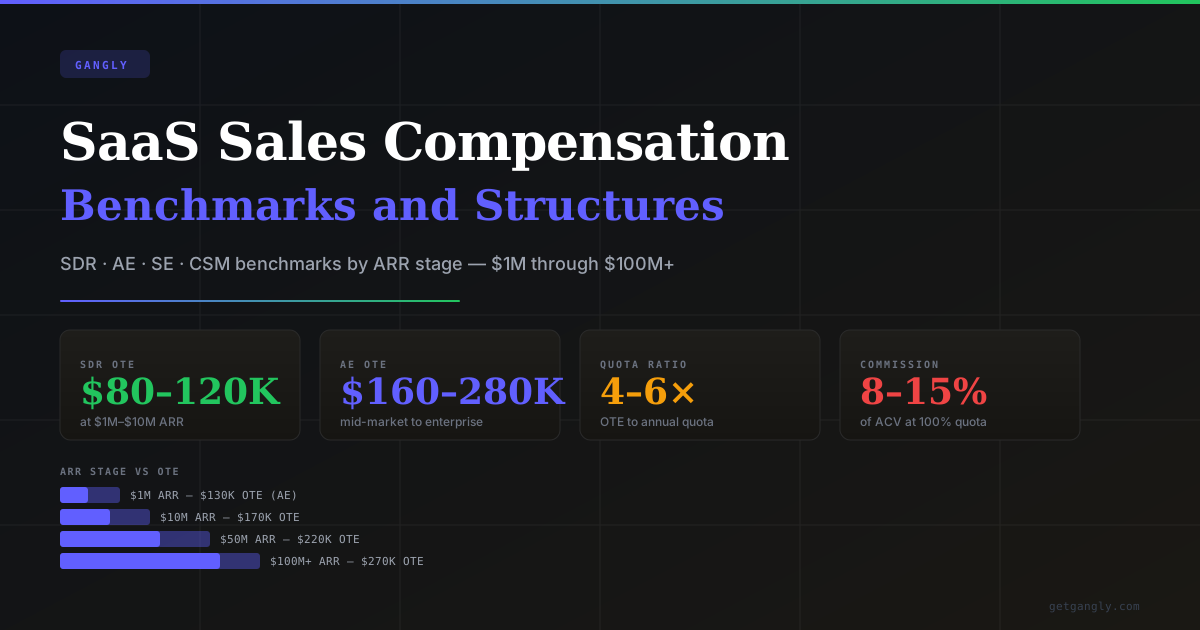
TL;DR
- SaaS sales compensation is ARR-stage dependent. An AE at a $2M ARR seed-stage startup earns $130–160K OTE; the same role at a $100M ARR company earns $260–360K OTE on a larger quota.
- The 2026 standard quota-to-OTE ratio is 4–5× for most stages and 5.5–6× for enterprise roles with large-ACV deals. Anything above 6× is structurally broken at median attainment levels.
- Commission rates run 8–12% of ACV for AEs, 8–15% of ACV for early-stage; the median across all SaaS AE roles at 100% quota is 11.5% (Everstage, 2026).
- SDRs earn $70–120K OTE on a 65/35 pay mix; CSMs earn $80–150K on a 75/25 to 80/20 mix. The ARR-Aligned Comp Framework maps six decisions — OTE, quota multiple, pay mix, commission model, accelerators, ramp — to your stage.
- Five mistakes kill SaaS comp plans: quota set before the market is proved, commission model mismatched to motion, accelerators capped below 150%, no written ramp, and mid-year plan changes.
Snippet answer
SaaS sales compensation is the total pay package a SaaS sales professional earns, combining base salary, variable commission, equity, and short-term bonuses. In 2026, OTE ranges from $70K for entry-level SDRs at seed-stage companies to $360K+ for enterprise AEs at $100M+ ARR organizations. Commission rates run 8–12% of ACV at quota, with quota set at 4–6× OTE depending on ARR stage and deal segment. Pay mix is typically 50/50 for closing AEs and 65/35 for SDRs.
Get the quarterly benchmark drop
SaaS comp updates, quota math, and red-flag signals — delivered quarterly. No spam, ever.
Subscribe freeWhat SaaS sales compensation is — and what the 2026 numbers mean
SaaS sales compensation is the pay structure a software-as-a-service company uses to recruit, retain, and motivate its sales team. It is not a single number — it is a system of four components: base salary, variable commission, equity, and short-term bonuses. The system looks different at a $1M ARR seed company than it does at a $100M ARR public company, and it looks different for an SDR than for an enterprise AE.
The defining characteristic of SaaS compensation versus traditional software sales is the emphasis on recurring revenue metrics. A conventional software company may pay commission on total contract value at close. A SaaS company with a subscription model must align compensation to ARR — annual recurring revenue — because that is the metric investors and boards use to value the business. Commission paid on deals that churn after 90 days destroys unit economics. The modern SaaS comp plan is therefore built around new ARR added, net revenue retention, and the rep behaviors that drive those outcomes.
Three SaaS-specific mechanics separate this from general sales compensation. First, the quota-to-OTE ratio is the central lever. SaaS companies set quota at a multiple of OTE — typically 4× to 6× — which means a $200K OTE AE carries a $800K to $1.2M annual ARR quota. This ratio determines whether the plan pays out or becomes a treadmill. Second, commission is almost always paid on first-year ACV (Annual Contract Value), not total contract value, to avoid over-paying on multi-year commitments that may not renew. Third, accelerators are structured to pay disproportionately above 100% attainment, incentivizing over-performance in a model where each incremental ARR dollar carries high gross margin.
For a fuller view of role-specific structures, the AE compensation and SDR compensation posts cover each role in depth. This article focuses on SaaS-specific structures, ARR-stage benchmarks, and the five-model commission framework — what generic role pages miss.
SaaS AE total compensation stack (illustrative — $200K OTE, Series B company)
Base + variable = OTE. Equity and bonuses are supplemental. Sources: ClosedWon Talent (2026), Bridge Group 2025.
Benchmarks by role — SDR, AE, SE, and CSM in one table
The table below covers all four SaaS go-to-market roles in one view: SDR/BDR, Account Executive (by segment), Sales Engineer, and Customer Success Manager. OTE, quota, pay mix, and commission benchmarks are drawn from ClosedWon Talent (2026), Bridge Group 2025 SaaS AE Compensation Report, Everstage 2026, RepVue (May 2026), and Prowi.io (2026).
| Role | Base | OTE | Quota | Pay mix | Commission | Notes |
|---|---|---|---|---|---|---|
| SDR / BDR (entry) | $45–60K | $70–90K | 8–12 SQLs/mo | 65/35 | $150–$400/SQL | Activity-based. Bonus on meetings, SQLs, or pipeline generated. Equity rare at this tier. |
| SDR / BDR (experienced) | $60–80K | $90–120K | 12–18 SQLs/mo | 65/35 | $250–$600/SQL | Higher per-SQL rate at growth-stage companies. Some plans pay on pipeline-created rather than meetings. |
| AE — SMB | $65–85K | $130–170K | $500K–$750K ARR | 50/50 | 8–12% ACV | High-velocity, transactional. 30–60 day cycles. Strong accelerators after 100% quota. |
| AE — Mid-Market | $90–120K | $180–240K | $750K–$1.2M ARR | 50/50 | 9–12% ACV | 60–90 day cycles. 50/50 pay mix is the 2026 standard. Median OTE $200K (RepVue, May 2026). |
| AE — Enterprise | $120–160K | $240–320K | $1.2M–$2.0M ARR | 55/45 | 8–10% ACV | 90–180 day cycles. Larger ACV per deal compensates for lower commission rate. MBO layer common. |
| Sales Engineer (SE) | $110–145K | $150–200K | Overlay / % of AE quota | 75/25 | 2–4% ACV overlay | Base-heavy by design. Variable tied to AE close rate within SE territory, not personal quota. |
| CSM — SMB | $60–80K | $80–110K | GRR / NRR target | 80/20 | 3–6% on expansion | Retention-focused. Bonus on CSAT, GRR above threshold, and net-new expansion bookings. |
| CSM — Mid-Market | $80–110K | $110–150K | NRR + expansion ARR | 75/25 | 4–8% on expansion | Expansion ARR is the growth lever. Plans with NRR targets above 115% unlock higher accelerators. |
Sources: ClosedWon Talent (2026), Bridge Group 2025, Everstage 2026, RepVue (May 2026), Prowi.io (2026).
Three patterns in the role table. First, every closing role (SMB, mid-market, enterprise AE) uses a 50/50 pay mix as the 2026 default. Enterprise roles shift slightly to 55/45 because the longer sales cycle creates more income uncertainty for reps and requires a higher base to sustain quality candidates through a 6–9 month ramp. Second, commission rate and deal size move inversely: enterprise AEs earn lower percentage commission (8–10%) on larger ACV deals, while SMB AEs earn higher percentages (10–12%) on smaller, higher-frequency deals. The resulting variable pay at target is similar across tiers because quota is calibrated accordingly. Third, SEs and CSMs are base-heavy by design because their variable pay depends on team outcomes (AE close rate, customer GRR) rather than personal quota.
For a complete breakdown of the SDR role — daily workflow, quota mechanics, and ramp — see the SDR compensation guide. For the full AE-to-enterprise career arc with OTE bands at every tier, see the AE career path.
SaaS comp benchmarks by ARR stage — $1M to $100M+
ARR stage is the most under-discussed variable in SaaS comp benchmarks. Most published guides show role-level OTE ranges without specifying that a $160K AE OTE at a seed company and a $160K AE OTE at a $50M ARR company represent entirely different risk profiles, quota expectations, and equity values. The table below corrects that by mapping OTE and quota benchmarks to ARR stage.
| ARR Stage | Label | AE OTE | AE Quota | SDR OTE | Notes |
|---|---|---|---|---|---|
| $0–1M ARR | Pre-PMF / Seed | $120–160K | $400–600K | $70–85K | First AE is often a Founding AE with equity (0.10–0.25%). Comp skews equity-heavy; cash is constrained. No formal ramp at many seed companies. |
| $1–5M ARR | Early-Growth / Series A | $130–180K | $500–800K | $75–95K | First SDR hire typically at $1–2M ARR. AE quota set at 3–4× OTE. Commission rate 10–15% of ACV. Ramp 4–5 months. |
| $5–15M ARR | Scaling / Series B | $160–220K | $700K–$1.1M | $85–105K | Pay mix settles at 50/50 for AEs. SDR team typically 1:2 ratio with AEs. SE overlay first introduced. Quota at 4–5× OTE. |
| $15–50M ARR | Mid-Scale / Series C | $200–270K | $1.0–1.5M | $90–115K | Enterprise tier opens. Segmentation into SMB / MM / Enterprise. CSM variable pay formalized. Quota at 4.5–5.5× OTE. |
| $50–100M ARR | Late-Scale / Pre-IPO | $230–310K | $1.3–2.0M | $95–120K | Formal comp bands with annual reviews. RSU vesting becomes meaningful. Median attainment drops as quota scales ahead of market. Quota at 5–6× OTE. |
| $100M+ ARR | Public / Category Leader | $260–360K | $1.5–3.0M+ | $100–130K | Public company RSUs dominate total comp at senior tiers. Commission rate narrows (7–10% ACV). MBOs and President's Club add significant upside. |
Sources: ClosedWon Talent (2026), Bridge Group 2025, Saastr framework (Lemkin), Palettehq SaaS comp benchmarks.
The jump from $5–15M ARR to $15–50M ARR is where SaaS comp plans most commonly break. At Series B, companies introduce enterprise segmentation for the first time — creating new quota tiers and commission rates — without updating the SDR comp structure to reflect the longer pipeline cycles that enterprise selling requires. SDRs who were booking 15 meetings a month for SMB deals suddenly carry the same SQL quota against 90-day enterprise cycles. That is the origin of most mid-scale SDR attrition spikes.
For founders deciding between their first AE and SDR hire at $0–2M ARR, the first sales hire framework covers the decision matrix, comp math, and 30-60-90 ramp plan for each path. For the full picture on VP-level comp by stage, see the Head of Sales vs VP Sales vs CRO comparison.
AE OTE progression by ARR stage (midpoint of range)
Midpoints of ranges in ARR-stage table above. OTE grows approximately 2.2× from Seed to $100M+ ARR.
SaaS commission structures — the five models with math
SaaS companies use five distinct commission structures. The choice between them is not a matter of preference — it is a function of ARR stage, revenue motion (PLG vs sales-led vs hybrid), average ACV, and the granularity of finance data available. Using the wrong model for the stage is one of the five SaaS comp mistakes covered in the final section.
Flat-rate ACV commission
8–12% of ACVBest for: Seed to Series A; $1M–$5M ARRRep earns a fixed percentage of every deal closed, regardless of deal size or multi-year length. Simple to administer and understand. Commission paid on first-year ACV only; renewals do not carry commission.
Tradeoff: No upside differentiation. High performers and average performers earn the same rate per dollar. Add accelerators or switch to tiered model at Series B.
Tiered commission
8% → 12% → 16%+Best for: Series B and beyond; $5M–$50M ARRRate steps up as the rep crosses quota thresholds. Common structure: 8% on deals 0–50% of quota, 10% at 50–100%, 12% at 100–125%, 16% above 125%. The tier reset is typically quarterly.
Tradeoff: More motivating for top performers but more complex to administer. Rep behavior can shift late in quarter to "sandbagging" deals into the next tier. Lock in the reset cadence in writing.
ARR-based (new ARR only)
10–15% new ARRBest for: Pure-play SaaS; $5M–$100M ARRCommission paid only on net-new ARR added, not gross bookings. Eliminates gaming via multi-year deals. Aligns rep incentive with what SaaS boards actually care about: ARR expansion.
Tradeoff: Requires clean ARR accounting and a finance system that can split new vs expansion vs renewal in real time. Adds complexity for reps closing a mix of new logos and upsells.
Multi-year uplift
+2% per additional yearBest for: Mid-market and enterprise; $10M+ ARRCommission rate increases by 1–2 percentage points per contract year added. Example: 10% for one-year deal, 12% for two-year, 14% for three-year. Incentivizes longer commitments without forcing reps to discount.
Tradeoff: Finance needs to model cash-flow impact. Multi-year deals reduce annual renewal risk but lock revenue at current pricing. Commission paid on full contract value at close, creating payroll spikes.
Consumption / usage-based
Variable; tied to customer usageBest for: Usage-based SaaS (PLG, API products); $5M+ ARRRep earns on expansion MRR as customers ramp usage. Initial commission paid on committed contract value; expansion commission accrues monthly as usage grows. Plan must define floor (minimum commit) and ceiling (max commission per customer).
Tradeoff: Hardest model to operate. Requires usage data piped to comp system. Creates uncertainty for reps in variable-usage accounts. Best reserved for companies where PLG is the primary motion.
The multi-year uplift model deserves extra attention in 2026. With SaaS buying committees demanding shorter initial contracts ("prove it in 12 months before we sign 3 years"), the uplift model aligns rep incentives with company cash-flow goals without forcing reps to discount multi-year commitments. A 2% uplift per year on a 3-year deal — 10% → 12% → 14% — creates meaningful incentive without inflating ARR accounting.
For a full breakdown of how commission structures interact with sales cycle length and segment, see the AE compensation benchmarks breakdown which covers accelerator mechanics and equity bands by stage in detail.
The quota-to-OTE ratio — the number that decides everything
The quota-to-OTE ratio is the single most diagnostic number in SaaS sales compensation. Divide annual quota by OTE. A 4× ratio means a $200K OTE AE carries an $800K quota. A 6× ratio on the same OTE means a $1.2M quota. The difference is whether the median rep actually earns the headline OTE — or earns 60% of it.
The 2026 SaaS AE quota-to-OTE ratio averages 4.5–5.0× across all segments, with enterprise roles running 5.5–6× due to larger ACV per deal. Median quota attainment across SaaS AEs was 51–52% in 2025 (Bridge Group 2025). A rep on a 6× plan with 52% attainment earns 52% of their variable pay — meaning a $200K OTE plan pays out approximately $152K in realized cash. The headline OTE is not the number most SaaS reps bank.
Sources: Bridge Group 2025 SaaS AE Compensation Report; Everstage 2026.
How to evaluate the ratio on any offer: divide the stated annual quota by the OTE. Below 4× is healthy but rare except at seed stage. 4–5× is the 2026 sweet spot — challenging but achievable. 5.5–6× is structurally tight; attainment data at that ratio typically shows fewer than 50% of reps hitting 100% of plan. Above 6× is broken for most motions — the only scenario where it works is a very large-ACV enterprise seat (average deal $200K+) where one or two closed deals move the rep from zero to plan.
| Ratio | Example ($200K OTE) | Signal | Typical attainment |
|---|---|---|---|
| 3–4× | $600K–$800K | Founder-led or early PMF — quota not yet pressure-tested | 65–75% of reps hit plan |
| 4–5× | $800K–$1.0M | Healthy, competitive; Series A–B standard | 55–65% of reps hit plan |
| 5–6× | $1.0M–$1.2M | Tight; viable with uncapped accelerators | 45–55% of reps hit plan |
| 6×+ | $1.2M+ | Structurally broken for most motions | Below 45% at median |
Sources: Bridge Group 2025, Everstage 2026, Saastr framework.
One more diagnostic: ask the hiring manager for last year's team attainment median before signing. A team where the median rep hit 65% of plan is meaningfully different from a team at 40% — and the difference is invisible from the offer letter. If the manager refuses to share, that is the answer. Median attainment below 50% means the comp plan is cosmetic.
Accelerators, pay mix, and clawback mechanics
Accelerators are the multipliers that govern how fast variable pay grows above quota. They are the most overlooked line in an offer letter and the largest driver of top-performer income. A rep who consistently closes 130–150% of quota earns more from the accelerator structure than from the base OTE.
The standard SaaS accelerator table in 2026 looks like this:
| Attainment threshold | Commission multiplier | Example ($10K monthly variable target) |
|---|---|---|
| 0–75% quota | 0.8× | $10K variable earns $8K |
| 75–100% quota | 1.0× | $10K variable earns $10K |
| 100–125% quota | 1.25× | $10K variable earns $12.5K |
| 125–150% quota | 1.5× | $10K variable earns $15K |
| 150%+ quota | 2.0× | $10K variable earns $20K |
Three mechanics to verify before signing any SaaS comp plan. First, the decelerator below 75% quota: most plans pay a reduced rate (0.8× or lower) for sub-75% attainment. This is standard and fair. What is not fair is a hard zero below 50% quota — that punishes reps during ramp periods and in quarters where pipeline dried up due to market conditions outside the rep's control.
Second, the accelerator cap: any ceiling below 150% is a signal the company does not want to pay for overperformance. The rep who closes 180% of quota in a given quarter is almost certainly the company's best performer. Capping their payout at 120% accelerator is a retention risk. Uncapped plans or ceilings at 175%+ are rep-friendly defaults.
Third, the clawback window: a 90-day clawback for deals that refund or churn within 90 days of close is standard and reasonable. Clawback windows beyond 180 days transfer what is effectively a customer-success failure onto the rep — the deal was sold correctly but retention failed. Read this clause carefully. A 12-month clawback on any customer churn effectively turns the AE into an unpaid customer success manager.
Pay mix by role recap: closing AEs run 50/50 (Series A–C standard) to 55/45 (enterprise AEs at large-stage companies). SDRs run 65/35 — base-heavy because their output (meetings, SQLs) is within their control but close rate is not. SEs run 75/25 because their variable is overlay-based on an AE's close rate, not personal quota. CSMs run 80/20 for renewal-focused roles and 75/25 when expansion ARR is a primary metric.
For a comprehensive look at how the SDR pay mix interacts with SQL quotas and ramp structures, see the SDR compensation benchmarks post. For SE role and compensation specifics, see the Sales Engineer vs Account Executive comparison.
Designing a SaaS comp plan — the ARR-Aligned Framework
The ARR-Aligned Comp Framework is Gangly's proprietary six-step process for building a SaaS sales compensation plan that scales from $1M to $100M ARR without requiring a full redesign at each funding round. Most comp plans fail at scale because they were built for one ARR stage and never updated — the commission model stays flat-rate when the company should have moved to tiered, or the quota multiple stays at 4× when the market is mature enough to support 5×.
- 01
Set OTE from ARR stage and segment
Pull from the ARR-stage table. Use the midpoint of the range for a standard hire. Adjust 10–15% upward for candidates from higher-ARR companies or with enterprise track records. Do not invent a number from last year's plan — benchmark to current data.
- 02
Pick a quota multiple (4× to 5× for most stages)
Multiply OTE by 4 for early-stage roles where market is still being proved. Use 5× for growth-stage AEs where the motion is repeatable. Use 5.5–6× only for enterprise roles with large-ACV deals — higher multiples fail on high-volume SMB motions.
- 03
Set pay mix by role and motion
Closing AEs: 50/50. Enterprise AEs: 55/45 (slightly base-heavy due to long cycles). SDRs: 65/35. SEs: 75/25. CSMs: 80/20 for renewal-focused, 75/25 for expansion-heavy. Match the mix to the risk profile of the role.
- 04
Choose a commission model by stage
Pre-Series B: flat-rate ACV commission at 10–12%. Series B and beyond: tiered commission with a meaningful accelerator above 100% quota. $50M+ ARR: ARR-only commission to align with board metrics. Consumption-based: only if usage data is available in real time.
- 05
Build the accelerator table
Standard table: 0.8× below 75% quota, 1.0× at target, 1.25× at 125%, 1.5× at 150%, 2.0× above 150%. Do not cap below 150% — a hard cap at 120% signals the company does not want to pay for overperformance, and top reps will leave.
- 06
Define ramp and clawback
Write the ramp in the offer letter: zero quota in month one, 30–50% in months two and three, 75–80% in months four and five, 100% by month six. Clawback window: 90 days for customer churn or refund events only. Anything beyond 90 days transfers customer-success risk onto the rep.
A worked example of the framework at $10M ARR (Series B, mid-market motion, average ACV $40K): OTE for an AE = $195K (midpoint of $5–15M ARR band). Quota = $195K × 5 = $975K ARR. Pay mix = 50/50. Commission model = tiered (8% at 0–100% quota, 12% at 100–125%, 16% above 125%). Accelerator table = standard as shown above. Ramp = 4 months (0% → 30% → 60% → 100%). Commission per deal at $40K ACV and 8% rate = $3,200. Rep needs 24 deals to hit quota — roughly 2 per month.
The math test every founder should run before finalizing quota: divide the annual quota by average ACV to get deal count required. Divide deal count by the historical win rate to get the number of qualified opportunities needed. Divide that by the average SDR SQL-to-opportunity conversion rate to get the SQLs needed. If the SDR team cannot generate that pipeline volume, the AE quota fails — not because the AE is wrong, but because the top-of-funnel math is broken.
Five SaaS comp plan mistakes that cost reps and companies
Five patterns account for the majority of SaaS comp plan failures. Each one looks like a compensation problem on the surface but is actually a structural decision made before the first offer letter was signed.
- 01
Quota set before the market is proved
Founders at $0–2M ARR set quota by reverse-engineering revenue targets rather than by win-rate math. If the average deal size is $30K and the win rate is 25%, a $1.2M quota requires 160 qualified opportunities — does the SDR pipeline actually generate that? Set quota from bottom-up math, not top-down hope.
- 02
Commission model mismatched to motion
A flat 10% ACV commission plan on a PLG product where customers self-serve to $5K then call sales at $50K creates the wrong incentive — reps ignore the long tail and hunt the rare upsell. Match the model to the actual revenue motion: where is the rep adding value, and what outcome should they be paid for?
- 03
Accelerators capped at 120% or lower
Capping accelerators at 120% attainment removes the upside that keeps top performers loyal. The rep who closes 180% of quota — the person most companies want to retain — earns the same above-target commission rate as the rep at 121%. Uncap above 150%, or at minimum set the ceiling at 175%.
- 04
No written ramp period
A ramp agreement that lives only in the hiring manager's head does not exist. Reps who join without a written ramp miss year-one quota at a rate of roughly 60% because pipeline takes months to mature even when activity starts on day one. Write the ramp into the offer letter with monthly quota percentages.
- 05
Comp plan changes mid-year
Changing quota, commission rate, or territory carve mid-year without a documented transition period is the fastest way to destroy trust and lose top performers. If business conditions change, give reps a full quarter of advance notice and hold-harmless protection for deals in their current pipeline.
The rarest mistake on this list — and the most damaging — is number five: mid-year plan changes. Reps manage their personal finances against the offer-letter numbers. An AE on a $200K OTE plan who has $300K in pipeline at mid-year has mentally reserved commission income for Q3. A mid-year quota increase or commission-rate reduction does not just change future behavior — it immediately destroys trust and creates a legal question about already-earned commission on pipeline committed under the original plan. Before any plan change, consult legal counsel and give reps a transition window.
For reps navigating a comp plan that may be broken, the sales careers overview includes a comp evaluation framework for every role from SDR to SE. The AE compensation guide covers the 6-question offer evaluation checklist in full.
How Gangly helps reps hit SaaS comp targets
SaaS compensation plans pay for output, not hours. Every dollar of variable a rep earns comes from closed-won ARR — not from researching accounts, updating CRM fields, building call prep briefs, or writing follow-up emails. Yet the average SaaS AE spends 28–32 hours per week on non-selling activity that does not directly advance pipeline (Bridge Group 2025). That is the attainment problem most comp plans are not designed to solve.
Gangly is the sales workflow system that removes the non-selling tax between buying signals and closed-won revenue. Signal detection runs automatically across LinkedIn activity, funding events, job changes, and intent data. When a signal lands on an account in your territory, Gangly builds the outreach, prepares the call brief, coaches in real time during the meeting, captures notes, and logs the CRM update — all in one connected sequence. Reps stop being the integration layer between five disconnected tools.
The comp connection is direct. A mid-market AE on a 5× plan needs to close $1M ARR per year — roughly $83K per month. Every hour that rep spends on admin instead of qualified conversations costs pipeline. Gangly does not change the comp plan, but it changes the number of decision-quality conversations the rep can run in a week. That is the ceiling the plan is designed to test.
See the Gangly pricing page for plan details, or book a demo to see how the workflow maps to your current comp structure and ARR stage.
Continue reading
Workflows
SDR Compensation: 2026 Benchmarks and Structures
2026 SDR compensation benchmarks by company stage (Seed–Series C+), industry, and experience tier — base, OTE, quota, ramp, commission structures.
Workflows
AE Compensation: 2026 Benchmarks by Industry and Experience
2026 AE compensation benchmarks across 10 industries, 5 experience tiers, and 10 US regions — base, OTE, quota, and ramp math in one reference.
Workflows
Sales Careers Explained: SDR, BDR, AE, CSM, Sales Engineer
The complete map of B2B SaaS sales roles — SDR, BDR, AE, CSM, SE — with 2025 comp bands, promotion timelines, tools, and quota-attainment data.