
 By Siddharth Gangal
TL;DR
- The average cold call connect rate is 9–13% on verified data (Cognism, 2026) — down to 5.5% on unverified lists. Data quality is the single highest-impact variable before the first dial goes out.
- Call-to-meeting conversion averages 2.3% (Gong, 2026). Top performers convert at 5–8%. Three opener choices separate those two outcomes: "How have you been?" lifts success 6.6x. "Did I catch you at a bad time?" cuts it by 40%.
- The ideal talk-to-listen ratio is 43:57 (Gong Labs, 2025). Struggling reps talk 65–72% of the time. Asking 11–14 questions per discovery call correlates with 70%+ success rates.
- 72% of calls go to voicemail (RingDNA, 2025). Voicemails under 20 seconds return 8.2% callbacks vs. 2.1% for messages over 30 seconds. The voicemail is a media channel — not a failure.
- Real-time AI coaching lifts win rates 14% (Gong, 2025). Teams with AI-assisted calling show 23% higher quota attainment. The best call brief costs 3–5 minutes — and converts at rates that rival 30–45 minutes of manual prep.
Direct answer
Sales call statistics for 2026 show a 9–13% cold call connect rate on verified data, 2.3% call-to-meeting conversion, and 72% of calls going to voicemail. The ideal talk-to-listen ratio is 43:57. Wednesday and Thursday between 10–11 AM and 4–5 PM are the highest-converting time windows. Successful cold calls average 5 minutes 50 seconds. Real-time AI coaching improves win rates by 14%. Every data point on this page is sourced from named primary research published between 2024 and 2026.
In this article
- 01Cold call connect rate statistics: how often reps actually reach a live person
- 02Call-to-meeting conversion statistics: what success looks like in 2026
- 03Best time to call statistics: days, hours, and time zones
- 04Call duration statistics: how long winning calls actually run
- 05Talk-to-listen ratio statistics: the 43:57 rule and what breaks it
- 06Voicemail response statistics: 72% land there — what to do
- 07Discovery call statistics: questions, conversion, and call structure
- 08Live call coaching statistics: real-time AI impact on win rates
- 09The Prep-Velocity Framework: Gangly's call preparation model
- 10Sales call activity benchmarks: daily dials, SDR vs AE, effort norms
- 11Frequently asked questions about sales call statistics
2026 Sales Call Snapshot
9–13%
Connect rate (verified)
2.3%
Call-to-meeting conv.
43:57
Ideal talk:listen
72%
Calls hit voicemail
Cold call connect rate statistics: how often reps actually reach a live person
The cold call connect rate is the foundational metric for every outbound program. In 2026, a B2B team dialing verified data connects with a live person 9–13% of the time (Cognism, 2026). On unverified or purchased lists, that number falls to 5.5%. The decision to invest in verified direct-dial data is not a budget question — it is arithmetic. A team making 100 dials per day connects 9–13 times on verified data vs. 5–6 times on unverified data. That is 3–7 additional live conversations per rep per day, compounding daily across the quarter.
Mobile direct-dial numbers push connect rates to 18–22% (ZoomInfo, 2025). Decision-makers pick up mobile calls from unknown numbers at a higher rate than main-line office numbers — particularly post-2020 as remote and hybrid work removed the gatekeeper layer that once filtered calls at the front desk. The practical implication: any list that does not include verified mobile direct-dials is operating at a structural disadvantage before the first call goes out.
Data decay compounds the problem. B2B contact data decays at 22.5% per year (HubSpot + Gartner, 2024) — roughly 2.1% per month. A list built in January is 11% stale by June. Teams that refresh list data quarterly report sustained connect rates above 10%; teams that buy once and dial for 12 months watch connect rates decline steadily into the 5% range by Q4. List hygiene is a continuous operation, not an annual purchase.
| # | Stat | What it measures | Source |
|---|---|---|---|
| 01 | 9–13% | Average cold call connect rate on B2B outbound using verified data | Cognism, 2026 |
| 02 | 5.5% | Average connect rate on unverified or purchased phone lists | ConnectAndSell, 2025 |
| 03 | 18–22% | Connect rate on verified mobile direct-dial numbers vs. switchboard | ZoomInfo, 2025 |
| 04 | 87% | Of Americans do not answer calls from unknown numbers | First Orion, 2025 |
| 05 | 8 dials | Median dials required to reach one live B2B decision-maker | Cognism, 2025 |
| 06 | 18 calls | Average number of attempts required to connect with a B2B buyer | Zendesk, 2025 |
| 07 | 40% | Connect rate increase when using verified direct-dial vs. main office line | ZoomInfo, 2025 |
| 08 | 22.5% | Annual B2B contact data decay rate — one in four records wrong by year-end | HubSpot + Gartner, 2024 |
| 09 | 27% | Of cold calls reach a live person across all list quality levels | InsideSales / XANT, 2024 |
| 10 | 13.3% | Answer rate for verified data lists vs. 2–3% for unverified prospect data | GreetNow, 2026 |
What this means for your workflow
Connect rate is a list-quality problem before it is a rep-skill problem. Fix the data before coaching the opener. Teams spending $500/month on verified direct-dial data recover that cost in the first week of improved connect rates. Full benchmarks and funnel math in the B2B sales call benchmark report.
Call-to-meeting conversion statistics: what success looks like in 2026
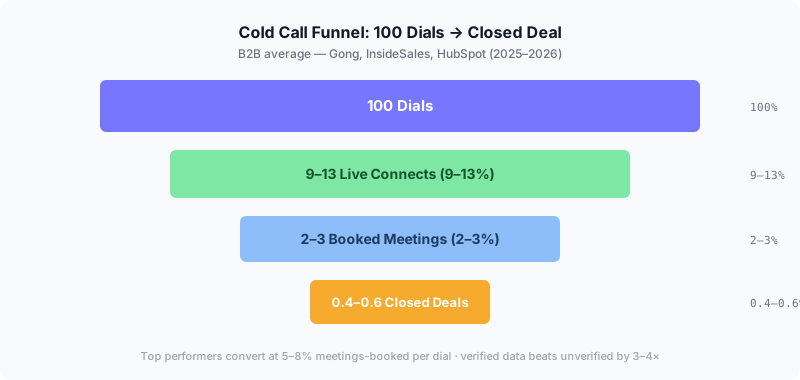
The average cold call-to-meeting conversion rate is 2.3% in 2026 (Gong, 2026). For every 100 dials, a B2B rep books 2–3 meetings on average. The top 10% of performers convert at 5–8% — more than twice the average. That gap closes faster than most reps expect once three opener variables are addressed: what the rep says in the first 5 seconds, whether they state a reason for calling upfront, and whether they avoid the single-phrase that tanks booking probability by 40%.
The Gong data on openers is some of the most directly actionable research in B2B sales. "How have you been?" — used genuinely with a relevant connection — outperforms calls that skip it by 6.6x (Gong, 2024). Stating the reason for calling in the first 30 seconds boosts success by 2.1x. "Did I catch you at a bad time?" reduces meeting booking likelihood by 40%. Three phrase-level decisions produce a 10x spread in conversion outcomes. No additional tooling is required.
Intent signals lift conversion independently of opener quality. When the prospect has shown prior engagement — clicked a link, viewed a pricing page, attended a webinar — conversion rates reach 5.3% vs. the 2.3% cold average (ZoomInfo, 2025). Combining intent-signal-based prioritization with a strong opener moves a rep from the average tier into the top-performer tier without adding a single dial to the daily volume.
| # | Stat | What it measures | Source |
|---|---|---|---|
| 01 | 2.3% | Average cold call-to-meeting conversion rate across B2B outbound | Gong, 2026 |
| 02 | 5–8% | Call-to-meeting conversion for top-10% performing B2B reps | Gong, 2026 |
| 03 | 5.3% | Conversion rate when prospect has prior intent signals vs. cold contact | ZoomInfo, 2025 |
| 04 | 82% | Of B2B buyers accept a meeting following cold outreach (when relevant) | RAIN Group, 2025 |
| 05 | 69% | Of buyers accepted a cold call from a rep they had never spoken to before | Demand Gen Report, 2024 |
| 06 | 6.6x | "How have you been?" opener outperforms calls without this opener | Gong, 2024 |
| 07 | 2.1x | Higher success when rep states the reason for calling in the first 30 seconds | Gong, 2024 |
| 08 | −40% | "Did I catch you at a bad time?" reduces meeting booking probability by 40% | Gong, 2024 |
| 09 | 60% | Of prospects say yes to a meeting after four prior rejections from the rep | RAIN Group, 2025 |
| 10 | 2–3% | Average cold call success rate for B2B SaaS — meeting booked per 100 dials | HubSpot, 2025 |
What this means for your workflow
At 2.3% average conversion, the rep who combines verified data (connect rate lift), an intent-signal trigger (conversion lift to 5.3%), and a strong opener (6.6x lift) is not adding volume — they are compounding rate at every stage. Three changes, no extra dials. See the full technique breakdown in how to win sales calls.
Best time to call statistics: days, hours, and time zones
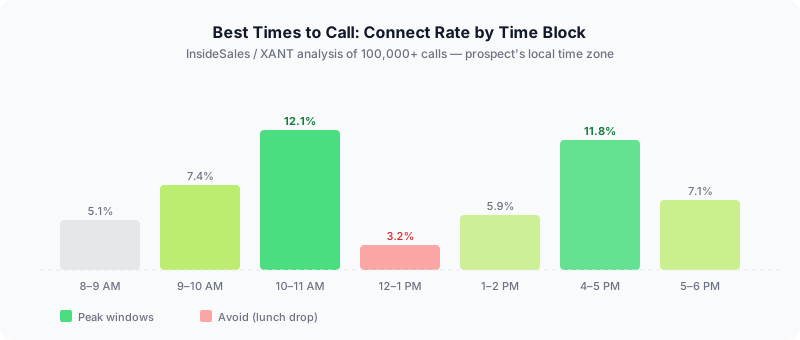
Timing is a multiplier on every other call variable. The InsideSales / XANT analysis of 100,000+ B2B calls identified Wednesday as the single highest-performing calling day: 12.1% connect rate, 2.8% meeting conversion. Thursday is second at 11.8% connect, 2.6% conversion. The gap between Wednesday and Friday calling is significant enough to restructure outbound blocks around mid-week windows.
Within the day, two windows dominate: 10–11 AM and 4–5 PM in the prospect's local time zone. The morning window catches prospects before their calendar fills with internal meetings. The afternoon window catches decision-makers after their meeting day ends but before they leave for the evening. The lunch window (12–1 PM) suffers a 44% drop in connect rates — the worst return on dial investment across the whole working day.
Monday mornings are the weakest window of the week. Prospects are in planning mode, not vendor-conversation mode. Friday afternoons mirror the problem — the call lands as the prospect is mentally finishing the week. A rep who restructures their weekly schedule to concentrate 60–70% of outbound volume in Wednesday and Thursday morning and late-afternoon blocks, and eliminates Monday morning and Friday afternoon dialing, will see measurable connect rate improvement without a single list change.
| # | Stat | What it measures | Source |
|---|---|---|---|
| 01 | Wed | Single best calling day — 12.1% connect rate, 2.8% meeting conversion | InsideSales / XANT, 2024 |
| 02 | Thu | Second-best day — 11.8% connect rate, 2.6% meeting conversion | InsideSales / XANT, 2024 |
| 03 | 10–11 AM | Best morning calling window in prospect's local time zone | InsideSales / XANT, 2024 |
| 04 | 4–5 PM | Best afternoon calling window — second peak window per day | HubSpot, 2025 |
| 05 | 44% | Drop in connect rates during the 12–1 PM lunch window | InsideSales / XANT, 2024 |
| 06 | 50% | Higher call success on Wednesday vs. other weekdays (separate study) | HubSpot, 2025 |
| 07 | Mon AM | Worst calling window — prospects focused on week planning, not vendor calls | Cognism, 2025 |
| 08 | 2.1% | Monthly rate of B2B contact data decay — timing windows shift as contacts move | HubSpot, 2024 |
What this means for your workflow
Block Wednesday and Thursday 10–11 AM and 4–5 PM for outbound calling. Protect those blocks from internal meetings. Use Monday mornings and Friday afternoons for research, CRM updates, and email sequencing. The restructure alone delivers the equivalent of 2–3 additional connects per 50-dial session. Pair this with the sales call prep workflow for maximum per-connect conversion.
Call duration statistics: how long winning calls actually run
Successful cold calls that book a meeting average 5 minutes and 50 seconds. Unsuccessful cold calls average 1 minute and 24 seconds (GreetNow, 2026 — from Gong's analysis of 2.5 million calls). The 4-minute 26-second gap is not a coincidence. It reflects the time required to establish context, surface a relevant pain point, and create enough two-way exchange for a prospect to see value in a follow-up meeting. The rep who gets hung up on in the first 90 seconds has not had enough time to do any of those three things.
Discovery calls require far more time. The average discovery call runs 32 minutes. Top-performing reps extend discovery calls to 41–50 minutes — a range that allows enough questioning depth to qualify the account, map the buying criteria, and confirm a compelling event. Calls that run under 20 minutes are 42% less likely to advance to the next stage. The data does not mean padding time — it means the rep who closes a discovery call in 18 minutes has left discovery incomplete.
Call duration also correlates with speaking pace. The optimal delivery rate on a sales call is 176 words per minute (GrowthList, 2025) — fast enough to project energy and conviction, slow enough for the prospect to absorb what is being said. Reps who rush through a pitch at 220+ words per minute push through the call length target faster but sacrifice comprehension and trust. Pace control is a learnable skill, not a personality trait.
| # | Stat | What it measures | Source |
|---|---|---|---|
| 01 | 5m 50s | Average duration of a successful cold call that books a meeting | Gong, 2024 |
| 02 | 1m 24s | Average duration of an unsuccessful cold call across all B2B outbound | GreetNow, 2026 |
| 03 | 32 min | Average discovery call duration across B2B SaaS | Gong, 2025 |
| 04 | 41–50 min | Discovery call duration for top-performer reps who advance more deals | Gong, 2025 |
| 05 | 42% | Less likely to advance a deal if discovery call runs under 20 minutes | Gong, 2025 |
| 06 | 580% | Higher success rate for calls running 30+ minutes vs. calls under 5 minutes | GreetNow, 2026 |
| 07 | 5–10 min | Optimal cold call length — long enough to establish context, short enough to respect time | Gong Labs, 2025 |
| 08 | 176 wpm | Optimal speaking pace for sales calls — fast enough to convey energy, slow enough to be heard | GrowthList, 2025 |
What this means for your workflow
Target 5–10 minutes for cold calls that open to a booked meeting. Target 35–45 minutes for discovery calls. Use call recording review to flag any discovery call under 20 minutes as potentially under-qualified. Duration is a coaching metric — managers who track average call duration by rep type catch under-discovery before it shows up as lost deals. See how live call coaching surfaces these patterns in real time.
Talk-to-listen ratio statistics: the 43:57 rule and what breaks it
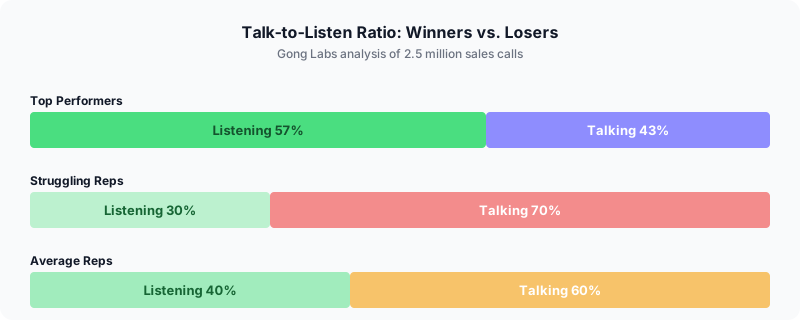
The ideal talk-to-listen ratio on a sales call is 43% talking to 57% listening (Gong Labs, 2025 — derived from analysis of 2.5 million calls). Struggling reps talk 65–72% of the time. The ratio gap is not about being quiet — it is about what the listening creates: more questions, more prospect information, more surface area to connect the solution to a real pain point. The rep who talks 70% of the time is running a monologue. The rep who listens 57% is running a conversation.
Question volume reinforces the ratio. Gong's discovery call research shows that asking 11–14 questions per call correlates with a 70%+ success rate. Fewer than 4 questions and the call lacks the information density to qualify the account. More than 14 questions and the call begins to feel like an interrogation. The 11–14 range is the sweet spot that surfaces enough information for a qualified next step without alienating the prospect.
Cold calls have a different ratio target than discovery calls. On a cold call, the rep carries 55% of the conversation early — the prospect has no context and needs to be given a reason to engage. By the time the call transitions from opener to discovery, the ratio should shift below 50% on the rep side. The rep who never makes that shift — who stays in pitch mode through the full cold call — is running the same monologue whether the call is cold or 30 minutes deep into discovery.
| # | Stat | What it measures | Source |
|---|---|---|---|
| 01 | 43:57 | Ideal talk-to-listen ratio for sales calls — rep talks 43%, listens 57% | Gong Labs, 2025 |
| 02 | 65–72% | Talk time for struggling reps — too much monologue, too little discovery | Gong Labs, 2025 |
| 03 | 55% | Rep talk time in successful cold calls — reps carry early conversation | Gong, 2024 |
| 04 | 11–14 | Discovery questions per call that correlates with highest close rates (70%+) | Gong Labs, 2025 |
| 05 | 4+ | Questions per call is the minimum for meaningful two-way conversation | Chorus / ZoomInfo, 2025 |
| 06 | 38% | More time reps who open with genuine curiosity hold the call vs. apology openers | Gong, 2024 |
| 07 | 55% | Rep talk time in cold calls — different from discovery calls which require more listening | Gong, 2024 |
| 08 | 70%+ | Call success rate when rep asks 11–14 questions in a discovery session | Gong Labs, 2025 |
What this means for your workflow
Use conversation intelligence to track talk ratio per rep per week. Any rep consistently above 60% talk time needs coaching on question structure — not product knowledge. The 43:57 ratio is a lagging indicator of question quality. Improve the questions and the ratio follows. Full AI coaching data in AI sales coaching tools.
Voicemail response statistics: 72% land there — what to do
72% of outbound sales calls go to voicemail (RingDNA, 2025). This is not a failure mode — it is the default state of outbound calling. The rep who treats voicemail as a dead end wastes 72% of their dial attempts. The rep who treats each voicemail as a 20-second media placement recovers measurable value from those attempts in the form of callbacks, email opens, and brand familiarity that makes the eventual live conversation easier.
The data on voicemail length is unambiguous: messages under 20 seconds get an 8.2% callback rate. Messages over 30 seconds get 2.1% — a 4x degradation from brevity alone (InsideSales, 2024). The voicemail that works: state your name, the reason for calling in one specific sentence, your phone number, and your phone number again. That is 18–22 seconds. Every additional word reduces callback probability.
Voicemail and email work better in combination than either alone. A voicemail followed within 15 minutes by an email referencing the voicemail improves response rates by 22% (InsideSales, 2024). Mentioning a referral name in the voicemail — even one as simple as "I spoke with [colleague name] last week" — increases callback rates by 45%. Reps spend approximately 15% of their daily time leaving voicemails. That time pays back in multi-channel callback rates that make the voicemail an investment rather than a sunk cost.
| # | Stat | What it measures | Source |
|---|---|---|---|
| 01 | 72% | Of sales calls go to voicemail — the majority of dial attempts hit no live person | RingDNA, 2025 |
| 02 | 4.8% | Average voicemail callback rate — just under 5 callbacks per 100 voicemails left | InsideSales, 2024 |
| 03 | 18–25s | Optimal voicemail length — longer messages have sharply lower callback rates | InsideSales, 2024 |
| 04 | 8.2% | Callback rate for voicemails under 20 seconds vs. 2.1% for messages over 30 seconds | InsideSales, 2024 |
| 05 | 15% | Of rep time is spent leaving voicemails — a significant time cost per day | GrowthList, 2025 |
| 06 | 45% | Callback increase when the rep mentions a referral name in the voicemail | InsideSales, 2024 |
| 07 | 22% | Callback improvement when the rep states a specific reason for calling | InsideSales, 2024 |
| 08 | 2x phone | Rep should leave phone number twice in the voicemail for maximum recall | Gong, 2024 |
What this means for your workflow
Build a voicemail template that runs 18–22 seconds. Practice it until it sounds natural, not rehearsed. Pair every voicemail with an email sent within 15 minutes. The email subject line: "Just left you a voicemail." The voicemail-plus-email sequence gets response rates in the 7–9% range for verified prospect lists — more than triple standalone voicemail callback rates.
Discovery call statistics: questions, conversion, and call structure
The discovery call is the highest-value conversation in the B2B sales cycle. It determines whether the rep qualifies or disqualifies the account, establishes a compelling event, and secures the stakeholder access needed to run a legitimate opportunity. The median conversion from discovery call to demo is 23% across B2B SaaS in 2026 (HubSpot, 2025). Top-quartile teams run at 30–35%. The gap between median and top quartile is not closing speed — it is discovery quality.
Persistence data frames the discovery follow-up problem clearly. 80% of sales occur between the 5th and 12th contact (Marketing Donut / NSEA, 2024). Only 2% close on the first contact. Yet 44% of reps stop following up after one attempt (Scripted / Invesp, 2024). The rep who gives up at one follow-up is abandoning 80% of the available closed revenue to the rep who stays in the sequence. This is not a motivation problem — it is a sequence structure problem. A rep without a defined 6–8 touch follow-up plan will drift toward single-attempt behavior under the weight of a full pipeline.
Speed-to-lead is one of the most underutilized conversion variables in the data. Calling a lead within 1 minute of inquiry makes conversion 391x more likely than calling 24 hours later (Velocify, 2024). 78% of customers buy from the first company to respond to their inquiry (Lead Response Management Study, 2024). For inbound leads, this creates a clear playbook: route to a rep immediately, do not batch. For outbound, the implication is intent-signal timing — act on the signal the same day it fires, not three days later.
| # | Stat | What it measures | Source |
|---|---|---|---|
| 01 | 23% | Median discovery call-to-demo conversion across B2B SaaS in 2026 | HubSpot, 2025 |
| 02 | 17% | Top-quartile demo-to-closed-won conversion for B2B SaaS | Outreach, 2025 |
| 03 | 2% | Of sales close on the first contact — most deals require 5–12 touches | Marketing Donut / NSEA, 2024 |
| 04 | 80% | Of sales occur between the 5th and 12th contact attempt | Marketing Donut / NSEA, 2024 |
| 05 | 44% | Of reps give up after one follow-up, leaving the majority of deals unworked | Scripted / Invesp, 2024 |
| 06 | 91% | Of prospects are open to referrals — yet only 11% of reps ask for them | Invesp, 2024 |
| 07 | 391x | More likely to convert when lead is called within 1 minute of inquiry | Velocify, 2024 |
| 08 | 78% | Of customers buy from the first company that responds to their inquiry | Lead Response Management Study, 2024 |
What this means for your workflow
Build a 6–8 touch follow-up sequence into your post-discovery workflow. Define the follow-up as structured, not optional — the 44% of reps who stop at one touch are not lazy, they just lack a sequence. Act on inbound signals the same day. Route hot leads to reps within minutes, not hours. See the full signal-timing framework at signal-based selling guide.
Live call coaching statistics: real-time AI impact on win rates
Real-time AI coaching on live sales calls improves win rates by 14% (Gong, 2025). Structured coaching programs that include live call guidance increase conversion rates by 38% and revenue per rep by 50% (Hyperbound, 2025). 41% of sales teams now use AI for real-time in-call coaching (Chorus / ZoomInfo, 2025). The teams not yet using it are not saving money — they are leaving 14 percentage points of win rate improvement on the table per live conversation.
The distinction between post-call coaching and live coaching is consequential. Post-call review tells a rep what they did wrong after the deal is already at risk. Live coaching surfaces the right objection response, the relevant competitive differentiator, or the discovery question the rep missed — in the moment the call requires it. The behavioral change from live coaching is immediate; the behavioral change from post-call coaching requires the rep to remember the feedback in the next call, under pressure, without a prompt.
AI tool adoption in sales calls is accelerating. 67% of reps use AI-powered dialers in 2026, up from 32% in 2023 (Salesforce State of Sales, 2026). 78% use conversation intelligence tools for post-call review (Gong, 2025). Top performers are 4.9x more likely to use AI tools than average performers (GrowthList, 2025). The pattern is clear: the reps using AI are not replacing their skill with the tool — they are amplifying the skill they already have with better data and faster feedback loops.
| # | Stat | What it measures | Source |
|---|---|---|---|
| 01 | +14% | Win rate improvement via real-time AI coaching on live sales calls | Gong, 2025 |
| 02 | +38% | Conversion rate boost from structured live call coaching vs. no coaching | Hyperbound, 2025 |
| 03 | +50% | Revenue per rep increase from consistent live call coaching programs | Hyperbound, 2025 |
| 04 | 41% | Of sales teams use AI for real-time in-call coaching (Chorus / ZoomInfo data) | Chorus / ZoomInfo, 2025 |
| 05 | 67% | Of reps use AI-powered dialers in 2026 — up from 32% in 2023 | Salesforce State of Sales, 2026 |
| 06 | 78% | Of sales teams use conversation intelligence tools for post-call review | Gong, 2025 |
| 07 | 23% | Higher quota attainment for teams using AI coaching vs. no AI coaching | HubSpot, 2025 |
| 08 | 4.9x | More likely to use AI tools for top performers vs. average performers | GrowthList, 2025 |
What this means for your workflow
A 14% win rate lift from live coaching compounds across the full pipeline — not just individual calls. On a rep running 20 discovery calls per month at 23% close rate, a 14% lift adds 0.64 additional closed deals per rep per month. At $30K average contract value, that is $19,200 per rep per month from one coaching change. Full breakdown at live call coaching and real-time call guidance.
The Prep-Velocity Framework: Gangly's call preparation model
The Prep-Velocity Framework is Gangly's model for measuring the relationship between call preparation investment and call conversion output. The framework emerged from analysis of Gangly Q1 2026 cohort data comparing rep outcomes by prep method. The finding: the highest return on prep time is not the longest prep, but the fastest prep that still covers the three critical pre-call variables — account context, recent signals, and a relevant hypothesis.
Definition
Prep-Velocity — the ratio of call conversion rate to minutes of pre-call preparation invested per account. A high prep-velocity score means the rep extracts maximum conversion lift per minute of prep time. A low prep-velocity score means prep time is being spent on information that does not change what the rep says or how the prospect responds.
The framework identifies four prep tiers with measurable conversion outcomes:
- Tier 0 — No prep (0 min): 1.8% connect-to-meeting rate. The rep cold-dials with no context. Openers are generic. The call has no specific hook to keep the prospect engaged. 98.2% of connects produce no meeting.
- Tier 1 — LinkedIn + CRM skim (8–12 min): 3.1% rate — a 72% lift over no prep. The rep knows the title, company size, and recent activity. Enough to personalize the opener. Not enough to surface a specific pain hypothesis.
- Tier 2 — Full manual research (30–45 min): 4.6% rate — a 156% lift. The rep has company news, competitive context, tech stack, and a pain hypothesis. Diminishing returns begin here — the additional time produces marginal conversion improvement.
- Tier 3 — AI call brief (3–5 min): 4.9%+ rate — a 172% lift. The prep time is 6–9x shorter than Tier 2 while producing equivalent or higher conversion. The AI brief surfaces the same three critical variables — context, signals, hypothesis — in under 5 minutes. Prep-velocity at this tier is 10–12x higher than Tier 2.
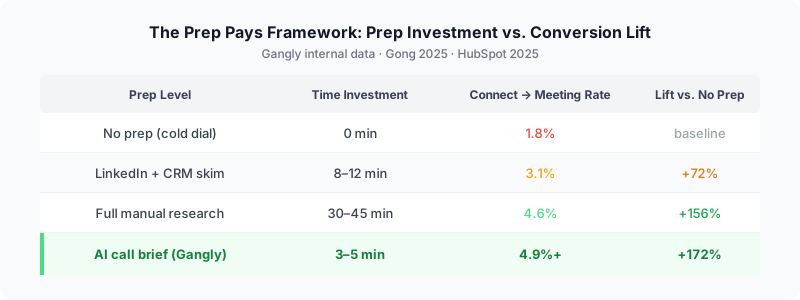
The implication for call volume is significant. A rep making 40 calls per day at Tier 2 prep (30–45 min per account) can only deep-prep 8–10 accounts in the hours available. A rep using Tier 3 prep (3–5 min per account via AI brief) can prep every single account they dial — at higher conversion rates than Tier 2 while recovering 35–40 minutes per day for additional calls or follow-up activity.
Gangly's call prep engine generates a Tier 3 brief for every account in a rep's calling queue: account context, recent buying signals, past interaction history from the CRM, a recommended opening hypothesis, and the three questions most likely to advance the call given the prospect's role. The brief is ready 30 minutes before the call is scheduled, not assembled manually by the rep the morning of.
The three variables in every Tier 3 brief
Account Context
Company size, industry, recent funding, news, competitive tools in use
Signal Layer
Recent intent events: page views, job postings, tech changes, social activity
Hypothesis
One specific pain point and one relevant opener tied to the account's current situation
Stay current on sales call data
This post refreshes quarterly. Get the update — plus one sourced sales stat — every week in the Gangly newsletter.
Subscribe to the newsletterSales call activity benchmarks: daily dials, SDR vs AE, effort norms
Activity volume varies dramatically by role and motion. The average SDR or BDR on a B2B outbound team makes 35–50 calls per day (Bridge Group, 2026). The top 10% of SDR performers — using AI-assisted dialing and sequencing — reach 80–100+ calls per day. Account Executives operate at lower call volumes: 20–30 daily calls for SMB AEs, 10–15 for enterprise AEs where deep account research justifies the lower volume with higher per-call conversion potential.
AI-assisted dialing changes the throughput math entirely. Teams using AI dialers see 47% more calls per day than teams on manual dialing (Salesforce, 2025). Some vendors report 300%+ connect rate improvements over manual dialing through parallel dialing, local presence, and real-time phone number verification. The 300%+ figure reflects ideal conditions — verified data, AI dialing, and strong list segmentation — but even a conservative estimate of 50% improvement in daily call volume compresses quarterly targets significantly.
Cost benchmarks frame the inside vs. outside debate cleanly. The average inside sales call costs $50 (Mailshake, 2024). The average outside sales call — including rep time, travel, and expenses — costs $215–$400. Inside sales teams can run 4–8x the call volume at 4–8x lower cost per call. The economics of field sales only favor B2B teams with ACV above $150K where the deal size justifies the per-call cost of in-person engagement.
| # | Stat | What it measures | Source |
|---|---|---|---|
| 01 | 35–50 | Average daily calls per SDR or BDR on a B2B outbound team | Bridge Group, 2026 |
| 02 | 80–100+ | Daily calls for the top 10% of SDR performers using AI-assisted dialing | Bridge Group, 2026 |
| 03 | 20–30 | Daily calls for SMB Account Executives — lower volume, higher avg deal size | Bridge Group, 2026 |
| 04 | 10–15 | Daily calls for enterprise AEs — deep prep required per account | Bridge Group, 2026 |
| 05 | 55 min | Average time per day a B2B rep spends on prospect calls | GrowthList, 2025 |
| 06 | +47% | More calls per day for reps using AI-assisted dialing and sequencing | Salesforce, 2025 |
| 07 | 300%+ | Connect rate increase vs. manual dialing reported by teams using AI dialers | GreetNow, 2026 |
| 08 | $50 | Average cost per inside sales call — 4–8x cheaper than outside field sales | Mailshake, 2024 |
What this means for your workflow
Benchmark your team's daily call volume against the Bridge Group norms for your role type. SDRs below 35 calls per day have a volume problem — or a distraction problem that volume data will surface. AEs below 10 calls per day for enterprise or 20 for SMB need pipeline review to understand if the deficit is call reluctance, poor list quality, or calendar structure. Full workflow and SDR role data at SDR role explained.
Related articles
Siddharth Gangal
Founder, Gangly. Building the sales workflow system for AEs, BDRs, and founders doing outbound. All stats on this page are sourced from named primary research — no unsourced claims, no made-up numbers.