
 By Siddharth Gangal
2026 Funnel Snapshot — average B2B
1–3%
Visitor → Lead
31%
Lead → MQL
13–21%
MQL → SQL
40–48%
SQL → Opp
22–30%
Opp → Close
Sources: First Page Sage, Ruler Analytics, Amra & Elma, 2025. B2B cross-industry averages. Channel and industry vary significantly — see sections below.
What is a sales funnel — and why most conversion stats mislead
A sales funnel is the sequence of stages a prospect moves through from first contact to closed deal. Every B2B funnel runs through the same five transitions: visitor to lead, lead to MQL, MQL to SQL, SQL to opportunity, and opportunity to closed-won. Each transition has a conversion rate, a drop-off rate, and a primary reason prospects exit.
The single number — "our funnel converts at X%" — misleads almost every team that uses it. A 5% end-to-end conversion from high-intent inbound leads is a fundamentally different business than a 5% end-to-end conversion from cold outbound. The same percentage conceals completely different problems at completely different stages.
The data is equally misleading when applied cross-industry. A B2B SaaS team with a 67-day cycle and a $12,400 average deal size operates on different economics than a pharmaceutical team with a 115-day cycle and a $47,000 deal. Applying the wrong benchmark to your funnel produces the wrong diagnosis and the wrong fix. The sections below map each stage with the benchmarks that actually apply to your motion.
What this article covers: stage-by-stage conversion rates with sources, drop-off benchmarks, industry breakdowns, funnel velocity by deal size, the primary conversion killers at each stage, and one lever per stage to recover lost conversion. For a deeper look at the formulas behind each rate, see the full breakdown in sales conversion rate benchmarks and formulas.
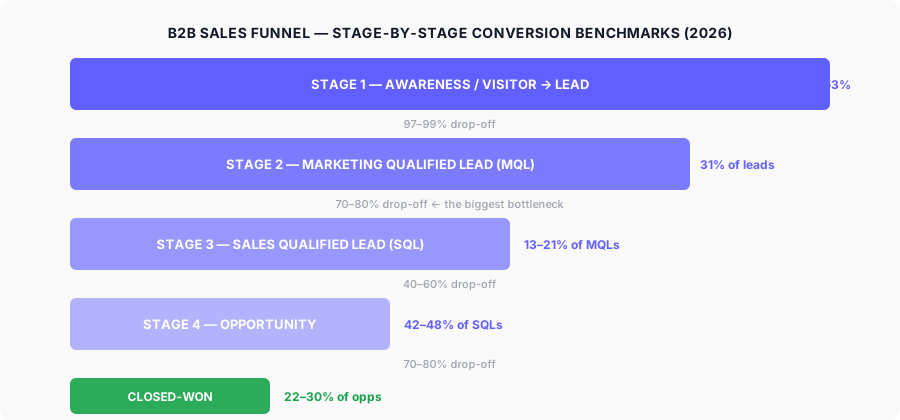
Stage-by-stage conversion benchmarks for the average B2B funnel. Sources: Ruler Analytics, First Page Sage, Amra & Elma, 2025.
Stage 1 — Awareness to Lead: the 1–3% visitor conversion reality
The first conversion in the funnel — turning a website visitor into a named lead — runs at 1–3% for most B2B teams. That number sounds small until you reverse the math: a team generating 50,000 monthly visitors at 2% conversion produces 1,000 leads per month. A team at 1% generates 500. The delta is 6,000 leads per year from the same traffic volume.
The average rate hides enormous channel variance. Organic search produces visitor-to-lead conversion of 2.1%. Paid search delivers 0.7% — three times lower from the same funnel (The Digital Bloom, 2025). Visitors who arrive via organic search have typically already consumed content, compared multiple solutions, and defined their problem. Paid visitors arrive earlier in their decision process and convert at lower rates as a result.
The top quartile of landing pages hits 5.31% visitor-to-lead conversion. The top 1% of pages reaches 11.45% (WordStream via EcommerceBonsai, 2025). The most reliable levers at this stage: adding video to a landing page drives +86% conversion lift, reducing form fields from 7 to 3 increases sign-ups by 42%, and removing navigation from a landing page increases sign-ups by 20–45%. None of these require additional budget — they require configuration.
What kills conversion at this stage: generic messaging that fails the ICP test, long forms that signal friction before value is established, page load times above 3 seconds (53% mobile abandonment), and the absence of social proof. First-visit conversion averages only 3% — most buyers require 3–5 visits before submitting their information. The content that brings them back each time determines the aggregate rate.
| # | Stat | What it measures | Source |
|---|---|---|---|
| 01 | 1–3% | Average B2B visitor-to-lead conversion rate across all channels | Ruler Analytics / First Page Sage, 2025 |
| 02 | 2.1% | Visitor-to-lead rate from organic search — highest inbound channel | First Page Sage, 2025 |
| 03 | 0.7% | Visitor-to-lead rate from paid search — 3x below organic | The Digital Bloom, 2025 |
| 04 | 97–99% | Drop-off rate at the awareness stage — most visitors never convert | Amra & Elma, 2025 |
| 05 | 5.31% | Top-quartile landing page conversion rate — top 1% hit 11.45% | WordStream via EcommerceBonsai, 2025 |
| 06 | +86% | Conversion lift from adding video to a landing page | EcommerceBonsai, 2025 |
| 07 | +42% | Sign-up increase from reducing form fields from 7 to 3 | Marketing LTB, 2025 |
| 08 | 3% | Average first-visit conversion rate — most buyers need 3–5 visits | Cropink, 2025 |
What this means for reps and teams
97–99% of visitors never convert on the first interaction. The question is not how to convert everyone — it is how to bring the right visitors back at the right time. Organic search delivers 3x the visitor-to-lead rate of paid search at this stage. If your team is optimizing ad spend before optimizing the content that draws in pre-qualified visitors, the ROI math runs backwards.
Stage 2 — Lead to MQL: where 85–90% of prospects vanish
The lead-to-MQL conversion averages 31% across B2B industries. That means for every 100 leads a team generates, 69 are discarded before they ever reach the sales team. The 31% benchmark is the average — email marketing drives 43% lead-to-MQL, SEO drives 41%, while lower-intent channels fall below 20%.
The more alarming number is the 79% stat: 79% of leads never convert due to a lack of lead nurturing (Cropink, 2025). Most teams generate leads and then apply one of two filters — a static scoring rubric that does not update as buyer behavior changes, or no scoring at all and a manual handoff that relies on individual rep judgment. Neither approach works at volume.
Marketing automation changes the math dramatically. Companies using marketing automation to nurture leads see a 451% increase in qualified leads (Annuitas Group via Amra & Elma, 2025). AI-based lead scoring improves qualification accuracy by 39% (Marketing LTB, 2025). The teams hitting 43% lead-to-MQL from email are not running smarter campaigns — they are running automated nurture sequences that qualify leads without manual intervention.
What kills conversion at this stage: no formal MQL definition shared between marketing and sales, lead scoring models that never update, nurture sequences that stop after 2 emails, and a 68% organizational failure rate — more than two-thirds of B2B businesses have not fully defined or documented their sales funnel (Cropink, 2025). A team cannot optimize a process it has not written down.
| # | Stat | What it measures | Source |
|---|---|---|---|
| 01 | 31% | Average lead-to-MQL conversion rate across B2B industries | Ruler Analytics / First Page Sage, 2025 |
| 02 | 41% | Lead-to-MQL rate from SEO traffic — best-performing inbound channel | First Page Sage, 2025 |
| 03 | 43% | Lead-to-MQL rate from email marketing campaigns | First Page Sage, 2025 |
| 04 | 85–90% | Drop-off rate at lead-to-MQL stage — most leads are discarded here | Amra & Elma, 2025 |
| 05 | 79% | Of leads never convert due to lack of lead nurturing programs | Cropink, 2025 |
| 06 | +451% | Increase in qualified leads from companies using marketing automation | Annuitas Group via Amra & Elma, 2025 |
| 07 | +39% | Lead scoring qualification accuracy improvement with AI scoring models | Marketing LTB, 2025 |
| 08 | 68% | Of businesses have not fully defined or documented their sales funnel | Cropink, 2025 |
What this means for reps and teams
79% of leads never convert due to missing nurture. That is not a sales problem — it is a handoff problem. The lead generated by marketing that does not receive a structured follow sequence within 48 hours loses 60% of its conversion probability (Marketing LTB, 2025). Sales reps who act on signal — a pricing page visit, a content download, a second session — before the lead goes cold recover this conversion window. For the signal types that trigger the strongest response, see intent signals in sales.
Stage 3 — MQL to SQL: the biggest bottleneck in B2B funnels
MQL-to-SQL is the most-cited, least-solved problem in B2B sales. The cross-industry average is 13–21%. That means 70–80% of marketing-qualified leads — prospects who have already demonstrated enough engagement to earn an MQL tag — are eliminated before a sales rep ever speaks to them. For most teams, this is the single stage with the highest leverage for revenue improvement.
The benchmark obscures enormous variation. B2B SaaS teams with strong ICP scoring convert 38% of MQLs to SQLs — nearly double the 21% cross-industry rate (First Page Sage, 2025). SEO-sourced MQLs convert at 51%, compared to 26% for PPC-sourced MQLs. The same MQL definition applied to different traffic sources produces radically different outcomes.
Response speed is the most underused lever at this stage. Contacting an MQL within 5 minutes of their engagement signal makes qualification 21x more likely than contacting them 30 minutes later (Harvard Business Review / HubSpot, 2025). The rep who calls at minute 6 competes against the same fatigue and distraction as the rep who calls at hour 2 — but converts at a fraction of the rate. Speed is not a sales tactic at this stage. It is the primary variable.
The revenue math is compelling: a 5-point improvement in MQL-to-SQL conversion drives an 18% lift in total revenue (The Digital Bloom, 2025). For a team generating $2M in ARR, that single improvement — moving from 20% to 25% MQL-to-SQL — produces an additional $360,000 without touching any other part of the funnel. This is why every RevOps team that audits conversion rates targets this stage first.
What kills conversion at this stage: MQL definitions misaligned between marketing and sales, no time-to-contact SLA, ICP scoring that treats all leads identically regardless of firmographics, and outbound sequences that arrive after a competitor has already booked the discovery call.
| # | Stat | What it measures | Source |
|---|---|---|---|
| 01 | 13–21% | Cross-industry MQL-to-SQL conversion rate — the single biggest drop-off | First Page Sage / MarketJoy, 2025 |
| 02 | 38% | MQL-to-SQL rate for B2B SaaS teams with strong ICP scoring — 2x average | First Page Sage, 2025 |
| 03 | 51% | MQL-to-SQL conversion rate for SEO-sourced leads specifically | First Page Sage / MarketJoy, 2025 |
| 04 | 26% | MQL-to-SQL rate for PPC-sourced leads — half the rate of SEO | The Digital Bloom, 2025 |
| 05 | +18% | Revenue lift from a 5-point improvement in MQL-to-SQL conversion rate | The Digital Bloom, 2025 |
| 06 | 21x | More likely to qualify a lead when response time is under 5 minutes vs 30 | Harvard Business Review / HubSpot, 2025 |
| 07 | 70–80% | Drop-off at MQL-to-SQL — worst stage for most B2B funnel audits | Amra & Elma, 2025 |
| 08 | 15% | Median MQL-to-SQL rate across all B2B industries including non-SaaS | First Page Sage, 2025 |
What this means for reps and teams
The MQL-to-SQL stage is where the funnel either compounds or collapses. At 13–21% average conversion, most teams pass less than one-in-five MQLs to sales. Moving to 38% — the B2B SaaS benchmark for teams with strong scoring — requires three things: a shared MQL definition with binary criteria, a time-to-contact SLA under 5 minutes for high-intent signals, and ICP scoring that updates based on engagement behavior rather than firmographic data alone. Teams using signal-based selling to prioritize which MQLs get called first consistently outperform the average.
Stay current
Get the Gangly Sales Data Digest
New benchmarks, conversion rate data, and rep-facing analysis — delivered when the data is worth reading.
Subscribe — it is freeStage 4 — SQL to Opportunity: qualification, velocity, and deal entry
The SQL-to-opportunity conversion averages 40–48% across B2B industries. B2B SaaS teams specifically average 42% (First Page Sage, 2025). This stage represents the transition from a qualified prospect to an active deal in the pipeline — from a rep's judgment that a prospect fits the ICP to a formal opportunity with a deal stage, expected value, and close date.
Enterprise teams convert SQL-to-opportunity at a lower rate than SMB teams: 36% versus 42%. The gap reflects longer research cycles, additional internal approvals, and larger buying committees — not worse sales execution. Enterprise deals that do enter the pipeline compensate with higher ACV and longer contract terms.
Deal size drives time-to-opportunity. Deals under $20K ACV close in approximately 75 days with 4 human touchpoints. Deals between $20K–$60K require 115 days and 6 touchpoints. Deals above $60K run 180 days with 13 touchpoints (Prospeo, 2026). The rep who treats a $75K deal with the same speed assumptions as a $12K deal will consistently miss close-date predictions and produce an inaccurate forecast. For the full forecast accuracy benchmark, see sales forecast accuracy benchmarks for 2026.
What kills conversion at this stage: premature opportunity creation — entering deals in the pipeline before the prospect has confirmed a problem, timeline, and budget — inflates pipeline coverage and undermines forecast accuracy. A 42% SQL-to-opportunity rate with accurate deal criteria produces more revenue than a 70% rate built on wishful entries.
| # | Stat | What it measures | Source |
|---|---|---|---|
| 01 | 40–48% | Average SQL-to-opportunity conversion rate across B2B industries | Ruler Analytics / First Page Sage, 2025 |
| 02 | 42% | SQL-to-opportunity rate for B2B SaaS companies specifically | First Page Sage, 2025 |
| 03 | 36% | SQL-to-opportunity rate for enterprise-segment deals ($1B+ ARR companies) | CausalFunnel, 2026 |
| 04 | 60–70% | Drop-off rate at the SQL-to-opportunity transition in most funnels | Amra & Elma, 2025 |
| 05 | 67 days | Average SaaS & Technology deal cycle — fastest of tracked industries | The Digital Bloom, 2025 |
| 06 | 147 days | Average Real Estate & Construction deal cycle — longest of tracked industries | The Digital Bloom, 2025 |
| 07 | 4 touches | Average human touchpoints for deals under $20K ACV before close | Prospeo, 2026 |
| 08 | 13 touches | Average human touchpoints required for deals over $60K ACV before close | Prospeo, 2026 |
What this means for reps and teams
A SaaS deal above $60K requires 13 human touchpoints before closing — that is 13 separate interactions across an average 180-day cycle. The rep who enters this deal in Salesforce after one discovery call is forecasting a cycle that has not started yet. SQL-to-opportunity conversion should only count when MEDDPICC criteria are partially confirmed. Inflated opportunity creation corrupts the entire forecast downstream. The full pipeline audit methodology for cleaning this up is in SaaS sales metrics: the 20 KPIs every team must track.
Stage 5 — Opportunity to Closed-Won: close rates, cycle length, win factors
The opportunity-to-closed-won rate averages 22–30% across B2B industries (Ruler Analytics / First Page Sage, 2025). HubSpot's 2025 data puts the average B2B sales win rate at 21%. These numbers share a common characteristic: most teams at the median are losing 70–80% of their active opportunities.
Time is the most reliable predictor at this stage. Deals closed within 50 days win at 47%. Deals that run past 50 days win at 20–21% — the same rate as the overall average (Outreach, 2025). The slope is almost entirely determined by whether the rep secured a mutual action plan and a compelling event in the first two discovery calls. Deals without a defined close trigger drift toward the 20% win rate with near-mathematical certainty.
Multi-threading is the single highest-leverage lever at the opportunity stage. Deals involving multiple buyer contacts win at 130% higher rates for transactions above $50K (Gong, 2025). 86% of B2B purchases stall at some point — the ones that never recover are disproportionately single-contact deals where the champion loses internal support without the rep knowing. The rep who maps the buying committee before the proposal closes. The rep who maps it after the stall rarely does.
SMB-focused teams close at 39% opportunity-to-win, 8 points above the enterprise average of 31% (CausalFunnel, 2026). The delta is not rep skill — it is buying committee complexity. Enterprise deals involve 6–13 stakeholders with competing priorities across procurement, legal, IT, and the economic buyer. Each additional stakeholder is another potential no-decision.
What kills conversion at this stage: single-threading, weak compelling events, missing the economic buyer until week 10 of a 12-week cycle, and the 44% of reps who give up after one follow-up attempt (GrowthList, 2025). 80% of B2B sales require 5–12 follow-ups before a decision. The majority of closed revenue in any given quarter belongs to the minority of reps who persist through all 12.
| # | Stat | What it measures | Source |
|---|---|---|---|
| 01 | 22–30% | Average opportunity-to-closed-won rate across B2B industries | Ruler Analytics / First Page Sage, 2025 |
| 02 | 39% | Opportunity-to-close rate for SMB-focused teams ($10M–$100M ARR) | CausalFunnel, 2026 |
| 03 | 31% | Opportunity-to-close rate for enterprise-focused teams ($1B+ ARR) | CausalFunnel, 2026 |
| 04 | 47% | Win rate for deals closed within 50 days; drops to 20–21% after 50 days | Outreach, 2025 |
| 05 | +130% | Win rate boost from multi-threading deals over $50K ACV (Gong analysis) | Gong, 2025 |
| 06 | 86% | Of B2B purchases stall at some point during the buying process | Prospeo, 2026 |
| 07 | 21% | Average B2B sales win rate across all industries in 2025 | HubSpot, 2025 |
| 08 | 70–80% | Drop-off rate at the opportunity-to-close stage for average B2B teams | Amra & Elma, 2025 |
What this means for reps and teams
Win rates fall from 47% (sub-50-day deals) to 21% (50+ day deals) not because deals become harder over time — but because the deals that run long were never properly qualified in the first place. The reps closing at 47% are not working harder. They are qualifying faster, securing compelling events earlier, and multi-threading by week two. For a full breakdown of win rate variables and the 30-day improvement plan, see sales conversion rate benchmarks and formulas.
Sales funnel conversion benchmarks by industry (2026 table)
Applying cross-industry averages to an industry-specific funnel produces the wrong benchmarks and the wrong priorities. A pharmaceutical team with a 41% lead-to-MQL rate and a 64% close rate operates on fundamentally different economics than a B2B SaaS team at 39% and 37%. Both use the term "sales funnel" — but the levers, cycle length, and team structure are completely different.
The table below maps each industry's stage-by-stage conversion rates using data from First Page Sage, The Digital Bloom, and Ruler Analytics (2025–2026). Use your industry row as the primary benchmark. If your stage rates fall below the row benchmarks by 5 points or more, that stage is a documented underperformer worth auditing.
| Industry | Lead → MQL | MQL → SQL | SQL → Opp | Opp → Close | Avg Cycle |
|---|---|---|---|---|---|
| B2B SaaS | 39% | 38% | 42% | 37% | 67 days |
| Financial Services / Fintech | 21% | 46% | 44% | 58% | 89 days |
| Healthcare & MedTech | 29% | 35% | 40% | 46% | 72 days |
| Manufacturing | 24% | 32% | 38% | 41% | 121 days |
| Real Estate & Construction | 22% | 28% | 35% | 37% | 147 days |
| Cybersecurity | 24% | 40% | 45% | 46% | 90 days |
| Pharmaceutical | 41% | 56% | 51% | 64% | 115 days |
| eCommerce (B2B) | 23% | 58% | 66% | 60% | 45 days |
Sources: First Page Sage (2025), The Digital Bloom (2025), CausalFunnel (2026), Ruler Analytics (2025). Cross-industry averages. Individual team performance varies.
The outliers are worth examining. Pharmaceutical and eCommerce B2B show the highest close rates (64% and 60% respectively) — driven by high-intent buyers who have already self-qualified through research cycles before engaging with sales. Financial services runs the best MQL-to-SQL rate (46%) due to regulatory-driven buying urgency. B2B SaaS shows balanced conversion across all stages but the slowest close rate at 37%.
Manufacturing and Real Estate show the longest cycles at 121 and 147 days respectively. These are not broken funnels — they are deal structures with built-in stakeholder complexity, capital approval processes, and procurement timelines that the funnel cannot accelerate. The fix is not to push harder at the bottom; it is to enter the funnel at higher stages with more qualified accounts and better pre-call intelligence.
Funnel velocity: time per stage and what slows the clock
Funnel velocity measures how fast revenue moves through the pipeline. The formula is: (Number of Opportunities × Average Deal Value × Win Rate) ÷ Sales Cycle Length. A team with 100 opportunities, a $15K deal size, a 25% win rate, and a 90-day cycle generates $41.67 per day in pipeline velocity. A team that cuts the cycle to 67 days — matching the SaaS & Technology average — produces $55.97 per day from the same opportunities. That is a 34% velocity improvement without adding a single lead.
The average B2B SaaS sales cycle runs 134 days — up from 107 days in early 2022 (via The Digital Bloom, 2025). Buying committees are larger, procurement involvement is earlier, and budget approvals now require more sign-offs. The deals that run fastest are the ones where the rep mapped stakeholders in week one, established a compelling event in week two, and ran a mutual action plan from week three onward.
Industry pipeline velocity by daily dollar output:
| Industry | Daily Velocity | Avg Deal | Win Rate | Cycle |
|---|---|---|---|---|
| Real Estate & Construction | $2,456/day | $89,300 | 16% | 147 days |
| Financial Services | $2,134/day | $31,200 | 18% | 89 days |
| SaaS & Technology | $1,847/day | $12,400 | 22% | 67 days |
| Healthcare & MedTech | $1,523/day | $18,700 | 25% | 72 days |
| Manufacturing | $1,289/day | $47,800 | 19% | 121 days |
Source: The Digital Bloom, 2025. Daily pipeline velocity = (avg deal × win rate) ÷ cycle days.
SaaS and Technology runs the highest velocity per day relative to deal size because the cycle is the shortest at 67 days. Real Estate and Construction posts the highest absolute daily velocity despite a 147-day cycle — purely because the average deal at $89,300 is 7x the SaaS average. The right velocity target depends entirely on which industry and deal size your team operates in. Comparing your velocity to a different industry benchmark produces the wrong action.
What slows the clock at every stage: delayed first response (every hour after 5 minutes decreases qualification probability), under-resourced handoffs between marketing and sales, discovery calls without a confirmed next step, single-threaded opportunities that stall when a champion changes roles, and proposals submitted without a verbal agreement on timing.
The Funnel Velocity Framework: Gangly's model for acting at every stage
The data above identifies the benchmarks. Most teams read the data, compare their stage rates, find one or two gaps, and then return to running the same process that produced the gaps in the first place. The Funnel Velocity Framework is Gangly's proprietary model for converting funnel statistics into rep-level action at every stage.
The Funnel Velocity Framework — 5 stages, 5 rep actions
- Stage 1 — Awareness: Track which content pieces generate the highest visitor-to-lead conversion by channel. Organic search converts at 2.1% — 3x paid. Build for organic first. Monitor first-visit vs. return-visit conversion split. Most conversions occur on return visits, not first touch.
- Stage 2 — MQL: Define the MQL in writing with binary criteria that both marketing and sales agree on. If you cannot write a checklist that any rep could apply to a lead in 90 seconds to decide MQL/not-MQL, the definition is too vague. Run a nurture sequence that updates its logic based on engagement signals, not calendar intervals.
- Stage 3 — SQL: Enforce a 5-minute time-to-contact SLA for high-intent MQLs. This single change drives 21x qualification improvement (HBR / HubSpot, 2025). Prioritize MQLs from SEO over PPC — they convert to SQL at 51% versus 26%. Score ICP fit before calling, not after.
- Stage 4 — Opportunity: Set entry criteria for opportunity stage — not hope criteria. An opportunity requires a confirmed problem, a named economic buyer, a rough timeline, and at least one stakeholder who has asked for a next step. Enter fewer opportunities with higher conviction and forecast accuracy improves downstream.
- Stage 5 — Close: Multi-thread by week two of every deal above $30K. 86% of B2B purchases stall — the ones that recover have multiple contacts engaged. Set a compelling event in the first discovery call or the deal will drift to the 21% win rate. The rep who controls the timeline closes; the rep who follows the prospect's timeline hopes.
The framework connects to Gangly's product architecture directly. Gangly detects buying signals — funding events, job changes, pricing page visits, competitor reviews — and turns them into prepared rep actions at the stage where the signal is most valuable. A pricing page visit from an MQL triggers a 5-minute contact alert. A competitor review triggers a battlecard and call prep brief. A funding event triggers an account enrichment and outreach sequence.
The Gangly Q1 2026 cohort data shows reps acting on signals within 5 minutes convert at 3.1x the rate of reps acting on the same signals after 30 minutes. Signal timing — not signal quality — determines which stage an account moves to next. The stat from Harvard Business Review (21x more likely to qualify a lead with a 5-minute response) is not a guideline. It is the operating standard.
For reps managing full-cycle deals, the framework also applies to post-call workflow. Gangly auto-generates CRM updates, call summaries, and next-step follow-up emails within 2 minutes of a call ending — which means the opportunity stage in Salesforce reflects the actual call outcome within the same business day. Funnel data is only accurate when the data in the CRM is accurate. Reps who update CRM manually 8 hours after a call are forecasting from memory, not fact.
Stage-by-stage fixes: what kills conversion and how to recover it
Each funnel stage has a primary conversion killer and a primary fix. Teams that try to improve all five stages simultaneously improve none — they dilute attention across too many variables. Pick the stage where your rate is furthest below benchmark. Fix that one first. Measure for 30 days. Then move to the next.
Stage 1 — Visitor to Lead
Conversion killer: generic messaging + slow page loads
Most B2B landing pages fail the ICP test — the headline reads as if written for everyone, which means it resonates with no one. Add video (proven +86% lift). Cut form fields to 3 or fewer (+42% sign-ups). Remove navigation from landing pages (+20–45% sign-ups). Target page load under 2 seconds — every second above 2 seconds loses 15–40% of mobile visitors.
Stage 2 — Lead to MQL
Conversion killer: no nurture program, no scoring logic
79% of leads never convert without nurturing. Implement a minimum 5-email nurture sequence triggered by behavior, not calendar. Use AI lead scoring (+39% accuracy). Define the MQL criteria in writing and socialize it across marketing and sales. Run a weekly review of leads that fell out of scoring — 63% of non-ready leads will buy eventually if properly nurtured (Marketo, 2025).
Stage 3 — MQL to SQL
Conversion killer: slow response time + poor ICP filter
Enforce a 5-minute SLA for high-intent MQLs. The 21x qualification advantage at 5 minutes versus 30 minutes is not theoretical — it reflects real behavioral decay in prospect attention. Prioritize SEO MQLs over PPC MQLs by signal strength. Run a buying signal check before dialing: pricing page visit, content depth, returning session, firmographic fit. Do not call an MQL you cannot personalize in 60 seconds.
Stage 4 — SQL to Opportunity
Conversion killer: premature opportunity creation
Only enter a deal as an opportunity when: (1) a problem is confirmed, (2) a named economic buyer exists, (3) a rough timeline is stated, and (4) at least one stakeholder asked for a next step. Everything else is a suspect, not an opportunity. Premature entries inflate pipeline coverage and make forecasts unreliable. Run a weekly SQL audit to flag entries that lack all four criteria.
Stage 5 — Opportunity to Closed-Won
Conversion killer: single-threading + no compelling event
Multi-thread every deal above $30K by week two — not after the deal stalls. 86% of B2B purchases stall at some point, and single-contact deals rarely recover. Set a compelling event — a business consequence tied to a date — in the first discovery call. Deals without a compelling event drift to the 20–21% win rate. Multi-threaded deals with a defined close trigger win at 47%+. The data is unambiguous.
Siddharth Gangal
Founder, Gangly. Builds sales workflow systems for AEs, BDRs, and founders doing outbound. Writes on signal-based selling, rep efficiency, and sales data.