
 By Siddharth Gangal
TL;DR
- Sales rep turnover averages 35% annually (HubSpot · Xactly, 2025) — nearly 3x the 13% cross-industry rate. 45% of B2B sales organizations report turnover exceeding 30%, meaning high churn is structural, not exceptional.
- The fully loaded replacement cost is $115,000–$150,000 per departure (Salesforce Research · Outperform Institute), covering recruiting, onboarding, lost pipeline, ramp loss, and manager time. Three departures in a year costs over $450K before quota shortfall.
- SDRs churn at 45% annually — the highest rate of any sales role — versus 30% for AEs. The leading exit driver is admin overload and burnout (35% of departures), not compensation.
- Average rep tenure is 18 months. Reps reach peak performance at 24–36 months. The tenure gap means most teams never see the output they hired for.
- Companies with clear 12–18 month SDR-to-AE promotion paths cut SDR attrition from 35–40% down to 20–25% (Optifai, 2026). The fix is structural, not motivational.
Direct answer
Sales rep turnover statistics show a 35% average annual rate in the US — nearly 3x the cross-industry average of 13%. SDR attrition reaches 45% annually, AE turnover runs 30%, and average rep tenure sits at just 18 months — six months before peak performance. The fully loaded replacement cost per departed rep is $115,000–$150,000. The five leading causes are admin burnout, no career path, quota unfairness, poor management, and culture misalignment. All statistics on this page are sourced from named primary research published between 2024 and 2026.
Sales rep turnover: the numbers at a glance
Four numbers frame the sales rep turnover problem in 2026. First: 35% annual turnover rate. For every ten reps on a team at the start of the year, three to four are gone before the year ends. The cross-industry average is 13%. Sales is not just a high-churn profession — it is the highest-churn profession in the B2B economy.
Second: $115,000 to $150,000 per departure. That is not the salary line. That is the fully loaded cost of one rep leaving — recruiting, onboarding, the revenue that evaporates from an open territory, the productivity gap while the new rep ramps, and the sales manager hours consumed by the hiring cycle. A team that loses three reps in a calendar year carries $450,000 in replacement costs before accounting for the quota shortfall from the vacant territory months.
Third: 18 months average tenure. Reps peak between 24 and 36 months. The math on that gap is brutal — most sales organizations never collect on the investment they made in the reps they hired. The rep leaves just as they would have started compounding.
Fourth: 45% SDR attrition. One in two SDRs leaves within 12 months. The leading cause is not pay — it is burnout from spending the majority of their day on tasks that have nothing to do with selling. Admin, manual CRM logging, rep reporting, and list cleanup consume the hours that should be turning into booked meetings.
2026 Sales Rep Turnover Snapshot
35%
Annual turnover rate
18 mo
Avg. rep tenure
$115K
Cost per departure
45%
SDR attrition
The sections below cover each dimension in detail: the full turnover rate data, the tenure gap, cost breakdowns, role-by-role comparisons, the five root causes, and five interventions backed by data. For the broader performance context, the 2026 sales statistics roundup covers quota attainment, AI adoption, and CRM data quality across 10 categories.
Sales rep turnover rate: how bad is it in 2026?
Sales rep turnover is chronically high — and in 2026, the data shows no meaningful recovery from the peaks set during the 2021–2022 talent disruption. The 35% annual rate is not an outlier reading from a bad year. It is the sustained baseline for a profession that structurally combines high rejection volume, short-cycle performance pressure, and administrative friction into one role.
The technology and software sector runs even hotter. Xactly's research found that tech companies saw 67% more departures than other industries during peak attrition periods. For SaaS teams building on a quota-carrying headcount model, this is the number that breaks the forecast: you cannot hit next quarter's number if you lose 35% of the team who is supposed to hit it.
What makes the 35% figure worse: It underrepresents the actual productivity disruption. Ramp time averages 5.7 months for SaaS (see sales ramp time benchmarks). A rep who leaves at 18 months only delivered peak output for, at most, 12 months. The organization paid for 18 months of ramp, salary, benefits, and management time to capture one year of full-productivity output — then started the cycle over.
| # | Stat | What it measures | Source |
|---|---|---|---|
| 01 | 35% | Average annual sales rep turnover rate in the US — nearly 3x the 13% cross-industry average | HubSpot · Xactly, 2025 |
| 02 | 45% | SDR/BDR annual attrition — the highest voluntary turnover rate of any sales role | Optifai, 939-company survey Q2 2025–Q1 2026 |
| 03 | 30% | AE annual attrition — lower than SDR but still 2.3x the all-industry average | Optifai, 939-company survey Q2 2025–Q1 2026 |
| 04 | 18 mo | Average sales rep tenure — compared to the 24–36-month window when performance peaks | HubSpot · Xactly Insights |
| 05 | $115K | Fully loaded cost per departed rep including recruiting, onboarding, lost pipeline, and ramp loss | Salesforce Research · Outperform Institute, 2025 |
| 06 | $150K | Upper bound replacement cost when territory revenue loss during vacancy is fully accounted for | 2CanTalks · Integrity Solutions, 2025 |
| 07 | 45% | Of B2B sales organizations report annual rep turnover exceeding 30% | SiriusDecisions (now Forrester) |
| 08 | 6.2 mo | Average time to fully replace a departed B2B sales rep from open role to productive contributor | DePaul University Sales Lab |
| 09 | 35% | Of SDR departures driven by burnout and admin overload — the single largest stated reason for leaving | Optifai / SkipCall, 2026 |
| 10 | 28% | Of departures driven by no clear promotion path — 72% of SDRs say career progression affects retention | Optifai / Prospeo, 2026 |
| 11 | 70% | Of reps who leave for lack of promotion are top performers — attrition disproportionately hits the best | Prospeo Sales Retention Report, 2026 |
| 12 | 20–25% | Reduced SDR attrition for companies with clear AE promotion paths in 12–18 months vs. 35–40% without | Optifai, 2026 |
| 13 | 19% | Lower voluntary turnover for teams where managers complete weekly 1:1s at 85%+ completion rate | Prospeo Sales Retention Report, 2026 |
| 14 | 40% | Reduction in ramp time when AI-driven adaptive training replaces static onboarding programs | Outperform Institute, 2025 |
What this means for sales leaders
At 35% annual turnover, a 10-rep team loses 3–4 people per year. At $115K–$150K per departure, that is $345K–$600K in replacement costs before counting the quota miss from open territories. The math makes retention the highest-ROI investment in the sales budget — above most top-of-funnel programs. For a full view of how turnover links to productivity loss, the statistics are stark.
Average sales rep tenure: 18 months and the peak-performance gap
Eighteen months. That is how long the average sales rep stays. The number itself is not the core problem — the timing is. Xactly's research on performance curves shows that reps reach their highest sustained output between 24 and 36 months in a role. At 18 months, the average rep is just crossing the threshold from ramped to productive. They leave six months before compounding begins.
The tenure gap — the distance between average exit (18 months) and peak performance (24–36 months) — represents a permanent tax on team output. Sales organizations that accept 18-month tenure as a structural constant are, by definition, running a perpetual ramp machine. Every new hire goes through a 5.7-month ramp (Prospeo, 2025). They deliver full output for roughly 12 months. Then they leave. The organization re-invests $115,000 to restart the cycle.
Outside sales is the outlier. Field reps average 4.8 years of tenure at their current company — more than three times the inside sales average. The difference likely reflects the relationship depth of field roles: a field rep's pipeline is partly their personal professional network. Switching employers severs those relationships. The switching cost is higher, so the rep stays longer.
For SDRs, average tenure is even shorter: 14–18 months. Most SDRs enter the role with an explicit or implicit expectation of transitioning to an AE role within 12–18 months. When that path does not materialize on schedule, they find a company where it will. The 28% of departures driven by "no clear career path" in the data directly reflects SDRs leaving for competitors who offer a faster promotion timeline.
The Tenure Math
18 mo
Average exit point
when most reps leave
24–36 mo
Peak performance window
when reps deliver most
6 mo
Compounding gap
output never realized
The real cost of rep turnover: $115K per departure
The $115,000–$150,000 figure surprises most sales leaders the first time they see it. The instinct is to think of turnover cost as the salary delta — what you paid versus what you expected. The real number is an aggregation of five cost categories, each of which is significant on its own. Together, they add up to a cost that exceeds the annual OTE of the rep who left.
The single largest cost bucket is not recruiting or training — it is lost pipeline during the open territory period. DePaul University's Sales Lab found that B2B sales positions take an average of 60 days to fill. During that window, the accounts in the departed rep's territory receive no active coverage. Deals stall. Competitors who maintain rep coverage on those accounts gain ground. The 25,000–$50,000 estimate for lost pipeline is conservative for teams working enterprise deals with long cycles.
The second-largest cost is ramp productivity loss. A new rep at 60–80% output during the 5.7-month ramp period delivers less revenue than the rep they replaced. The delta between what the new rep generates and what a fully ramped rep would have generated is the ramp productivity loss. At quota levels typical of mid-market AE roles, this loss runs $22,000–$38,000 per rep per ramp cycle.
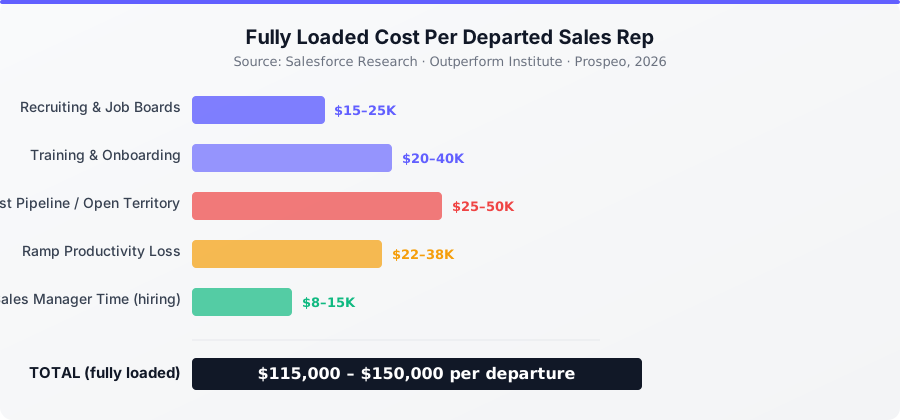
| Cost Category | Low Estimate | High Estimate |
|---|---|---|
| Recruiting, job boards, and assessments | $15,000 | $25,000 |
| Training and onboarding programs | $20,000 | $40,000 |
| Lost pipeline during open territory (45–60 days) | $25,000 | $50,000 |
| Ramp productivity loss (new rep at 60–80% output) | $22,000 | $38,000 |
| Sales manager hiring time (25–50% of hours) | $8,000 | $15,000 |
| TOTAL fully loaded cost per departure | $115,000 | $150,000+ |
Sources: Salesforce Research · Outperform Institute · Prospeo 2025–2026 · DePaul University Sales Lab
One factor the table does not capture: manager time. During periods of high turnover, sales managers spend 25–50% of their working hours on hiring-related activities — sourcing, screening, interviewing, and onboarding. This is time they are not spending coaching the reps currently on the team. High turnover compounds itself: departures consume the coaching attention that would have reduced future departures.
Turnover by role: SDR vs AE vs Sales Manager
Turnover is not uniform across sales roles. Optifai's survey of 939 B2B companies, conducted between Q2 2025 and Q1 2026, found a clear hierarchy: SDRs churn at roughly 1.5x the rate of AEs, who churn at roughly 1.1x the rate of sales managers. The gap between SDR and CSM attrition — 45% versus 25% — is the widest spread in the data.
SDR/BDR: 45% annual attrition. SDRs operate in a structural churn environment. High outbound rejection volume, repetitive activity (dials, emails, sequences), manual CRM logging, and an unclear or slow promotion timeline combine to create the highest voluntary exit rate in sales. The role is designed as an entry point, and most SDRs treat it as one — they leave when the expected promotion does not arrive on schedule. For teams where the SDR-to-AE path exceeds 18 months, attrition will run close to 45%. For teams where the path is explicit and 12–18 months, attrition drops to 20–25%.
AE: 30% annual attrition. AEs have more deal-closing feedback, clearer compensation tied to closed revenue, and deeper account relationships that make switching more costly. Their 30% annual rate is still 2.3x the cross-industry average — but the gap from SDRs reflects the structural improvements that come with the role transition. AE turnover spikes when quota feels arbitrarily set, when comp plans contain errors (77% of sales professionals have experienced at least one compensation error, per CaptivateIQ), or when managers do not provide active coaching. The SDR compensation benchmark data shows that pay transparency alone does not retain — fairness in how the number is set matters more.
Sales Manager: 28% annual attrition. Managers churn at slightly lower rates than AEs, likely because the management track represents a career progression that carries social switching costs. A manager who leaves loses their team relationships, their organizational authority, and often their sales territory context.
CSM: 25% annual attrition. Customer Success Managers show the lowest attrition of any customer-facing revenue role. The relationship depth of post-sale accounts, combined with less outbound rejection volume, produces a retention profile closer to the broader cross-industry average.
| Role | Annual Attrition | Primary Exit Driver | vs. Cross-Industry Avg. |
|---|---|---|---|
| SDR / BDR | 45% | Admin burnout + no promotion path | 3.5x higher |
| Account Executive | 30% | Quota unfairness + comp errors | 2.3x higher |
| Sales Manager | 28% | Burnout + culture misalignment | 2.2x higher |
| CSM | 25% | Career ceiling + limited comp growth | 1.9x higher |
| All Industries (avg) | 13% | — | Baseline |
Source: Optifai 939-company survey, Q2 2025–Q1 2026
Why sales reps quit: the five root causes
Most post-exit surveys ask the wrong question. "Why are you leaving?" produces socially safe answers: better opportunity, compensation, career growth. The honest answer is usually one of five structural problems that the organization failed to address before the rep's decision calcified.
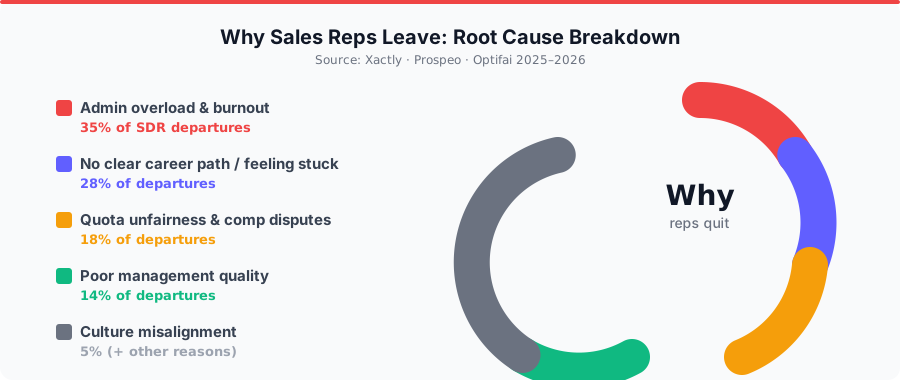
Admin overload and burnout
SDR departures
Reps spending 70%+ of their time on non-selling work report burnout as the primary exit driver.
No clear career path or promotion
All departures
72% of SDRs say career progression is a primary factor in whether they stay long-term.
Quota unfairness or comp disputes
All departures
39% of revenue leaders admit their comp plans do not align with business goals — reps feel it immediately.
Poor management quality
All departures
Teams with managers who complete weekly 1:1s at 85%+ see 19% lower voluntary turnover.
Culture and values misalignment
All departures
56% of job seekers say they would not join a company whose culture conflicts with their values.
The compensation finding deserves particular attention. Salary ranks seventh in stated exit reasons, accounting for approximately 7% of SDR departures. This contradicts the assumption many sales leaders carry that turnover is primarily a pay problem. Reps who leave for a 10% pay increase typically leave because of one of the five structural reasons above — and the offer from a competitor happens to arrive at the right moment. Fixing the structural problem retains reps at a lower total comp cost than bidding against every competing offer that lands in their inbox.
The admin burden connection: how non-selling time drives attrition
Admin burden is the most underestimated driver of sales rep turnover. The data is not ambiguous: reps spend approximately 60–70% of their working hours on non-selling tasks — CRM entry, post-call notes, internal reporting, sequence management, research, and scheduling. One documented case from Prospeo's retention data showed rep admin time reaching 72% of the working week, making it mathematically impossible to hit activity targets.
The connection to attrition runs through three mechanisms. First, reps who cannot hit activity targets cannot hit quota. Reps who cannot hit quota — regardless of the reason — either leave voluntarily or are performance-managed out. The data from CaptivateIQ shows 90% of salespeople face major obstacles reaching their annual targets (CaptivateIQ, State of Sales 2026). A large share of those obstacles are self-inflicted by admin-heavy workflows.
Second, admin overload accelerates burnout. The SDR role already carries the highest rejection volume in sales. Adding 70% of the day in administrative friction — logging calls, updating fields, building reports — produces the condition that Optifai's data identifies as the single largest SDR exit driver.
Third, reps who feel they spend most of their day on tasks that do not contribute to their commission check quickly disengage. The sales admin time study found that Gangly's Q1 2026 cohort spent 12.8% of the working week on CRM data entry alone — approximately 5 hours per week on a single admin category. Eliminating that one category frees time equivalent to the active selling hours most reps get in a full day. The admin reduction playbook covers the workflow-level fixes in detail.
The Admin-Attrition Chain
- 01 Admin consumes 60–70% of rep time
- 02 Activity targets become unreachable
- 03 Quota miss follows — regardless of rep skill
- 04 Burnout and disengagement accelerate
- 05 Rep exits at or before 18 months
- 06 $115K replacement cycle restarts
Quota fairness and turnover: what the research shows
Quota fairness is the second largest structural turnover driver, and the one most often misdiagnosed as a compensation problem. When a rep believes their quota was set arbitrarily, unfairly distributed across territories, or changed without transparent reasoning, the outcome is not a negotiation — it is a departure timeline. Academic research from Kennesaw State University confirmed that perceived procedural justice in quota-setting directly predicts turnover intention, independent of absolute quota level.
The field data reinforces this. CaptivateIQ's State of Sales 2026 found that 71% of salespeople started the year without a confirmed quota. For a rep to be evaluated and potentially fired for missing a number that was never officially communicated is, by any reasonable standard, a fairness failure. The 77% who have experienced at least one compensation error add a financial dimension to the same trust problem.
The retention implication is direct. Teams that set quotas using objective territory data and communicate the methodology to reps — what accounts are included, how potential was estimated, what the ramp schedule looks like — see meaningfully lower attrition among the reps most likely to hit the number. The 29% of companies that offer quota flexibility for reps affected by territory shifts or market changes show improved retention outcomes among the affected reps.
For context on what achievable quota benchmarks look like by role and segment, the quota attainment rate benchmarks cover SDR, AE SMB, AE mid-market, and enterprise quotas in detail. Setting a quota that fewer than 20% of reps can hit is not a performance standard — it is an attrition schedule.
The RETAIN Framework: Gangly's model for cutting rep churn
Retention programs that focus on perks — ping pong tables, team offsites, improved snack options — address none of the five structural exit drivers. The data points to a different model: one that reduces the friction between what reps were hired to do (sell) and how most of their day is actually spent (admin). Gangly's analysis of churn patterns across its customer cohorts produced the RETAIN Framework: six organizational decisions that address the six highest-impact attrition levers.
The RETAIN Framework — Gangly's 6-Lever Retention Model
Reduce admin to under 30% of rep time
Connect signal capture, call notes, CRM updates, and sequence management into one automated workflow. Each disconnected tool adds 45–90 minutes of daily admin. The target: reps spend 70%+ of their day on conversations, not logging.
Impact: 35% reduction in burnout-driven exits
Establish explicit promotion timelines
Publish the SDR-to-AE path with objective criteria (meetings booked, pipeline created, skills demonstrated) and a defined timeline of 12–18 months. Remove ambiguity about when and how promotion decisions are made.
Impact: attrition drops from 35–40% to 20–25%
Tie quota-setting to objective data
Use territory potential analysis, historical attainment by segment, and comp plan modeling before the quota is communicated. Give reps the methodology — not just the number. Offer flexibility for territory disruptions.
Impact: 18% of exits from quota disputes are preventable
Activate weekly 1:1 completion at 85%+
The single highest-correlation management behavior with retention. Teams where managers complete structured weekly 1:1s at 85%+ completion experience 19% lower voluntary turnover. The mechanism is early identification of disengagement before it becomes a departure decision.
Impact: 19% lower voluntary turnover
Invest in AI-driven onboarding
Adaptive AI training that adjusts to each rep's knowledge gaps reduces ramp time by up to 40% (Outperform Institute, 2025). Faster ramp means faster quota attainment, which directly reduces the early-tenure exits that occur when new reps struggle and disengage before they produce.
Impact: 40% reduction in ramp time
Normalize recognition at the activity level
Sixty-six percent of employees say they would quit if they did not feel appreciated (Achievers, 2022). Sales cultures that only celebrate closed revenue miss 90% of the work that leads to it. Recognizing pipeline creation, discovery quality, and sequence consistency keeps reps engaged before the commission check arrives.
Impact: addresses 14% of management-driven exits
The RETAIN Framework is not a replacement for comp plan design, hiring quality, or manager development. It is the six structural decisions that address the six most common reasons reps leave — before the exit interview happens. Gangly's platform directly addresses the R, E, and I levers: reducing admin burden through connected workflow automation, enabling faster onboarding through AI-assisted call prep and real-time coaching, and giving managers the activity data they need to have 1:1 conversations grounded in evidence rather than gut feel.
How to reduce sales rep turnover: five interventions that work
The five interventions below each have measurable data behind them. They are not culture initiatives or engagement programs — they are operational changes that address the specific reasons reps leave.
Intervention 01
Connect the workflow — eliminate admin seams
The core admin problem is not any single tool — it is the gaps between tools. Every CRM update done manually, every post-call note typed in a separate doc, every sequence step logged independently adds 5–15 minutes of switching and re-entry friction. Across a full day, that adds to 3–4 hours. Connecting signal detection, call prep, live coaching, post-call notes, and CRM updates into one automated sequence eliminates the seams. Reps who reach the 70%+ selling time threshold report significantly higher engagement and hit quota at materially higher rates. Full workflow documentation: sales call prep workflow.
Intervention 02
Publish the SDR-to-AE path with a timeline and criteria
Companies that define the promotion timeline explicitly — "AE promotion is available at 12–18 months, based on X meetings booked, Y pipeline created, and Z skills demonstrated" — see SDR attrition drop from 35–40% to 20–25% (Optifai, 2026). The key word is explicit. Vague language like "high performers are considered for promotion on an ongoing basis" does not create the certainty SDRs need to commit to a timeline. Publish criteria, review them quarterly, and hold to them. For a deeper look at the SDR role trajectory, the SDR-to-AE transition guide covers the skills, timelines, and negotiation points.
Intervention 03
Set quotas with territory data and share the methodology
A quota a rep understands is a quota a rep commits to. When the number arrives as a decree — "your new quota is $X" — with no territory analysis behind it, the rep's default assumption is that the number was arbitrary or punitive. Show the work: territory account count, estimated potential by segment, comparable attainment from last period, and the ramp schedule for new hires. Reps who understand how their quota was built exit at significantly lower rates from quota-dispute-related attrition than reps who received the number without explanation.
Intervention 04
Implement structured weekly 1:1s at 85%+ completion
Weekly 1:1s at 85%+ completion correlate with 19% lower voluntary turnover (Prospeo, 2026). The mechanism is simple: a rep who meets weekly with their manager has 52 opportunities per year to surface frustrations before they become departure decisions. A rep who meets monthly has 12. Structured 1:1s — with a standard agenda covering deal progress, pipeline health, skill development, and career goals — give managers the signal they need to intervene when a rep is disengaging. The data on coaching effectiveness is strong: 99% of reps who receive high-quality coaching agree it directly impacts their performance (MySalesCoach/Aircall, 2025).
Intervention 05
Replace static onboarding with AI-adaptive training
Static onboarding programs — a fixed set of videos, role-play sessions, and product certifications — deliver average outcomes for the median rep profile. New reps who complete training faster because the program adapted to their specific knowledge gaps ramp 40% faster (Outperform Institute, 2025). Faster ramp means faster first commission check, faster quota attainment, and reduced likelihood of early-tenure voluntary exit. A significant share of voluntary exits in the 6–10 month window occur among reps who are still ramping and have not yet experienced the win that anchors their commitment to the role.
Sales Data Monthly
Get the numbers before your competitors do.
New sales benchmarks, turnover data, quota attainment rates, and rep productivity statistics — delivered monthly. No fluff. Just data your team can act on.
Siddharth Gangal
Founder, Gangly — Sales Workflow System for AEs and BDRs. Building the product that turns buying signals into prepared reps — from outreach through CRM update.