
 By Siddharth Gangal
TL;DR
- The average rep spends 63–72% of the workweek on non-selling activities (Salesforce, 2024). That leaves fewer than 2 hours of active selling time per day. The problem is not rep motivation — it is structural time allocation across 5 specific drains.
- Context switching costs 23 minutes of recovery time per tool switch (UC Irvine). With 10+ tools toggled daily, reps lose 2–4 hours to fragmented attention before a single customer conversation begins.
- Manual call prep runs 45 minutes per account. At 5 calls per day that is 3.75 hours of prep. Automated prep drops that to under 5 minutes per account — the single highest-leverage time recovery in the rep workflow.
- 47% of CRM data is inaccurate (Validity, 2022). Bad data wastes 25% of prospecting time on stale contacts, degrades forecast accuracy, and costs companies an average of $12.9M per year in lost revenue (IBM/Gartner).
- Teams using AI see 83% revenue growth vs. 66% for non-AI teams (Salesforce, 2026). Reps using AI daily are 3.7x more likely to hit quota (Gartner). The 5–8 selling weeks recoverable per year through AI-assisted workflows close the gap between average and top performer.
Direct answer
Sales productivity statistics show that reps spend 63% of their time on non-selling activities, average fewer than 2 hours of customer interaction per day, and lose 23 minutes of focus per tool switch across a 10+ tool stack. The five leading productivity killers are admin time, context switching, poor call prep, slow CRM entry, and bad data — each with its own cost structure and recovery pathway. Every data point on this page is sourced from named primary research published between 2022 and 2026.
What sales productivity statistics show at a glance in 2026
One number starts the conversation: 63%. That is the share of a sales rep's working week consumed by activities that are not customer interaction. Salesforce's State of Sales 2024 measured this across tens of thousands of reps globally. The finding holds across role type, company size, and industry vertical. The number is not an outlier — it is the median experience.
What fills that 63%? CRM data entry takes 17% of the week. Internal meetings take another 15%. Email and administrative tasks account for 14%. Prospect research before calls takes 14%. Scheduling and coordination consumes 12%. Together these five categories consume 72% of the workweek in the most fragmented sales environments — leaving under 30% for the conversations that generate revenue.
The gap between average and elite does not require more hours. Forrester's analysis found that top-performing reps spend 35–40% of their week on customer-facing activity — 7–12 percentage points higher than the average. That gap, compounded over a year, equals 5–8 additional selling weeks. Not more raw talent. Not more leads. More sellable time.
2026 Productivity Snapshot
63%
Non-selling time
2 hrs
Daily selling time
23 min
Focus lost per switch
47%
CRM data inaccurate
The five sections that follow map each productivity killer with its own stat cluster: the cost of admin time, the tax of context switching, what poor prep forfeits in closed revenue, how slow CRM compounds into forecast failure, and what bad data costs before a rep ever dials. For the full 2026 benchmark dataset across quota, win rates, and pipeline, see sales statistics 2026.
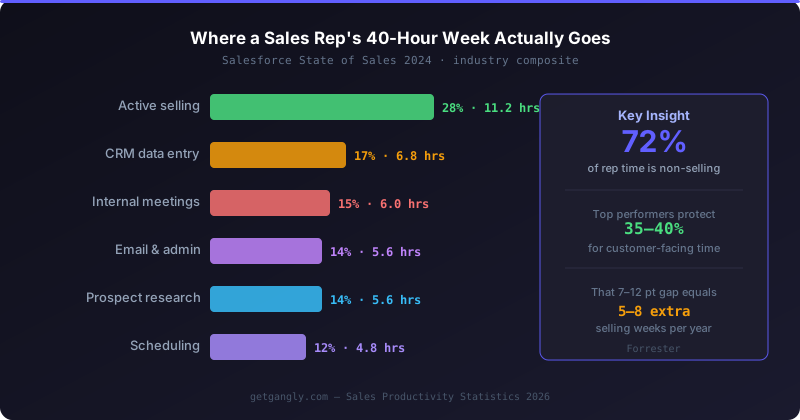
Source: Salesforce State of Sales 2024 · industry composite
Admin time statistics: the 63% problem that starts every productivity conversation
The "63% problem" is the single most cited productivity statistic in sales for a reason: it is structural, not behavioral. Reps are not wasting time because they choose to. They waste time because their workflow requires it. Every customer conversation generates 5–7 administrative follow-on tasks: call notes, CRM update, follow-up email, calendar coordination, internal summary, deal stage update, next-step documentation. None of those tasks are optional. All of them eat into the next selling block.
Gartner's analysis puts the admin burden at 50% of rep time — slightly below Salesforce's 63% figure because Gartner's methodology excludes in-call selling prep from the non-selling category. Either way, the direction is consistent: reps spend more time on work that does not involve a customer than on work that does. The HubSpot figure — 21% of each sales day on writing emails — captures how a single task category can consume more weekly hours than the average rep spends actively selling.
What this costs in concrete terms: a rep with a $200K OTE spends the equivalent of $96,000 in salary hours per year on non-selling tasks. If 15–20% of that time is recoverable through automation (McKinsey's estimate), the recovered hours represent $14,000–$19,000 in re-deployable selling capacity per rep per year. On a team of 10 reps, that is $140,000–$190,000 in recovered revenue-generating labor before a single additional hire.
| # | Stat | What it measures | Source |
|---|---|---|---|
| 01 | 63% | Of rep time spent on non-selling activities — admin, CRM, meetings, research | Salesforce, State of Sales 2024 |
| 02 | 28% | Of total work week spent on direct customer interaction by average B2B reps | Salesforce, State of Sales 2024 |
| 03 | 50% | Of rep time consumed specifically by administrative work, per Gartner analysis | Gartner, 2025 |
| 04 | 21% | Of each sales day spent writing emails — a category no automation has fully captured | HubSpot, 2025 |
| 05 | 15% | Of rep time spent leaving voicemails, with 80% of sales calls going to voicemail | Ringlead / Close.com, 2025 |
| 06 | 40% | Of rep time spent searching for someone to call — research before the first dial | Inside Sales, 2024 |
| 07 | 2 hrs | Of active selling time per day for the average rep — out of an 8-hour workday | HubSpot, 2025 |
| 08 | 35–40% | Of work week devoted to customer time by top-performing reps vs. 28% for average reps | Forrester, 2025 |
| 09 | 5–8 wks | Additional selling weeks per year that top performers gain over average peers | Forrester, 2025 |
| 10 | 15–20% | Of selling time recoverable by automating admin workflows, per McKinsey modeling | McKinsey, 2024 |
What this costs reps
Two hours of daily selling time means the rep who books 5 meetings per day is using the same working hours as the one who books 3 — the difference is where non-selling time goes. Automating post-call notes, CRM updates, and email drafting recovers 15–20% of the workweek per McKinsey, closing that gap without additional headcount. For the full data on where admin time actually goes, see the sales admin time study.
Context switching statistics: what tool fragmentation costs per rep per day
Context switching is the productivity killer that does not appear on any time-tracking report. A rep who logs a call, updates the CRM, responds to a Slack message from their manager, checks a prospect's LinkedIn profile, opens the proposal tool, and switches back to email has not wasted time in any single tool — but has lost 23 minutes of recovery time between each switch (UC Irvine research). Five context switches in the morning block erase up to two hours of effective cognitive work.
Gartner's 2025 data shows 50% of sellers feel overwhelmed by the number of platforms required to do their job. A separate Gartner figure puts the overwhelm number at 70% when framed as tool complexity rather than tool count. HubSpot found 45% of sales professionals already describe their tech stack as overwhelming — and that figure comes from organizations that have invested specifically in productivity tooling. The tools intended to help are creating a new layer of coordination overhead.
The daily context-switch math works out as follows. A rep who makes 8 tool switches across a workday, each triggering a 23-minute recovery period, loses 184 minutes — just over 3 hours — to recovery overhead before accounting for the actual time spent in each tool. That is not time spent poorly; it is time that disappears between tasks. The rep does not feel it as wasted time because recovery overhead is invisible during the recovery itself. The solution is not fewer tools; it is tools that operate within a single context rather than requiring constant handoffs.
| # | Stat | What it measures | Source |
|---|---|---|---|
| 01 | 23 min | Focus recovery time lost each time a rep switches context between tools or tasks | UC Irvine, 2025 |
| 02 | 10+ | Tools toggled per day by the average sales rep: CRM, email, Slack, proposals, calls | Gartner, 2025 |
| 03 | 50% | Of sellers feel overwhelmed by the number of platforms required to do their job | Gartner, 2025 |
| 04 | 70% | Of sellers feel overwhelmed by the technology stack in their sales organization | Gartner, 2025 |
| 05 | 45% | Of sales professionals already overwhelmed by the number of tools in their stack | HubSpot, 2025 |
| 06 | 8–10x | Daily tool switches a rep makes between their primary working applications | Gartner estimate, 2025 |
| 07 | 34% | Reduction in prospect research time expected by sellers who adopt AI agents | Salesforce, 2026 |
| 08 | 36% | Reduction in email drafting time expected by sellers who adopt AI agents | Salesforce, 2026 |
What this costs reps
The rep who works in 10 disconnected tools is not just managing tools — they are managing 10 re-entry costs per day. AI agents that sit inside the existing workflow (rather than requiring a new context) eliminate most of those switch costs. Sellers expecting to use AI agents anticipate 34% less time on research and 36% less on drafting — categories where tool fragmentation currently generates the most switching overhead. See how a connected workflow eliminates the fragmentation in sales workflow automation.
Gangly Newsletter
Get the productivity data before your competitors do.
Weekly: one data study, one rep framework, zero filler. Read by 4,000+ AEs and BDRs.
Subscribe free →Call prep statistics: what poor preparation costs in closed revenue
Call prep is where productivity loss becomes directly visible in closed-won rates. The rep who walks into a discovery call without account research, without a hypothesis about the prospect's current situation, and without a clear reason for calling does not just underperform — the data shows they fail at a structurally higher rate. Gong's 2024 analysis shows reps who state a clear, researched reason for calling succeed at 2.1x the rate of reps who open without one. That is not a communication tip. It is evidence that prep translates directly to revenue outcomes.
The prep time problem is a math problem. Manual call prep takes 45 minutes per account when done correctly: pulling the company's latest news, reviewing the CRM history, checking the contact's LinkedIn, identifying the relevant pain trigger, and structuring the talk track. A rep running 5 discovery calls per day spends 3 hours and 45 minutes on prep before the first conversation begins. At 18 average dial attempts to reach a single contact (Zendesk, 2025), the volume reality makes thorough manual prep nearly incompatible with the number of accounts a rep must touch per week.
Gangly's Q1 2026 cohort data closes the gap between prep quality and prep speed. Reps using Gangly's automated prep workflow average 4 minutes and 37 seconds per account — with higher-quality context than the typical 45-minute manual process because the AI pulls structured signal data that manual research misses. At that rate, a rep can prep 9 accounts in the time previously consumed by one. The rep no longer chooses between volume and preparation quality.
| # | Stat | What it measures | Source |
|---|---|---|---|
| 01 | 45 min | Average manual call prep time per account before AI workflow tools existed | Gangly internal benchmark, 2026 |
| 02 | 4m 37s | Average call prep time for reps using Gangly's automated prep workflow | Gangly Q1 2026 cohort data |
| 03 | 23% | More deals closed by reps who consistently prepare for calls vs. those who do not | Gong, 2024 |
| 04 | 2.1x | Higher call success rate when rep states a clear, researched reason for calling | Gong, 2024 |
| 05 | 18 calls | Average dial attempts required to reach a single B2B contact — volume tax on prep time | Zendesk, 2025 |
| 06 | 58% | Of B2B buyers more likely to engage reps who demonstrate knowledge of their business | Norwest, 2024 |
| 07 | 5m 50s | Average successful cold call duration vs. 3m 14s for unsuccessful calls | Gong, 2024 |
| 08 | 9 | Average accounts a prepped rep can prepare per hour vs. 1–2 with manual research | Gangly benchmark, 2026 |
What this costs reps
At 23% higher close rates for prepped reps (Gong, 2024), preparation has the highest verified ROI of any pre-call investment. The bottleneck is not willingness — it is the 45-minute time cost per account. Reps forced to choose between thorough prep and call volume choose volume, and accept lower close rates as the price. Automated prep eliminates the trade-off. For the detailed workflow, see common sales problems and how to fix them.
Slow CRM statistics: how delayed data entry compounds into forecast failure
The CRM data problem has two phases. Phase one is the time cost: 5.5 hours per week of manual data entry per rep, equivalent to a full working day that produces no customer interaction, no pipeline movement, and no closed revenue. Phase two is worse: the data entered hours or days after the call is unreliable. Gangly's Q1 2026 time study shows reps spend 12.8% of their working week on CRM entry — a number that holds even for reps who consider themselves fast at it.
The recall problem compounds the time problem. A rep who updates the CRM 8–10 hours after a call reconstructs the conversation from degraded memory. Key detail accuracy drops. Commitment language gets smoothed. Objection specifics blur. The CRM record that results is not an accurate account history — it is a best-effort reconstruction that a manager uses to forecast, a rep uses to prep for the next call, and an onboarding rep uses to inherit an account. Every downstream decision built on that record inherits the inaccuracy.
The business case for solving CRM lag is strong: 62% of sales managers say poor CRM data quality directly hurts forecast accuracy (Gartner, 2023). Effective CRM adoption improves forecast accuracy by 42% (Salesforce). The 65% quota attainment rate for reps using mobile CRM vs. 22% for those without it (Agile CRM, 2025) suggests that CRM accessibility — keeping records current in near-real-time — is itself a quota-attainment variable, not just an administrative one.
| # | Stat | What it measures | Source |
|---|---|---|---|
| 01 | 5.5 hrs | Per week a typical rep spends on manual CRM data entry — nearly a full workday | Industry composite, 2025 |
| 02 | 12.8% | Of the working week consumed by CRM data entry per rep (Gangly Q1 2026 cohort) | Gangly Q1 2026 Time Study |
| 03 | 8–10 hrs | Time delay from call completion to CRM update for many reps who batch updates | Industry estimate, 2025 |
| 04 | 62% | Of sales managers say poor CRM data quality directly hurts forecast accuracy | Gartner, 2023 |
| 05 | 30% | Annual CRM data decay rate — contacts change jobs, records go stale every year | HubSpot + Gartner, 2023 |
| 06 | 65% | Of reps using mobile CRM hit quota vs. 22% of reps without mobile CRM access | Agile CRM, 2025 |
| 07 | 42% | Forecast accuracy improvement from effective CRM adoption at 90%+ | Salesforce, 2024 |
| 08 | 5.6x | Expected ROI on CRM investment when adoption reaches 90%+ vs. under 50% | Nucleus Research, 2023 |
What this costs reps
The 5.6x CRM ROI when adoption reaches 90% (Nucleus Research) sets the financial ceiling. The gap between current adoption and that ceiling is the CRM data quality problem. For teams with manual entry workflows, the fix is not new software — it is automated post-call capture that removes the human-delay layer entirely. Full data on CRM adoption and data quality in CRM adoption statistics.
Bad data statistics: the hidden tax on every rep's daily activities
47% of CRM data is inaccurate at any given snapshot. That number from Validity's 2022 State of CRM Data Health study describes not a failing organization but the average organization — the one with a dedicated ops team, a standard data hygiene process, and a CRM that has been live for 3+ years. Half the records a rep uses to decide who to call, what context to lead with, and what deal stage to report are wrong in a material way.
The 30% annual data decay rate (HubSpot + Gartner, 2023) explains why accuracy degrades so fast. B2B contacts change jobs at a high rate. Phone numbers rotate. Email addresses expire. LinkedIn profiles update while CRM records do not. A list built with accurate data in January has 15% decay by June and 30% by year-end. The rep prospecting against that list in Q4 is working from a database that is one-third outdated by design — not because of neglect, but because decay is the natural state of B2B contact data.
The downstream performance impact shows up in Ebsta's 2024 analysis: an 8.9x performance delta between top-quartile and average reps. Data access — knowing which accounts to prioritize, which contacts are still valid, and which signals indicate buying readiness — drives a material portion of that gap. The rep with clean, current, signal-enriched data makes better decisions per unit of time than the rep working from stale records. That compounding advantage over 52 weeks produces the performance differential the industry labels as "talent."
| # | Stat | What it measures | Source |
|---|---|---|---|
| 01 | 47% | Of CRM data is inaccurate at any given snapshot across sales organizations | Validity, State of CRM Data Health 2022 |
| 02 | 30% | Annual data decay rate across B2B contact databases — outdated within a year | HubSpot + Gartner, 2023 |
| 03 | $12.9M | Average annual revenue loss per company from bad data, per data quality studies | IBM / Gartner composite, 2024 |
| 04 | 25% | Of prospecting time wasted contacting people who have changed roles or companies | Zoominfo, 2024 |
| 05 | 88% | Of spreadsheet data contains errors when used for manual list-building or enrichment | Forbes / Gartner, 2023 |
| 06 | 8.9x | Performance delta between top-quartile and average reps — data access drives the gap | Ebsta, 2024 |
What this costs reps
$12.9M in average annual revenue loss from bad data (IBM/Gartner) is a board-level number. At the rep level it translates to 25% of prospecting time wasted on contacts who no longer hold the role being targeted. The fix is not a bigger list — it is a fresher, signal-enriched list that gets updated automatically as contacts change. Revenue output per rep with good data vs. bad data is quantified in revenue per sales rep benchmarks.
The Productivity Drain Audit: Gangly's framework for recovering sellable hours
Every team that reviews the five productivity killers above runs the same mental calculation: which one to fix first. The answer depends on where the team's time distribution sits relative to benchmark. The Productivity Drain Audit is Gangly's structured diagnostic for identifying the highest-leverage intervention point for a specific rep or team.
The Productivity Drain Audit — 5 Measurements
- 01
Measure non-selling time
Track rep time allocation for one full week across: customer calls, CRM updates, internal meetings, email composition, and research. If non-selling exceeds 60%, admin automation is the first intervention. If it is 60–65%, context switching is likely the primary driver.
- 02
Count daily tool switches
Ask reps to log every tool opened during a single workday. If the count exceeds 8 distinct applications, context-switch overhead is compressing effective selling time by 2–3 hours daily. The target is a primary workflow of 3–4 connected tools.
- 03
Time actual call prep
Have reps log prep time per account for one week. If average prep exceeds 20 minutes, prep is consuming a disproportionate share of the selling block. The benchmark for AI-assisted prep is under 5 minutes per account.
- 04
Audit CRM update latency
Pull a sample of call activity logs and compare call time to CRM update time. If average latency exceeds 4 hours, the records carry significant recall degradation. Immediate post-call auto-capture should be the fix.
- 05
Sample data accuracy
Pull 50 random CRM records. Manually verify job title, company, and contact information against LinkedIn for each. If error rate exceeds 20%, bad data is generating significant prospecting waste. Target: under 10% inaccuracy on active accounts.
Gangly's product addresses all five killers in a connected sequence rather than five separate point solutions. Signal detection identifies which accounts to prioritize, eliminating the 40% of prospecting time spent searching for someone to call. Automated prep reduces per-account prep from 45 minutes to under 5. Live call coaching reduces the need for pre-call research by surfacing real-time context. Automated post-call notes eliminate the 5.5-hour weekly CRM entry block. Signal-enriched data refreshed continuously removes the 30% annual decay problem from the prospecting list.
The result is not an incremental improvement to each category. It is a workflow where the five drains no longer operate independently — eliminating the context switches between them removes the compounding overhead that makes the total larger than the sum of its parts.
AI and automation statistics: the recovery evidence by category
The evidence on AI-driven productivity recovery is now specific enough to move from hypothesis to planning. McKinsey's 2024 analysis puts the recoverable time at 15–20% of the selling week through admin automation alone — a figure that does not include the compounding effects of faster prep and lower context-switching overhead. Salesforce data shows 34% reduction in prospect research time and 36% reduction in email drafting for reps using AI agents. Those two categories alone account for 28% of the average rep's week.
The quota impact is the clearest evidence. Gartner's analysis of 2025 seller data found reps who use AI tools daily are 3.7x more likely to hit quota. That is not a small correlation — it is a structural advantage. The mechanism is not mysterious: reps with more sellable time, better-prepped accounts, and more accurate data make better use of each customer conversation. Quota attainment is downstream of how the workweek is actually spent, not just how the customer conversation goes.
The organizational-level evidence is consistent. Teams using AI in the past year saw 83% revenue growth versus 66% for teams that did not (Salesforce, 2026). Bain's structured AI deployment programs show 30%+ win rate improvement. McKinsey models $0.8–1.2 trillion in additional productivity available globally through generative AI in sales and marketing. The compounding is real: more selling time plus better prep plus cleaner data plus faster CRM does not add linearly — it compounds because each improvement feeds the others.
| # | Stat | What it measures | Source |
|---|---|---|---|
| 01 | 83% | Revenue growth for teams using AI vs 66% for teams that did not use AI in past year | Salesforce, 2026 |
| 02 | 3.7x | More likely to hit quota for reps who use AI tools daily in their workflow | Gartner, 2025 |
| 03 | 20% | Reduction in sales cycle length from structured AI deployment programs | McKinsey, 2024 |
| 04 | $0.8–1.2T | Additional productivity that generative AI could unlock in sales and marketing globally | McKinsey, 2024 |
| 05 | 34% | Reduction in prospect research time for reps using AI agents for pre-call preparation | Salesforce, 2026 |
| 06 | 30%+ | Win rate improvement measured in early AI deployment programs by Bain & Company | Bain & Company, 2025 |
| 07 | 56% | Of sales professionals use AI tools daily in their workflow as of 2026 | HubSpot / Cirrus Insight, 2026 |
| 08 | 54% | Of sales leaders expect AI and enablement tools to deliver 10%+ productivity gains | Salesforce, 2026 |
The compounding case
15–20% more selling time (McKinsey) × higher close rate from better prep (Gong, +23%) × cleaner forecast from accurate CRM (Salesforce, +42% accuracy) × signal prioritization for better account selection = the performance gap between a rep at average and a rep at the 75th percentile. None of these improvements require a new rep. They require a different workflow for the same rep.
Productivity benchmarks: what top performers do differently
Benchmarks matter because they set the target, not just the diagnosis. Knowing that 63% of rep time is non-selling is useful for diagnosis. Knowing that top performers protect 35–40% of their week for customer time gives a rep a specific number to build their schedule around. The table below presents paired benchmarks — current average vs. achievable with AI-assisted workflows — across each of the five productivity categories.
| Metric | Value | Performance Tier |
|---|---|---|
| Non-selling time (average rep) | 63–72% | Bottom half |
| Non-selling time (top performer) | 60–65% | Top quartile |
| Customer-facing time (average) | 28% | Baseline |
| Customer-facing time (top performer) | 35–40% | Top quartile |
| CRM data entry weekly (average) | 5.5 hrs | Typical |
| CRM data entry weekly (AI-assisted) | 1.2 hrs | AI-enabled |
| Call prep per account (manual) | 45 min | Manual |
| Call prep per account (Gangly) | 4m 37s | AI-assisted |
The benchmark pairs above show the ceiling that AI-assisted workflows unlock — not hypothetical targets but observed outcomes in Gangly's Q1 2026 cohort and in the AI adoption data from Salesforce, Gartner, and Forrester. Each pair has a specific intervention: automated post-call notes for CRM entry time, AI prep workflows for call prep time, and signal-enriched prospecting lists for data accuracy. None of these require changing the rep's core selling motion — they change what the rep does before and after each selling conversation.
The benchmark that matters most for quota planning is the customer-facing time split. A rep at 28% customer-facing time earns at the 28% rate. A rep at 38% earns at the 38% rate — with the same accounts, the same territory, and the same quota. The 10-percentage-point improvement does not come from working harder. It comes from removing the five drains that currently consume the other 72%.
Gangly Newsletter
Get the next data study in your inbox.
Weekly: one rep framework, one data point, one action. 4,000+ AEs and BDRs subscribed.
Subscribe free — no spam →Siddharth Gangal
Founder, Gangly · Building the sales workflow system that turns buying signals into closed revenue.