
 By Siddharth Gangal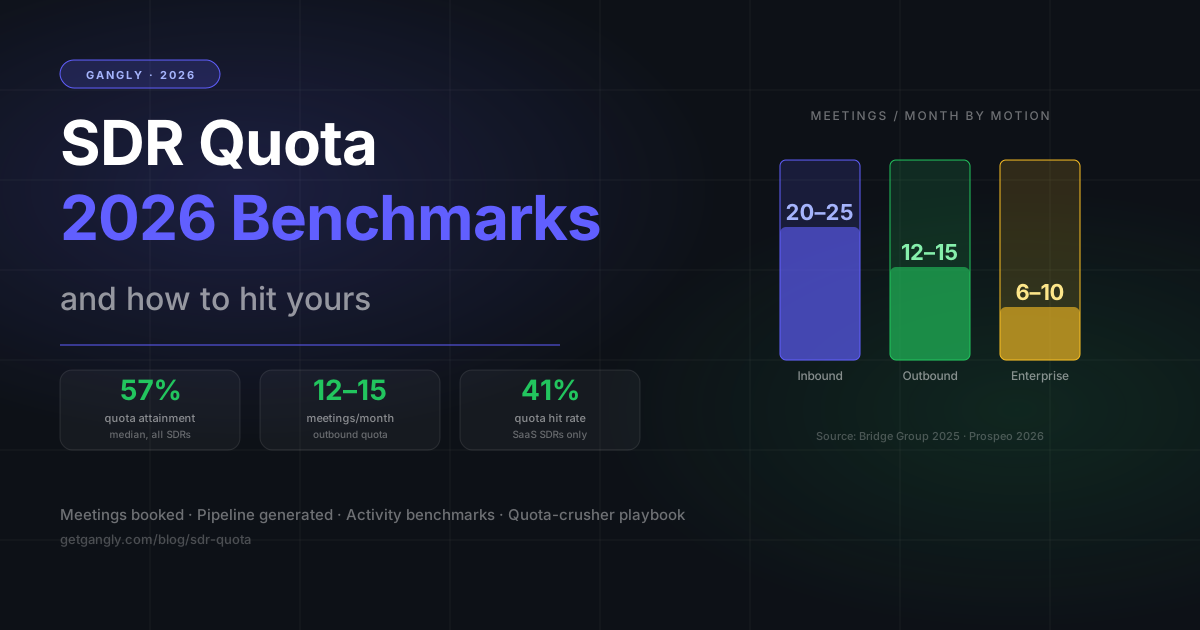
TL;DR
- The 2026 outbound SDR quota is 12–15 qualified meetings per month for mid-market motions — but only 57% of SDRs hit it (Prospeo 2026, Bridge Group 2025).
- Attainment varies sharply by motion: inbound-supplemented SDRs attain at 65–70%; pure outbound SaaS SDRs attain at 41%.
- SDR quotas have increased 35–40% since 2021 while cold-call connect rates dropped from 15–20% to 3–8% — the gap is where most attainment problems live.
- The top-quartile SDRs who hit 110%+ share six specific habits: signal-timed outreach, batched research, sub-90-second warm trigger calls, pipeline tracking, show-rate management, and quality handoffs.
- Reps who use signal-based workflows spend under 5 minutes per account on research vs 20–45 minutes manually — that time difference converts directly into more conversations per day.
Direct answer
SDR quota is the monthly or quarterly pipeline-creation target assigned to a sales development representative — most commonly expressed as qualified meetings booked, SQLs passed to AEs, or pipeline dollars generated. In 2026, the US median outbound SDR quota is 12–15 qualified meetings per month, with a median attainment rate of 57%. The quota varies by motion type (inbound vs outbound), market segment (SMB vs enterprise), and company stage (Seed through Series C+). Connect rates have declined sharply since 2021, making signal-based targeting — not raw call volume — the primary lever for hitting the number.
What is SDR quota — and what the 2026 numbers actually mean
SDR quota is the monthly or quarterly performance target that determines how much of an SDR's variable pay is earned. Unlike AE quota, which is tied to closed revenue, SDR quota is tied to pipeline-creation activities: qualified meetings booked, sales-qualified leads (SQLs) handed to AEs, or pipeline dollars sourced. The quota type matters because it shapes behavior — a meetings-based quota optimizes for volume, an SQL-based quota optimizes for quality, and a pipeline-based quota optimizes for deal size.
In 2026, the dominant quota structure for US outbound SDRs is the meeting-based quota (65% of companies), followed by the SQL-based quota (25%), and the pipeline-dollar quota (10%). Meeting-based quotas are the most common because they are the easiest to track and the most directly connected to SDR activity. SQL-based quotas are growing in adoption at Series B+ companies because they align SDR and AE incentives better — the AE's acceptance decision creates a quality gate that a meetings-only quota lacks.
The 2026 median outbound SDR quota is 12–15 qualified meetings per month for mid-market motions (Bridge Group 2025, Prospeo 2026). That number has increased 35–40% since 2021, when the median was 8–10 meetings per month. Over the same period, cold-call connect rates declined from 15–20% to 3–8%, and email reply rates dropped from 6.8% to 5–6%. More quota required with fewer connections available — that structural gap is where most attainment problems originate.
SDR quota vs. connect rate — the widening gap (2021–2026)
Sources: Bridge Group 2025 · Prospeo 2026 · Gong 2025. Quota indexed; connect rate shown directionally.
The implications are clear. A rep dialing 60 accounts per day in 2021 at a 15% connect rate had 9 conversations. The same rep dialing 60 accounts per day in 2026 at a 5% connect rate has 3 conversations. To restore the 9-conversation baseline, the rep now needs to dial 180 accounts — or target the 60 accounts where a warm signal exists. Signal-based targeting does not replace activity; it concentrates activity where it converts.
For a deeper look at the full SDR role — responsibilities, daily workflow, and career path — see the SDR role breakdown. For compensation benchmarks linked directly to quota type and attainment, see the SDR compensation guide.
SDR quota benchmarks by motion — inbound, outbound, and blended
Motion type is the first split to make when evaluating SDR quota. Inbound, outbound, and blended SDRs do fundamentally different work, face different conversion economics, and carry different quota numbers as a result. Comparing an inbound SDR's 22-meeting monthly quota to an outbound SDR's 12-meeting monthly quota without motion context produces misleading performance conclusions.
| Motion | Meeting quota | Show rate | Connect rate | Email reply | Calls/day | Motion characteristics |
|---|---|---|---|---|---|---|
| Inbound-led | 20–25/mo | 80–85% | 8–12% | 5–8% | 30–50 | Warm leads from marketing. Speed-to-lead is the primary variable — a 5-minute response yields up to 4× the conversion of a 30-minute response. Less outbound research required. |
| Outbound | 12–15/mo | 75–80% | 3–8% | 3–5% | 50–80 | Cold prospecting from ICP lists. Each connection requires ~21 touches on average (up from 17 in 2022). Multi-channel cadences averaging 53 days duration. Research burden is highest here. |
| Blended hybrid | 15–18/mo | 78–82% | 5–9% | 4–6% | 40–65 | Most common at Series B–C SaaS. Weighted quota: inbound lead volume sets the floor, outbound activity sets the ceiling. Quota typically splits 60/40 outbound-to-inbound. |
Sources: Prospeo 2026 · Bridge Group 2025 · tamtotarget.com 2026 · Gong 2025.
Three observations drive quota negotiation strategy. First, the inbound quota premium (20–25 vs 12–15 for outbound) reflects a genuine difference in lead quality — not a difference in rep effort. Inbound leads have demonstrated intent by engaging with content or filling out a form. Outbound SDRs must manufacture that intent through research and relevance. Neither role is easier; they require different skills and carry different risk profiles.
Second, show rate management is quota-critical for outbound SDRs. At a 75% show rate, a 15-meeting quota produces 11.25 actual conversations. At an 85% show rate, the same 15-meeting quota produces 12.75 conversations — 1.5 additional discovery calls per month, which compounds into 15–18 additional qualified conversations per year. The gap between 75% and 85% show rate is typically the difference between 60% attainment and 75% attainment.
Third, multi-channel sequencing is the standard approach for outbound motions. An average outbound sequence requires 21 touches across phone, email, and LinkedIn over 53 days. SDRs who abandon sequences before touch 8 miss the inflection point where cold prospects most frequently convert. The sequence duration data means that pipeline booked in month 3 often started sequences in month 1.
SDR quota by segment — SMB, mid-market, and enterprise
Market segment is the second axis for quota calibration. SMB, mid-market, and enterprise SDRs operate in different conversion environments: ACV scales with segment, which determines how much pipeline each meeting is worth, which determines both the per-meeting comp rate and the meeting quota itself. An enterprise SDR booking 6 meetings per month that each convert into $200K+ opportunities is generating more qualified pipeline than an SMB SDR booking 18 meetings that each convert into $15K opportunities.
| Segment | Meeting quota | SQL quota | Pipeline target/yr | Motion characteristics |
|---|---|---|---|---|
| SMB (ACV < $15K) | 15–20/mo | 12–18 SQLs/mo | $500K–$1.2M/yr | High-volume, fast-cycle motion. Meeting quotas are higher because ACV is lower — pipeline math requires more events. Sequences are shorter (5–7 touches). ICP is broader. |
| Mid-Market ($15K–$80K) | 10–15/mo | 8–14 SQLs/mo | $1M–$3M/yr | The SDR median. 50–80 call attempts per day. Multi-channel cadences. Quota attainment is most predictable here because ICP is defined and motion is proven. |
| Enterprise (ACV > $80K) | 6–10/mo | 4–8 SQLs/mo | $2M–$6M/yr | Lower volume, longer cycles. Enterprise SDRs prioritize account research and executive-level outreach. Each SQL is worth $500–$2,000 in per-meeting comp to reflect deal size. |
Sources: Bridge Group 2025 · Prospeo SDR Benchmarks 2026 · MarketBetter 2026.
The pipeline-per-year target deserves particular attention. The 2026 median SDR pipeline generation target is $3M per year across all segments (Prospeo 2026). But the distribution is wide: bottom-quartile SDRs generate under $750K, and top-quartile SDRs generate over $10M. The $10M figure is almost exclusively enterprise SDRs at cybersecurity and cloud infrastructure companies where individual deals exceed $500K. For the vast majority of B2B SaaS SDRs, a realistic annual pipeline generation target is $1M–$2.5M.
Annual SDR pipeline generation by segment (2026)
Enterprise SDRs target $2M–$6M/yr. Median across all segments: ~$3M/yr (Prospeo 2026).
Pipeline quota is gaining traction because it aligns SDR effort with revenue outcomes. When an SDR carries a $1.5M quarterly pipeline target, they make different choices about which accounts to sequence: they prioritize accounts with higher ACV potential, invest more research time per opportunity, and qualify more rigorously before the AE handoff. That quality shift benefits both the SDR (higher per-SQL comp on pipeline-based plans) and the AE (higher SQL conversion rate). The tradeoff is a longer feedback cycle — pipeline does not close in the same month it is sourced.
SDR quota by company stage — Seed through Series C+
Company stage shapes SDR quota through three mechanisms: motion maturity (is the ICP defined?), systems readiness (does the AE team respond to SQLs within 24 hours?), and inbound support (does marketing generate warm leads that supplement outbound?). A well-designed quota at a poorly-instrumented company produces the same attainment outcome as an aggressive quota at a well-instrumented one. Stage is a proxy for instrumentation.
| Stage | Meeting quota | SQL quota | Pipeline/yr | Ramp | What to expect at this stage |
|---|---|---|---|---|---|
| Seed (pre-Series A) | 6–10/mo | 5–8/mo | $300K–$700K/yr | 2–3 mo | ICP is still being validated. Quota is soft and frequently adjusted. Expect to do AE duties (discovery, demo setup) alongside prospecting. Quota misses are common due to undefined motion. |
| Series A | 8–12/mo | 8–12/mo | $500K–$1.2M/yr | 2–3 mo | First structured SDR playbook. Quota often set aspirationally — attainment below 50% in first two quarters is normal. Sequences exist but require personal judgment on targeting. |
| Series B | 10–15/mo | 10–15/mo | $1M–$2.5M/yr | 3 mo | Proven motion. Inbound support exists. Written ramp protection standard. Quota attainment closer to 60–65% median. Accelerators kick in at 100–110%. |
| Series C | 12–18/mo | 12–18/mo | $1.5M–$4M/yr | 3 mo | Highest SDR density. Inbound supplements outbound at meaningful volume. Quota pressure increases as headcount scales. Team attainment median: 55–65%. |
| Series D+ / Public | 10–15/mo | 10–15/mo | $1.5M–$3.5M/yr | 3–4 mo | Most stable quota setting. Formal territory carves. Quota set conservatively relative to earlier stages. RSU grants partially replace variable upside. |
Sources: Bridge Group 2025 · RepVue (May 2026) · Pavilion Pulse 2025 · Prospeo 2026.
Seed and Series A SDRs carry the highest ambiguity risk. The quota number may look reasonable on paper (8–12 meetings per month), but the lack of a defined ICP, proven sequence library, and consistent inbound support means that 100% attainment depends heavily on the rep's personal judgment rather than the company's systems. That same 8-meeting quota at a Series B company with inbound support and a written ramp is fundamentally a different quota.
Series B and Series C represent the highest quota attainment stability because the motion is proven, inbound supplements outbound, and the AE team follows up SQLs within the 24-hour window. The quota is also highest at these stages (12–18 meetings per month) because the system can support higher output. SDRs evaluating offers at different stages should weight the team's median attainment history above the headline quota number.
For the broader question of how company stage affects SDR compensation and career progression, the SDR compensation guide breaks down OTE, base, and variable pay by stage in detail.
SDR daily activity benchmarks by motion (2026)
| Activity | Outbound | Inbound | Enterprise | Notes |
|---|---|---|---|---|
| Cold calls dialed | 50–80 | 30–50 | 20–40 | Connect rates 3–10%. Multi-dial sequences with voicemail drops at touch 2 and 5. |
| Emails sent | 30–50 | 15–30 | 15–25 | Reply rates 3–6%. Personalized openers lift reply rate by 2–4×. Sequence depth: 7–9 touches. |
| LinkedIn activities | 15–25 | 10–20 | 10–20 | Profile views, connection requests, InMail. 10–15% acceptance rate for targeted requests. |
| Accounts researched | 8–15 | 5–10 | 3–6 | Research time: 20–45 min per account manually. Signal-based research compresses this to under 5 min. |
| New accounts added to seq | 5–12 | 3–8 | 2–5 | ICP scoring determines which accounts enter sequences. Quality of targeting is the primary conversion lever. |
Sources: Prospeo 2026 · Bridge Group 2025 · MarketBetter 2026.
Quota attainment reality — why 57% is the median and what drives the gap
Quota attainment is the most important number to understand before evaluating any SDR role. The headline OTE assumes 100% attainment. The actual payout is a function of attainment, which is a function of motion type, quota design, AE support quality, and the rep's own workflow. The 2026 median attainment rate of 57% means that roughly 43% of SDRs miss quota in any given month — a number that has not improved since 2022 despite increased investment in SDR tooling.
57%
All SDRs hit quota
Prospeo 2026, Bridge Group 2025. Roughly 43% of SDRs miss quota in any given month.
41%
SaaS-only SDRs hit quota
Software motion is harder — ICP is diffuse, TAM is competitive, outbound noise is highest here.
65–70%
Inbound-supplemented SDRs attain
Inbound support is the single largest predictor of SDR attainment after quota design.
22%
SDRs hitting 110%+
Top quartile. These are the reps who have signal-based workflows, low admin burden, and fast AE response.
Three structural forces drive low attainment. The first is admin burden: the average SDR spends 40–50% of the day on non-selling tasks — manual account research, CRM entry, sequence management, and meeting prep. That time does not produce meetings. It produces the appearance of activity without the output that pays variable comp.
The second is connect rate compression. Outbound cold-call connect rates dropped from 15–20% in 2021 to 3–8% in 2026 (Gong 2025, Prospeo 2026). The volume required to produce the same number of conversations has tripled. Companies that set meeting quotas in 2021 and never adjusted them for connect rate reality created quotas that are structurally unachievable for average reps.
The third is AE response quality. The AE-to-SDR ratio in 2026 is 1:2.4 (consistent since 2018 — Bridge Group 2025). At a 1:4 or 1:5 ratio, each AE has 4–5 SDRs generating leads simultaneously. SQL handoff lag increases. Meetings booked more than 72 hours before the AE follows up lose a significant portion of conversion potential because the prospect's attention has moved on. SDRs who book 15 meetings per month at a company with a 4-day AE response SLA earn variable comp for roughly 9 of those meetings, not 15.
The attainment gap between inbound-supplemented SDRs (65–70%) and pure outbound SDRs (55–60%) confirms that motion type — not rep effort alone — is the strongest predictor of attainment. Reps who evaluate role quality only by OTE headline systematically underestimate the motion context that determines whether that OTE is achievable.
What quota-crushers do differently — the six habits that separate the top quartile
The top quartile of SDRs — those who consistently attain 110%+ — share a set of observable workflow habits that separate them from average performers. These are not "work harder" platitudes. They are specific behavioral patterns that compound across a month of work. The data comes from Gangly's workflow analysis, Bridge Group research, and the RepVue survey base of 50,000+ SDR reviews.
- 01
They prioritize signal-timed outreach
Top-quartile SDRs do not send cold volume. They identify accounts with active buying signals — a new hire, a funding round, a technology change, a pricing-page visit — and contact those accounts in the first 48 hours. Signal-timed outreach delivers 3–5× the reply rate of untriggered cold volume because the message is relevant to something the buyer just did. The 72-hour decay window is real: accounts that receive relevant outreach on day 1 of a trigger convert at 3× the rate of the same accounts contacted on day 10.
- 02
They protect research time — and slash it with tools
High-attainment SDRs spend 20–30 minutes per day on research — not per account. They batch account research into a dedicated morning block, use signal-detection tools to pre-populate context, and enter sequences with specific personalization tokens in place before calling. Average SDRs spend 40–50% of their day on non-selling activities including manual research, CRM entry, and sequence management. That gap — 20 minutes of focused research vs 4 hours of scattered admin — is where quota attainment is won or lost.
- 03
They call within 90 seconds of a warm trigger
When a prospect opens an email three times in 20 minutes, or engages with a LinkedIn post, or visits the pricing page — the highest-attainment SDRs call within 90 seconds. This is not responsiveness theater. Open-and-call sequences produce 6–8× the connection rate of cold-first calling because the prospect is actively in context. Most SDRs wait hours or days, or never call at all. The connection rate on a cold call to a never-engaged prospect is 3–6%. The connection rate on a call triggered by a fresh engagement event is 15–25%.
- 04
They track pipeline value — not just meeting count
Meeting quota is a leading indicator. Pipeline generated is the outcome that matters for comp, promotion, and AE trust. Top-quartile SDRs track which of their meetings convert to opportunities, which opportunities close, and what their SQL-to-close rate is. That data gives them a personal conversion funnel they can defend in 1:1s, use to negotiate for inbound support, and reference when requesting accelerator clarity. SDRs who only track meeting volume cannot answer the question: "Why do your meetings convert at 2× the team rate?" Those who track pipeline can.
- 05
They manage show rate as actively as booking rate
Booking 15 meetings with a 60% show rate produces 9 actual conversations. Booking 12 meetings with an 85% show rate produces 10.2 — more pipeline, fewer wasted bookings. Top-quartile SDRs confirm meetings 24 hours in advance, send calendar prep notes that create perceived value before the call, and set explicit agenda items so the prospect knows what they are walking into. A meeting without a confirmed agenda is a meeting the prospect will cancel.
- 06
They use discovery to create handoff quality, not just handoff volume
AEs accept SDR-sourced SQLs at a higher rate when the handoff brief includes: (1) the specific pain point the prospect articulated, (2) the trigger event that prompted the outreach, (3) the decision criteria the prospect mentioned, and (4) the next-step commitment the prospect made. SDRs who provide this context in the CRM handoff note see AE acceptance rates 40–60% higher than SDRs who hand off meeting bookings with no notes. Higher SQL acceptance rate translates directly to higher variable comp on SQL-based or pipeline-based plans.
The common thread across all six habits is time allocation. Top-quartile SDRs protect conversation time by eliminating or automating everything that is not a conversation. The 40–50% admin burden that consumes average SDRs is compressed to 15–20% for top performers — not because they skip steps, but because they use signal-based tools that do the research, draft the outreach, and update the CRM automatically.
For context on how AI tools are reshaping the SDR role and which tasks are most effectively automated, see the AI SDR breakdown.
The SDR Quota-Hit Playbook — Gangly's five-step weekly framework
The SDR Quota-Hit Playbook is Gangly's five-step weekly framework for hitting quota — derived from the workflow patterns of top-quartile SDRs and designed to be repeatable regardless of quota type (meeting-based, SQL-based, or pipeline-based). The framework runs Monday-to-Friday on a 5-hour active-selling day, accounting for the 40–50% overhead that average SDR days require.
The SDR Quota-Hit Playbook — 5-step weekly framework
Monday AM: Signal sweep and account tiering
Review the week's signal feed: funding announcements, executive hires, job postings, pricing-page visits, and LinkedIn engagement from target accounts. Tier the 20 highest-signal accounts as Priority A. These accounts get personalized outreach this week. The remaining accounts get sequence templates. Budget: 45 minutes.
Monday–Tuesday: Priority A outreach in a 90-minute block
Write personalized openers for each Priority A account referencing the specific signal (not a generic "I saw you raised funding"). Call each Priority A account within the signal window — ideally within 48 hours of the trigger. Personalized signal-timed outreach converts at 3–5× the rate of cold volume. Budget: 90 minutes per day, Monday–Tuesday.
Tuesday–Thursday: Sequence management and follow-up
Add 5–12 new accounts to active sequences daily. Follow up on open threads from previous sequences — touch 4, 5, and 6 are where most outbound conversions happen. Check email engagement events: triple-opens or rapid re-visits trigger an immediate call attempt. Budget: 60–90 minutes per day.
Wednesday–Friday: Meeting confirmation and show-rate management
Confirm all meetings booked for the following week with a 24-hour reminder that includes: the meeting agenda, a 2-sentence prep note ("Here is what we'll cover and why it matters to you"), and a calendar link to reschedule. This single step lifts show rates from 75% to 82–85% consistently. Budget: 20 minutes per day.
Friday: Handoff quality and pipeline tracking
Update CRM with handoff notes for every SQL submitted this week: pain point identified, trigger event, decision criteria mentioned, next-step commitment made. Track the week's pipeline contribution vs target. Adjust next week's Priority A list based on which signal types converted. Budget: 30 minutes.
The math behind the playbook: an outbound SDR running the five-step framework should produce 3–4 qualified meetings per week on a 12–15-meeting monthly quota. That requires 1.2–1.4 meetings booked per day across a 15-day outbound month (excluding weekends). At a 12% conversation-to-meeting rate, the rep needs roughly 12 real conversations per day — achievable on 60–80 dial attempts at a 5–8% outbound connect rate, plus 3–5 responses from email sequences.
The framework breaks down when admin time expands. If account research takes 30 minutes per account instead of 5 (the manual research benchmark), Step 2 of the framework consumes the entire day. The tool intervention that makes the playbook executable is signal-based account enrichment — pre-populated context that compresses research from 30 minutes to under 5 minutes per account, restoring the time budget for actual outreach.
Gangly turns buying signals into prepared reps — detecting trigger events, enriching account context, drafting signal-grounded outreach, and updating CRM after every call. SDRs using Gangly's signal-to-sequence workflow report spending under 5 minutes per account on research vs the 20–45-minute manual baseline. That time difference translates directly to more Priority A accounts touched per day, more conversations per week, and more meetings per month.
Start a 14-day free trial to see how Gangly maps to your current quota and motion, or book a demo for a walkthrough of the signal-to-SQL workflow.
SDR quota updates · quarterly
Get the next SDR benchmark drop — free.
Quarterly data on SDR quota benchmarks, attainment rates, and activity norms. No spam.
Subscribe to the newsletterSix quota mistakes that guarantee a miss — and what to do instead
Most SDR quota misses trace back to a small set of repeatable workflow errors. These are not motivation problems. They are process problems — each one has a specific fix that takes under a week to implement.
Treating all accounts as equal
Fix: Tier your book. Top 20 accounts (ICP-fit + active signal) get 80% of your research and sequencing effort. The other 80% of accounts get templated multi-touch with low manual overhead. If you spend equal time on every account, you dilute effort where it compounds.
Measuring calls dialed, not conversations had
Fix: Calls dialed is a vanity metric. The number that predicts quota attainment is meaningful conversations per week. Track the ratio of calls dialed to real conversations (2+ minutes). If your conversation rate is below 6%, the problem is call timing and targeting — not volume.
Letting admin eat the morning block
Fix: The first 90 minutes of the day are the highest-conversion calling window (decision-makers answer at higher rates before 9:30 AM and between 4:00–5:30 PM). SDRs who spend that window on CRM cleanup, email catchup, or sequence configuration lose 30–40% of their best conversation hours every week.
Quitting a sequence too early
Fix: The average deal requires 21 touches before a response (up from 17 in 2022). Most SDR sequences are 5–7 touches. The majority of SDRs give up at touch 4 if there is no reply. The 6th, 7th, and 8th touches are where the conversion curve inflects for cold outbound — that is the discovery most reps never reach.
Booking demos instead of discovery calls
Fix: SDRs who book "demos" instead of "discovery calls" hand off prospects who have not been qualified for pain, urgency, or decision authority. AEs reject these at higher rates, destroying the SDR's SQL acceptance ratio and variable comp. The fix: structure the SDR handoff as a qualified discovery, not a product demo. Use the BANT or MEDDPICC criteria to qualify before passing.
Ignoring the AE handoff SLA
Fix: A booked meeting that gets followed up by the AE 72+ hours later loses 60–70% of its conversion potential. If the AE-to-SDR ratio is 4:1 or higher, or if the AE average response time is over 24 hours, the SDR's attainment is structurally capped regardless of activity. Track the handoff SLA. If it is above 24 hours, surface it to the manager with pipeline data before the quarter ends.
Continue reading
Workflows
AI SDR: Can It Replace Your Business Development Rep?
AI SDRs handle volume. Human SDRs handle signal. The honest breakdown of what AI SDRs actually do, where they fail, and how to combine both.
Workflows
SDR Role Explained: What a Sales Development Rep Actually Does
The SDR role explained in full — responsibilities, day-in-the-life time breakdown (including the 41% admin burden most guides skip), KPIs, career path.
Workflows
SDR Compensation: 2026 Benchmarks and Structures
2026 SDR compensation benchmarks by company stage (Seed–Series C+), industry, and experience tier — base, OTE, quota, ramp, commission structures.