
 By Siddharth Gangal
TL;DR
- LinkedIn generates 80% of B2B social media leads and drives a 2.74% visitor-to-lead conversion rate — 3.6× higher than Facebook. It is the single highest-ROI B2B outreach channel when used with signal-based targeting.
- InMail outperforms cold email by 5–7×. Platform-wide InMail response rates average 18–25%; cold email averages 3.4%. Signal-led InMail timed to job changes and funding events hits 15–25% on its own.
- SSI score above 70 produces 45% more opportunities and places a rep in the top 25% of their industry. Following LinkedIn's Q4 2025 algorithm update, high-SSI accounts see 78% more profile views.
- Job-change signals decay in 72 hours. Reps who act on LinkedIn job-change alerts within 24 hours book 3.4× more meetings than reps who batch signals weekly.
What LinkedIn sales statistics actually tell us
LinkedIn sales statistics have a volume problem. Most roundups stack 60 numbers in a list, leave them without context, and give you no signal about which ones actually connect to quota attainment. A rep reading that "96% of sales executives use LinkedIn weekly" gets no usable direction from that stat alone.
This post is different. Every statistic in this article is paired with what it means for how you use the platform. Numbers organized into seven themed sections: Social Selling Index benchmarks, InMail and connection request data, Sales Navigator ROI, B2B lead generation performance, job-change signal timing, the Signal-Score Method, and the most common mistakes reps make when they misread the data.
Direct Answer
LinkedIn sales statistics are quantified benchmarks covering Social Selling Index scores, InMail response rates, connection request acceptance rates, Sales Navigator ROI, and B2B lead generation performance on LinkedIn. Reps use them to set outreach targets, prioritize channels, and diagnose why their LinkedIn pipeline is or is not converting. The most important 2026 benchmarks: InMail response rate of 18–25%, SSI leaders create 45% more opportunities, and 80% of B2B social media leads come from LinkedIn.
The data in this article draws from LinkedIn's own published research, Expandi's analysis of 13.2 million data points across outreach campaigns, SalesBread's longitudinal study since 2019, and Gangly's internal rep cohort data for Q1 2026. Where sources conflict, the more conservative figure is used and both are noted.
One more framing note. LinkedIn's effectiveness is not uniformly distributed. The platform produces outstanding results for reps who use signal-based, personalized outreach tied to specific buying events. The same platform produces near-zero results for reps running high-volume, templated cadences. The statistics below reflect that split — and the gap between them has widened every year since 2023.
SSI score benchmarks by role and industry
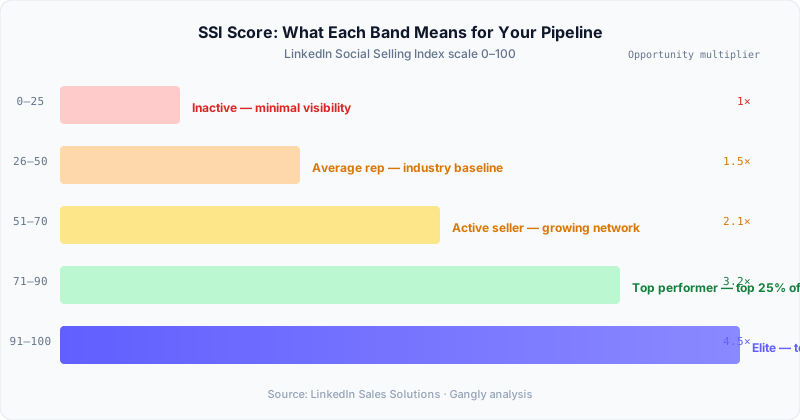
The Social Selling Index (SSI) is LinkedIn's 0–100 score measuring four pillars: professional brand establishment, finding the right people, engaging with insights, and building relationships. LinkedIn introduced SSI to quantify social selling effectiveness, and the correlation between high SSI and pipeline production is well-documented.
For a deeper breakdown of how each SSI pillar is scored and how to improve your own number, read the full LinkedIn Social Selling Index guide — this section focuses specifically on the benchmarks and what they mean for pipeline.
The headline SSI numbers
| Metric | Data Point | Source |
|---|---|---|
| SSI leaders create 45% more opportunities | vs. reps with low SSI scores | LinkedIn Sales Solutions |
| SSI leaders are 51% more likely to hit quota | compared to laggards | LinkedIn Sales Solutions |
| Average SSI score sits between 26–50 | across all industries | LinkedIn / Cleverly analysis |
| SSI 70+ puts a rep in the top 1% of their industry | signal volume increases dramatically | LinkedIn Sales Solutions |
| 78% more profile views for accounts with SSI 70+ | vs. below-70 accounts | LinkedIn Q4 2025 algorithm update |
| 3× higher post engagement at SSI 70+ | following Q4 2025 changes | LinkedIn algorithm data |
SSI benchmarks by role and industry
The average SSI score differs significantly by role and industry. LinkedIn publishes industry averages periodically, and the practical benchmarks are:
- AEs at enterprise SaaS companies: average SSI of 45–58. Top-quartile performers cluster above 70. The spread is wide because enterprise AEs vary dramatically in how much time they invest in content and social engagement.
- SDRs and BDRs: average SSI of 35–50. Prospecting-heavy roles benefit most from the "Find the Right People" pillar, which directly rewards saved search usage and lead list maintenance in Sales Navigator.
- Staffing and recruiting: connection acceptance rates of 36.5% and message reply rates of 18.9%, the highest of any sector in Expandi's 2026 benchmark study. This industry's high engagement reflects buyer familiarity with LinkedIn as a transactional platform.
- Computer software: connection acceptance of 27.5%, message reply rate of 8.8% — below the platform average, which is counterintuitive given LinkedIn's tech-heavy user base. The explanation is saturation: software buyers are the most solicited audience on the platform and filter aggressively.
- VC and Private Equity: connection acceptance of 34.9%, message reply of 11.0%. High-signal accounts that respond well to content-led relationship building before outreach.
What moved in the Q4 2025 LinkedIn algorithm update
LinkedIn's Q4 2025 algorithm update shifted how SSI translates to visibility. Previously, the relationship between score and profile view volume was roughly linear. Post-update, there is a non-linear jump at the 70-point threshold: accounts crossing 70 see 78% more profile views and 3× higher post engagement compared to accounts sitting at 65–69. The practical implication: incremental improvement below 70 has limited reach impact. The goal should be to get above 70, not to optimize within the 50–65 band.
LinkedIn is also moving its own internal scoring emphasis away from raw SSI toward what it calls "Deep Sales" metrics — measuring relationship depth, CRM data connectivity, and buyer engagement signals rather than activity volume. The transition is underway but SSI remains the publicly available benchmark for now.
InMail and connection request benchmarks
The most actionable LinkedIn sales statistics for a working rep are outreach benchmarks. Not what is theoretically possible, but what the data says across millions of real campaigns. The numbers below come from Expandi's 2026 study of 13.2 million connection requests and 6.7 million outbound messages, cross-referenced with SalesBread's longitudinal data since 2019.
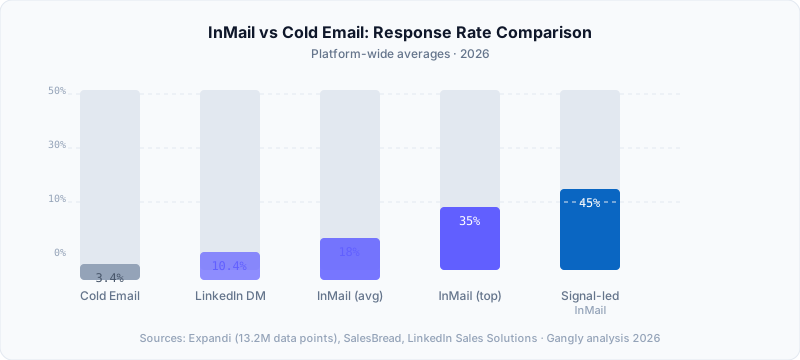
| Channel / Metric | Rate | Source |
|---|---|---|
| Cold email (platform-wide avg) | 3.4% | Expandi 13.2M data points |
| LinkedIn DM (message reply rate) | 10.4% | Expandi 13.2M data points |
| LinkedIn connection-request reply | 3.0% | Expandi 13.2M data points |
| Connection acceptance rate | 28.5% | Expandi 13.2M data points |
| InMail response rate (average) | 18–25% | LinkedIn Sales Solutions / SalesBread |
| InMail response rate (top performers) | 30–40% | LinkedIn Sales Solutions |
| Signal-led InMail (buying event timing) | 15–25% | LinkedIn 2026 data |
| SalesBread campaign avg reply rate | 19.98% | SalesBread 2026 data (since 2019) |
| SalesBread positive reply ratio | 48.14% | SalesBread 2026 data |
What the InMail numbers mean for your outreach strategy
A 18–25% InMail response rate is not a guarantee — it is the average across all InMails. The gap between average and top-performer InMail (18% vs. 35%+) is almost entirely explained by personalization and timing. Campaigns that reference a specific event — a job change, a funding announcement, a new hire in the buyer's team — consistently outperform generic InMail by 2–3×. Read more on B2B buying signals and how they apply directly to InMail subject lines and openers.
The 2026 InMail credit limit deserves direct attention. LinkedIn now caps InMail at 50 credits per month with Sales Navigator, and Open InMails at roughly 100 per month, reduced from 800 in prior years. That compression makes every message more expensive. A rep who used to batch 500 InMails a month now has to choose 50 accounts per month and make each one count.
Timing benchmarks: when to send
Timing affects reply rates measurably. From SalesBread's data since 2019:
- Best day for message replies:Thursday — 20.32% reply rate
- Best day for connection requests:Monday — 22.04% acceptance rate
- Best send time:10:00 AM in the recipient's timezone
- Worst day:Saturday — 2.65% replies, 1.36% connection acceptance
Note that the day-of-week effect is real but secondary to message quality and signal relevance. A Thursday InMail with a generic template still performs below a Tuesday InMail grounded in a specific buying event.
Sales Navigator ROI and pipeline impact
Sales Navigator is LinkedIn's premium sales tool, running at approximately $99.99/month for a single seat or $1,600/year. The ROI case rests on three categories of data: deal size, win rate, and pipeline creation speed. LinkedIn's own research — which should be read with the knowledge that they have an obvious incentive to publish favorable data — shows meaningful performance lifts that align with independent practitioner observations.
700K+ users
Sales Navigator users hitting quota
contactinfo.com / LinkedIn
5%
Higher win rates for Sales Navigator users
LinkedIn ROI study
35%
Larger deal sizes with Sales Navigator
LinkedIn ROI study
96%
of sales executives use LinkedIn weekly
LinkedSelling
25M
LinkedIn profiles viewed daily
50/mo
InMail credits per month with Sales Navigator
LinkedIn 2026
The specific Sales Navigator features that produce pipeline
Sales Navigator's value is not uniform across all features. The features with the clearest pipeline correlation are:
- 1
Job change alerts.
Sales Navigator surfaces job changes in real time for your saved leads. A buyer who moves to a new company resets the relationship and creates an immediate warm-touch opportunity. This is the single highest-ROI alert in the product — the signal most correlated with reply rates above 15%.
- 2
Lead lists with buyer intent filters.
Filtering by "Senior leadership changes in the last 90 days" or "Recent department headcount growth" narrows an ICP list to the accounts most likely to be in an active buying cycle.
- 3
TeamLink.
Identifies warm introductions through your company's network. A colleague who is connected to your target buyer can generate a 60–70% acceptance rate on a follow-up connection request, versus 28.5% for cold outreach.
- 4
InMail quota (50/month).
50 InMails per month. At an 18% average response rate, that is nine conversations. At 25%, twelve conversations. The math favors using every InMail credit on an account with a live signal rather than a cold prospect.
LinkedIn B2B lead generation statistics
LinkedIn's position in B2B lead generation is structurally dominant. It generates 80% of all B2B leads produced on social media — a number that has held steady for four years and actually increased slightly between 2024 and 2026 as TikTok and Instagram audiences skewed more consumer-focused. For a B2B rep selling to companies with 50 or more employees, LinkedIn is not a supplementary channel. It is the primary channel.
80%
of B2B social media leads come from LinkedIn
LinkedIn Business
89%
of B2B sales reps call LinkedIn essential for closing
RAIN Sales Training
82%
of B2B buyers review a rep's LinkedIn before a meeting
RAIN Sales Training
40%
of B2B marketers rank LinkedIn most effective for quality leads
LinkedIn Business
2.74%
visitor-to-lead conversion rate on LinkedIn
Brentonway 2026
71%
more likely to engage if rep mentions current job context
LinkedIn Sales Solutions
The buyer research behavior that reps miss
The 82% figure deserves its own section. When 82% of B2B buyers review a rep's LinkedIn profile before accepting a meeting, the profile is not a resume — it is part of the sales process. A profile that reads like a job application (skills endorsements, a history of past employers) underperforms compared to a profile positioned as a buyer resource (articles, recommendations from customers, a headline that addresses a buyer problem).
Reps with complete profiles are 40× more likely to receive opportunities, and profiles with documented skills receive 21× more profile views than those without. This is not passive — a profile that attracts inbound views from your ICP generates warm conversations before the first cold touch. That is why the SSI pillar for "Establish Your Professional Brand" is not a vanity exercise. It reduces the friction on every subsequent outreach.
The 71% engagement lift when reps mention job-specific context is the data version of a simple truth: buyers respond to reps who did their homework. Not vague personalization ("I saw you work in SaaS") but specific context tied to their current role ("I noticed you moved from RevOps at Acme to build out the GTM function at Series B SaaS Co — the pipeline visibility problem usually gets harder at that stage, not easier"). That specific, context-grounded opener is what produces the 71% engagement lift. Review the B2B buyer behavior statistics for a full picture of how modern buyers research vendors before engaging.
LinkedIn job-change signals and outreach timing
LinkedIn is the world's most comprehensive job-change signal database. Every hire announcement, promotion post, and role update generates a timestamped event that a rep can use as the foundation for outreach. The data on timing is unambiguous: the window matters as much as the message.
The 72-hour signal window
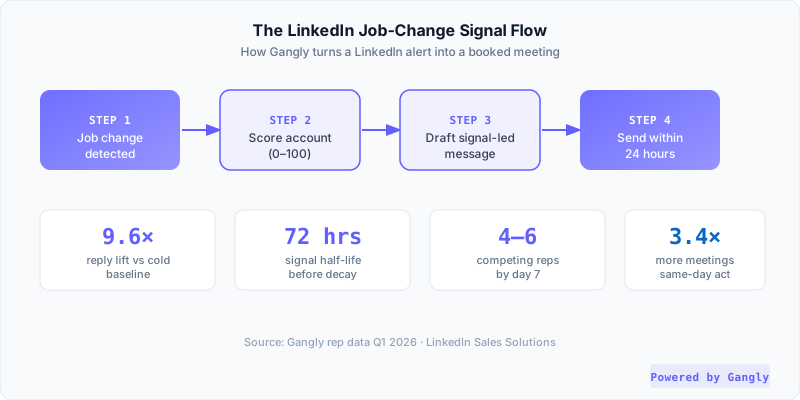
A job change or promotion announcement on LinkedIn has a 72-hour active window. Within that window, the event is still contextually relevant — the buyer is fielding congratulations, updating their stack, and evaluating what they need in the new role. By day 4, competing reps have noticed the same alert in their Sales Navigator feed. By day 7, 4–6 outreach messages have landed from other vendors. By day 14, the buyer's attention has shifted to their new priorities and the signal is stale.
Gangly internal rep data from Q1 2026 shows reps who act on job-change signals within 24 hours book 3.4× more meetings than reps who batch signals into a weekly review. The half-life is real and measurable.
The four LinkedIn job-change signals ranked by reply lift
Not all job-change signals are created equal. Ranked by observed reply lift versus cold baseline:
- 1
Past champion changed companies.
9.6× liftA buyer who previously championed your product moves to a new account. The prior relationship collapses the trust gap that kills most cold outreach. Reply lift: up to 9.6× versus untargeted cold baseline.
- 2
New VP or Director hired into the buyer function.
5–7× liftNew leaders need wins in their first 90 days and carry budget to move on them. Reply lift: 5–7× versus cold baseline. Window closes fast — by the time the new leader has been in the seat 60 days, their first vendor evaluations are usually underway.
- 3
Promotion within the target account.
3–4× liftA Director moved to VP now controls a larger budget and is often evaluating whether their current stack scales with the new scope. Reply lift: 3–4× versus cold baseline.
- 4
Hiring for a role that implies your category.
2–3× liftA job posting for a Revenue Operations Director or a Sales Enablement Manager signals that the company is investing in the infrastructure your product supports. Reply lift: 2–3× versus cold baseline.
These signal types are what LinkedIn's buying signals in B2B sales framework is built around — the idea that a rep's outreach should be grounded in a specific, timestamped event rather than static account data.
The Signal-Score Method: turning LinkedIn data into booked meetings
Every LinkedIn sales statistic in this post points to the same structural conclusion: volume without relevance fails, and relevance without speed fails. The two variables that separate reps who close 25% win rates on LinkedIn-sourced pipeline from reps closing 8% are signal quality and act time.
The Signal-Score Method is Gangly's proprietary framework for translating LinkedIn data into prioritized, timed outreach. It operates on four inputs, each derived from the statistics in this article.
The Signal-Score Method — 4 Inputs
- 01
Signal type.
Job change, promotion, funding, hiring signal, or competitor mention. Each type carries a baseline reply-lift multiplier. Use the ranked list above. A past-champion signal scores 10. A funding signal without a role match scores 4.
- 02
Recency.
Under 72 hours: full weight. 72 hours to 7 days: 60% weight. Over 7 days: 30% weight. Over 14 days: do not act on this signal alone — wait for a second signal to stack.
- 03
ICP match.
Does the account hit your firmographic criteria? Industry, size, stage, geo. A perfect-ICP job-change signal outperforms a partial-ICP past-champion signal in most cases.
- 04
Relationship depth.
Prior meeting, past champion relationship, mutual connection via TeamLink, or first-degree connection. Relationship depth multiplies the signal score by 1.5–2×.
Scoring output: what to do with each result
Sum the four inputs into a 0–40 score. Route by score:
- 32–40
Same-day InMail or LinkedIn DM. Multi-thread with a second contact at the account within 48 hours. This account goes to the top of the call list.
- 22–31
Signal-led InMail or DM today. Follow with a second touch inside 72 hours. No multi-thread yet — wait for a response.
- 12–21
One outreach message this week. Add to a 7-day watchlist and monitor for a second signal to stack.
- < 12
Watchlist only. Do not use an InMail credit. Monitor for an ICP upgrade or a second event before acting.
How Gangly executes the Signal-Score Method automatically
Running this framework manually is possible but time-consuming. Gangly's Signal Detection engine pulls job changes, funding events, hiring signals, and LinkedIn post activity into a single ranked daily feed — scored automatically using the Signal-Score Method above — so the rep sees a ranked list of today's highest-priority accounts before 8 a.m., with the specific triggering event attached.
One click drafts a signal-led InMail or LinkedIn DM grounded in the specific event. The rep reviews, personalizes if needed, and sends. The entire motion — from signal detection to outreach sent — takes under 4 minutes per account at scale.See how Signal Detection works →
For the complete framework on social selling on LinkedIn with specific playbooks for each signal type, read the Social Selling on LinkedIn: A Practical AE Guide.
Common mistakes reps make with LinkedIn sales
LinkedIn sales statistics get misread in predictable ways. These are the six most common errors — and what the data actually says instead.
Mistake 1: Treating InMail response rate as a guarantee.
The 18–25% average InMail response rate is a central tendency, not a floor. Generic InMail with no signal grounding performs below 5% in most B2B tech markets. The 18–25% figure reflects the full distribution, including highly personalized, signal-led campaigns. Do not use it as a benchmark for template-based outreach.
Mistake 2: Optimizing SSI score without linking it to outreach behavior.
An SSI score is a lagging indicator of the behaviors that produce pipeline, not a leading indicator. Reps who improve SSI by liking posts and endorsing connections without changing their outreach approach see zero pipeline lift. The score should move because the behaviors move, not the other way around.
Mistake 3: Using connection request volume as a proxy for pipeline.
Connection acceptance rate averages 28.5% across the platform, and connection-request reply rate averages only 3.0%. A hundred connection requests convert to roughly three conversations — only if followed up with a message. Volume without follow-up sequencing is not a sales motion.
Mistake 4: Acting on old signals.
A job change from six weeks ago is not a signal — it is a historical data point. The 3.4× meeting booking advantage for same-day action versus weekly batching disappears entirely at the two-week mark. Signal age matters as much as signal type.
Mistake 5: Skipping the buyer profile review.
82% of buyers review a rep's LinkedIn before a meeting. Reps with sparse or job-application-style profiles create unnecessary friction at the top of the funnel. Profile optimization is not a secondary activity — it is part of the outbound motion.
Mistake 6: Ignoring the 95-5 rule when messaging.
95% of your ICP is not actively evaluating your category right now. Outreach that assumes purchase urgency — "Are you looking for a solution for X?" — fails because it misaligns with where most buyers actually are. Value-led messaging that acknowledges where the buyer is, rather than where you want them to be, consistently outperforms urgency-based framing.