
 By Siddharth Gangal
TL;DR
- What it is: the social selling index (SSI) is a 0–100 score LinkedIn assigns to every user based on four behaviors — professional brand, finding prospects, engaging with content, and building relationships. It updates daily and is free at linkedin.com/sales/ssi. No equivalent official metric exists on other platforms.
- The 45% claim: LinkedIn research says high-SSI reps create 45% more opportunities and are 51% more likely to hit quota. That data is correlative — the behaviors that raise the score also raise pipeline. A rep who chases the number through generic activity books zero meetings.
- Use it as a behavioral checklist: check which of the four pillar sub-scores is lowest, identify the missing behavior, install the habit. The score is a diagnostic. Pipeline is the goal.
- Fastest gains: complete the profile to All-Star status (brand pillar), run five filtered searches and save 20 ICP leads per day (find pillar), post three times per week with five substantive comments daily (engage pillar). Most reps gain 15–25 points in 30 days.
Gangly Newsletter
Get the weekly playbook for signal-based outbound
Tactics on LinkedIn selling, signal-based prospecting, and rep workflows — sent every Tuesday.
Subscribe freeWhat is the social selling index?
The social selling index (SSI) is a 0–100 score LinkedIn calculates for every user to measure how effectively they use the platform for social selling. It reflects four equally weighted behaviors: building a professional brand, finding and saving the right prospects, engaging with relevant content and insights, and nurturing relationships. The score updates every 24 hours and is freely accessible at linkedin.com/sales/ssi. No Sales Navigator subscription is required.
LinkedIn introduced the SSI in 2014 as a paid feature for Sales Navigator subscribers. In August 2015, the company opened it to all members at no cost. The stated purpose was to give salespeople a quantified view of their social selling habits — a behavioral health check packaged as a single number. That framing is largely accurate, with one important caveat: the score reflects your inputs, not your outputs.
The score reflects activity over the trailing 90 days, not a single day. A rep who was highly active for six months and then stopped will see their score decay gradually — typically two to four points per week with zero activity. The score also benchmarks you against two external groups: others in your industry and others in your LinkedIn network. Both comparisons appear on the free SSI dashboard.
One persistent misconception worth addressing upfront: the SSI score does not affect profile search visibility or post reach. LinkedIn has stated this explicitly. The score is a self-diagnostic tool, not an algorithm input. However, the behaviors it tracks (publishing content, engaging with contacts, building an active network) do influence reach indirectly, because LinkedIn's feed algorithm rewards consistent engagement regardless of your SSI number.
This post covers the SSI concept broadly — what the four pillars measure, what benchmark data actually shows, and why the most important thing a rep can do with their score is read it as a behavioral checklist rather than a ranking to maximize. For the full LinkedIn-specific playbook — including how to find your score, a 30-day improvement plan, and pillar-by-pillar tactics — read the companion post on the LinkedIn Social Selling Index.
The question worth asking is not "how high is my score?" The question is "which pillar is lowest, and what does that tell me about a gap in my prospecting behavior?" That is the lens that makes the SSI useful.
The four SSI pillars — what each one actually measures
Each pillar contributes up to 25 points to the total SSI score. A rep who scores 22/25 on brand but 9/25 on finding prospects has a total of 31, not 75. The gap in one pillar does not get cancelled by strength in another. That is why the pillar breakdown — not the headline number — is the diagnostic that matters.
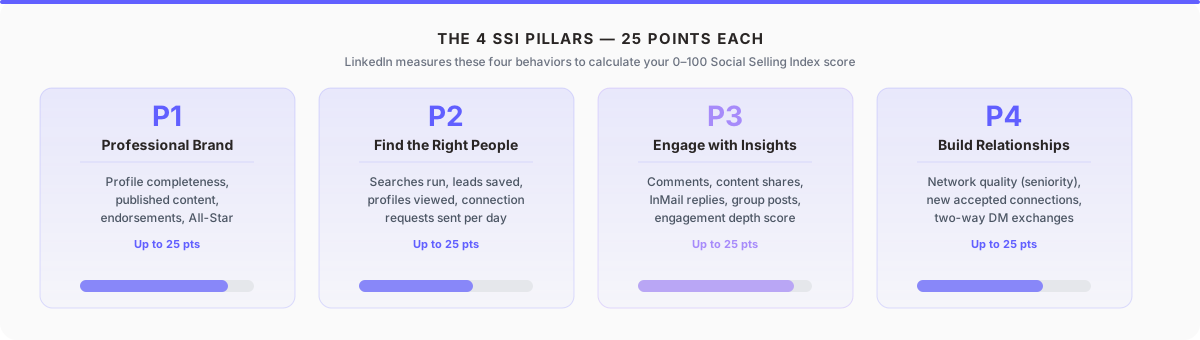
Pillar 1: Establish Your Professional Brand (up to 25 points)
This pillar scores how complete, credible, and content-rich your profile is. LinkedIn weighs profile completeness (reaching All-Star status), the presence of original published content, the quality of your Featured section, the number of skill endorsements, and whether your profile reads as a resource for buyers rather than a resume for recruiters.
A sparse profile — no featured section, no endorsements, no original articles — will cap your brand pillar score below 10. An All-Star profile with a weekly LinkedIn post and ten or more skill endorsements from colleagues and clients can reach 20 or higher. The brand pillar is the one most reps can improve fastest because it depends primarily on one-time setup tasks rather than daily habit changes.
The pipeline connection: a strong brand profile generates inbound profile views from target accounts. When a prospect views your profile before you reach out, your connection request has context. The accept rate on personalized requests climbs from roughly 20% for unknown profiles to 40–50% when the prospect has already viewed your content. That is not SSI working — that is buyer behavior responding to a credible signal source.
Pillar 2: Find the Right People (up to 25 points)
This pillar measures active prospecting behavior: how many filtered searches you run, how many ICP-matched leads you save, how many decision-maker profiles you view per day, and whether you prospect consistently across the week rather than in occasional bursts. LinkedIn tracks search frequency, lead-saving cadence, and profile view volume — all as a proxy for whether you are actively working a territory.
The practical daily target: five or more filtered searches using advanced criteria (seniority, company size, geography, job change recency), 20 or more ICP leads saved, and 15 to 25 decision-maker profile views. That volume sounds high if you have not built the habit. It takes under 20 minutes once the workflow is installed.
The pipeline connection: profile views generate return views. A rep who views 25 VP Sales profiles on Monday will typically see 3 to 8 of those prospects view their profile back within 48 hours. That return view is a warm signal — the prospect is curious. A connection request arriving within 24 hours of their return view converts at substantially higher rates than a cold request arriving days later.
Pillar 3: Engage with Insights (up to 25 points)
The third pillar scores engagement depth — how often you comment on relevant posts, share content with original commentary, respond to InMails, and interact with saved account activity. Passive scrolling and one-word reactions earn nothing. LinkedIn tracks the number of substantive comments (three or more sentences), original shares, and InMail reply speed.
The practical target: five substantive comments per day on posts from prospects, peers, or industry leaders in your ICP industry. One original share per week with two or three sentences of your own perspective. InMail replies within 24 hours, even when the answer is a decline. The response speed on InMails affects this pillar score directly.
The pipeline connection: commenting on a prospect's post before reaching out removes the cold from "cold outreach." The prospect has seen your name three times before your connection request arrives. The warm DM that references their specific post converts at 3x the rate of a generic pitch. Engaging with insights is the pillar that makes outreach feel like a continuation, not an interruption. This is covered in depth in the guide to social selling on LinkedIn.
Pillar 4: Build Relationships (up to 25 points)
The final pillar scores network quality and growth. LinkedIn measures whether you are connecting with senior decision-makers (VP-level and above), whether new connection requests you send are accepted, and whether you are maintaining active two-way exchanges (messages, replies, introductions) rather than accumulating passive connections who never hear from you again.
This pillar takes the longest to move because it depends on network quality built over time. A rep with 500 connections to fellow SDRs and zero VP-level contacts will score lower on this pillar than a rep with 2,000 connections that include 300 VP Sales, CRO, and C-level contacts at ICP-fit accounts. Upgrading network quality requires sending warm, contextual connection requests to senior contacts daily and following up on every accepted request within 48 hours.
The pipeline connection: a strong relationship pillar means your second-degree network includes senior decision-makers. That gives you warm introduction paths to target accounts. A "we have three mutual connections" cold message converts at 2x the rate of a message with zero mutual context. The relationship pillar is an infrastructure investment — slow to build, compounding over time.
SSI score benchmarks: what good looks like by role
The average SSI score across all LinkedIn users sits between 40 and 50. For active B2B sales reps using Sales Navigator, the average is closer to 55–65. A score above 70 puts you in the top 25% of your industry. A score above 86 places you in the top 10% — the tier LinkedIn labels "Industry Leader."
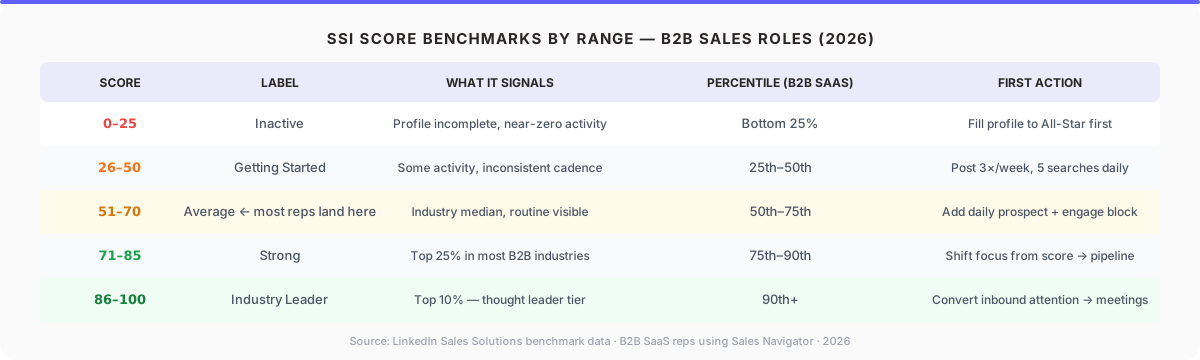
Score ranges by role in B2B SaaS (based on LinkedIn Sales Solutions benchmark data):
- SDRs and BDRs: average 48–60. The find-people and engage pillars typically underperform due to inconsistent daily prospecting habits.
- AEs (mid-market): average 55–68. Brand and relationship pillars tend to be stronger. Find-people pillar often lower because AEs focus on a smaller number of accounts.
- Enterprise AEs: average 58–72. Profile quality tends to be higher. Prospecting behaviors are more targeted and less frequent, which can drag the find-people pillar.
- Founders doing outbound: average 50–70. Highly variable. Founders who publish thought leadership consistently can score 80+ on brand alone. Systematic daily prospecting habits are often missing.
- Sales managers and leaders: average 65–80. Network quality (relationship pillar) tends to be strongest. Daily prospecting activity often lower than front-line reps.
These ranges are baselines, not targets. A founder at 70 who converted that score into 12 booked meetings last month performed better than a rep at 85 with four. The score describes behavior intensity. It does not describe behavior quality or outcome.
SSI is a proxy metric, not a pipeline metric
Here is the single most important thing to understand about the social selling index: SSI is a proxy metric for behavior, not a pipeline metric for outcomes.
A proxy metric measures an input that tends to correlate with a desired output. The SSI measures whether you are doing LinkedIn activities that typically lead to pipeline — publishing content, prospecting, engaging, networking. But those activities only produce pipeline when they are executed with quality, relevance, and the right targeting. Volume without quality gives you a high SSI and empty calendar.
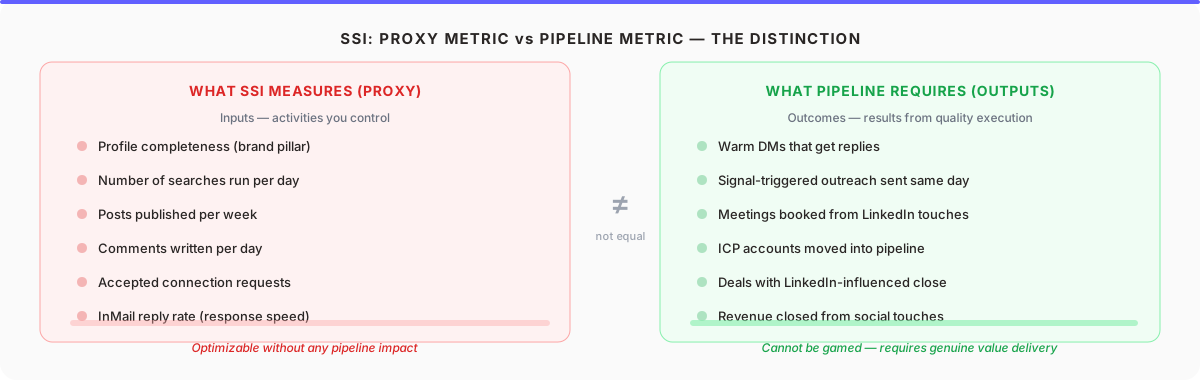
Consider two reps with SSI scores of 78:
Rep A posts generic sales motivation content three times per week. She comments on five posts each day, but the comments are generic ("great insight!") on posts from other salespeople — not her ICP. She saves 20 leads per day but never acts on the saved leads with outreach. Her SSI is 78. Her LinkedIn-sourced pipeline last quarter: zero.
Rep B posts one genuinely useful perspective piece per week targeting VP Sales in mid-market SaaS. He comments substantively on posts from the 30 accounts in his territory. He saves 20 leads per day and sends a warm DM within 48 hours of every signal — a job change, a funding announcement, or a post about a problem he solves. His SSI is also 78. His LinkedIn-sourced pipeline last quarter: eight qualified opportunities.
Same score. Opposite outcomes. The score does not tell you which rep you are.
This distinction matters because many sales teams now include SSI score in rep scorecards or manager coaching sessions. That is reasonable — it is a visible behavioral indicator in a world where most LinkedIn activity is invisible to managers. But using SSI as a primary performance signal without tracking pipeline-level outputs creates an incentive to optimize the score rather than the outcomes. The rep who figures out how to run 50 filtered searches per day with zero follow-up has a perfect find-people pillar and empty funnel.
The right framing: pair the SSI diagnostic with pipeline attribution. Track meetings booked from LinkedIn-sourced touches, warm DM reply rate, and connections accepted at target accounts. If the SSI is rising but the pipeline attribution is flat, the behaviors are happening at the wrong quality level. For a full breakdown of what to measure, read the guide to social selling metrics.
Gangly Newsletter
Signal-based outbound tactics, every Tuesday
How to convert LinkedIn signals into pipeline — one playbook per week.
Subscribe free →The 45% claim — reading the LinkedIn research honestly
LinkedIn's most-cited SSI statistic is this: social sellers with a high SSI create 45% more opportunities per quarter and are 51% more likely to hit quota than peers with a low SSI (LinkedIn Sales Solutions, 2023).
That is a significant gap. It is also worth reading carefully. LinkedIn measures this relationship by comparing quota attainment data from Sales Navigator users against their SSI scores. The correlation is real. The causal interpretation is not.
The most straightforward alternative explanation: reps who hit quota tend to be more disciplined, consistent, and skilled at prospecting — and those same qualities produce a high SSI score. In other words, both the high quota attainment and the high SSI score are outputs of the same underlying discipline, not a causal chain where one produces the other.
This is not a reason to dismiss the SSI. It is a reason to interpret it correctly. If the 45% correlation holds because disciplined prospecting habits drive both metrics, then the right action is to install those habits — not to find shortcuts to raise the score without running the real prospecting behaviors. A rep who runs fake searches to game the find-people pillar will temporarily raise their SSI without gaining a single warm conversation.
Three things the 45% data does support, correctly read:
- The behaviors matter. Consistent LinkedIn prospecting, publishing, and engagement are associated with better outcomes. Installing the habits is worth the effort.
- Consistency beats intensity. The correlation is with reps who are consistently active across the trailing 90 days, not reps who post heavily for a week and go quiet.
- The floor matters. Reps with SSI below 25 (inactive) show dramatically worse outcomes. Even moderate, consistent activity (a score of 50–60) produces meaningfully better results than near-zero activity.
The headline to hold onto: a rising SSI is a useful leading indicator that your LinkedIn discipline is improving. It is not a guarantee of pipeline. Treat it the way a runner treats their resting heart rate — a health indicator, not a race result.
SSI as a concept beyond LinkedIn
LinkedIn created the SSI, but the underlying concept — measuring social selling effectiveness through behavioral inputs — applies to any platform where reps build relationships before pitching. Twitter/X, Instagram, and emerging platforms do not have equivalent official scores, but the same four-pillar framework translates.
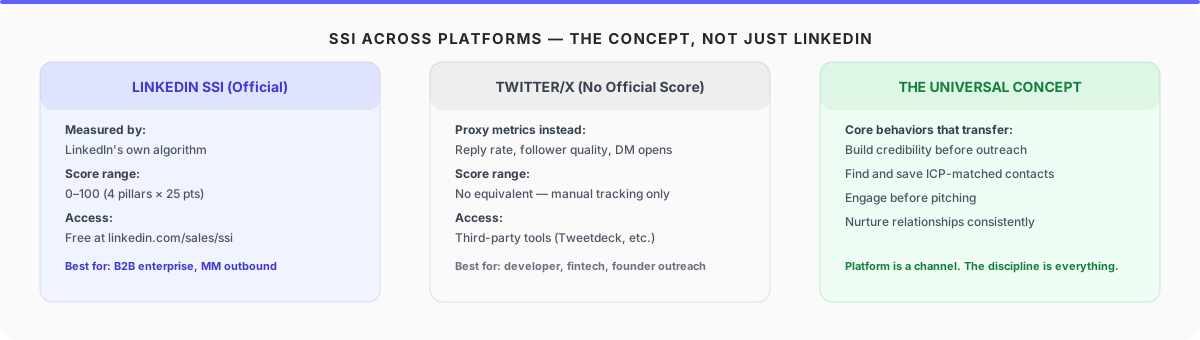
For B2B sales in 2026, LinkedIn remains the dominant platform where an SSI-equivalent framework applies. The reason is context density: LinkedIn profiles contain job title, company, seniority, and professional history in a single view. That context makes every touchpoint — a connection request, a comment, a DM — interpretable within a professional frame. Twitter/X has speed but lacks context. Instagram has reach but typically the wrong audience for B2B outbound.
The universal principle, regardless of platform, is this: reps who build credibility and context before they pitch — who are not strangers at the moment of outreach — convert at higher rates. The SSI operationalizes that principle for LinkedIn. On other platforms, the rep must self-measure: What is my reply rate on cold DMs? What percentage of my conversations start warm? How many target accounts have seen my content before I reach out?
For teams working multi-channel outbound that includes both LinkedIn and cold email, the signal-based selling guide covers how to sequence those channels using buying signals rather than volume-based cadences.
The Behavioral Checklist Framework: use SSI as a diagnostic
The correct way to use the SSI is not to chase the number. The correct way is to treat each pillar sub-score as a behavioral audit question:
The SSI Diagnostic — Four Questions
- P1Brand pillar below 16? Your profile is incomplete or you are not publishing original content. Fix: reach All-Star profile status and post once per week before doing anything else.
- P2Find people pillar below 14? You are not running daily searches or saving ICP leads consistently. Fix: block 20 minutes each morning for five filtered searches and 20 lead saves.
- P3Engage pillar below 16? You are posting but not engaging with others. Fix: comment on five prospect posts per day before writing your own content.
- P4Relationship pillar below 14? Your network lacks senior decision-makers or you are not maintaining active exchanges. Fix: send five warm contextual DMs to recently accepted connections every day and target VP-level contacts in your ICP.
This diagnostic framing produces different behavior than score-chasing. A rep told to "raise your SSI to 75" will find the fastest path to the number. A rep told "your find-people pillar is 11 out of 25 — that means you are not running daily searches" understands the specific missing behavior and can act on it. Same information, different outcome.
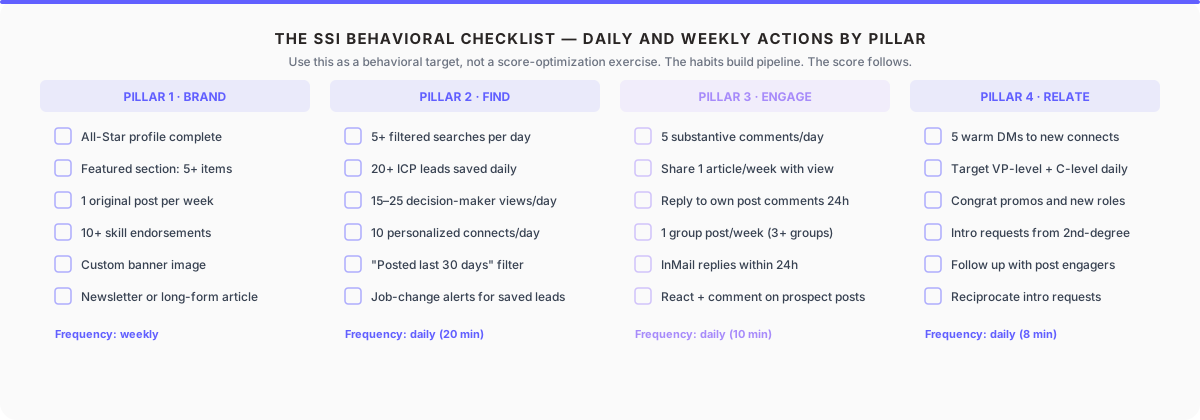
The total time commitment for the full behavioral checklist across all four pillars: 38 to 45 minutes per day. That is the equivalent of two cold calls or three cold emails — but the outcomes from warm signal-led LinkedIn outreach substantially outperform the outcomes from cold volume in most B2B SaaS contexts. The question is whether the time is allocated consistently or in bursts.
Consistency matters more than intensity for two reasons. First, the SSI scores the trailing 90 days — a single week of heavy activity barely moves the number. Second, buyer attention compounds: a prospect who has seen your content for four consecutive weeks is far warmer to a connection request than a prospect who saw one post. The LinkedIn algorithm and the buyer's memory both reward regularity.
What to do with a low score: pillar-by-pillar fixes
A low SSI score is useful information only if you act on the specific pillar that is lowest. Generic advice to "be more active on LinkedIn" produces generic results. Here are the targeted fixes by pillar.
Fixing a low brand pillar (P1)
The brand pillar responds to one-time setup actions faster than any other pillar. Start with profile completeness: fill every section to All-Star status, rewrite the headline to name your buyer and your outcome (not your job title), rewrite the About section to follow a problem → solution → proof → call-to-action structure, and replace the default banner with something specific to your ICP. These changes take two to three hours and can lift the brand pillar by 8 to 12 points within a week.
After the profile is done, publish one original piece of content per week. Not reposts. Not links to articles with no commentary. Original perspective pieces — what you observed this week, what a prospect said that surprised you, a framework you tested and found useful. Publish to the audience you are trying to reach, not to other salespeople. A VP Sales reading your post about why enterprise deals stall in legal review is more valuable than 200 salespeople liking it.
Fixing a low find people pillar (P2)
The find people pillar is a volume-plus-consistency problem. If you run five searches on Monday and nothing for the rest of the week, the pillar score reflects the inconsistency. LinkedIn tracks active days — how many days per week you searched and saved leads — not just the raw count.
The fix is to make prospecting the first 20-minute block of every working day. Run five filtered searches using Advanced People Search or Sales Navigator with criteria that match your ICP: seniority (VP and above), company headcount (your sweet spot), geography, and — critically — the "Posted in the last 30 days" filter. Active prospects reply to outreach at dramatically higher rates than contacts who are on LinkedIn only intermittently. Save 20 leads per session. That cadence, maintained five days per week, moves the find people pillar from a score of 10 to 20 within three to four weeks.
Fixing a low engage pillar (P3)
The engage pillar is often the fastest to fix once reps understand the distinction between activity and engagement. Clicking "like" on five posts earns near-zero points. Writing a three-sentence substantive comment on a prospect's post earns multiple times more. LinkedIn weights comment depth and originality, not reaction count.
The fix: each morning, before posting your own content, scroll the feed and comment on five posts from your saved leads or ICP-adjacent accounts. Write three or more sentences. Add your own perspective or experience. Disagree respectfully if you disagree. Avoid generic affirmations. The target is to leave a comment that the poster would quote in a screenshot because it added value — not one that disappears into the reply thread.
Fixing a low relationship pillar (P4)
The relationship pillar takes the longest to fix because it depends on network quality — and network quality changes slowly. The fastest lever is to change who you are connecting with rather than how many requests you send. Send ten personalized connection requests per day, exclusively to VP-level and C-level contacts at ICP-fit accounts. Include a one-sentence context note that is not a pitch. The accept rate on a contextual request to a well-matched prospect is 30 to 40%. On a blank request, it drops below 15%.
After a connection is accepted, send a warm DM within 48 hours. Not a pitch. A genuine, short exchange: congratulate them on recent news at their company, share something relevant to a challenge they mentioned in a recent post, or ask a single specific question about their approach to something in your area of expertise. The goal is one real exchange. That exchange is what the relationship pillar measures.
How Gangly converts SSI habits into pipeline
The gap between a high SSI score and a booked meeting is the step most reps skip: converting the LinkedIn behaviors into signal-triggered outreach at the right moment. Gangly is built to close that gap.
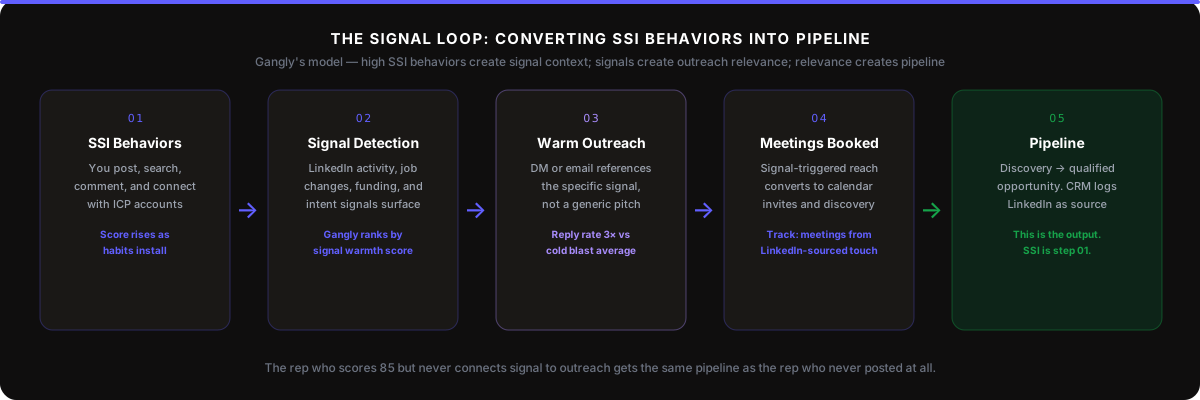
Here is how the Signal Loop works in practice:
Stage 1 — SSI behaviors: the rep runs daily searches, saves ICP leads, comments on prospect posts, and publishes weekly content. These are the activities the SSI measures. They warm the target accounts and create visibility before the pitch.
Stage 2 — Signal Detection: Gangly monitors saved accounts and contacts for buying signals — job changes, funding announcements, hiring posts, tech stack changes, and intent events. Each signal is ranked by warmth on a 1–10 scale. A new VP Sales at a target account who viewed your LinkedIn profile in the last 72 hours is a 9/10. An account that posted a job for a RevOps hire is a 6/10. The rep sees the ranked feed in the morning and acts on the top signals that day, not a week later. Signal decay is real: the email sent on day 10 after a job change announcement competes with 30 other vendors who reached out on days 1 through 3.
Stage 3 — Warm Outreach: Gangly's Outreach Writer drafts the LinkedIn DM or email in the rep's voice, tied to the specific signal. The message is not a template blast — it references the exact event that triggered the reach. The rep reviews before sending. The draft removes the blank-page problem and cuts the time from signal to outreach from 30 minutes to under 3 minutes.
Stages 4 and 5 — Meetings Booked and Pipeline: warm, signal-tied outreach converts at 3 to 4x the rate of cold volume sequences. The meeting source (LinkedIn, signal type, content touchpoint) is logged in CRM automatically. Over 90 days, the attribution data shows which SSI behaviors are actually driving pipeline — and which are raising the score without producing outcomes.
The rep who uses Gangly this way does not optimize for SSI. They optimize for meetings. The SSI goes up as a natural consequence of the daily habits required to run the Signal Loop. The loop is what produces pipeline. The score is a side effect. To see how this connects to the full intent signal workflow used by Gangly customers, read the complete guide to intent signals in sales.
If you are running outbound today and want to see how the Signal Loop applies to your territory, book a 20-minute demo and we will walk through the signal feed live.
Gangly Newsletter
Get the signal-based outbound playbook every Tuesday
One tactic per week on LinkedIn selling, signal detection, and rep workflows. No fluff. Under three minutes to read.
Subscribe freeSiddharth Gangal
Founder, Gangly · Revenue workflow systems for AEs, BDRs, and founders doing outbound
LinkedIn →