
 By Siddharth Gangal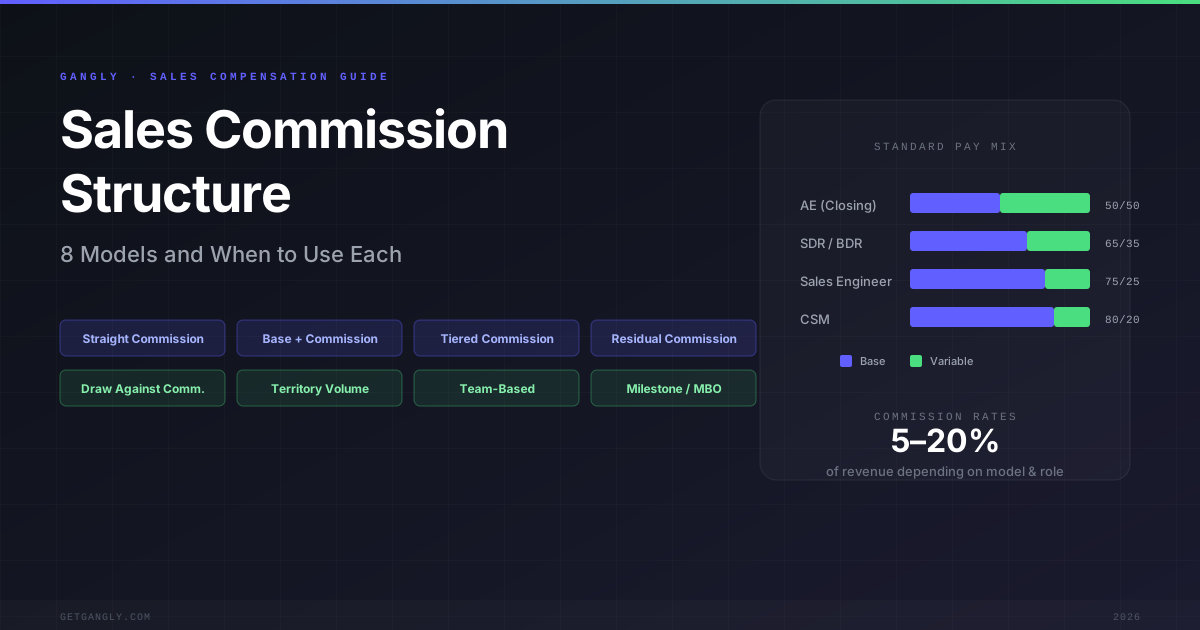
TL;DR
- Commission structure is a behavioral system, not a payment formula. The model you choose determines whether reps hunt new logos, protect existing accounts, collaborate with teammates, or sandbag deals near the end of a quarter.
- The 8 core models — straight commission, base plus commission, tiered, residual, draw against commission, territory volume, team-based, and milestone — each produce distinct rep behaviors, and each fits a specific company stage and sales motion.
- The 2026 SaaS standard for closing AEs is base plus tiered commission at a 50/50 pay mix. Commission rates run 8–12% of ACV at quota, with accelerators at 125% and 150% attainment.
- The Behavior-First Commission Framework maps your stage, motion, and role to the right structure — and identifies the specific rep behavior each model produces before you commit to a plan.
- Five structural mistakes — quota set before the motion is proved, no written ramp, capped accelerators below 150%, commission model mismatched to motion, and mid-year plan changes — account for most comp plan failures.
Direct answer
A sales commission structure is the formula that determines how salespeople are paid based on their performance. It defines the commission rate, the base salary component, when payment triggers, and how rates change with attainment. The most common types are straight commission (no base salary), base salary plus commission, tiered commission (rates that increase with quota achievement), residual commission (ongoing pay on retained accounts), draw against commission (advance recouped from future earnings), territory volume commission, team-based commission, and milestone commission. Each structure produces different rep behaviors. The right choice depends on company stage, sales motion, and role.
Get the quarterly sales comp benchmark drop
Commission rate benchmarks, quota math, and comp plan red flags — delivered quarterly. No spam, no fluff.
Subscribe freeWhat is a sales commission structure — and why it determines rep behavior
A sales commission structure is not a math formula. It is a behavioral system. Every dollar amount in a commission plan sends a signal to a sales rep about what the company values, what behaviors earn income, and what risks are worth taking. Choose the wrong structure and you get the wrong behavior — not because reps are malicious, but because incentives work exactly as designed.
The classic failure mode: a SaaS company running straight commission on a consultative, 90-day sales cycle. Reps are paid only when they close. So they rush qualification, avoid complex multi-stakeholder deals, and push prospects to sign before the prospect is ready. Churn climbs. Customer Success blames Sales. Sales blames Marketing for poor-fit leads. The structure produced exactly what it was designed to produce — urgency above all else. The problem was the design, not the people.
Definition
Sales commission structure — the plan that governs how a sales professional is compensated based on sales performance. It specifies the base salary (if any), the variable commission rate, the measurement metric (revenue, ACV, MRR, units), the payment trigger (close date, invoice date, cash receipt), and any accelerators or decelerators applied to attainment thresholds.
Three variables determine which structure is correct for any given role and company:
- Sales cycle length. Short transactional cycles (days to weeks) support straight commission and tiered structures. Long enterprise cycles (90–180 days) require base salary support and milestone components.
- Role type. New-logo hunters (AEs, BDRs) need structures that reward pipeline creation and deal close. Renewal-focused roles (CSMs, account managers) need structures that reward retention and expansion. The same commission rate for both roles produces wrong behavior in at least one of them.
- Company stage. Pre-Series A companies cannot afford the payroll overhead of high base salaries. Post-Series C companies cannot afford the turnover that comes from inadequate base support during a multi-month ramp. Stage determines the financial constraints that govern the base-to-variable ratio.
For context on how commission structures interact with OTE benchmarks by role, the SaaS sales compensation guide covers OTE, quota multiples, and pay mix across every stage from Seed to $100M ARR. The AE compensation page covers how AE commission rates and accelerator structures vary by segment (SMB, mid-market, enterprise).
8 sales commission structure models with formulas and behavioral outcomes
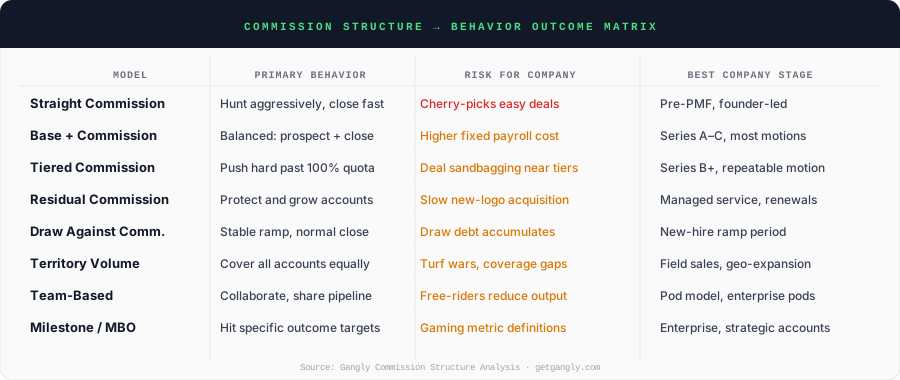
The 8 models below are not alternatives — they are tools. Most real-world compensation plans combine two or three of them. A SaaS AE plan might use base salary plus tiered commission as the foundation, with a draw against commission during the 4-month ramp period, and a milestone bonus for the first enterprise logo. Understanding each model in isolation lets you combine them deliberately.
Straight Commission (Commission Only)
5–20% of revenueFormula
Commission = Sale Amount × Commission Rate
Example
Close $50,000 at 10% = $5,000 commission. No base salary. No close, no pay.
Behavioral outcome
Reps hunt aggressively. Pipeline volume prioritized over deal quality. High performers thrive; average performers leave.
Best for
Pre-PMF startups, independent contractors, founder-led sales with 1–2 reps
Red flag
Turnover spikes sharply when quota is hard to reach. Reps cherry-pick easy deals and avoid complex, high-value accounts.
Base Salary Plus Commission
8–15% variable on top of fixed baseFormula
Total Pay = Base Salary + (Sale Amount × Commission Rate)
Example
$80K base + 10% commission. Close $500K ARR = $80K + $50K = $130K total at target.
Behavioral outcome
Reps balance prospecting and closing. Financial stability reduces panic selling. Longer ramp periods are sustainable.
Best for
Series A–C SaaS, SMB and mid-market AEs, any role with a 60–180 day sales cycle
Red flag
If base is too high relative to variable, reps lose urgency. The 50/50 pay mix (base/variable) is the 2026 SaaS standard for closing AEs.
Tiered Commission
8% → 12% → 16% (stepped by quota attainment)Formula
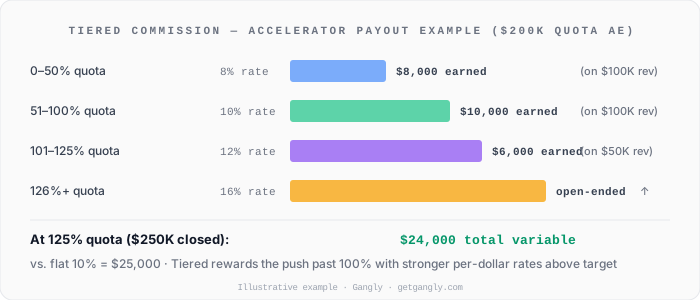
Rate increases at predefined quota thresholds: 8% at 0–100%, 12% at 100–125%, 16% above 125%
Example
On a $200K quota: $200K closed at 10% base rate = $16K. Add $50K above quota at 16% = $8K. Total: $24K variable.
Behavioral outcome
Reps push hard past 100% quota. The inflection point above target creates the strongest behavioral pull in any structure.
Best for
Series B and beyond with proven sales motions, any role where overperformance is both possible and desirable
Red flag
Reps may delay closing deals to land in a higher tier next period. Lock the tier reset date in writing and communicate it clearly.
Residual Commission
2–5% of recurring revenue per periodFormula
Commission = Active Customer MRR × Residual Rate (paid each month/quarter the account renews)
Example
Rep closes $10K MRR account at 3% residual. Earns $300/month as long as the account stays.
Behavioral outcome
Reps protect existing accounts intensely. Churn becomes a direct financial loss. New-logo prospecting drops unless paired with a new-business quota.
Best for
Managed services, insurance, telecom, any model where rep involvement drives retention over multi-year periods
Red flag
Without a new-logo component, rep effort shifts entirely to account protection. Pipeline dries up. Layer residual on top of a new-ARR quota, not instead of it.
Draw Against Commission
Advance paid monthly; earned commission offsets the drawFormula
Draw = monthly advance. If commission earned > draw, rep keeps the difference. If commission < draw, deficit carries forward.
Example
$5K monthly draw. Month 1: $3K commission earned → $2K deficit carried. Month 2: $9K earned → $9K − $5K − $2K deficit = $2K net paid.
Behavioral outcome
Reps do not panic in slow months. Financial stability maintained during ramp. Risk: draw debt accumulates if a rep consistently underperforms.
Best for
New-hire ramp periods (typically 3–6 months), seasonal sales motions, territory expansion into unknown markets
Red flag
Forgive draw debt at the end of ramp if the rep hit activity targets. Carrying draw debt into year two signals the hire was wrong, not that the rep owes a refund.
Territory Volume Commission
5–15% of all revenue within an assigned territoryFormula
Commission = Total Territory Revenue × Commission Rate (paid regardless of which rep closed which deal)
Example
Territory generates $2M ARR. Rep earns 8% = $160K. Every deal in the territory counts, regardless of source.
Behavioral outcome
Reps develop deep coverage across all accounts in their territory. Collaboration with SDRs and channel partners increases. Territorial disputes arise at boundary accounts.
Best for
Field sales organizations with geographic territories, channel-heavy motions, large-enterprise account coverage models
Red flag
Territory design is as important as the commission rate. Uneven territory value destroys rep equity and top-performer retention.
Team-Based Commission
Pool distributed among team members based on role, tenure, or equal splitFormula
Team Commission Pool = Total Team Revenue × Pool Rate. Individual payout = Pool × Individual Share %
Example
Team closes $1M. Pool is 10% = $100K. Split equally among 4 reps = $25K each, regardless of individual contributions.
Behavioral outcome
Collaboration increases. Reps share pipeline, coach each other, and back up teammates on calls. Free-rider problem emerges when team size exceeds 4–5 people.
Best for
Enterprise pod models (SDR + AE + SE + CSM sharing quota), early-stage teams where role boundaries are fluid
Red flag
Define contribution metrics clearly or team plans collapse. Weight payouts by individual contribution (meetings set, pipeline created, deals closed) rather than pure equal split.
Milestone / MBO Commission
Fixed payouts tied to specific objective achievementFormula
Commission = Sum of payouts for each milestone reached. Each milestone has a defined payout and completion criteria.
Example
Milestone 1: Close 3 new logos = $5K. Milestone 2: Hit $500K ARR = $10K. Milestone 3: Land a named enterprise account = $15K.
Behavioral outcome
Reps focus precisely on defined outcomes. Gaming risk is high — reps find paths to milestone completion that may not align with business intent.
Best for
Enterprise strategic accounts, new market expansion, roles with multi-quarter sales cycles where standard quota is not measurable monthly
Red flag
Define milestones with outcome criteria, not activity proxies. "Close 3 logos" is better than "hold 30 demos." Measurability beats intent.
Model comparison: rates, admin complexity, and best-fit roles
The table below compares all 8 models on six practical dimensions: commission rate range, administrative complexity, ability to retain top performers, fit for new-hire ramp periods, fit for enterprise sales cycles, and fit for SaaS new-logo motions.
| Model | Rate | Admin | Top Rep Retention | Ramp Fit | Enterprise Fit | SaaS New-Logo |
|---|---|---|---|---|---|---|
| Straight Commission | 5–20% | Low | High | Poor | Poor | Fair |
| Base + Commission | 8–15% | Medium | High | Good | Good | Excellent |
| Tiered Commission | 8–16%+ | Medium | Excellent | Fair | Good | Excellent |
| Residual Commission | 2–5% MRR | High | Fair | Poor | Fair | Poor |
| Draw Against Comm. | Varies | High | Fair | Excellent | Good | Good |
| Territory Volume | 5–15% | Very High | Fair | Poor | Excellent | Poor |
| Team-Based | 8–12% pool | Medium | Poor | Good | Fair | Fair |
| Milestone / MBO | Fixed per milestone | High | Fair | Poor | Excellent | Fair |
Sources: Gangly analysis of Everstage 2026, Bridge Group 2025, RepVue data (May 2026), CaptivateIQ comp benchmarks.
Two patterns stand out in this table. First, tiered commission has the strongest top-performer retention rating — because it is the only model where overperformance produces disproportionate income growth. A rep who consistently closes 140% of quota earns far more under tiered commission than under a flat-rate model at the same base rate. Second, team-based commission scores poorly on top-performer retention because top performers resist income dilution. A rep who closes 200% of quota while a teammate closes 50% does not want to split the pool equally. Reserve team-based models for pods where contribution weighting is built in.
Decision matrix: which commission structure fits your stage and motion
The right commission model is not universal. It is a function of company stage, sales motion, and role. The matrix below maps each combination to a recommended structure with the rationale for the choice.
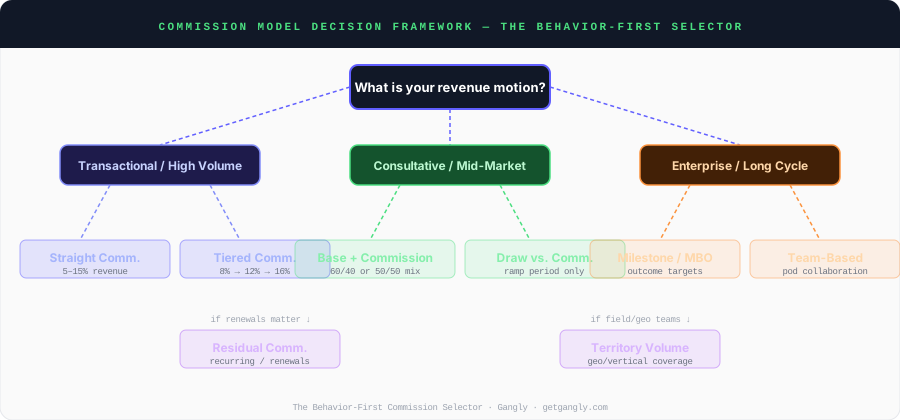
Stage
Pre-PMF / Seed
Founder selling
Recommended Structure
Straight Commission or Base + Commission (60/40)
Cash-constrained, unproven quota. Straight commission if rep has prior book of business; 60/40 base/variable if founder needs a trained full-cycle rep.
Stage
Series A ($1–5M ARR)
First AEs, SDR team forming
Recommended Structure
Base + Commission (50/50)
Motion is being proved. Reps need financial stability to build pipeline correctly. 50/50 mix at AE level, 65/35 for SDRs.
Stage
Series B ($5–15M ARR)
Repeatable motion, segmenting
Recommended Structure
Tiered Commission on top of base
Motion is proven. Tiered structure rewards overperformance and retains top performers. Add accelerator at 125% and 150% quota.
Stage
Series C+ ($15–100M ARR)
Enterprise segment opening
Recommended Structure
Base + Tiered + Milestone for enterprise AEs
Enterprise AEs have 90–180 day cycles. Milestone layer for strategic accounts. Tiered model continues for SMB and mid-market.
Stage
New hire ramp (any stage)
Rep months 1–5
Recommended Structure
Draw Against Commission
Pipeline does not mature in month 1. Draw protects income stability. Forgive deficit if activity targets are met.
Stage
Field / Geo expansion
Geographic territory coverage
Recommended Structure
Territory Volume Commission
Rep incentivized to develop full territory, not just named accounts. Requires clean territory design before launch.
For SDR and BDR-specific commission structures — including per-SQL rates, meetings-set bonuses, and pipeline-generated targets — the SDR compensation guide covers quota structures and pay mix benchmarks in full. For a look at how commission structures shift as teams scale from $1M to $100M ARR, see the sales compensation benchmarking audit framework.
The Behavior-First Commission Framework — Gangly's proprietary selector
Most commission structure guides tell you what each model is. They do not tell you what behavior each model produces — which is the only decision that matters. The Behavior-First Commission Framework inverts the standard process: instead of starting with a commission rate and asking "is this competitive?", start with the behavior you need and work backward to the structure that produces it.
The Behavior-First Commission Framework — 4 Steps: Step 1: Name the specific behavior you need (example: "close 2 new logos per month"). Step 2: Identify which commission model rewards that exact behavior. Step 3: Set the rate to make the target income achievable at plan. Step 4: Stress-test for unintended behaviors (sandbagging, cherry-picking, free-riding) before launch. Every commission plan produces both intended and unintended behaviors. The framework forces you to name both before you sign the first offer letter.
The Behavior-First Commission Framework — Gangly, 2026
Walk through the framework with each of the 8 models:
Straight Commission
Intended
Maximum effort, high deal volume
Unintended
Cherry-picks easy deals, avoids complex high-ACV accounts, high turnover in slow periods
Base + Commission (50/50)
Intended
Balanced prospecting and closing, stable ramp
Unintended
Complacency risk if base is too high; reps cruise on base without urgency to close
Tiered Commission
Intended
Strong push above 100% quota, top-performer retention
Unintended
Deal sandbagging near tier resets; reps delay closing to land in next tier
Residual Commission
Intended
Deep account protection, low churn
Unintended
New-logo prospecting drops to near zero; pipeline dries up in 12–18 months
Draw Against Commission
Intended
Stable ramp, confident prospecting from day one
Unintended
Draw debt accumulates if underperforming; can create financial disputes at departure
Territory Volume
Intended
Full-territory coverage, no cherry-picking by deal size
Unintended
Turf wars at territory borders; reps do minimum in low-potential accounts
Team-Based
Intended
Collaboration, pipeline sharing, pod cohesion
Unintended
Free-rider problem; top performers subsidize low performers and leave
Milestone / MBO
Intended
Precise focus on strategic outcomes
Unintended
Gaming milestone definitions; reps target the metric, not the underlying business goal
The unintended behavior column is what every compensation design meeting skips. It is also the column that determines whether reps stay or leave in year two. Build the unintended behavior check into every commission plan review — quarterly for early-stage companies and semi-annually for scaling organizations.
Pay mix, accelerators, and the mechanics that move rep behavior
Pay mix is the ratio of base salary to variable commission at 100% quota attainment. It is the most misunderstood dimension of commission structure design. The commission rate gets attention in every offer letter negotiation. The pay mix gets none — even though it is a better predictor of top-performer satisfaction and retention than the headline OTE.
Definition
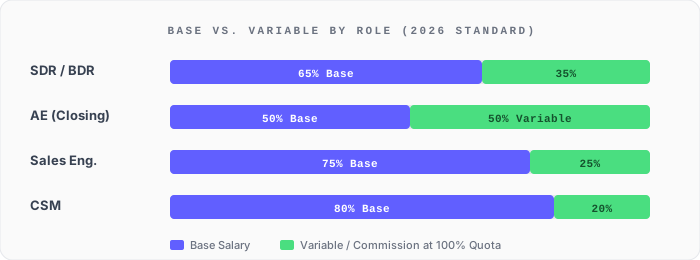
Pay mix — the percentage split between base salary and variable commission in a total compensation plan, expressed at 100% quota attainment. A 50/50 pay mix on a $200K OTE means $100K base and $100K variable at target. The higher the variable component, the more income risk the rep carries — and the more upside they earn through accelerators above quota.
Standard pay mix by role in 2026:
- Closing AEs (SMB and mid-market): 50/50. The 2026 SaaS standard. Reps accept high variable because accelerators above 100% quota create meaningful upside.
- Enterprise AEs: 55/45. Slightly base-heavy to sustain financial stability through 90–180 day cycles. Variable component is still significant but lower relative to base.
- SDRs and BDRs: 65/35. Higher base because SDRs control activity (calls, emails, meetings) but not close rate. The 35% variable is achievable through a mix of meetings-set and SQL bonuses.
- Sales Engineers: 75/25. Base-heavy by design. Variable is overlay-based on the AE's close rate, not personal quota.
- Customer Success Managers: 80/20 for retention-focused roles, 75/25 for expansion-heavy roles where the CSM holds an expansion ARR quota.
Accelerators are multipliers that govern how fast variable pay grows above quota. The standard SaaS accelerator table in 2026:
| Attainment Threshold | Commission Rate | Example (on $10K variable target) |
|---|---|---|
| 0–74% quota | 0.75× multiplier | Earn 75 cents per dollar of variable target |
| 75–99% quota | 1.0× (baseline) | Earn $1.00 per dollar of variable target |
| 100–124% quota | 1.25× accelerator | Earn $1.25 per dollar above target |
| 125–149% quota | 1.5× accelerator | Earn $1.50 per dollar above 125% |
| 150%+ quota | 2.0× accelerator | Earn $2.00 per dollar above 150% — uncapped |
Two accelerator rules every rep should verify before signing: first, the cap level. Any ceiling below 150% attainment signals the company does not want to pay for overperformance — and the rep who consistently closes 160–180% of quota will leave for a company with an uncapped plan. Second, the decelerator below 75%. A hard zero payout below 50% quota punishes reps during ramp and in quarters where pipeline dried up due to market conditions outside their control. The correct approach is a graduated decelerator, not a cliff.
Clawback provisions are the third accelerator-adjacent mechanic to verify. A 90-day clawback — where commission is recovered if the customer refunds or churns within 90 days of close — is standard and reasonable. Clawback windows beyond 90 days, or clawbacks triggered by churn beyond the rep's influence, transfer customer-success risk onto the sales rep. Read this clause before signing.
Five commission structure mistakes that cost companies their top reps
Five structural mistakes account for the majority of commission plan failures — not individual rep underperformance, not bad markets, but decisions made before the first offer letter was signed.
Quota set before the motion is proved
At $0–2M ARR, founders set quota by reverse-engineering a revenue target rather than by win-rate math. If the average deal is $20K and the win rate is 20%, a $1M quota requires 250 qualified opportunities. Does the top-of-funnel actually generate that? Set quota bottom-up from deal math, not top-down from a financial model. Bottom-up quota math: Quota ÷ Average Deal Size = Deals Needed. Deals Needed ÷ Win Rate = Opportunities Needed. Opportunities Needed ÷ SQL-to-Opportunity Rate = SQLs Required. If the SDR team cannot generate that SQL volume, the AE quota fails before the rep starts.
Commission model mismatched to motion
Straight commission on a consultative enterprise deal produces rushed qualification. Residual commission on a new-logo AE role kills pipeline within 18 months. Team-based commission on a high-performance individual-contributor team drives out the top 20% within a year. Before choosing a model, write down the specific rep behavior the plan is designed to produce. If you cannot write that sentence clearly, the model is not yet defined.
Accelerators capped below 150%
Capping accelerators at 120% attainment removes the upside that retains top performers. The rep who closes 170% of quota is almost certainly the company's most valuable sales employee. Capping their payout at 120% sends a clear message: the company does not want to pay for exceptional performance. Top performers respond by leaving for an uncapped plan. Keep the ceiling at 150% minimum; uncapped above 175% is the standard at growth-stage companies with proven motions.
No written ramp period
A ramp agreement that lives only in the hiring manager's verbal commitment does not exist in any legally relevant sense. Reps who join without a written ramp miss year-one quota at high rates because pipeline takes 60–90 days to mature even when activity starts on day one. Write the ramp into the offer letter with explicit monthly quota percentages: 0% in month one, 30% in month two, 50% in month three, 75% in month four, 100% from month five onward. Anything less is a retention risk.
Mid-year plan changes without transition protection
Changing quota, commission rate, or territory mid-year — without a documented transition period and hold-harmless protection for pipeline committed under the original plan — is the fastest way to destroy rep trust and lose high performers. Reps manage personal finances against their offer letter. A Q2 quota increase on pipeline the rep already built in Q1 is a retroactive pay cut. If business conditions require a plan change, give reps a full quarter of advance notice and protect commission on any deal in the current pipeline at the old rate.
Commission plans fail when they are designed once and never revisited. The sales motion changes. The market shifts. ACV increases. A plan that was correct at $2M ARR may produce entirely wrong behaviors at $20M ARR. Build a quarterly review into the plan design from day one — not to change rates arbitrarily, but to verify that the behavioral outcomes the plan was designed to produce are actually appearing in the data. If median attainment has been below 50% for two consecutive quarters, the plan is broken and the review finds it before the best reps leave to find a better one.
How Gangly connects to commission performance
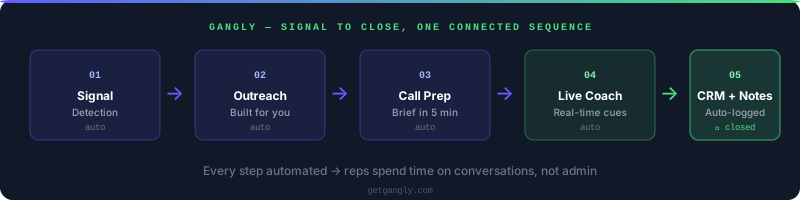
Every commission model measures output — closed ARR, deals signed, milestones hit. It does not measure the 25–30 hours per week the average AE spends on non-selling work: researching accounts, writing follow-up emails, updating CRM fields, and building call prep briefs. Gangly automates that sequence — signal detection, outreach, call prep, live coaching, notes, and CRM updates — in one connected workflow. Reps spend more time in qualified conversations. More conversations produce more closed deals. More closed deals hit the numbers the commission plan was designed to reward.
Continue reading
Workflows
SDR Compensation: 2026 Benchmarks and Structures
2026 SDR compensation benchmarks by company stage (Seed–Series C+), industry, and experience tier — base, OTE, quota, ramp, commission structures.
Workflows
SaaS Sales Compensation: Benchmarks and Structures
2026 SaaS sales compensation benchmarks for SDR, AE (SMB/MM/Enterprise), SE, and CSM — OTE, quota, commission structures, and pay mix by ARR stage from $1M to $100M+.
Workflows
AE Compensation: 2026 Benchmarks by Industry and Experience
2026 AE compensation benchmarks across 10 industries, 5 experience tiers, and 10 US regions — base, OTE, quota, and ramp math in one reference.