
 By Siddharth Gangal
TL;DR
- OTE = Base Salary + Variable Pay at 100% quota. It is the total you earn if you hit your number — not a guaranteed salary and not a ceiling if you overperform on an uncapped plan.
- Only 50 to 60% of reps hit OTE in a given year (Bridge Group 2025). The median rep earns roughly 70% of the stated number, meaning a $200K OTE is really a ~$140K job for the average performer.
- The quota-to-OTE ratio is the single best diagnostic for a realistic offer. A 4× ratio pays out. A 6× or higher ratio means fewer than 40% of reps hit OTE structurally.
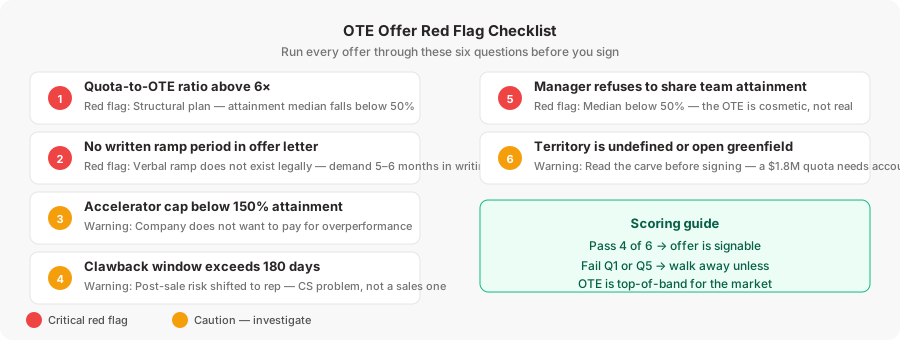
- Six red flags reveal whether an OTE is real: ratio above 6×, no written ramp, capped accelerators below 150%, clawback over 180 days, refusal to share team attainment, and undefined territory.
- Four levers move in negotiation: ramp length, base-variable split, accelerator structure, and territory definition. The headline OTE number rarely moves — the structure around it does.
Direct answer
Sales OTE (on-target earnings) is the total annual compensation a sales rep earns when they hit 100% of their assigned quota. It combines a fixed base salary and a performance-based variable component (commission or bonus). A $200K OTE with a 50/50 pay mix means $100K base plus $100K commission at full quota attainment. OTE is not a guaranteed salary — only 50 to 60% of reps actually achieve it in a given year (Bridge Group 2025 SaaS AE Compensation Report).
What is sales OTE — the direct answer
OTE stands for on-target earnings. In sales compensation, it represents the total annual cash a rep earns when performance hits exactly 100% of assigned quota. The number lives on every sales job description and offer letter — and it creates more confusion, false expectations, and poor offer decisions than almost any other compensation term.
On-Target Earnings (OTE) — The projected total annual compensation a sales rep earns if they hit 100% of their quota. Includes base salary (fixed) plus variable pay (commission or bonus at full quota attainment). Does not include equity, benefits, or short-term SPIFs. Example: $90K base + $90K commission at 100% quota = $180K OTE.
OTE is not a guarantee. It is a target. The base salary portion is guaranteed — paid monthly regardless of performance. The variable portion requires work, quota attainment, and a compensation plan that is structured to actually pay out at scale. The word "on-target" is doing a lot of work in that phrase: you have to hit the target for the number to materialize.
This distinction matters because the gap between stated OTE and realized earnings is large. According to Bridge Group's 2025 SaaS AE Compensation Report, only 50 to 60% of reps hit 100% of quota in a given year. That means in a room of ten account executives all with $200K OTE on their offer letters, four to five of them will earn significantly less. The median rep earns approximately 70% of OTE — not the headline number.
OTE also appears under different labels depending on company and context. You will see "total target compensation" (TTC), "total cash compensation" (TCC), or "on-track earnings" used interchangeably. They all describe the same thing: base plus variable at full quota. For the rest of this guide, OTE covers all of those variants.
Three things determine whether an OTE offer is worth taking: the formula behind the number, the pay mix that divides it, and the quota-to-OTE ratio that sets the attainment challenge. All three are explained in detail below. For a broader look at how OTE fits into the full compensation picture for closing reps, the AE compensation guide covers base, equity, MBO bonuses, and industry benchmarks in a single reference.
The OTE formula and how to calculate it
The OTE formula is straightforward. The complexity enters when you try to verify that the inputs are realistic.
OTE Formula
OTE = Base Salary + (Commission Rate × Annual Quota)
Example: $90K base + (10% × $1,000,000 quota) = $90K + $100K = $190K OTE
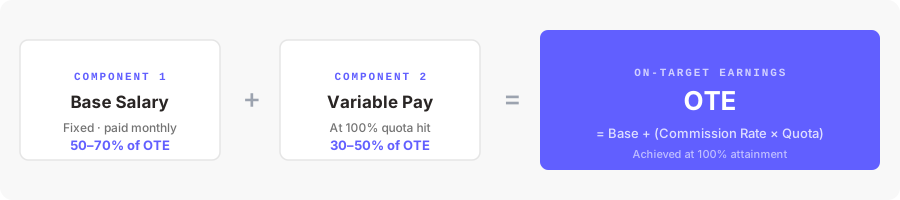
The formula has three variables: base salary, commission rate, and annual quota. All three can be negotiated — though the quota is often the hardest to move because it is set by finance or sales leadership before the hire is made. Here is how each variable works:
- BBase salary — Fixed pay, typically paid twice monthly. Non-negotiable on a daily basis, but the split between base and variable is negotiable at offer stage. A higher base with a lower variable reduces income risk but also caps upside on overperformance.
- CCommission rate — The percentage of ACV (annual contract value) paid as commission. Most SaaS AE plans run at 8 to 12% on ACV. Some plans use a tiered structure — a lower rate below quota, stepping up at 100%+. Verify the rate applies to ACV, not ARR recognized over time, which delays payment.
- QAnnual quota — The dollar target you must close in a year to earn the full variable component. The quota-to-OTE ratio (quota divided by OTE) is the single most important number for evaluating whether a plan pays out. More on this in the red flags section below.
One calculation to run immediately on any offer: divide the quota by the OTE. A $1M quota on a $200K OTE is a 5× ratio. A $1.2M quota on the same $200K OTE is a 6× ratio. The two numbers look close, but the difference in attainment probability is significant. At 5×, roughly 55% of reps hit OTE. At 6×, fewer than 40% do (Bridge Group 2025 + RepVue 2026 data). The headline OTE number is the same; the realized earnings are materially different.
For the full picture on how commission structure affects OTE — including accelerators, clawback mechanics, and SaaS-specific structures — see the sales commission structure guide.
Base vs variable: pay mix ratios by role
Pay mix is the ratio between base salary and variable pay inside the OTE. A 50/50 mix on $200K means $100K base and $100K variable. A 70/30 mix on the same $200K means $140K base and $60K variable. The split signals what the company believes about its sales motion — and shifts financial risk between company and rep.
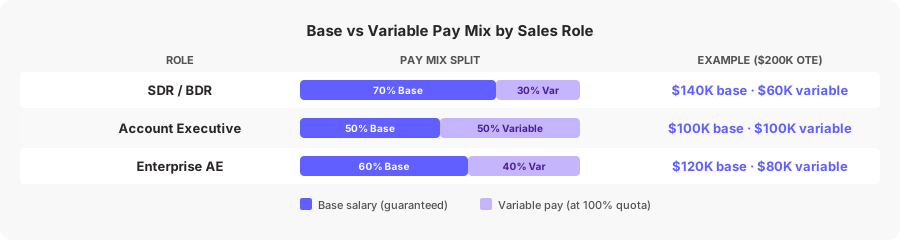
| Role | Pay mix | Base | Variable | OTE | Notes |
|---|---|---|---|---|---|
| SDR / BDR | 70/30 | $63K | $27K | $90K | Base-heavy because pipeline generation is activity-based. Lower variable ceiling by design. |
| Account Executive (SMB) | 50/50 | $60K | $60K | $120K | Standard closing motion. Equal split incentivizes pipeline self-generation and close. |
| AE (Mid-Market) | 50/50 | $90K | $90K | $180K | 2026 mid-market median. 50/50 is the Bridge Group default for B2B SaaS. |
| Enterprise AE | 60/40 | $132K | $88K | $220K | Higher base acknowledges longer cycles and procurement risk. Variable on ACV, not units. |
| Sales Manager | 70/30 | $120K | $51K | $171K | Manages team quota. Variable tied to team attainment rather than personal closing. |
| VP of Sales | 60/40 | $180K | $120K | $300K | Significant variable on company ARR plan. MBO layer common at VP level. |
Sources: Bridge Group 2025 SaaS AE Compensation Report · RepVue May 2026 · Pavilion Pulse 2025.
Three rules of pay mix. First, the lower the base relative to OTE, the higher the income risk. A 40/60 plan (base/variable) on $200K means $80K guaranteed and $120K at risk. This is common at seed and Series A where the motion is still being proved. Second, pay mix signals company stage: 50/50 is the 2026 median for B2B SaaS AEs per Bridge Group; 70/30 is common at post-IPO companies with predictable motions and account managers handling renewals. Third, variable pay unlocks accelerators — and accelerators are where top reps make significantly more than OTE on uncapped plans.
SDR and BDR roles run higher bases (70/30 or 80/20) because their output — meetings booked, pipeline generated — is activity-dependent rather than booking-dependent. The variable is smaller but tied to pipeline quotas, not closed revenue. For full SDR compensation benchmarks including OTE by segment and company stage, see the SDR compensation guide.
OTE attainment reality: only 50–60% of reps hit it
Only 50 to 60% of sales reps hit their OTE in any given year. That is the benchmark from Bridge Group's 2025 SaaS AE Compensation Report — and it is consistent with Pavilion Pulse 2025 and RepVue's 2026 attainment data. The median quota attainment rate for B2B SaaS AEs sits at approximately 52%, down from 58% in 2022. The practical implication: the average rep earns roughly 70% of the number on the offer letter, not 100%.
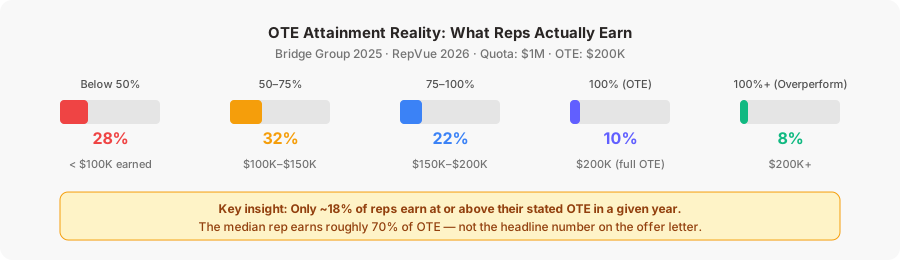
This does not mean OTE is a lie. It means OTE requires accurate evaluation of the conditions under which it is achievable. Four variables drive attainment:
- Quota difficulty: The quota-to-OTE ratio (covered in the next section) is the structural driver. Plans with ratios above 6× produce systemic miss rates because the math does not work at median performance.
- Ramp design: First-year reps on a poorly structured ramp lose three to four months of potential attainment. A $200K OTE rep who ramps over six months at 0% to 100% quota is on a $150K effective OTE for year one even with excellent performance.
- Territory quality: Named-account reps can map opportunity to quota before they start. Open-territory reps depend on competitive density, inbound volume, and channel support — all variable.
- Product-market fit and sales cycle length: A rep selling a product in a market that is not yet established faces attainment challenges that have nothing to do with rep performance. Ask where the company sits in its go-to-market cycle before evaluating the OTE.
The Reddit r/sales community is vocal about this gap. Multiple threads document companies posting $180K to $250K OTE offers where fewer than 30% of reps ever hit the number — including companies that had not had a single rep hit full OTE in the prior twelve months. The red flag checklist in section six gives you the specific questions to ask to surface this before signing.
For data on quota attainment benchmarks by role and segment, see the sales quota attainment rate guide.
What a good OTE looks like by role and segment
A good OTE is not just a high number — it is a number attached to a realistic quota, a fair pay mix, and a plan structure that actually pays out at scale. Benchmarks matter for context. Here is what OTE looks like in 2026 across the main sales roles and segments in B2B SaaS and tech.
| Role | OTE range (2026) | Typical quota | Ratio | Notes |
|---|---|---|---|---|
| SDR / BDR | $70–100K | $50–80K ARR | N/A | Pipeline quota, not booking quota. OTE based on meeting and pipeline targets. |
| SMB AE | $100–150K | $500K–750K ARR | 4–5× | High-velocity, shorter cycles. Smaller ACV but higher volume. |
| Mid-Market AE | $150–200K | $750K–1.2M ARR | 4–6× | 2026 B2B SaaS median. 50/50 pay mix is standard at this tier. |
| Enterprise AE | $200–340K | $1.2–2.0M ARR | 5–7× | Longer cycles, larger ACVs. Higher base offsets slower pipeline build. |
| Strategic / Principal AE | $300–420K+ | $2.0–4.0M+ ARR | 6–8× | Named account motion. High MBO component alongside commission. |
| Channel / Partner Sales | $140–220K | $1.0–2.0M ARR | 5–7× | Variable tied to partner-sourced and partner-influenced bookings. |
Sources: Bridge Group 2025 · RepVue May 2026 · Pavilion Pulse 2025 · BuiltIn 2026 · Glassdoor May 2026.
A few patterns in the table. First, a "good" OTE is relative to the quota attached to it. A $250K OTE on a $2.0M quota (8× ratio) is less attractive than a $180K OTE on a $720K quota (4× ratio) — the lower-number plan pays out more reliably. Second, the right benchmark column for evaluating an offer is the ratio, not the headline number. Third, SDR OTE operates differently: pipeline quotas (meetings booked or opportunities created) drive variable pay, not closed revenue, so the ratio benchmark above does not apply.
For full compensation benchmarks across industries, experience tiers, and US regions, see the SaaS sales compensation benchmarks guide. The data covers B2B SaaS, cybersecurity, fintech, healthcare, and industrial roles with sourced numbers from RepVue, Bridge Group, and Pavilion.
Six OTE red flags to check before you sign
Six questions reveal whether an OTE offer is real or cosmetic. Run every offer through these before signing. A failure on red-flag items (marked critical) is grounds to walk away or renegotiate significantly.
- 01
Quota-to-OTE ratio exceeds 6×
Divide quota by OTE. At 6× and above, attainment medians drop below 50%. A $240K OTE on a $1.5M quota (6.25×) pays less reliably than a $200K OTE on an $800K quota (4×). When comparing offers, pick the lower ratio.
- 02
No written ramp in the offer letter
A verbal ramp does not exist legally. Without a written ramp, year-1 quota starts at 100% on day one. Reps who join without a written ramp miss year-1 quota roughly 60% of the time because pipeline takes months to mature even with full activity from day one.
- 03
Accelerator cap below 150% attainment
A commission cap at or below 150% attainment signals a company that does not intend to pay for overperformance. Top reps leave these plans first because their ceiling is artificial. Push for uncapped accelerators or a cap no lower than 200%.
- 04
Clawback window exceeds 180 days
Standard clawback covers 90 days for refund-driven churn. Anything beyond 180 days shifts customer-success failure onto the rep. The rep closed the deal in good faith — holding the commission hostage past six months is a CS problem, not a sales one.
- 05
Manager refuses to share team attainment data
Every hiring manager knows last year's team attainment median. Refusal to share it is an answer. A team where fewer than 50% hit quota means the OTE on the offer letter is aspirational — the math does not support paying it out at scale. Ask directly: "What percentage of your team hit 100% quota last year?"
- 06
Territory is undefined or fully open greenfield
A $1.8M quota on 35 named accounts is signable. A $1.8M quota on open territory in a contested market is a different job. Read the territory carve before signing. Accounts must exist, must be reachable, and must have enough buying capacity to support the quota math.
Scoring guide
Pass on at least four of the six and the offer is signable. Fail on the quota-to-OTE ratio (flag 01) or the team attainment question (flag 05) and walk away unless the OTE is at the top of the market band for the role. Those two flags reflect company-level decisions that negotiation rarely changes.
How to negotiate OTE — the four levers that move
The headline OTE number rarely moves in negotiation. Finance sets it based on headcount budget and quota models before the hire cycle starts. What moves is the structure around it — four levers that can materially change realized earnings without changing the advertised OTE.
The Four OTE Negotiation Levers
- 1
Ramp length and structure
Push for a written six-month ramp: 0% quota in month one, scaling to 25%, 50%, 75%, 100% over months two through six. Every month of ramp protection preserves eight to twelve percent of year-one variable pay. A one-month ramp extension on a $100K variable component is worth roughly $8K in protected commission.
- 2
Base-variable split
On a $180K OTE, shifting from 50/50 to 55/45 raises base by $9K and reduces variable by $9K. For reps entering a new market or territory, a higher base reduces income risk during ramp. Companies with predictable motions often accept a 5-point shift in pay mix without changing the total OTE.
- 3
Accelerator structure
Ask two questions: where do accelerators start, and is there a cap? Accelerators beginning at 100% attainment (not 120%) and running uncapped are the rep-friendly default. A cap at 200% OTE on a $180K plan means maximum earnings of $360K for your best year — acceptable. A cap at $220K means your upside is capped $40K above OTE regardless of performance.
- 4
Territory and account definition
Get the account list or territory carve in writing before signing. For named-account AEs, verify each account has been contacted before and has active budget cycles. For greenfield territories, ask the last rep's close rate and average deal size in that geography. Territory quality determines whether the quota is achievable more than any other single factor.
A negotiation pattern that works: come in with specific data. "I am seeing mid-market AE roles at companies in your segment offering a five-month ramp. I would like to make the same ramp explicit in the offer letter before I sign." This reframes negotiation from asking for favors to citing market norms — and market norms are hard to argue against.
The least-used negotiation lever is the territory definition. Most reps accept "open territory" without asking what revenue the last rep in the role closed, what the win rate was in that geography, and how many accounts are in the addressable market. A $1.2M quota on open territory in a market with 200 addressable accounts and a 12-month sales cycle is a structural problem, not a performance problem — and it is visible before you accept.
The OTE Promise Framework: Gangly's model for evaluating realistic OTE
Most OTE evaluation frameworks stop at the ratio check. The OTE Promise Framework goes one level deeper — it scores an OTE offer on four dimensions to produce a single attainability rating. Gangly built this model from analysis of rep outcomes across different plan structures to give reps a systematic way to evaluate whether the number on the offer letter will be earned, not just offered.
| Dimension | What to check | Green | Red |
|---|---|---|---|
| Ratio | Quota ÷ OTE | ≤ 5× | ≥ 6× |
| Ramp | Written ramp in offer letter | 5–6 months written | Verbal or 0–2 months |
| Attainment history | Team median attainment last year | ≥ 60% hit quota | < 50% hit quota |
| Territory | Account list or territory carve in writing | Named accounts with buying history | Open greenfield, undefined |
Score each dimension green or red. Four greens: the offer is realistic and signable. Three greens: proceed carefully and negotiate the one red item before signing. Two or fewer greens: the OTE is aspirational. Either negotiate aggressively on every red dimension or walk away.
The framework matters because comp plans are designed at scale — they are not engineered specifically for your success. A plan that pays out for the top 30% of reps can look identical on paper to one that pays out for 65% of reps. The four dimensions in the framework are the only signals that separate the two before you start the role.
Gangly connects directly to this framework at the execution level. Once you are in a role, the variable between a rep who hits OTE and one who does not is often not quota size — it is the number of decision-quality conversations run per week. Gangly's workflow system detects buying signals, drafts outreach, builds call prep briefs, coaches live during calls, and updates the CRM — removing the four to six hours of admin that compress weekly selling time. Reps who reclaim that time run more conversations. More conversations close more quota. Quota closed pays out OTE. Book a demo to see how the workflow maps to your current quota plan.
For the full comp plan context — including how SaaS companies structure OTE across funding stages — see the SaaS sales compensation guide.
Free newsletter
Get the next comp benchmark drop. Free.
Quarterly OTE updates · Quota attainment data · Pay mix benchmarks · Red flag alerts. No spam, ever.
Subscribe — it is freeContinue reading
Workflows
SDR Compensation: 2026 Benchmarks and Structures
2026 SDR compensation benchmarks by company stage (Seed–Series C+), industry, and experience tier — base, OTE, quota, ramp, commission structures.
Workflows
SaaS Sales Compensation: Benchmarks and Structures
2026 SaaS sales compensation benchmarks for SDR, AE (SMB/MM/Enterprise), SE, and CSM — OTE, quota, commission structures, and pay mix by ARR stage from $1M to $100M+.
Workflows
AE Compensation: 2026 Benchmarks by Industry and Experience
2026 AE compensation benchmarks across 10 industries, 5 experience tiers, and 10 US regions — base, OTE, quota, and ramp math in one reference.